US Imposes 126% Tariff on Solar Panel Imports from India: US Solar Panel Tariffs & Market Impact
US tariff on solar panels hits India with a 126% duty under Trump policies, escalating India-US tariffs and affecting global solar imports.
On February 25–26, 2026, the United States government made headlines worldwide by announcing preliminary countervailing duties (CVD) of up to 126% on solar cell and panel imports from India, a steep measure that could reshape trade flows, supply chains, and renewable energy markets. According to the latest US import data, the total value of US solar panel imports from India reached $836.42 million in 2025. The total value of the USA’s solar panel and cell imports from India reached over $792.6 million in 2024-25.
India is among the top 5 exporters of solar modules to the USA, as per the global trade data. This decision represents one of the most aggressive tariff actions in recent years against Indian solar exporters and comes amid broader efforts by U.S. policymakers to protect domestic production and address alleged unfair trade practices in the global solar industry. This article examines what the tariff decision means, why it was imposed, who it affects, how markets are reacting, and what the near-term and long-term implications are for the global solar trade.
Why the U.S. Imposed a 126% Tariff: The Case Background
Anti-Subsidy Investigation & U.S. Commerce Decision
The U.S. Department of Commerce concluded that certain solar panels and cells imported from India benefited from unfair subsidies, giving Indian manufacturers an unfair cost advantage over U.S. solar producers.
In response, it set preliminary countervailing duties of 125.87% (commonly rounded to 126%) on solar cell imports from India. These duties are aimed at offsetting the cost advantage derived from government support programs.
The tariff decision is part of a broader trade case initiated by the Alliance for American Solar Manufacturing and Trade, representing U.S. solar companies that claim imports, particularly subsidized ones, have undercut U.S. manufacturing.
Scope of the Duties: Cells vs. Modules
A key nuance is that these duties are focused on solar cells manufactured in India, not necessarily all finished solar panels assembled there using imported cells.
-
Solar cells are the critical semiconductor units that convert sunlight into electricity, often manufactured using complex and subsidized processes.
-
Solar panels are assemblies, usually combining cells with frames, glass, and wiring; they can be assembled in India from imported cells originating in low-duty jurisdictions.
Because of this distinction, some panel manufacturers in India that import cells from third countries may not be directly hit by the tariff, potentially limiting the impact on exports.
The Scale of US Solar Imports from India
India’s solar exports to the US, classified under HS code 8541, have grown rapidly over the past few years:
-
In 2024, solar panel and cell exports from India to the U.S. were valued at approximately $792.6 million, representing a more than nine-fold increase from 2022 levels.
-
Between April 2023 and November 2025, India exported more than ₹34,000 crore (US$4.1 billion) worth of solar modules and cells to the U.S. market.
Moreover, India, Indonesia, and Laos together accounted for about 57% of the U.S. solar module imports in the first half of 2025, as per the US solar module import data.
The U.S. decision essentially targets this trade concentration, especially where the solar cells are manufactured in India.
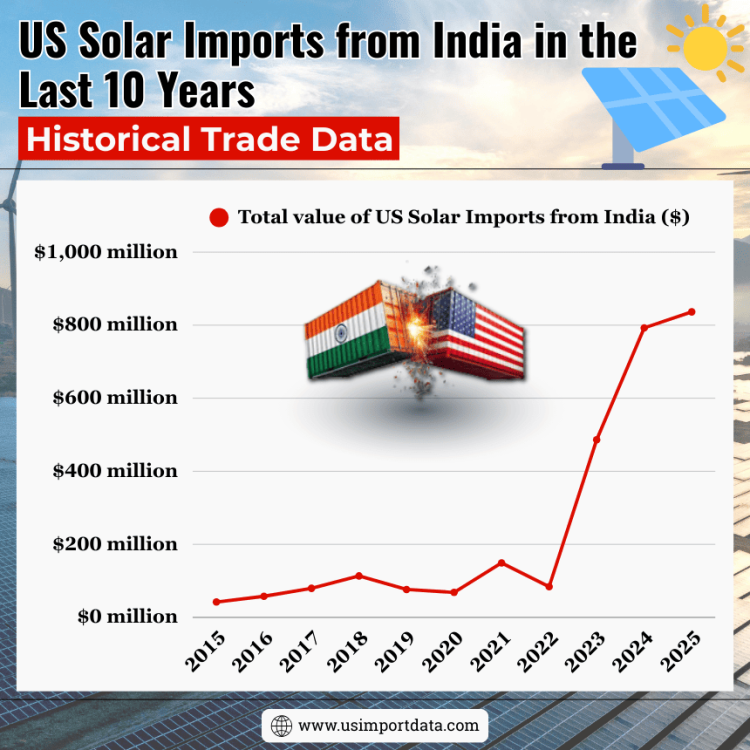
US Solar Imports from India in the Last 10 Years: Historical Trade Data
|
Year of Imports |
Total value of US Solar Imports from India ($) |
|
2015 |
$42.15 million |
|
2016 |
$57.83 million |
|
2017 |
$79.64 million |
|
2018 |
$113.52 million |
|
2019 |
$76.48 million |
|
2020 |
$68.37 million |
|
2021 |
$149.26 million |
|
2022 |
$84 million |
|
2023 |
$486.35 million |
|
2024 |
$792.60 million |
|
2025 |
$836.42 million |

Immediate Market Reaction: Stocks, Sentiment & Volatility
The tariff announcement triggered significant market reactions, particularly in Indian solar manufacturing stocks:
-
Shares of Indian renewable energy firms like Waaree Energies, Premier Energies, and Vikram Solar fell sharply, with some declining up to 14% in a single session.
-
Market sentiment was broadly negative as investors reassessed revenue exposure from the U.S. market.
These firms have been pioneers in exporting modules to the U.S., so concerns about lost competitiveness and margin pressure spread quickly through financial markets.
Notably, some reports suggest that solar stocks bounced back modestly after initial panic selling, as analysts emphasized that the duty applies specifically to solar cells, not all panels assembled in India, reducing the blanket impact on all exports.
Impact on Indian Solar Manufacturers
Export-Oriented Businesses
For firms that rely heavily on exporting panels and cells, the tariff could severely restrict access to the U.S. market, long a key destination for Indian modules.
According to industry analysts:
-
The high duty rate may erase the cost advantage Indian products had in the U.S., effectively making many export deals commercially unviable.
-
A $100 solar panel imported from India could cost roughly $226 in the U.S. market once tariffs are applied, drastically reducing Indian competitiveness.
Supply Chain and Production Strategy Changes
Many Indian firms have been importing solar cells from countries with low or zero duty, then assembling panels domestically for export, a strategy that can help mitigate tariff exposure.
Some companies are also expanding manufacturing capacity in the U.S. to circumvent tariff barriers, a strategic pivot that could preserve access to American customers.
Diversification of Export Markets
With U.S. tariffs looming, Indian manufacturers are increasingly eyeing alternative export markets in Europe, Africa, Latin America, and Southeast Asia, regions with fewer trade barriers and growing solar demand.
Domestic Market Effects in India
Pricing Pressure and Oversupply Risks
With export avenues constrained, some analysts warn that excess production capacity at home could intensify competition and compress prices in the Indian domestic solar market.
India’s solar module manufacturing capacity has expanded rapidly and, by some estimates, now exceeds 140–160 GW per annum, while domestic demand is notably lower. Without international outlets like the U.S., Indian producers may find themselves competing more fiercely at home, potentially affecting margins & long-term profitability.
Government Position and Industry Response
Indian authorities have indicated they may not intervene directly on behalf of exporters facing U.S. tariffs, instead advising firms to pursue legal remedies through trade forums.
At the same time, key industry players in India emphasize that the immediate impact may be limited because many exports are structured to avoid direct duty application or represent a smaller proportion of total production.
Broader Renewable Energy & Trade Policy Implications
U.S. Solar Industry Protection
From the U.S. perspective, the tariffs are part of a broader strategy to protect domestic solar manufacturers, rebuild domestic capacity, and reduce dependency on imported modules.
Proponents argue that unfairly subsidized imports can distort markets, hinder domestic manufacturing growth, and depress wages in the U.S. renewable industry.
Potential Global Ripple Effects
The tariff action may encourage restructuring of global solar supply chains:
-
Companies reliant on exports to the U.S. may shift production to local American facilities to maintain market access.
-
Manufacturers in India and other affected countries may seek tariff-friendly trade agreements with third markets.
-
Supply chain links, such as polysilicon and wafer suppliers, may face altered demand patterns.
This situation underscores how trade policy and environmental objectives increasingly intersect, with tariffs now shaping the economics of renewable energy just as heavily as tariffs have shaped traditional industries like steel and agriculture.
Looking Ahead: Final Duty Determinations & Future Trade Decisions
The current 126% tariff on Indian solar imports is preliminary, meaning the final countervailing duty ruling is expected later in 2026, likely by July 6, 2026. Moreover, the U.S. is also conducting a parallel anti-dumping investigation to determine whether solar products from India and other countries are being sold in the U.S. at less than fair market value, a separate trade finding that could lead to further duties. The outcome of these investigations will be decisive in shaping the future of global solar trade flows.
What This Means for Global Solar Markets
Short-Term Outlook
-
U.S. market access for Indian solar exporters is significantly constrained.
-
Export volumes to the U.S. are likely to decline sharply in the near term.
-
Market volatility in solar stocks and renewable equities may persist.
Medium-Term Adjustments
-
Manufacturers may relocate production or establish U.S. facilities to maintain a presence in the American market.
-
Diversification into the EU, Africa, LATAM, and Asia Pacific markets will become a higher priority.
-
Global supply chains may shift focus to regions with lower trade friction.
Long-Term Dynamics
-
Trade policies like these could accelerate the reshoring of solar manufacturing in the U.S. and allied markets.
-
Countries like India may bolster domestic demand and regional export hubs in Southeast Asia or Africa.
-
The definition of “clean energy trade” may increasingly involve trade diplomacy and subsidy reforms.
Key Highlights: US Imposes 126% Tariff on Indian Solar Imports
Here’s a precise summary of the major developments and implications from the latest reports on the new U.S. duty on solar products imported from India:
-
High Preliminary Duty Imposed: The U.S. Commerce Department has set a significant countervailing duty of nearly 126% on certain solar cells and modules imported from India, accusing manufacturers of benefiting from unfair subsidies.
-
Solar Trade at Stake: Indian solar imports to the U.S. were valued at roughly $792.6 million in 2024, a nearly nine-fold increase from 2022, highlighting the strategic importance of the U.S. market for Indian exporters.
-
Impact on Indian Exporters: Major Indian solar manufacturers such as Waaree Energies, Vikram Solar, and Premier Energies could see their U.S. business significantly affected due to reduced price competitiveness in the American market.
-
Market Reaction: Stocks of leading Indian solar firms faced sharp declines following the tariff announcement, reflecting investor concerns over disrupted export prospects.
-
Trade Relations & Policy Uncertainty: The decision complicates recent efforts to ease trade tensions between India and the U.S., especially after a broader trade understanding was reached earlier this month.
-
Next Steps: A final determination on the subsidy investigation is anticipated by July 6, 2026, and a separate anti-dumping probe could introduce further developments in the coming months.
Conclusion and Final Verdict
In conclusion, the U.S. imposition of a 126% preliminary tariff on solar panel and cell imports from India is a watershed moment in renewable energy trade. It highlights how quickly global supply chains can be reshaped by trade policy, especially when linked to strategic industries like solar energy. Whether this move ultimately boosts U.S. domestic manufacturing without raising consumer costs, or disrupts global clean energy deployment, will depend on future rulings, legal challenges, and strategic adaptations by affected companies.
As of early 2026, Indian solar firms are navigating both challenges and opportunities by diversifying markets, refining supply chains, and reassessing strategies in the face of elevated trade barriers.
Note for Our Readers
We hope you found this detailed analysis of the U.S. 126% solar tariff on Indian imports useful and practical. If you’re looking for deeper insights into solar trade flows, tariff data, or verified US export-import shipment data for solar components and clean energy equipment, visit USImportdata. Access customized USA trade-intelligence, country-level shipment figures, company-level US solar panel buyers & importers database, and market entry insights tailored to your goals.
Turn real trade data into real market advantage with our specialized US trade database solutions. For inquiries, partnerships, or sample datasets, feel free to reach out to us at info@tradeimex.in and explore how data-driven decisions can strengthen your position in the global solar industry.
What's Your Reaction?