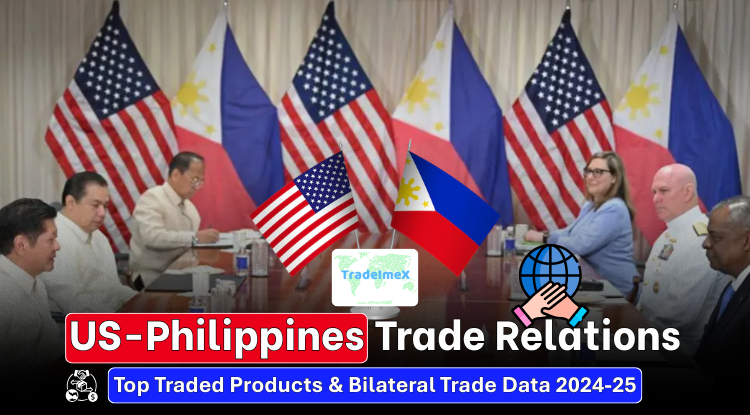
US-Philippines Trade Relations: Top Traded Products & Bilateral Trade Data 2024-25
Explore the latest US-Philippines trade relations in 2025, including top traded goods, bilateral trade data, & strategic opportunities for both economies.
Introduction
The trade relationship between the United States and the Philippines has deep historical roots, shaped by colonial legacy, security alliances, and evolving economic interdependence. In recent years, this relationship has become more complex: while trade volumes remain significant, structural imbalances, tariff pressures, and shifting global value chains are redefining how both countries engage economically. According to the US import data & Philippines export data, the total value of US imports from the Philippines reached $14.49 billion in 2024 and $8.02 billion in the first two quarters of 2025. According to the US export data & Philippines customs data, the total value of US exports to the Philippines reached $9.29 billion in 2024 and $4.46 billion in the first two quarters of 2025. Philippines trade with US has been growing steadily over the years, with both goods and services exchanged across multiple sectors. Despite this, the Philippines US trade deficit remains a concern, as imports from the US continue to exceed exports.
Specifically, the Philippines trade deficit with US highlights the imbalance in certain industries, prompting discussions on strategies to boost exports. Monitoring the US Philippines trade balance is crucial for policymakers to ensure sustainable economic growth and strengthen bilateral trade relations. The total value of US-Philippines trade was $23.78 billion in 2024 and $12.48 billion in the first half of 2025. The Philippines is the 29th largest trading partner of the USA, as per the global trade data. In July 2025, a tariff agreement between the US and the Philippines lowered the US tariff rate on Philippine goods from 20% to 19%. To further collaboration on clean energy, the US-Philippines civil nuclear cooperation "123" agreement came into effect in July 2024. The Philippines' reliance on the US as a market for exports is being hindered by tariffs, yet its overall trade with the US represented a sizable share of its international trade.
The years 2024 and early 2025 mark a critical period: trade continues to grow, but both sides face new challenges and strategic decisions. This blog explores the most recent bilateral trade data, breaks down the top traded products, examines key drivers of trade, and highlights the strategic and policy risks, along with potential opportunities, for both economies.
The Big Picture: US–Philippines Trade in 2024–25
Overall Trade Value & Balance
-
In 2024, the total value of U.S.–Philippines trade (goods + services) reached around US$36.9 billion, reflecting a 5 percent increase from 2023.
-
On the goods side, U.S. exports to the Philippines were about US$9.2 billion, while imports from the Philippines stood at US$14.2 billion. This resulted in a U.S. goods trade deficit of roughly US$4.9 billion.
-
From a broader perspective (goods + services), data shows a bilateral trade deficit from the U.S. side of about US$8.6 billion in 2024.
These numbers highlight that, while the U.S. and the Philippines trade significantly, the U.S. buys more goods and services from the Philippines than it sells to it.
Monthly Goods Trade Trends
Looking at the monthly cadence in 2024 (goods trade only), U.S. exports to the Philippines ranged from roughly US$630 million to US$900+ million, while imports from the Philippines fluctuated between US$900 million and more than US$1.4 billion in some months. The monthly trade balance was consistently negative, indicating a persistent U.S. goods deficit.
By mid-2025, the trend continued: for instance, in the first six months, U.S. exports to the Philippines totaled over US$5.2 billion, and imports came to around US$9.2 billion, widening the deficit further.
Services Trade
-
In 2024, U.S. services exports to the Philippines were approximately US$4.8 billion, while U.S. services imports from the Philippines were about US$8.7 billion, resulting in a services trade deficit of US$3.9 billion.
-
On the Philippine side, preliminary data from the central bank shows that the country's overall services trade volume fell in 2024: service exports rose modestly, but service imports surged, especially in travel, financial services, and computer/technical services. The net effect was a drop in net receipts from trade in services compared to prior quarters.
In sum, in both goods and services, flows are tilted toward the Philippines, resulting in deficits for the U.S. but net inflows of services for the Philippines.
The US Philippines trade agreement has become a key focus for policymakers looking to strengthen economic ties. Understanding US exports to Philippines helps identify opportunities for American businesses, while tracking Philippines trade partners highlights the country’s global connections. Recent negotiations over a us Philippines trade deal aim to clarify tariffs and market access, influencing what does the US import from Philippines and shaping what does the Philippines export to the US. Data on Philippines exports to US shows strong performance in electronics and agricultural goods, emphasizing the strategic importance of a Philippines US trade agreement for both nations’ economies.
Top Goods the US Imports from Philippines: What Does the US Import from Philippines?
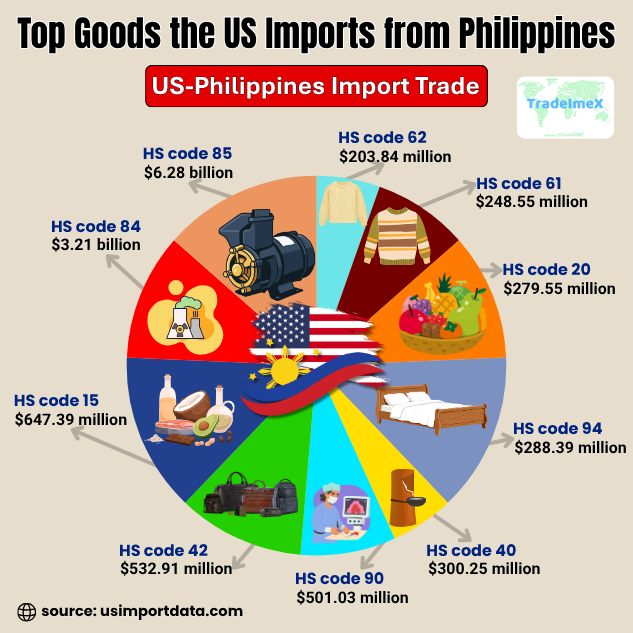
The US imports a variety of top goods from the Philippines, showcasing the robust trade relationship between the two countries. Key imports include electronic equipment such as semiconductors, machinery, medical devices, and agricultural products like fruits and nuts. This bilateral trade dynamic illustrates the importance of economic ties between the US and the Philippines, creating mutually beneficial outcomes for both nations. The top 10 products that the US imports from the Philippines, as per the US import statistics and the US-Philippines trade data for 2024-25, include:
1. Electrical machinery & equipment (HS code 85): $6.28 billion
Electrical machinery and equipment are at the top of the list of goods that the US imports from the Philippines, as per the data on the US imports from Philippines by HS code. With a value of $6.28 billion, this category includes items such as electronic devices, appliances, and other electrical equipment.
2. Nuclear reactors & machinery (HS code 84): $3.21 billion
Nuclear reactors and machinery come second on the list, with a total import value of $3.21 billion. This category includes parts and components for nuclear reactors, as well as machinery related to nuclear power generation.
3. Animal or vegetable fats & oils (HS code 15): $647.39 million
Animal or vegetable fats and oils are also significant imports from the Philippines, totaling $647.39 million. This category includes products such as cooking oils, fats, and other related items.
4. Articles of leather (HS code 42): $532.91 million
Articles of leather hold the fourth position on the list, with an import value of $532.91 million. This category includes leather goods such as bags, shoes, and other accessories.
5. Optical, medical, & surgical instruments (HS code 90): $501.03 million
Optical, medical, and surgical instruments are another major import from the Philippines, amounting to $501.03 million. This category includes items such as eyewear, medical devices, and surgical instruments.
6. Rubber and articles thereof (HS code 40): $300.25 million
Rubber and articles thereof are also significant imports, with a total value of $300.25 million, as per the data on Philippines rubber exports to the US by HS code. This category includes rubber products such as tires, hoses, and other items.
7. Furniture, bedding, and mattresses (HS code 94): $288.39 million
Furniture, bedding, and mattresses are popular imports from the Philippines, totaling $288.39 million. This category includes items such as furniture, bedding sets, and mattresses.
8. Preparations of vegetables & fruits (HS code 20): $279.55 million
Preparations of vegetables and fruits are another key import, with a total value of $279.55 million. This category includes processed vegetable and fruit products.
9. Articles of apparel, knitted (HS code 61): $248.55 million
Articles of apparel, knitted, hold the ninth position on the list, with an import value of $248.55 million. This category encompasses knitted clothing items, including sweaters, shirts, and other apparel.
10. Articles of apparel, not knitted (HS code 62): $203.84 million
Articles of apparel, not knitted, complete the top 10 list of imports from the Philippines, with a total value of $203.84 million. This category includes non-knitted clothing items such as dresses, pants, and skirts.
Top Products the US Exports to Philippines: US-Philippines Export Trade
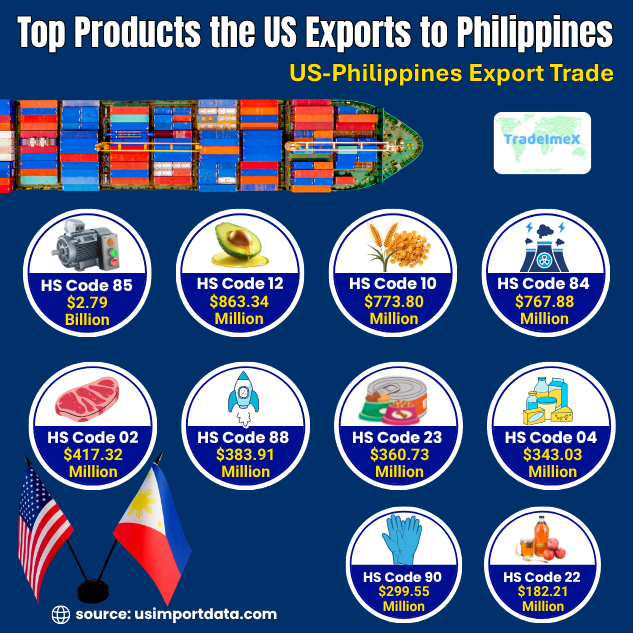
In the US-Philippines export trade relationship, some of the top products that the United States exports to the Philippines include electrical machinery, machinery, soybeans, wheat, and aircraft. This trade partnership plays a significant role in fostering economic ties between the two countries, contributing to mutual growth and benefiting consumers on both ends. The top 10 goods that the US exports to Philippines, as per the data on US exports by country and the US shipment data for 2024-25, include:
1. Electrical Machinery & Equipment (HS Code 85): $2.79 Billion
Electrical machinery and equipment are among the top exports from the US to the Philippines, with an export value of $2.79 billion. This category includes items such as electrical generators, electrical transformers, and electrical motors.
2. Oil Seeds & Oleaginous Fruits (HS Code 12): $863.34 Million
The US also exports oil seeds and oleaginous fruits to the Philippines, with a total export value of $863.34 million. This category includes products like soybeans, sunflower seeds, and palm oil.
3. Cereals (HS Code 10): $773.80 Million
Cereals are another significant export from the US to the Philippines, with an export value of $773.80 million. This category includes products like wheat, maize, rice, and barley.
4. Nuclear Reactors & Machinery (HS Code 84): $767.88 Million
Nuclear reactors and machinery are also key exports from the US to the Philippines, with a total export value of $767.88 million. This category includes items such as steam turbines, nuclear reactors, and machinery parts.
5. Meat & Edible Meat Offal (HS Code 02): $417.32 Million
Meat and edible meat offal products are among the top exports from the US to the Philippines, with an export value of $417.32 million, as per the data on US meat exports to Philippines by HS code. This category includes items like frozen beef, pork, and poultry.
6. Aircraft, Spacecraft, & Parts Thereof (HS Code 88): $383.91 Million
Aircraft, spacecraft, and parts thereof are significant exports from the US to the Philippines, with a total export value of $383.91 million. This category includes items like aircraft engines, aircraft parts, and satellites.
7. Prepared Animal Food (HS Code 23): $360.73 Million
Prepared animal food products are also key exports from the US to the Philippines, with an export value of $360.73 million. This category includes items like pet food, livestock feed, and animal supplements.
8. Dairy Products (HS Code 04): $343.03 Million
Dairy products are among the top exports from the US to the Philippines, with an export value of $343.03 million. This category includes items like milk, cheese, butter, and yoghurt.
9. Optical, Medical, Surgical Instruments (HS Code 90): $299.55 Million
Optical, medical, and surgical instruments are significant exports from the US to the Philippines, with a total export value of $299.55 million. This category includes items like surgical gloves, medical imaging equipment, and contact lenses.
10. Beverages, Spirits, & Vinegar (HS Code 22): $182.21 Million
Finally, beverages, spirits, and vinegar are also key exports from the US to the Philippines, with an export value of $182.21 million. This category includes products like wine, beer, spirits, and vinegar.
US-Philippines Bilateral Trade in the Last 10 Years: Historical US-Philippines Trade Data
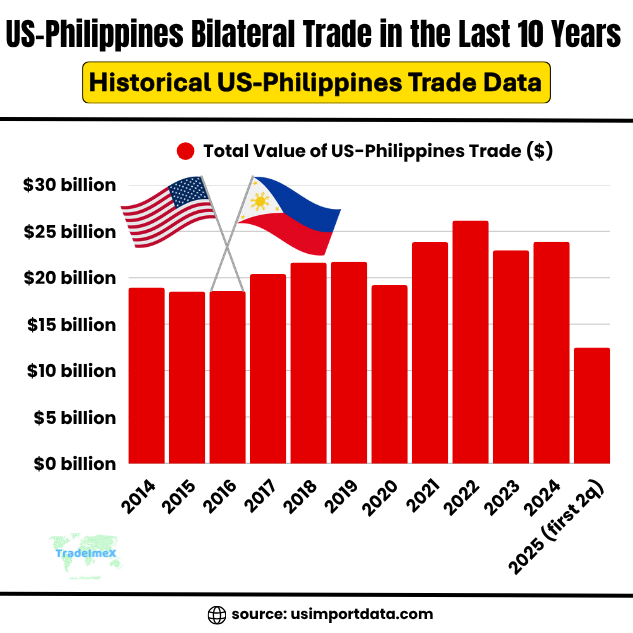
|
Year of Trade |
Total Value of US-Philippines Trade ($) |
|
2014 |
$18.94 billion |
|
2015 |
$18.51 billion |
|
2016 |
$18.56 billion |
|
2017 |
$20.40 billion |
|
2018 |
$21.64 billion |
|
2019 |
$21.71 billion |
|
2020 |
$19.22 billion |
|
2021 |
$23.84 billion |
|
2022 |
$26.16 billion |
|
2023 |
$22.96 billion |
|
2024 |
$23.88 billion |
|
2025 (first 2 quarters) |
$12.48 billion |
Key Traded Products: What Is Exchanged & Why
To understand the economic substance behind the numbers, it's essential to look at which products dominate bilateral trade.
What does the Philippines Export to the US
Based on the Philippines export data by commodity group and destination:
-
Electronic Products
-
By far the largest category. In 2024, electronic products made up more than half of the Philippines’ total exports, according to national trade data.
-
Specifically, U.S.-bound exports in this category included integrated circuits, microassemblies, and logic circuits. On a more granular level, products such as microprocessors, memory chips, and insulated wires (like cabling) are key items.
-
This dominance reflects the Philippines’ strong position in the global electronics value chain: many of its exported electronics are components or semi-finished, assembled or tested in the Philippines, then shipped abroad.
-
Coconut Oil (and other agricultural products)
-
Among the top goods the Philippines sends to the U.S. is coconut oil. In 2024, coconut oil exports to the U.S. were substantial, accounting for a large share of agri-exports to that market.
-
This reflects the continuing importance of traditional tropical agricultural exports in the Philippines’ trade mix, especially in specialty food and oleochemical markets.
-
Machinery & Transport Equipment
-
Some portion of machinery, transport equipment, and related manufactured goods goes to the U.S. These could be engines, parts, or other capital goods.
-
Tuna and Other Fish Products
-
The Philippines also exports fish (notably tuna) to the U.S., although the value here is much smaller compared to electronics.
These product patterns illustrate a dual structure: on the one hand, high-value, tech-oriented manufacturing (electronics) and, on the other, more traditional agricultural goods like coconut oil.
What the U.S. Exports to the Philippines
On the U.S. side, the top exports to the Philippines in 2024 can be broken down as follows:
-
Electrical/Electronic Equipment
-
A major portion of U.S. exports to the Philippines is also in electronics, from components to potentially more finished products. This shows that trade is not unidirectional: the Philippines doesn’t just export electronics, it imports from the U.S. too, likely for use in its own manufacturing or consumer markets.
-
Oil Seeds, Grains, and Agricultural Commodities
-
The U.S. ships a significant volume of agricultural commodities to the Philippines, such as oil-seeds (soy, for example) and grains. This supports local farm demand, feed industries, and food processing.
-
Cereals (wheat, corn) are also a considerable share, underlining the strategic role of the U.S. in the Philippines’ food security and raw-material supply chain.
-
Machinery, Reactors, Boilers (Capital Goods)
-
These are classic U.S. exports: industrial machinery, heavy equipment, and other capital goods. These help the Philippines build out its infrastructure, manufacturing capacity, or energy systems.
-
Meat and Edible Animal Products
-
The U.S. exports meat, edible offal, and other animal products to the Philippines. These serve both consumer and possibly industrial/food-processing demand.
-
Aircraft and Aerospace Equipment
-
There is a non-trivial trade in aircraft and aerospace parts: U.S. exports of aircraft or spacecraft components to the Philippines suggest an ongoing demand in aviation and transport infrastructure.
-
Food-Industry Residues and Animal Fodder
-
The U.S. also exports by-products from its food industries (residues, processing waste) that are useful as animal fodder or industrial feed in the Philippines.
-
Dairy, Eggs, and Other Edible Products
-
Dairy products, honey, eggs, and related goods form part of this trade, meeting consumer demand in the Philippines for U.S.-sourced food.
-
Optical, Medical, Technical Apparatus
-
Specialized equipment, like medical and optical instruments, also flows from the U.S. to the Philippines, likely supporting health care, research, and precision manufacturing.
Strategic Drivers & Underlying Trends
Understanding the numbers is crucial, but what is behind these trade flows? Several major trends and strategic drivers help explain the dynamics.
1. Role of Electronics & Supply-Chain Integration
-
The sheer weight of electronics in the bilateral trade equation shows that supply-chain integration is central. The Philippines is not just a final-goods exporter; it plays a sophisticated role in assembling, testing, and packaging electronic components.
-
Given global competition (especially with China) and rising geopolitical tensions, the U.S. has a strategic interest in deepening supply-chain ties with the Philippines, especially in semiconductor assembly and back-end production.
-
The growing U.S. investment in Philippine semiconductor capacity could help both reduce risk and diversify production.
2. Agricultural Trade and Food Security
-
The Philippines heavily relies on agricultural imports from the U.S., particularly grains and oilseeds. This reflects both commercial opportunity and food security concerns.
-
For the U.S., agri-exports to the Philippines remain a reliable market, helping stabilize volumes for key agricultural commodities.
3. Tariff Pressures and Policy Risk
-
A key flashpoint in 2025 has been U.S. reciprocal tariffs imposed on Philippine goods. Initially, a 20% tariff was threatened; after negotiations, this was reduced to 19%, which nonetheless remains a significant burden for Philippine exporters.
-
This tariff environment creates uncertainty. The Philippines has signaled it wants a comprehensive economic agreement or even a free trade agreement (FTA) with the U.S. to stabilize access and mitigate trade risk.
4. Geopolitical and Strategic Context
-
The economic relationship is deeply intertwined with geopolitics. As the U.S. competes with China for influence in the Indo-Pacific, strengthening economic ties with the Philippines, a longstanding security partner, becomes strategically valuable.
-
For the Philippines, leveraging its industrial strengths (especially electronics) and export positioning is a way to attract U.S. investment and deepen its role in key global value chains.
Risks & Challenges
While there are clear opportunities, there are also significant risks and challenges in the US-Philippines trade relationship.
-
Tariff Vulnerability
-
The imposition of relatively high U.S. reciprocal tariffs on Philippine goods creates cost risk for exporters. Even a 1-percentage-point change can materially affect competitiveness.
-
There is political risk if these tariffs are not managed or if negotiations fall short, leading to trade frictions.
-
Over-concentration in Electronics
-
The Philippine export portfolio remains heavily concentrated on electronics. Overreliance on this sector makes the economy sensitive to global demand shocks or technological disruption.
-
If global demand for certain components shifts, or if supply-chain strategies change, the Philippines could face significant disruption.
-
Services Trade Imbalance
-
While the U.S. runs a goods and services deficit, the composition of services trade suggests structural imbalances. The Philippines benefits from exporting business process services, but its imports (especially in travel and financial services) are rising sharply, which could create vulnerabilities.
-
Agricultural Competition and Food Risks
-
Heavy dependence on imported U.S. agricultural commodities may make the Philippines vulnerable to global price volatility, currency risk, or supply-chain disruption.
-
Domestic producers may struggle to compete with imported U.S. grains or oilseeds, raising food security and economic sustainability concerns.
-
Negotiation Uncertainties
-
The future of a potential trade deal / FTA is uncertain. Negotiations may be protracted, and even if successful, political shifts could undermine commitments.
-
Global Supply-Chain Competition
-
Other Southeast Asian countries (Vietnam, Malaysia, etc.) are aggressively positioning themselves as supply-chain destinations. The Philippines competes for investment, but must continually improve its infrastructure, labor skills, and regulatory climate.
Opportunities & Strategic Paths Forward
Despite these risks, there are multiple opportunities for deeper and more sustainable US-Philippines economic engagement.
1. Supply-Chain Diversification
-
With global tensions and U.S. companies looking to de-risk from China, the Philippines can position itself as a “China +1” location for electronics manufacturing, especially in semiconductor back-end operations.
-
By attracting further U.S. investment in assembly, testing, and packaging plants (ATP), the Philippines can create higher value-added jobs and deepen its role in global value chains.
2. Expansion of Agri-Exports
-
The Philippines can capitalize on its specialty agricultural products (like coconut oil) and push for value-added processing to increase margins and export resilience.
-
At the same time, supporting local farmers to meet changing global demand (for health oils, organic products, etc.) could unlock new markets.
3. Services & Digital Economy
-
The BPO industry, R&D services, and other digital services remain a core strength for the Philippines. By investing in higher-skilled digital exports (cloud-based services, professional services), the country can further monetize its services edge.
-
Strengthening digital infrastructure, data protection, and innovation ecosystems could help the Philippines capture more upstream service exports.
4. Trade Agreement Strategy
-
Negotiating a bilateral economic agreement or FTA (US-Philippines Trade Agreement) could help reduce tariff risk, provide more certainty for exporters, and deepen long-term trade integration.
-
Such an agreement could also be structured to incentivize U.S. investment in critical sectors (electronics, infrastructure, sustainable agriculture).
5. Strengthening Resilience
-
The Philippines should build greater resilience by diversifying both export products and trade partners. Reducing over-reliance on a few sectors or markets will mitigate risk.
-
Investments in infrastructure, workforce upskilling, and regulatory reform will also improve competitiveness.
Policy Developments & Recent Shifts (2025)
-
In 2025, Manila and Washington renewed talks over tariffs. The Philippines expressed concern about the 20 percent reciprocal tariff initially threatened by the U.S., and engaged in negotiations to lower the rate.
-
Through these negotiations, the U.S. agreed to apply a 19 percent tariff on Philippine goods, slightly better than initially feared. This is being hailed by Philippine officials as an important concession.
-
In parallel, the Philippines is pushing for a deeper economic cooperation framework with the U.S., possibly seeking a free trade agreement.
-
On its side, the Department of Trade and Industry of the Philippines argues that the country is relatively well-positioned under the new tariff structure because some of its key exports, like integrated circuits and copper concentrates, are either exempt or less affected.
Conclusion: Why The US-Philippines Trade Relationship Matters
In conclusion, the US-Philippines trade relationship in 2024–25 is more than just numbers; it is deeply strategic.
-
For the Philippines, the U.S. remains a top-tier export market, especially for electronics & value-added manufacturing. It is also a critical partner in agricultural imports and services. The ability to sustain and scale these sectors depends largely on how the Philippines navigates tariff risk, attracts investment, and diversifies.
-
For the United States, the Philippines offers a reliable manufacturing base in a geopolitically strategic location, especially for electronics and semiconductors. Strengthening trade ties aligns with broader security and supply-chain diversification goals.
-
Strategically, both countries have powerful incentives to deepen economic integration: the Philippines to capture more value and scale, and the U.S. to reduce risk and shore up supply chains.
However, achieving this requires deft negotiation, investment in infrastructure and skills, and careful management of trade risks.
Moving ahead, the key questions will be: Will the Philippines secure a stable, favorable trade deal? Can it leverage its strengths to move up the value chain? And can the U.S. deepen its economic engagement in a way that goes beyond just raw geopolitical interest?
We hope that you liked our data-driven and interactive blog report on the US-Philippines trade relations 2025. For more insights into the latest US trade data, or to search live US import-export data by country, product, or HS code, visit USImportdata. Contact us at info@tradeimex.in for customized US trade reports and market insights.
What's Your Reaction?