US-China Summit 2026 Analysis: Trump and Xi Meeting Ends Without Any Major Trade Deal
Explore the complete analysis of the US-China Summit 2026 as Donald Trump & Xi Jinping conclude talks without a major trade deal.
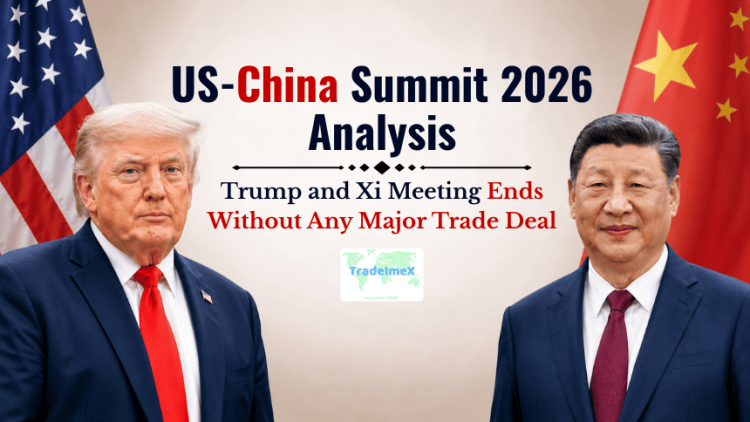
The 2026 summit between Donald Trump and Xi Jinping was supposed to reset one of the world’s most important relationships. Instead, it delivered something far more limited: temporary stability without structural resolution. For two days in Beijing, the leaders of the world’s two largest economies projected warmth, exchanged symbolic gestures, and announced selective tariff reductions and purchase commitments. But beneath the Trump-Xi meeting headlines, the summit exposed a deeper reality. As far as bilateral trade is concerned, the total value of US-China trade accounted for $414.67 billion in 2025 and $88.24 billion in the first quarter of 2026, according to the US export data and China import data.
The United States and China remain locked in a strategic rivalry that neither side currently knows how to unwind. Markets initially hoped for a breakthrough. Investors wanted clarity on tariffs, technology restrictions, supply chains, and geopolitical risks. Businesses wanted predictability after years of escalating trade friction. Yet when the summit ended, there was no comprehensive trade agreement, no roadmap toward normalization, & no major settlement on core disputes such as Taiwan, semiconductors, industrial policy, or export controls. Instead, the summit produced what analysts increasingly describe as a “managed stalemate.” This article will analyze the outcome of the Trump Xi summit and its implications for the future of US-China trade relations.
Why the 2026 US-China Summit Mattered So Much
The summit took place at a fragile moment for the global economy in Mid-May 2026. The US-China trade relationship had already been damaged by years of tariffs, technology sanctions, investment restrictions, and geopolitical mistrust. Since returning to the office, Trump has doubled down on protectionist trade policies, while Beijing has accelerated efforts to reduce its dependence on Western supply chains. At the same time, several global pressures intensified the urgency of talks & the Trump Xi meeting:
-
Slowing global growth
-
Inflationary pressure from tariffs and energy disruptions
-
The ongoing Iran-related regional instability
-
Supply chain fragmentation
-
Rising military tensions around Taiwan
-
Investor concerns over a prolonged economic decoupling
The Trump-Xi summit was therefore seen as more than a diplomatic meeting. It became a test of whether Washington and Beijing could stabilize relations before economic rivalry evolved into deeper geopolitical confrontation.
Even before the talks began, expectations were mixed. Some observers hoped Trump’s transactional negotiating style could produce sector-specific deals, particularly in agriculture and aviation. Others argued the structural divide between the two countries had become too large for any meaningful reset. The outcome ultimately supported the second view.
What Was Actually Agreed During the Trump-Xi Summit?
Despite claims from both sides about “successful” discussions of the Trump and Xi meeting, the concrete outcomes remained modest.
1. Partial Tariff Reductions
The most tangible announcement involved selective reductions in levies on certain goods. China and the United States agreed to lower tariffs on some products to support bilateral trade flows, especially in the agriculture and industrial sectors. However, officials avoided providing comprehensive details. Critically:
-
Most punitive tariffs remained intact
-
No broad rollback framework was announced
-
There was no legally binding long-term agreement
-
Existing trade-war mechanisms stayed operational
Trump himself later said tariffs were not substantially discussed during portions of the summit, despite the trade being presented publicly as a central agenda item. That contradiction reflected a broader issue throughout the summit: rhetoric often exceeded policy substance.
2. Chinese Agricultural Purchases
The White House claimed China would significantly increase purchases of US agricultural products. Reports suggested Beijing could buy around $17 billion annually in American farm goods. For Trump politically, this matters. Agricultural exports remain central to support in key Midwestern states. During previous trade disputes, American farmers suffered heavily from retaliatory Chinese tariffs. A renewed Chinese buying commitment allows Trump to present the summit as economically beneficial for US workers and exporters, impacting the US exports to China. Yet there are reasons for skepticism:
-
China did not fully confirm the scale publicly
-
Similar purchase commitments during earlier trade agreements were inconsistently implemented
-
Structural trade imbalances remain unresolved
In other words, the summit may provide short-term relief for agricultural exporters without solving broader trade tensions.
3. Boeing and Symbolic Commercial Wins
Another major announcement involved aircraft purchases. China reportedly agreed to buy Boeing aircraft, with Trump later suggesting the number could rise dramatically. These deals matter symbolically because they create visible economic wins that both leaders can showcase domestically, impacting the US aircraft exports to China.
For Trump:
-
It supports manufacturing narratives
-
It demonstrates “America First” export success
-
It offers positive headlines amid tariff criticism
For Xi Jinping:
-
It signals China remains open to selective economic engagement
-
It avoids appearing fully confrontational
-
It reassures international investors worried about economic isolation
Still, these are transactional outcomes rather than transformational ones. They do not address the deeper strategic conflict reshaping the global economy.
US-China Bilateral Trade Data in The Last 10 Years
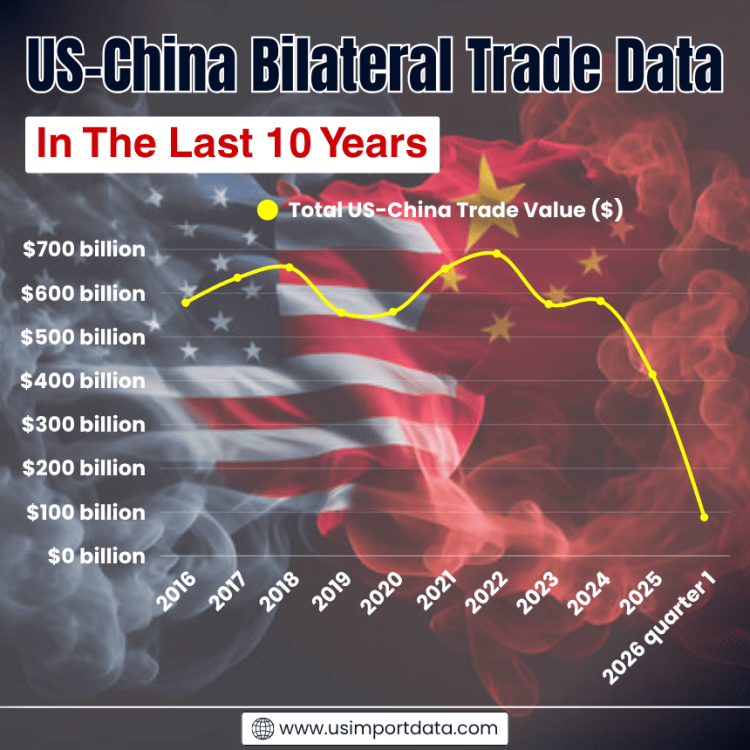
|
Year of Trade |
Total US-China Trade Value ($) |
|
2016 |
$578.01 billion |
|
2017 |
$635.15 billion |
|
2018 |
$658.79 billion |
|
2019 |
$555.59 billion |
|
2020 |
$557.12 billion |
|
2021 |
$655.67 billion |
|
2022 |
$690.24 billion |
|
2023 |
$574.87 billion |
|
2024 |
$581.96 billion |
|
2025 |
$414.67 billion |
|
2026 quarter 1 |
$88.24 billion |

The Biggest Story: What Did Not Happen
The most important takeaway from the summit was not what the leaders agreed on. It was what they avoided.
No Comprehensive Trade Deal
There was no broad agreement restoring normal trade relations. No new framework replaced the current tariff architecture. No meaningful dispute resolution mechanism emerged. And no long-term economic integration strategy was introduced. That matters because businesses now operate in an environment where uncertainty itself has become a structural cost.
Companies still face:
-
Tariff unpredictability
-
Export-control risks
-
Investment screening barriers
-
Supply-chain relocation pressure
-
Political retaliation risks
The summit may have slowed escalation temporarily, but it did not restore confidence.
No Resolution on Technology Wars
Technology remains the real battlefield in the US-China competition or the US-China trade war. Washington continues to restrict Chinese access to advanced semiconductors, AI systems, and sensitive technologies. China, meanwhile, is accelerating domestic self-sufficiency programs and reducing reliance on Western suppliers. The summit produced no breakthrough on:
-
Semiconductor export restrictions
-
AI governance
-
Data regulation
-
Tech investment screening
-
Cybersecurity disputes
This is crucial because technology competition increasingly drives the broader geopolitical rivalry. Trade disagreements can sometimes be negotiated. Technological dominance is harder to compromise on because both sides increasingly see it as tied to national security.
Taiwan Remains a Flashpoint
Taiwan quietly overshadowed much of the summit. Although official statements remained cautious, post-summit commentary created concern across the Indo-Pacific region. Trump’s remarks suggesting US weapons sales to Taiwan could become part of broader negotiations unsettled policymakers in Taipei. For China, Taiwan remains the most sensitive issue in bilateral relations. For the United States, Taiwan is increasingly viewed as strategically essential for:
-
Regional security
-
Semiconductor supply chains
-
Military deterrence in Asia
Neither side shifted meaningfully during the summit. That means the core geopolitical risk between Washington and Beijing remains unresolved.
Why Both Leaders Still Claimed Victory
Despite limited progress, both governments portrayed the summit positively. That was politically necessary.
Trump’s Domestic Incentives
Trump benefits politically from projecting strength while avoiding market instability. A complete breakdown in talks could:
-
Hurt financial markets
-
Increase inflation risks
-
Damage exporters
-
Alarm business leaders
-
Complicate the 2026 economic outlook
By presenting selective trade concessions and purchase agreements as victories, Trump can argue his aggressive tariff strategy forced China back to the negotiating table. At the same time, avoiding a major compromise protects his broader nationalist economic messaging.
Xi Jinping’s Strategic Calculations
Xi also had reasons to avoid confrontation. China’s economy continues to face:
-
Weak domestic consumption
-
Property-sector instability
-
Youth unemployment concerns
-
Slower export growth
-
Foreign investment pressures
A temporary easing of tensions with Washington gives Beijing breathing room without requiring major structural concessions. Importantly, Xi appeared determined to avoid looking weak domestically. Chinese officials framed the summit as proof that Beijing could negotiate with Washington from a position of confidence rather than submission.
Market Reaction: Relief Mixed With Disappointment
Financial markets reacted cautiously after the summit. Investors welcomed the absence of escalation but remained disappointed by the lack of concrete progress. Latest data reported that markets interpreted the summit more as a “risk containment” exercise than a genuine economic breakthrough. Several trends became clear:
-
Chinese stocks remained subdued
-
The yuan weakened
-
Businesses stayed cautious on long-term investment decisions
-
Commodity markets continued to price geopolitical uncertainty
This reflects a broader shift in how markets now view US-China relations. In previous decades, investors expected eventual integration & cooperation. Today, many assume strategic rivalry is permanent. That changes corporate behavior dramatically.
The Return of “Managed Rivalry”
The summit highlighted a new reality in global politics: the US and China are moving toward managed competition rather than genuine partnership. This matters because earlier economic assumptions no longer apply. For decades, globalization was built on the idea that deeper economic interdependence would reduce geopolitical conflict. Instead, the USA & China increasingly view interdependence itself as a vulnerability. That is why:
-
The US pushes supply-chain diversification
-
China promotes domestic technological independence
-
Both countries use trade policy strategically
-
Export controls are expanding
-
Industrial subsidies are rising globally
The summit did not reverse these trends. If anything, it confirmed them.
The Geopolitical Context Beyond Trade
Another important feature of the summit was how much discussion extended beyond economics. Issues linked to:
-
Iran
-
Energy security
-
Maritime trade routes
-
Regional military stability
-
Russia-China relations
all shaped the broader atmosphere. This is important because the US-China competition is no longer just about trade deficits. It now spans:
-
Military influence
-
Energy systems
-
Artificial intelligence
-
Rare earth minerals
-
Financial systems
-
Global diplomatic influence
Trade policy has become only one layer of a much larger strategic contest.
What the Summit Means for the Global Economy
Even without a major deal, the summit still carries major implications.
1. Full Economic Decoupling Is Unlikely
Despite tensions, both sides still appear reluctant to completely sever economic ties. The summit showed:
-
Both governments still value communication
-
Trade channels remain active
-
Selective cooperation remains possible
That reduces the immediate risk of a sudden economic rupture.
2. But Fragmentation Will Continue
At the same time, partial decoupling is clearly accelerating. Businesses are increasingly shifting production toward:
-
India
-
Vietnam
-
Mexico
-
Southeast Asia
to reduce dependence on China-centered supply chains. This trend will likely continue regardless of future summits.
3. Tariffs Are Becoming Permanent
Originally presented as negotiating tools, tariffs increasingly look like long-term structural policy instruments. Even after talks, most trade barriers remain in place. That suggests companies should prepare for a world where:
-
Higher trade costs persist
-
Geopolitical risk becomes normal
-
Economic efficiency is secondary to strategic resilience
Why the Summit Fell Short
Several structural reasons explain why no breakthrough emerged.
Strategic Distrust Runs Too Deep
Both governments fundamentally distrust each other’s long-term intentions. The USA believes China seeks technological and geopolitical dominance. Beijing believes the US aims to contain China’s rise. That creates negotiating limits no summit alone can overcome.
Domestic Politics Restrict Flexibility
Neither Trump nor Xi can afford to appear weak domestically. In both countries, nationalist sentiment limits compromise space. Trade concessions now carry political risks that did not exist two decades ago.
The Conflict Is Structural, Not Temporary
This is not simply a tariff dispute anymore. The rivalry increasingly reflects:
-
Competing political systems
-
Competing technological ecosystems
-
Competing visions of global order
Those are much harder to negotiate than commodity purchases or tariff rates.
Conclusion and Final Verdict: Stability Without Resolution
In conclusion, the 2026 Trump-Xi summit ultimately achieved one thing reasonably well: it prevented deterioration. That alone carries value in a highly unstable geopolitical environment. But the summit failed to produce the transformative trade agreement many investors and businesses hoped for. Instead, it reinforced the reality that US-China relations have entered a new phase defined by controlled rivalry, selective cooperation, and persistent mistrust.
The world’s two largest economies are no longer trying to integrate fully. They are trying to compete without collapsing into open confrontation. That distinction may define global economics and geopolitics for the rest of the decade. The summit in Beijing did not end the trade war era. It simply showed that both sides now prefer managing the conflict rather than resolving it.
Note For Our Readers
We hope this blog on the US-China Summit 2026, the Trump-Xi meeting outcomes, evolving US-China trade relations, tariff negotiations, and the broader geopolitical and economic implications helps you better understand the current global trade landscape, bilateral policy shifts, market uncertainty, and the future direction of international trade.
If you’re looking for deeper market intelligence, customized US import-export data, tariff impact analysis, or want to explore live US import-export data by country, product, HS code, buyer, or supplier, feel free to connect with USImportdata. We provide comprehensive and up-to-date global trade databases designed to support market research, competitor analysis, buyer identification, supply chain tracking, and international business expansion. For exclusive access or customized trade data solutions, contact us at info@tradeimex.in and make smarter global trade decisions with confidence.
What's Your Reaction?