US-Mexico-Canada Trade Agreement Review 2026: Latest Data Tells The Story
Explore the US-Mexico-Canada Trade Agreement Review 2026 with the latest US-Canada & US-Mexico trade data & North America's evolving economic strategy.
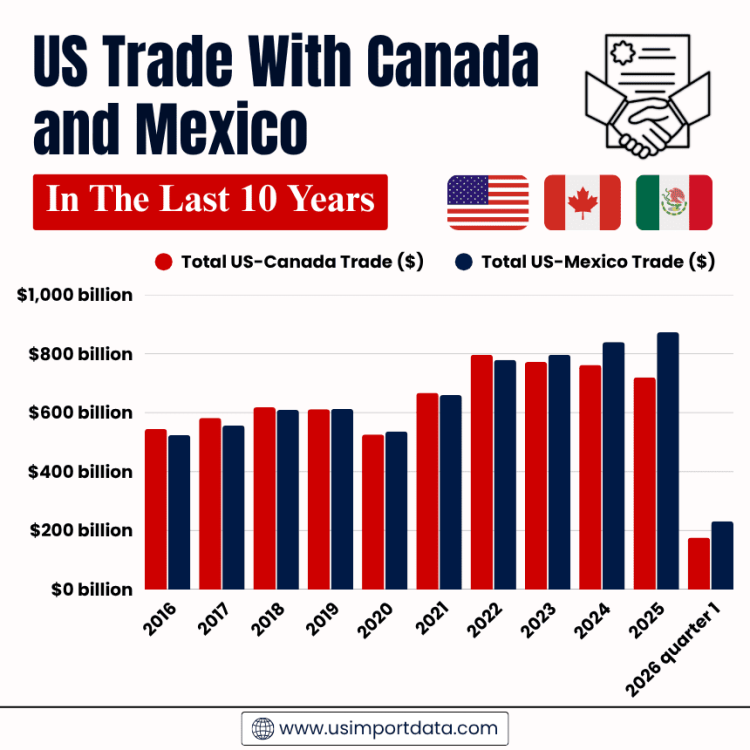
The United States-Mexico-Canada Agreement (USMCA) is entering one of its most critical phases since replacing NAFTA in 2020. As the agreement approaches its scheduled 2026 joint review, lawmakers in Washington are intensifying pressure for stronger labor protections, tighter trade enforcement mechanisms, and new economic security reforms aimed at reshaping North American supply chains. According to the latest US export data and Canada import data, the total value of US-Canada trade accounted for $719 billion in 2025. The US-Mexico trade reached a record $873 billion in 2025, according to the latest US import data and Mexico export data. The latest congressional discussions surrounding the USMCA review highlight growing concerns about:
-
Labor rights enforcement in Mexico
-
China-linked manufacturing entering North America
-
Supply chain vulnerabilities
-
Automotive sourcing rules
-
Strategic industrial competitiveness
-
Semiconductor and critical minerals security
The review process comes at a time when North America is undergoing major economic realignment driven by:
-
Geopolitical tensions
-
US-China trade competition
-
Nearshoring trends
-
Energy transition investments
-
Industrial policy expansion
According to recent congressional trade discussions and policy proposals, lawmakers from both parties increasingly view the USMCA not only as a trade agreement but also as a strategic economic security framework for the region.
What Is the USMCA?
The United States-Mexico-Canada Agreement (USMCA) replaced the North American Free Trade Agreement (NAFTA) in July 2020 after years of renegotiation. The agreement governs trade among:
-
United States
-
Mexico
-
Canada
Together, these three economies represent:
-
More than $30 trillion in combined GDP
-
Over 510 million consumers
-
One of the world’s largest integrated manufacturing regions
USMCA modernized several trade rules compared to NAFTA, particularly in:
-
Digital trade
-
Labor standards
-
Automotive content requirements
-
Intellectual property
-
Environmental protections
-
Agricultural trade
A unique feature of the USMCA is its mandatory 2026 joint review process, where all three countries evaluate the agreement’s performance and decide whether to extend it beyond its 16-year sunset period.
Why the 2026 USMCA Review Matters
The 2026 review has become highly significant because North America’s economic environment has changed dramatically since the agreement took effect. Several major developments are reshaping regional trade policy:
-
Rising US-China tensions
-
Expansion of nearshoring
-
Semiconductor supply chain competition
-
Inflation and industrial policy shifts
-
Clean energy manufacturing growth
-
National security concerns tied to trade
Congressional leaders increasingly argue that the USMCA must evolve into a broader economic security agreement capable of protecting North American manufacturing competitiveness against global geopolitical risks.
North American Trade Volumes Continue Growing
Despite political disagreements, the USMCA has significantly boosted regional trade. According to recent trade estimates:
-
Total trilateral trade among the US, Mexico, and Canada exceeded $1.9 trillion in 2025.
-
Mexico became the United States’ largest trading partner for the second consecutive year.
-
US-Mexico bilateral trade surpassed $872 billion.
-
US-Canada trade exceeded $719 billion.
North America now accounts for one of the most deeply integrated manufacturing ecosystems globally. Key sectors driving trade include:
-
Automotive manufacturing
-
Electronics
-
Energy
-
Agriculture
-
Machinery
-
Aerospace
-
Semiconductors
US Trade With Canada and Mexico in The Last 10 Years
|
Year of Trade |
Total US-Canada Trade ($) |
Total US-Mexico Trade ($) |
|
2016 |
$544.44 billion |
$523.72 billion |
|
2017 |
$581.83 billion |
$556.26 billion |
|
2018 |
$618.30 billion |
$609.64 billion |
|
2019 |
$611.40 billion |
$612.76 billion |
|
2020 |
$526.23 billion |
$535.98 billion |
|
2021 |
$666.87 billion |
$659.75 billion |
|
2022 |
$796.49 billion |
$779.02 billion |
|
2023 |
$772.41 billion |
$796.53 billion |
|
2024 |
$761.78 billion |
$839.55 billion |
|
2025 |
$719.47 billion |
$872.83 billion |
|
2026 quarter 1 |
$175.9 billion |
$231.2 billion |

What Are the Major US Exports to Canada & Mexico
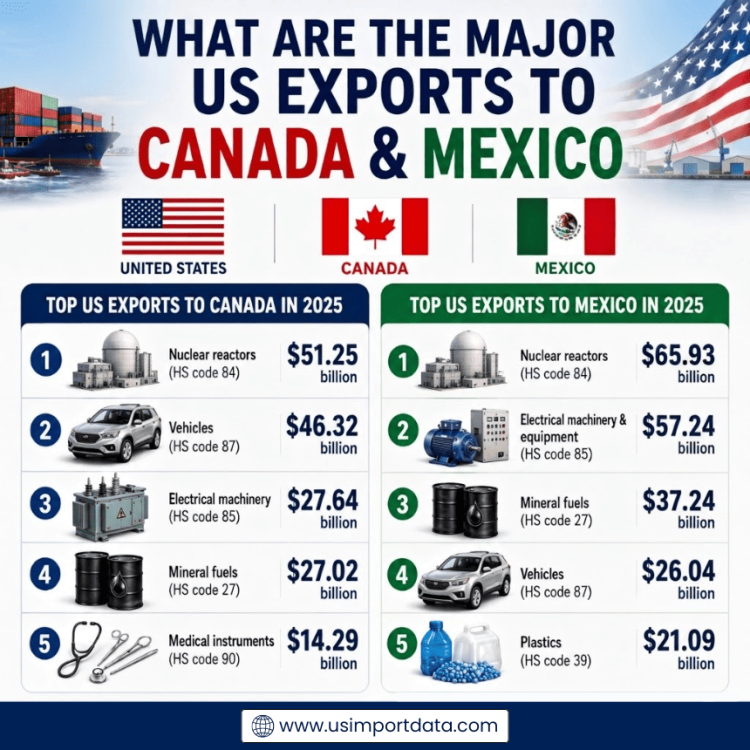
When considering the major US exports to Canada and Mexico, it is essential to highlight the significant trade relationships between these countries. Canada and Mexico are vital economic partners for the United States, with a wide range of top exports. In terms of US exports to Canada, key products include vehicles, machinery, electrical machinery, and mineral fuels. Whereas, US exports to Mexico primarily consist of electrical machinery, vehicles, mineral fuels, and plastics. These trade flows demonstrate the interconnectedness of the North American market.
Top US Exports to Canada in 2025
1. Nuclear reactors & machinery (HS code 84): $51.25 billion
2. Vehicles (HS code 87): $46.32 billion
3. Electrical machinery & equipment (HS code 85): $27.64 billion
4. Mineral fuels & oils (HS code 27): $27.02 billion
5. Optical, medical, & surgical instruments (HS code 90): $14.29 billion
Top US Exports to Mexico in 2025
1. Nuclear reactors & machinery (HS code 84): $65.93 billion
2. Electrical machinery & equipment (HS code 85): $57.24 billion
3. Mineral fuels & oils (HS code 27): $37.24 billion
4. Vehicles (HS code 87): $26.04 billion
5. Plastics & articles thereof (HS code 39): $21.09 billion
Congress Pushes for Stronger Labor Rules
One of the central issues in the 2026 review is labor enforcement, particularly regarding manufacturing facilities in Mexico. Many U.S. lawmakers argue that low labor costs in Mexico continue encouraging companies to relocate production away from American factories. Democratic lawmakers and labor organizations are demanding:
-
Stronger labor monitoring systems
-
Faster dispute resolution mechanisms
-
Tougher penalties for labor violations
-
Expanded union protections
-
Greater wage transparency
The Rapid Response Labor Mechanism (RRM), introduced under USMCA, has already been used multiple times to investigate labor rights violations at Mexican factories. Supporters claim the mechanism has:
-
Improved union voting processes
-
Increased worker protections
-
Strengthened labor inspections
However, critics argue that enforcement remains inconsistent and insufficient.
Automotive Industry Remains at the Center
The automotive sector continues to dominate USMCA discussions because of its massive economic importance. North America produces millions of vehicles annually through highly integrated cross-border supply chains.
USMCA currently requires:
-
75% regional content for vehicles
-
Higher North American steel and aluminum sourcing
-
Labor value content rules requiring partial production by higher-wage workers
Congressional leaders are now pushing for:
-
Stricter regional content requirements
-
Reduced dependence on Chinese auto components
-
Stronger electric vehicle sourcing standards
-
Greater domestic battery production incentives
The rapid growth of electric vehicle manufacturing is transforming regional trade dynamics.
Major automakers, including:
-
Ford Motor Company
-
General Motors
-
Tesla
-
Toyota
They are heavily investing across North America to localize EV supply chains.
Economic Security Has Become a Core Trade Priority
One of the biggest shifts in the 2026 review is the growing focus on economic security. U.S. policymakers increasingly view trade policy as closely tied to:
-
National security
-
Industrial resilience
-
Technology competition
-
Critical infrastructure protection
Congressional proposals are exploring new USMCA provisions related to:
-
Semiconductor supply chains
-
Critical minerals
-
Pharmaceutical manufacturing
-
Strategic technologies
-
Artificial intelligence infrastructure
-
Rare earth materials
The objective is to reduce North America’s dependence on China-centered supply chains.
Nearshoring Is Reshaping North American Manufacturing
The nearshoring boom has become one of the biggest economic trends supporting the USMCA, according to the North America trade data. Global companies are increasingly relocating manufacturing closer to the United States due to:
-
Supply chain disruptions
-
Rising geopolitical risks
-
Tariff uncertainty
-
Transportation costs
-
Faster delivery requirements
Mexico has become one of the largest beneficiaries of nearshoring. Industries rapidly expanding in Mexico include:
-
Electronics
-
Automotive parts
-
Appliances
-
Medical devices
-
Aerospace manufacturing
Northern Mexican industrial cities have seen:
-
Record factory demand
-
Rising foreign investment
-
Increased trade expansion
However, U.S. lawmakers remain concerned that some Chinese companies are using Mexico as a manufacturing platform to access the U.S. market tariff-free under USMCA provisions.
Concerns About Chinese Investment in Mexico
Congressional scrutiny of Chinese investment in Mexico has intensified significantly. Lawmakers are debating whether USMCA rules should:
-
Restrict Chinese-owned manufacturing access
-
Tighten rules of origin
-
Increase supply chain transparency
-
Strengthen customs enforcement
Industries under particular focus include:
-
Electric vehicles
-
Solar panels
-
Batteries
-
Electronics
-
Telecommunications equipment
Some policymakers argue the agreement must prevent North America from becoming an indirect entry point for subsidized Chinese goods.
Canada’s Position in the Review
Canada is also expected to play a major role during the 2026 review process. Several issues remain sensitive between the U.S. and Canada, including:
-
Dairy market access
-
Softwood lumber disputes
-
Electric vehicle tax incentives
-
Energy infrastructure regulations
At the same time, Canada remains critical to North American supply chains because of:
-
Energy exports
-
Critical minerals
-
Automotive manufacturing
-
Agricultural trade
Canada’s mining sector has become increasingly important as North America seeks secure supplies of:
-
Lithium
-
Nickel
-
Cobalt
-
Rare earth minerals
These materials are essential for EV batteries and clean energy technologies.
Semiconductor Supply Chains and Industrial Policy
Semiconductors are emerging as a strategic issue in USMCA discussions. North America is attempting to strengthen domestic semiconductor production following global chip shortages and geopolitical tensions involving Taiwan and China. The U.S. CHIPS Act and related industrial policies are encouraging:
-
Semiconductor fabrication investments
-
Supply chain localization
-
Advanced manufacturing expansion
Congressional leaders increasingly want the USMCA framework aligned with broader North American industrial policy objectives.
Agriculture Trade Remains Strong
Agriculture continues benefiting significantly from USMCA integration. Major agricultural trade flows include:
-
Corn
-
Soybeans
-
Dairy products
-
Meat products
-
Fruits and vegetables
Mexico remains one of the largest export markets for American agricultural products. At the same time:
-
Canadian grain exports
-
Mexican produce exports
-
Cross-border food supply chains
They remain highly integrated. Food security and agricultural sustainability may become more important topics during future trade negotiations.
Labor and Environmental Standards May Expand
Progressive lawmakers are pushing for stronger environmental and sustainability provisions in the USMCA review. Proposals under discussion include:
-
Carbon reporting requirements
-
Green manufacturing standards
-
Sustainable supply chain rules
-
Climate-related trade policies
Labor groups also want expanded enforcement related to:
-
Collective bargaining rights
-
Wage protections
-
Factory safety standards
These debates reflect broader global trends toward ESG-linked trade policy.
Business Community Wants Stability
While lawmakers debate reforms, businesses across North America are primarily seeking predictability and stability. Manufacturers and investors generally support preserving USMCA because the agreement supports:
-
Integrated supply chains
-
Lower tariffs
-
Investment certainty
-
Cross-border production
Any major disruption to the agreement could create uncertainty for:
-
Automotive manufacturing
-
Electronics production
-
Agricultural trade
-
Industrial investment
Potential Outcomes of the 2026 Review
Several scenarios are possible during the review process.
1. Limited Adjustments
The most likely outcome may involve:
-
Stronger labor enforcement
-
Increased customs cooperation
-
Supply chain transparency improvements
without major structural changes.
2. Expanded Economic Security Framework
The agreement could evolve into a broader strategic industrial partnership focused on:
-
Semiconductor production
-
Critical minerals
-
EV supply chains
-
Technology manufacturing
3. Tougher Trade Enforcement
Congress may push for:
-
Faster dispute resolution
-
Higher penalties
-
More aggressive rules-of-origin enforcement
especially regarding Chinese-linked supply chains.
4. Extended Agreement Stability
All three countries are still expected to support maintaining the agreement overall because of its major economic importance.
Future Outlook for North American Trade
North America is likely entering a new phase of economic integration centered on:
-
Industrial resilience
-
Supply chain security
-
Energy independence
-
Advanced manufacturing
-
Strategic competitiveness
Trade policy is increasingly overlapping with:
-
National security policy
-
Climate policy
-
Industrial strategy
This represents a major evolution from the traditional free-trade focus of earlier agreements.
Conclusion and Final Verdict
The USMCA review in 2026 is shaping up to be one of the most important trade policy events in North America since the agreement replaced NAFTA. Congressional efforts to strengthen labor rules, tighten trade enforcement, and expand economic security provisions reflect broader geopolitical and industrial shifts affecting global trade.
As the United States, Mexico, and Canada navigate rising geopolitical tensions, nearshoring expansion, and supply chain restructuring, the USMCA is increasingly becoming more than just a trade agreement. It is evolving into a strategic framework for North American economic resilience and industrial competitiveness. While debates over labor standards, Chinese investment, automotive sourcing, and environmental policies may intensify, the overall importance of the USMCA to regional trade and manufacturing remains undeniable.
With trilateral trade approaching $2 trillion annually and North America becoming an increasingly integrated production hub, the decisions made during the 2026 review could shape the future of regional trade, manufacturing, and economic security for the next decade.
Note For Our Readers
We hope this blog on the USMCA Review 2026, North American trade reforms, labor rule enforcement, and economic security trends helps you better understand the evolving trade landscape, regional supply chain dynamics, and future policy direction across the United States, Mexico, and Canada.
If you’re looking for deeper market insights, customized North America trade data, or want to explore live US trade data by country, buyer, supplier, product category, or HS code, feel free to connect with USImportdata. We provide comprehensive and updated global trade databases designed to support market research, supply chain analysis, competitor tracking, buyer identification, and international business expansion. For exclusive access or customized trade data solutions, contact us at info@tradeimex.in and make smarter import-export decisions with confidence.
Read Also:
US-China Summit 2026 Analysis: Trump and Xi Meeting Ends Without Any Major Trade Deal
US-Singapore Trade Relations: Top US Exports to Singapore, Bilateral Trade Data, & USSFTA Insights
Exploring the US–UAE Trade Relations: Top US Exports to UAE & Trade Deal Insights
What's Your Reaction?