US-Singapore Trade Relations: Top US Exports to Singapore, Bilateral Trade Data, & USSFTA Insights
Explore US-Singapore trade relations with detailed insights on top US exports to Singapore, bilateral trade data, & key highlights of the USSFTA agreement.
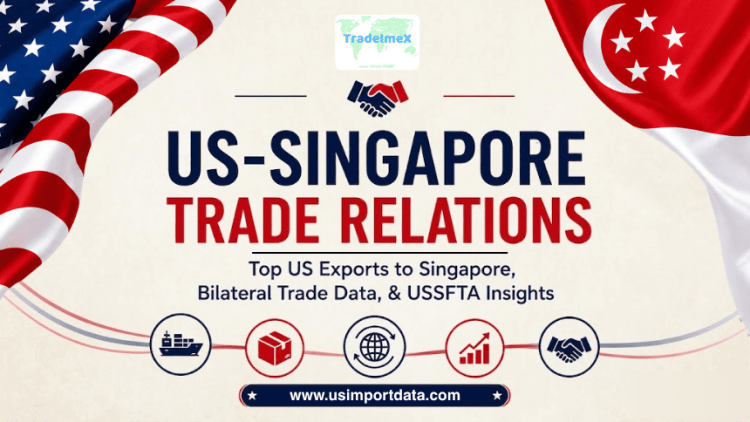
The trade relationship between the United States and Singapore is often described as one of the most successful bilateral economic partnerships in the Asia-Pacific region. That’s not just diplomatic language. When you look at the data, the structure of trade, and the policy framework behind it, the relationship stands out for its stability, balance, and high-value exchange. According to the latest US export data & Singapore import data, the total value of US exports to Singapore reached $41.65 billion in 2025, a 7% decline from the previous year. The total US-Singapore trade value accounted for $80.07 billion in 2025, according to US trade data. The total trade between the USA and Singapore reached $12.49 billion in the first two months of 2026.
Singapore is the 16th largest trading partner of the USA, according to the database on US trade with Singapore. Unlike many US trade relationships that are marked by persistent deficits or dependence on low-cost manufacturing imports, the US–Singapore corridor is different. It is driven by advanced industries, services, and a free trade agreement that has been in force for over two decades.
This article takes a detailed, data-driven look at three core areas:
-
The structure and scale of bilateral trade in 2025
-
The top U.S. exports to Singapore and what drives them
-
The role and real-world impact of the US–Singapore Free Trade Agreement (USSFTA)
Overview of US–Singapore Trade Relations
Singapore is a small country by population, but it plays an outsized role in global trade. Its strategic location along major shipping routes and its position as a financial & trade hub make it a key partner for the United States. Singapore remains one of the United States’ most important trading partners in Southeast Asia. What makes this relationship notable is not just the size of trade flows, but their composition. Trade between the two countries is heavily concentrated in high-value goods and services rather than bulk commodities or low-margin manufacturing.
Total bilateral goods trade in 2025 was around $80 billion, with the United States exporting $41.6 billion in goods to Singapore and importing about $38.1 billion, according to US-Singapore trade data. This results in a U.S. trade surplus of roughly $3.6 billion, which is relatively rare in U.S. trade relationships, particularly in Asia. This surplus reflects a key structural feature: Singapore imports high-value goods & services from the United States to support its own advanced economy and its role as a regional hub.
Bilateral Trade Data 2025: A Closer Look
1. Trade Balance and Structure
The U.S. surplus with Singapore is consistent over time, though it fluctuates year to year. In 2025, the surplus is modest but stable, indicating a balanced relationship rather than one dominated by either side.
Exports from the United States to Singapore are largely composed of:
-
Capital goods
-
Intermediate inputs
-
High-tech equipment
Imports from Singapore into the United States include:
-
Pharmaceuticals
-
Electronics
-
Refined petroleum products
This reflects a two-way industrial relationship, where both countries are deeply embedded in global value chains.
2. Monthly Trade Patterns
Monthly trade data in 2025 shows significant fluctuations, which is typical for high-value trade:
-
Export peaks occur in months like April and October, exceeding $4 billion.
-
Lower months dip closer to $3 billion.
-
Trade surpluses widen during periods of strong capital goods exports.
These variations are often linked to:
-
Semiconductor demand cycles
-
Large-scale industrial shipments
-
Energy market movements
Unlike consumer-driven trade flows, this relationship is more sensitive to industrial investment cycles.
3. Growth Trends into 2026
Early data from 2026 suggests a strong upward trend, with U.S. exports to Singapore rising sharply in the first quarter. This growth is likely driven by increased demand for:
-
Semiconductor equipment
-
AI-related hardware
-
Energy products
This aligns with broader global trends where supply chains are shifting, and investment in advanced technologies is accelerating.
Top Goods US Exports to Singapore: What Does the US Export to Singapore?
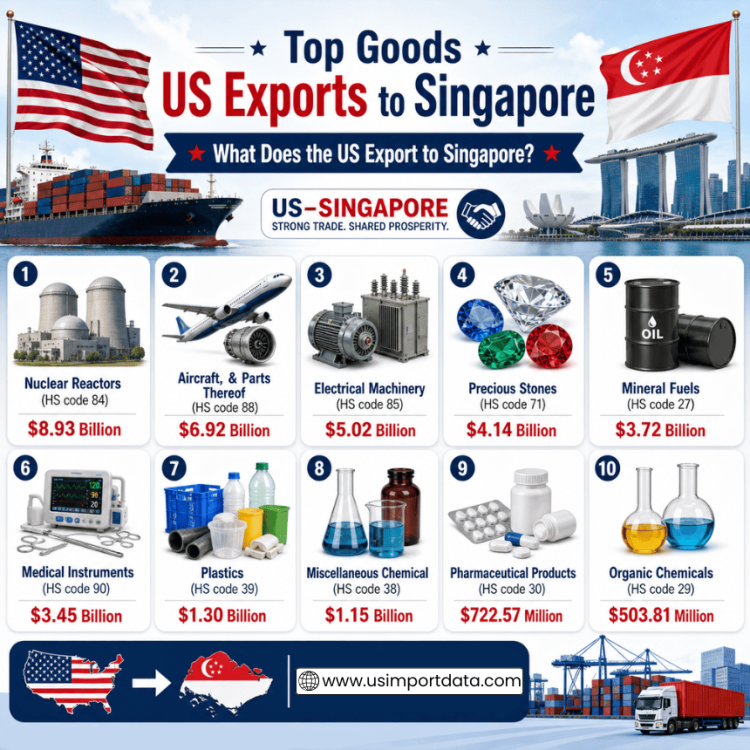
The United States has a strong trade relationship with Singapore, exporting a variety of goods to the country. Some of the key exports from the US to Singapore include machinery, pharmaceutical products, optical and medical instruments, aircraft, and electrical machinery. These products constitute a significant part of trade between the two nations, underscoring the importance of their economic ties. The top 10 goods that the US exports to Singapore, as per the US shipment data for 2025, include:
1. Nuclear Reactors & Machinery (HS code 84): $8.93 billion
The largest product category exported from the US to Singapore is nuclear reactors and machinery, which falls under HS code 84. This category includes equipment related to nuclear energy production, such as reactors, parts, and components. With a value of $8.93 billion, this category constitutes a significant portion of US exports to Singapore by HS code.
2. Aircraft, Spacecraft, & Parts Thereof (HS code 88): $6.92 billion
Another major export category from the US to Singapore is aircraft, spacecraft, and parts thereof, classified under HS code 88. This category encompasses aeroplanes, helicopters, spacecraft, and various related components. With a value of $6.92 billion, this category is a significant contributor to the trade relationship between the two countries.
3. Electrical Machinery & Equipment (HS code 85): $5.02 billion
Electrical machinery and equipment, categorized under HS code 85, is another top export from the US to Singapore, as per the data on US exports to Singapore under HS code 85. This category includes items such as electrical generators, transformers, and various other electrical devices. With a value of $5.02 billion, this category is a key component of US exports to Singapore.
4. Precious Stones & Metals (HS code 71): $4.14 billion
Precious stones and metals, falling under HS code 71, are also significant US exports to Singapore. This category includes items such as diamonds, gold, silver, and platinum, among others. With a value of $4.14 billion, this category plays a crucial role in the trade relationship between the two countries.
5. Mineral Fuels & Oils (HS code 27): $3.72 billion
Mineral fuels and oils, classified under HS code 27, are essential US exports to Singapore. This category includes products such as petroleum, natural gas, and various types of oils. With a value of $3.72 billion, this category contributes significantly to the overall trade between the US and Singapore.
6. Optical, Medical, & Surgical Instruments (HS code 90): $3.45 billion
Optical, medical, and surgical instruments, falling under HS code 90, are also key exports from the US to Singapore. This category includes items such as eyeglasses, medical devices, and surgical equipment. With a value of $3.45 billion, this category is essential in the trade relationship between the two countries.
7. Plastics & Articles Thereof (HS code 39): $1.30 billion
Plastics and articles thereof, categorized under HS code 39, are significant US exports to Singapore. This category includes products such as plastic bottles, containers, and various plastic articles. With a value of $1.30 billion, this category is an important component of US exports to Singapore.
8. Miscellaneous Chemical Products (HS code 38): $1.15 billion
Miscellaneous chemical products, classified under HS code 38, are also essential exports from the US to Singapore. This category includes various chemical products, excluding pharmaceuticals and organic chemicals. With a value of $1.15 billion, this category contributes significantly to the trade relationship between the two countries.
9. Pharmaceutical Products (HS code 30): $722.57 million
Pharmaceutical products, falling under HS code 30, are crucial US exports to Singapore. This category includes medications, vaccines, and various pharmaceutical preparations. With a value of $722.57 million, this category plays a vital role in the trade between the US and Singapore.
10. Organic Chemicals (HS code 29): $503.81 million
Organic chemicals, categorized under HS code 29, are also a significant export from the US to Singapore. This category includes various organic compounds and chemical substances. With a value of $503.81 million, this category is an important component of US exports to Singapore.
US-Singapore Trade in The Last 10 Years: Historical Bilateral Trade Data
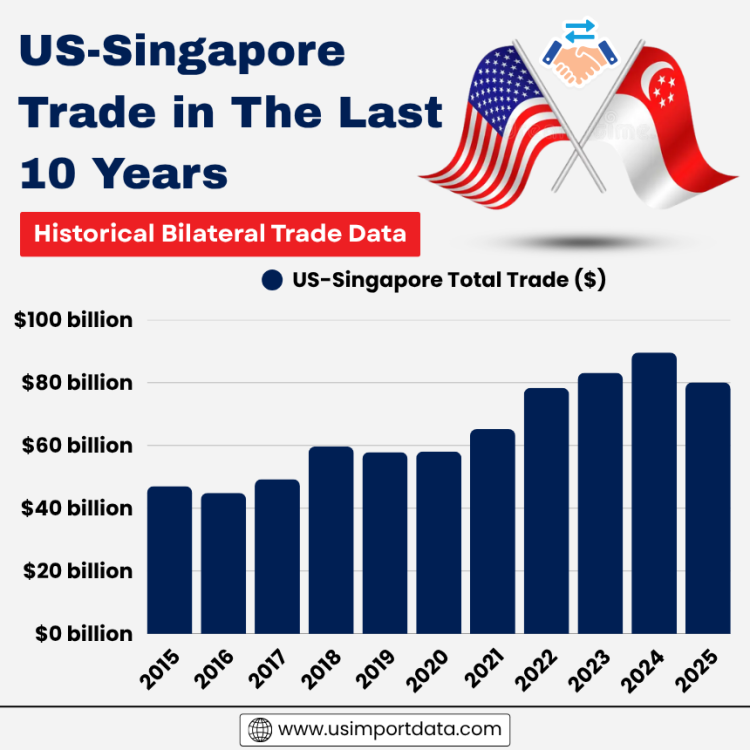
|
Year of Trade |
US-Singapore Total Trade ($) |
|
2015 |
$47.01 billion |
|
2016 |
$44.87 billion |
|
2017 |
$49.26 billion |
|
2018 |
$59.67 billion |
|
2019 |
$57.88 billion |
|
2020 |
$58.04 billion |
|
2021 |
$65.19 billion |
|
2022 |
$78.32 billion |
|
2023 |
$83.15 billion |
|
2024 |
$89.58 billion |
|
2025 |
$80.07 billion |

Services Trade: A Major Advantage for the US-Singapore Trade
While goods trade is important, services trade is where the United States holds a significant advantage. Total bilateral services trade exceeds $50 billion annually, with the United States exporting far more services than it imports.
Key categories include:
-
Financial services
-
Cloud computing and digital services
-
Intellectual property licensing
-
Education and travel
The U.S. enjoys a large services trade surplus, which strengthens the overall economic relationship. Singapore’s role as a financial center makes it a natural partner for U.S. service providers, particularly in banking, fintech, and consulting.
The US–Singapore Free Trade Agreement (USSFTA)
The US-Singapore Free Trade Agreement (USSFTA), implemented in 2004, is one of the most comprehensive trade agreements the United States has signed.
Key Features
The agreement includes:
-
Elimination of tariffs on most goods
-
Strong intellectual property protections
-
Open access to services markets
-
Transparent regulatory frameworks
It also includes provisions for:
-
E-commerce
-
Government procurement
-
Investment protections
Impact on Trade
The USSFTA has had a clear impact on bilateral trade:
-
Trade volumes have increased significantly since its implementation.
-
U.S. firms have greater access to Singapore’s markets.
-
Singapore has become a base for U.S. companies operating in Asia.
The agreement reduces uncertainty and lowers the cost of doing business, which encourages long-term investment.
Limitations and Challenges
Despite its strengths, the USSFTA is not perfect.
Some challenges include:
-
Residual tariffs in certain sectors
-
Regulatory differences
-
Emerging trade barriers in strategic industries
In recent years, there have been discussions around tariffs on pharmaceuticals and semiconductors, reflecting broader geopolitical tensions.
Strategic Importance of the US-Singapore Relations
1. Singapore as a Gateway to ASEAN
Singapore serves as a gateway to Southeast Asia, a region with over 600 million people and rapidly growing economies. U.S. companies often use Singapore as a regional headquarters because of:
-
Its business-friendly environment
-
Strong legal system
-
Advanced infrastructure
2. Role in Supply Chains
Singapore is deeply integrated into global supply chains, particularly in:
-
Electronics
-
Pharmaceuticals
-
Energy
This makes it a critical partner for the United States, especially as companies seek to diversify supply chains.
Key Trends Shaping the Future
1. Rise of Digital Trade
Digital services are becoming increasingly important, including:
-
Cloud computing
-
Data flows
-
Digital payments
The USSFTA’s provisions on e-commerce give the U.S. an advantage in this space.
2. Semiconductor and AI Boom
The global push for AI and advanced computing is driving demand for semiconductors. Singapore’s role in this ecosystem ensures continued growth in trade.
3. Energy Transition
As the world moves toward cleaner energy, trade in LNG and renewable technologies is expected to grow.
4. Geopolitical Factors
U.S.–China tensions are reshaping trade patterns. Singapore’s neutral stance makes it an attractive partner for both sides.
Challenges Ahead
Despite strong fundamentals, the US-Singapore trade relationship faces several risks:
-
Global economic slowdowns
-
Trade policy uncertainty
-
Overdependence on specific sectors
-
Supply chain disruptions
Managing these risks will require continued cooperation and policy alignment.
Opportunities for Growth
There are several areas where bilateral trade can expand:
-
Digital economy partnerships
-
Green technology and sustainability
-
Advanced manufacturing
-
Financial services integration
These sectors align with the strengths of both countries.
Conclusion and Final Thoughts
In conclusion, the U.S.–Singapore trade relationship in 2025 is a model of modern economic cooperation. It is built on high-value trade, strong institutions, and mutual strategic interests. The United States exports advanced goods and services that support Singapore’s role as a global hub. In return, Singapore provides access to regional markets and a stable platform for business operations.
The USSFTA continues to underpin this relationship, even as new challenges emerge. While trade dynamics are evolving due to technology, geopolitics, and shifting supply chains, the fundamentals remain strong. In a global economy that is becoming more fragmented, the U.S.–Singapore partnership stands out for its resilience, balance, and forward-looking nature.
Note For Our Readers
We hope this blog on U.S.–Singapore trade relations, top U.S. exports to Singapore, 2025 bilateral trade data, and insights from the US–Singapore Free Trade Agreement (USSFTA) has helped you better understand how this high-value and strategically important partnership is evolving. With Singapore continuing to serve as a key gateway to Southeast Asia, strong U.S. exports in machinery, semiconductors, energy, and services, and a stable policy framework under the USSFTA, access to accurate and timely trade intelligence is essential for making informed business and investment decisions.
If you’re looking for deeper insights, customized US import-export data, or want to explore live US import-export data by country, product, or HS code, feel free to connect with USImportdata. We provide comprehensive and up-to-date U.S. trade databases to support your research and business needs. For exclusive access or tailored data solutions, contact us at info@tradeimex.in and move forward with clarity and confidence.
What's Your Reaction?