US Beer Imports Data 2025: Database of Beer Importers in USA & Beer Imports by Country
Access US beer imports data 2025 with a complete database of beer importers in the USA and detailed insights on beer imports by country & trends.
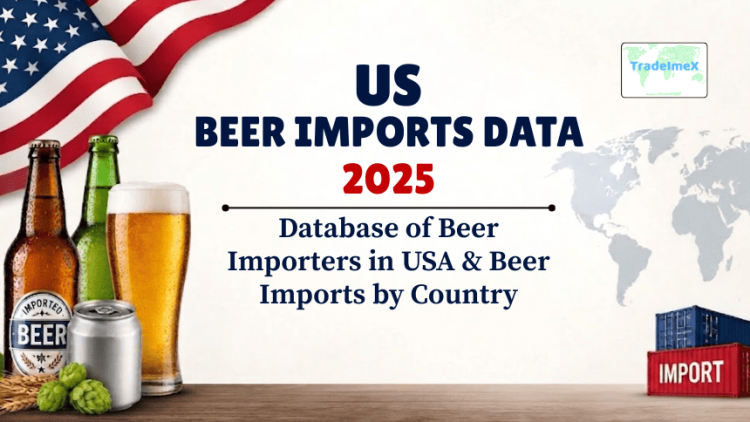
The United States remains the world’s largest beer importer by a wide margin. In 2025, despite economic pressure, shifting consumer preferences, and policy changes, the U.S. import market continues to dominate the global beer trade. According to the latest US import data and beer import data of the USA, the total value of US beer imports reached $7.20 billion in 2025, a 7% decline from the previous year. US beer imports totaled 4.64 million cubic meters in 2025. According to the US beer import data by HS code 2203, the US imported beer worth $1 billion in the first 2 months of 2026.
Beer was the 88th-most-imported commodity in the USA in 2025. The USA is the largest importer of beer in the world, as per the global trade data. This blog breaks down the latest data on U.S. beer imports, key supplier countries, the importer ecosystem, and how a structured database of beer importers can unlock business opportunities.
Overview of the U.S. Beer Import Market
The U.S. beer import market sits at the center of global trade flows. In 2024, total beer imports into the U.S. reached approximately $7.74 billion, up 8.44% year-over-year. By comparison, the U.S. accounted for roughly 47% of global beer imports, making it the single most important destination market worldwide, as per the Beer Institute report.
Globally, beer imports are highly concentrated:
-
The U.S. alone represented about 35% of global beer imports in 2025
-
The next largest importers, France, Italy, the Netherlands, and the UK, each account for less than 7% individually
By 2025, however, early-year data shows a slight cooling:
-
Imports (2025): $7.2 billion
-
Year-over-year change: 7%
This slowdown reflects a mix of inflation, tariffs, and changing consumption patterns.
US Beer Imports by Country: Where Does the US Import Beer From?
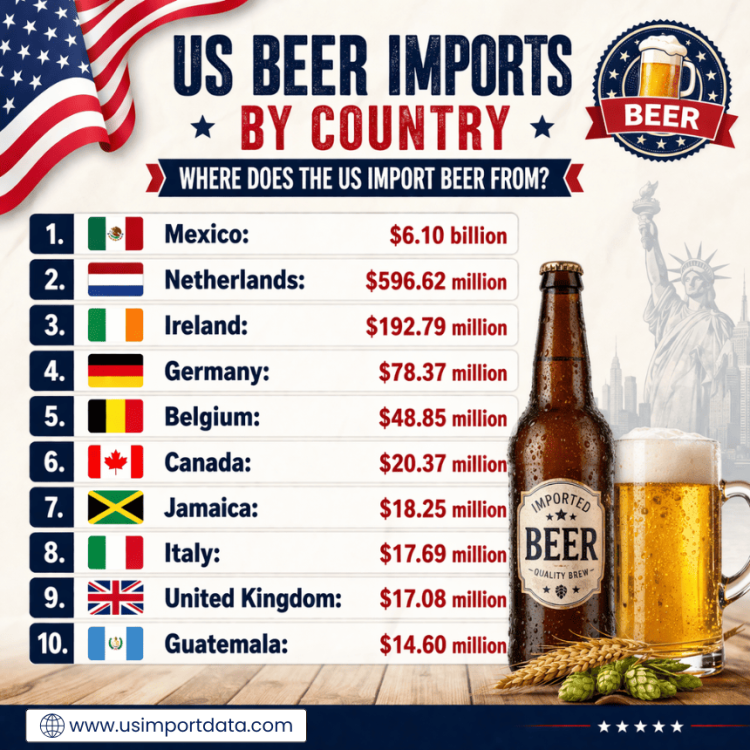
When talking about beer, many people automatically think of popular beer brands in the United States. The US beer imports by country diversify the American beer market with unique flavors and styles. The US imports beer primarily from Mexico, followed closely by the Netherlands, Belgium, Germany, and Canada. Each country brings its own brewing traditions & expertise, contributing to the rich tapestry of choices available to American beer consumers. The top 10 beer supplier countries to the USA, as per the US beer shipment data for 2025, include:
1. Mexico: $6.10 billion (84.6%)
Mexico is the leading country from which the US imports beer, accounting for a staggering 84.6% of total beer imports, as per the data on US beer imports from Mexico by HS code. With its proximity to the United States and popular Mexican beers such as Corona and Modelo, it is no surprise that Mexico holds the top spot.
2. Netherlands: $596.62 million (8.3%)
The Netherlands comes in second place as a significant source of beer imports for the US, making up 8.3% of total beer imports. Dutch beer brands like Heineken and Amstel are well-loved in the US, contributing to the substantial amount of beer imported from the country.
3. Ireland: $192.79 million (2.7%)
Ireland holds the third position as a key importer of beer to the US, accounting for 2.7% of total beer imports. Irish beers like Guinness have a strong presence in the US market, making Ireland a notable player in the beer import industry.
4. Germany: $78.37 million (1%)
Germany, known for its rich beer culture and famous beer festivals like Oktoberfest, also plays a role in supplying beer to the US, as per the data on US beer imports from Germany. It holds a 1% share of total beer imports, with popular German brands like Beck's and Warsteiner being enjoyed by beer enthusiasts in the US.
5. Belgium: $48.85 million (0.7%)
Belgium may be a small country, but it certainly makes a big impact on the US beer import market. Accounting for 0.7% of total beer imports, Belgium is known for its high-quality and diverse beer selection, with brands like Stella Artois and Duvel gaining popularity among American consumers.
6. Canada: $20.37 million (0.3%)
Our neighbor to the north, Canada, also contributes to the US beer import scene, making up 0.3% of total beer imports. Canadian beer brands like Labatt and Molson are well-received in the US, adding to the variety of beers available to American consumers.
7. Jamaica: $18.25 million (0.3%)
Jamaica may be more famous for its rum, but it also plays a part in the US beer import market. Accounting for 0.3% of total beer imports, Jamaican beers like Red Stripe are enjoyed by those looking for a taste of the Caribbean in their beer.
8. Italy: $17.69 million (0.2%)
Italy, known for its wine production, also exports beer to the US. With a 0.2% share of total beer imports, Italian beers like Peroni have made their mark on American beer aficionados, adding a touch of Italian flair to the US beer market.
9. United Kingdom: $17.08 million (0.2%)
The United Kingdom may be known for its pubs and ales, but it also contributes to the US beer import market. Accounting for 0.2% of total beer imports, British beers like Guinness and Newcastle Brown Ale have a loyal following in the US.
10. Guatemala: $14.60 million (0.2%)
Rounding out the list is Guatemala, a smaller player in the US beer import market but still making a notable contribution. With a 0.2% share of total beer imports, Guatemalan beers offer a taste of Central American brewing traditions to American consumers.
Why Mexico Dominates
Mexico’s dominance is striking. With more than 80% market share, it is driven by:
-
Proximity and trade agreements (USMCA)
-
Strong global brands (e.g., Corona, Modelo)
-
Efficient trade and lower transportation costs
Mexico alone exported over $6.1 billion worth of beer to the U.S. in 2025.
European Suppliers
The European Union collectively contributes close to $1 billion in exports, led by:
-
Netherlands (Heineken)
-
Belgium (premium craft imports)
-
Germany (traditional lagers)
These imports are typically positioned in premium or specialty segments.
US Beer Importers Database: Top Beer Importers with Shipment Records
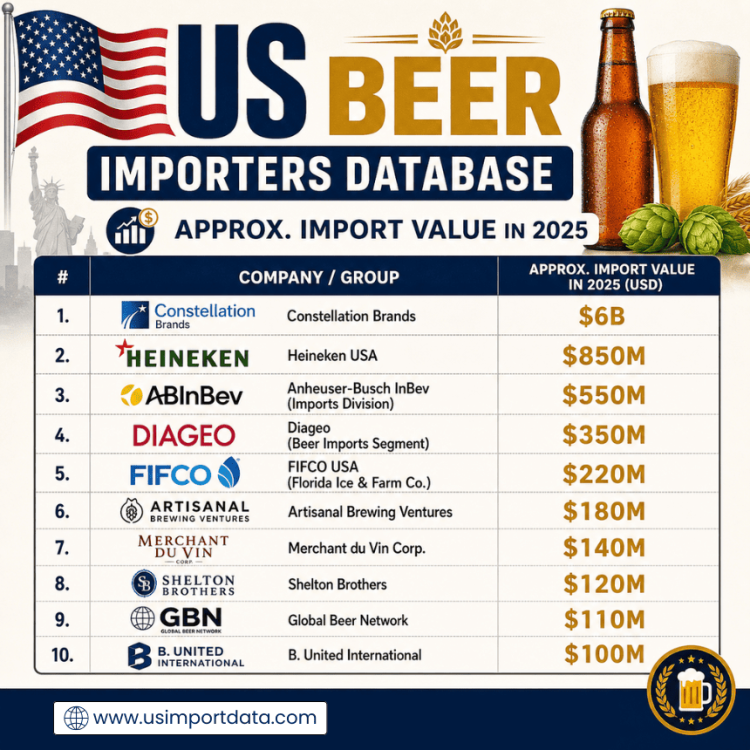
A US beer importers database is a structured dataset containing key American beer-importing companies engaged in importing beer into the U.S. These databases are essential for exporters, suppliers, and market analysts. The leading beer importers in USA, as per the US beer buyers & beer importers database for 2025, include:
1. Constellation Brands
-
Approx. import value in 2025: $6B
-
Top import types: Mexican lagers (Modelo, Corona)
-
Top import source: Mexico
2. Heineken USA
-
Approx. import value in 2025: $850M
-
Top import types: Premium lager, Light beer
-
Top import sources: Netherlands, Mexico
3. Anheuser-Busch InBev (Imports Division)
-
Approx. import value in 2025: $550M
-
Top import types: European lagers, Global beer brands
-
Top import sources: Belgium, Mexico, Canada
4. Diageo (Beer Imports Segment)
-
Approx. import value in 2025: $350M
-
Top import types: Irish stout, Specialty beer
-
Top import source: Ireland
5. FIFCO USA (Florida Ice & Farm Co.)
-
Approx. import value in 2025: $220M
-
Top import types: Costa Rican lager (Imperial), Craft imports
-
Top import sources: Costa Rica, Mexico
6. Artisanal Brewing Ventures
-
Approx. import value in 2025: $180M
-
Top import types: European craft beer, Specialty ales
-
Top import sources: Germany, Belgium
7. Merchant du Vin Corp.
-
Approx. import value in 2025: $140M
-
Top import types: British ales, Specialty beers
-
Top import sources: United Kingdom, Germany
8. Shelton Brothers
-
Approx. import value in 2025: $120M
-
Top import types: Belgian craft beer, European specialty beer
-
Top import sources: Belgium, France
9. Global Beer Network
-
Approx. import value in 2025: $110M
-
Top import types: Trappist beers, Abbey-style beers
-
Top import source: Belgium
10. B. United International
-
Approx. import value in 2025: $100M
-
Top import types: Farmhouse ales, Niche craft beer
-
Top import sources: Belgium, Germany, the Czech Republic
Key Takeaways
-
The market is dominated by Constellation Brands, with 70–75% of imports.
-
Mexico is the dominant supplier as the primary source for most high-volume importers.
-
Large-scale importers import high-volume lagers.
-
Specialty importers import premium and craft beers.
-
Lagers dominate overall imports (70%+), especially Mexican styles.
-
European imports focus on premium niches such as Belgian ales, German lagers, and British beers.
Key Data Fields in an Importer Database
A high-quality database typically includes:
-
Company name
-
Import license details
-
Import volumes (by HS code 2203)
-
Supplier countries
-
Brand portfolio
-
Distribution network coverage
-
Shipment frequency and history
Beer Importer Segmentation in the U.S.
While detailed proprietary databases list thousands of importers, the market is dominated by a few major players:
Large Importers
-
Constellation Brands (imports Mexican beer brands)
-
Heineken USA
-
Anheuser-Busch InBev (import portfolio)
-
Diageo (for select beer brands)
Mid-Sized and Specialty Importers
-
Craft beer importers specializing in European beers
-
Niche distributors focused on premium or organic labels
Emerging Importers
-
Small importers focusing on:
-
Asian craft beers
-
Latin American microbrews
-
Alcohol-free imported beers
US Beer Imports in The Last 10 Years: Historical Import Data
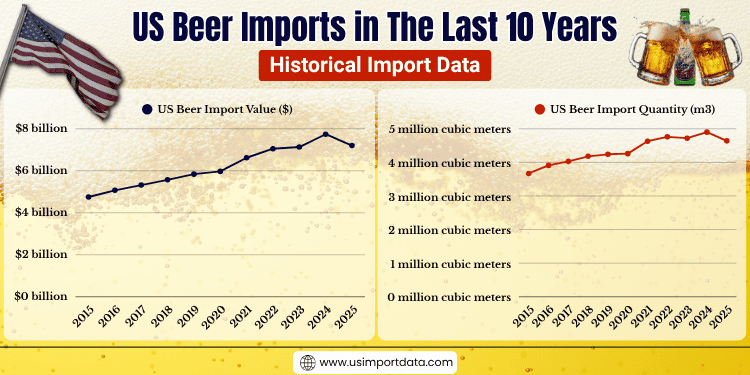
|
Year of Imports |
US Beer Import Value ($) |
US Beer Import Quantity (m3) |
|
2015 |
$4.75 billion |
3.67 million cubic meters |
|
2016 |
$5.07 billion |
3.91 million cubic meters |
|
2017 |
$5.32 billion |
4.03 million cubic meters |
|
2018 |
$5.57 billion |
4.18 million cubic meters |
|
2019 |
$5.84 billion |
4.24 million cubic meters |
|
2020 |
$5.97 billion |
4.26 million cubic meters |
|
2021 |
$6.62 billion |
4.63 million cubic meters |
|
2022 |
$7.05 billion |
4.76 million cubic meters |
|
2023 |
$7.13 billion |
4.72 million cubic meters |
|
2024 |
$7.74 billion |
4.90 million cubic meters |
|
2025 |
$7.20 billion |
4.64 million cubic meters |

US Beer Market Size and Sales Performance
Beyond import value, retail sales provide another lens into demand. Imported beer sales in the U.S. reached approximately:
-
$11.1 billion in 2025 retail sales
-
–2.6% decline in dollar sales
-
–4.2% decline in volume (case sales)
Despite the slight decline, imports remain a major segment. In fact, imported beers have recently surpassed domestic brands in popularity among consumers, signaling a structural shift in preferences.
Key Insight: Even with declining volumes, premiumization and brand positioning keep imported beer highly competitive in value terms.
Trends Shaping Beer Imports in 2025
1. Slowing Growth After Expansion
While the U.S. beer import market saw strong growth in 2024, 2025 shows early signs of stagnation:
-
Volume growth turned negative (–5.03%) in early 2025
-
Monthly import growth stabilized at just 0.17%
2. Tariffs and Trade Policies
Recent policy developments have added pressure. For example:
-
A 25% tariff on beer imports and aluminum cans was introduced in 2025
This directly impacts import costs and pricing strategies, particularly for packaged beer.
3. Premiumization vs Volume Decline
Global data suggests:
-
Premium beer segments continue to grow
-
Overall beer consumption is slightly declining globally (–0.2% forecast for 2025)
4. Changing Consumer Behavior
Key shifts include:
-
Preference for imported brands over domestic brands
-
Growth in craft and specialty imports
-
Increased competition from RTDs and spirits
Structure of the U.S. Beer Import Ecosystem
Understanding imports requires understanding the three-tier system in the U.S.:
1. Importers
Licensed entities responsible for bringing beer into the U.S.
2. Distributors (Wholesalers)
They move products from importers to retailers.
3. Retailers
Bars, restaurants, supermarkets, and liquor stores.
This system is legally mandated and shapes how beer flows into the market.
Data-Driven Insights from Importer Databases
A structured importer database enables powerful insights:
1. Supplier–Importer Relationships
You can map which countries supply which importers:
-
Mexican exporters to large national importers
-
European exporters to premium-focused distributors
2. Market Entry Strategy
Exporters can identify:
-
Active importers by volume
-
Importers specializing in specific regions
-
Untapped distribution channels
3. Pricing Intelligence
Using shipment data:
-
Average import price (2024): $1,580 per ton
-
Price trends help position products competitively
Regional Analysis of U.S. Beer Imports
North America
-
Dominated by Mexico
-
Accounts for the majority of imports
Europe
-
Premium and specialty segment
-
Strong presence in urban markets
Asia & Latin America
-
Smaller share but growing
-
Increasing demand for unique flavors and craft styles
Globally, North America accounted for 43.8% of imported beer consumption in 2025.
Challenges in the U.S. Beer Import Market
1. Regulatory Complexity
-
Three-tier system
-
Labeling and compliance requirements
2. Shipment Costs
-
Shipping and storage costs remain high
-
Inflation impacts margins
3. Competition
-
Domestic craft beer
-
Ready-to-drink beverages
-
Spirits and wine
4. Demand Volatility
-
Economic slowdown affects discretionary spending
-
Volume declines despite premium growth
Opportunities for Exporters
Despite challenges, the U.S. remains highly attractive:
1. Largest Import Market
-
Over $7.7 billion in imports annually
2. Strong Premium Segment
-
Consumers are willing to pay for quality and brand
3. Diverse Consumer Base
-
Demand for international flavors
-
Growth in ethnic and niche markets
4. Data-Driven Market Entry
With access to importer databases, exporters can:
-
Target high-volume importers
-
Identify regional distribution gaps
-
Optimize pricing and positioning
Future Outlook for 2025 and Beyond
The outlook for U.S. beer imports is mixed:
Positive Drivers
-
Continued dominance of imported brands
-
Growth in premium and specialty categories
-
Strong trade relationships with Mexico and Europe
Negative Pressures
-
Tariffs and trade tensions
-
Declining overall beer consumption
-
Competition from alternative beverages
Expected Trend
-
Stable to slightly declining volumes
-
Value growth driven by premiumization
Conclusion and Final Thoughts
In conclusion, the U.S. beer import market in 2025 is a complex but opportunity-rich landscape. With imports exceeding $7 billion annually and dominating global demand, the U.S. remains the most critical destination for beer exporters worldwide.
Key takeaways:
-
Mexico dominates the supply with over 80% market share.
-
Total imports show a slight decline in 2025 after strong 2024 growth.
-
Import databases are essential tools for market entry & competitive intelligence.
-
Premiumization continues to offset volume declines.
For businesses, success in this market depends on data-driven decision-making. A robust database of beer importers, combined with country-level trade insights, can provide the edge needed to enter and scale in the U.S. beer industry.
Note For Our Readers
We hope you found this blog on U.S. beer imports data for 2025, key supplier countries, and the US beer importers & buyers database useful in understanding how this dynamic market is evolving. With the United States continuing to lead global beer imports, strong dominance from Mexican suppliers, and growing demand for premium and specialty beers from Europe and other regions, having access to accurate and timely trade data is more important than ever for making informed business decisions.
If you’re looking for deeper insights, customized U.S. export-import data, or want to explore live U.S. beer import data by country, company, or HS code, feel free to connect with USImportdata. We provide comprehensive and up-to-date U.S. trade databases to support your research and business needs. For exclusive access or tailored data solutions, contact us at info@tradeimex.in and move forward with clarity and confidence.
What's Your Reaction?