Exploring the US–UAE Trade Relations: Top US Exports to UAE & Trade Deal Insights
Access the US-UAE trade relations covering US exports to UAE and UAE imports from the US, with data-driven insights on trends, demand, & trade growth.

The trade relationship between the United States and the United Arab Emirates has evolved into one of the most strategically significant economic partnerships in the Middle East. Driven by strong diplomatic ties, complementary economic structures, and increasing cooperation in advanced technologies, this bilateral relationship continues to grow in both scale & importance. According to the latest US export data & UAE import data, the total value of US exports to the UAE reached $31.41 billion in 2025, a 16% increase from the previous year. The USA exported goods worth $6.62 billion to the UAE in the first 2 months of 2026. The total US-UAE trade value accounted for $39.32 billion in 2025, a 13% increase from the previous year.
For the 16th year in a row, the UAE remained the largest U.S. export market in the MENA region in 2025, solidifying its status as a top trading partner of the United States. Notably, the U.S. exported $31.4 billion in goods to the UAE, while US imports from the UAE totaled $7.6 billion as per the US import data, resulting in a substantial U.S. trade surplus of $23.8 billion. This blog explores the structure of the US-UAE trade relations, the top US exports to the UAE, key sectors driving growth, and insights into trade agreements and future opportunities.
Overview of US–UAE Trade Relations
The UAE has consistently maintained its position as the largest export market for U.S. goods in the Middle East and North Africa (MENA) region for over 17 consecutive years, as per the US-UAE trade data. UAE exports to USA remain relatively niche compared to its global trade basket, but still play a strategic role in strengthening UAE-US bilateral trade, especially in sectors like aluminum, petrochemicals, and specialized industrial goods; when asking What does UAE export to USA, the answer typically includes metals, refined petroleum products, and niche manufactured items that contribute to steady US imports from UAE.
While, at the same time US exports to UAE dominate the relationship, covering aircraft, machinery, technology, and services, leading to a consistent US trade surplus ; ongoing discussions around a potential UAE-US trade deal or broader UAE US Trade Agreement aim to reduce barriers and deepen economic ties, especially in response to policies like the US tariff on UAE metals such as steel and aluminum, which have influenced trade flows & negotiations; overall, US-UAE relations are built on a strong economic, investment, and strategic partnership that continues to expand through trade, technology collaboration, and long-term bilateral agreements.
This sustained dominance is rooted in several factors:
-
The UAE’s role as a regional re-export hub
-
Strong trade and port infrastructure (e.g., Dubai, Abu Dhabi)
-
A business-friendly environment with minimal trade barriers
-
Strategic geopolitical alignment between the two nations
Key Trade Metrics (2024–2025)
|
Indicator |
Value |
|
Total bilateral trade (2025) |
$39.3 billion |
|
US exports to UAE (2025) |
$31.4 billion |
|
UAE exports to the US (2025) |
$7.6 billion |
|
US trade surplus |
$23.8 billion |
|
Services trade (2024) |
$13.4 billion |
In addition to goods trade, services such as finance, tourism, and technology play an increasingly important role, contributing over $13 billion annually to bilateral trade.
Top Goods US Exports to UAE: What Does the USA Export to the UAE?
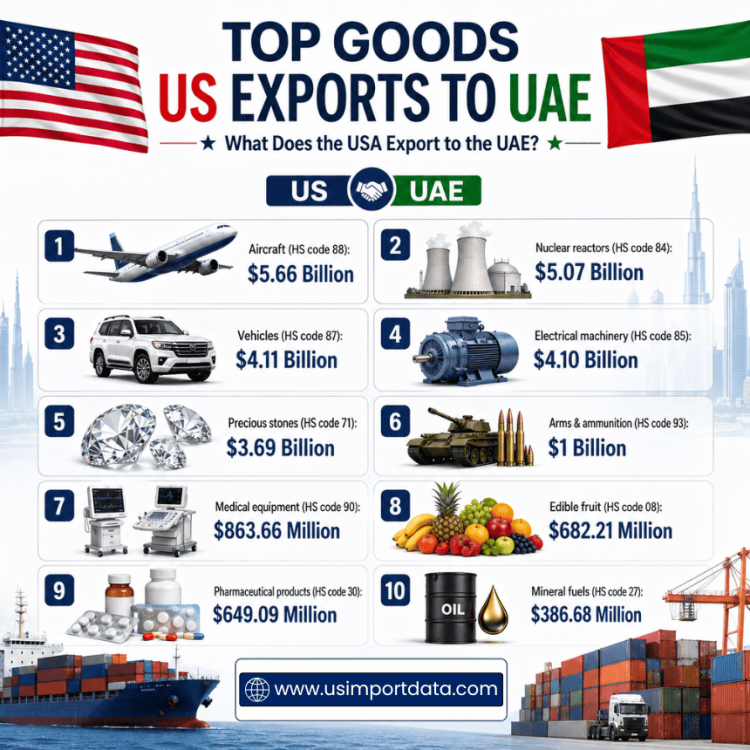
The United Arab Emirates is a significant trading partner for the United States, with various goods being exported from the USA to the UAE. Among the top goods US exports to the UAE are aircraft, machinery, vehicles, electrical machinery, and precious metals. These exports contribute to fostering strong economic ties between the two nations, benefiting both economies. The UAE’s import demand is heavily concentrated in high-value manufactured goods, transportation equipment, and advanced technology products. The top 10 products that the US exports to the UAE, as per the US-UAE trade data and US shipment data for 2025, include:
1. Aircraft, spacecraft, & parts thereof (HS code 88): $5.66 billion
Aircraft, spacecraft, and parts thereof are among the top goods that the US exports to the UAE. With a value of $5.66 billion, these products play a significant role in the trade between the two countries.
2. Nuclear reactors & machinery (HS code 84): $5.07 billion
Nuclear reactors and machinery are another major export category for the US to the UAE, valued at $5.07 billion, as per the data on US machinery exports to the UAE by HS code. These products are essential for various industries and infrastructure projects in the UAE.
3. Vehicles (HS code 87): $4.11 billion
Vehicles, including cars, trucks, and other types of transportation, are also significant exports from the US to the UAE, with a total value of $4.11 billion, as per the data on US vehicle exports to the United Arab Emirates. The UAE is a growing market for automotive products, making this category an important one for US exporters.
4. Electrical machinery & equipment (HS code 85): $4.10 billion
Electrical machinery and equipment are essential for various industries and sectors in the UAE, making them a popular export category from the US. With a value of $4.10 billion, these products are in high demand in the UAE market.
5. Precious stones & metals (HS code 71): $3.69 billion
Precious stones and metals, including gold, diamonds, and other valuable commodities, are among the top goods exported from the US to the UAE. With a value of $3.69 billion, these products play a crucial role in the trade relationship between the two countries.
6. Arms & ammunition (HS code 93): $1 billion
Arms and ammunition are also significant exports from the US to the UAE, with a value of $1 billion. The UAE has a strong defense sector, making this category an important one for US exporters.
7. Optical, medical, surgical equipment (HS code 90): $863.66 million
Optical, medical, and surgical equipment are essential for the healthcare industry in the UAE, making them valuable exports from the US. With a value of $863.66 million, these products are in high demand in the UAE market.
8. Edible fruit & nuts (HS code 08): $682.21 million
Edible fruit and nuts are popular exports from the US to the UAE, with a total value of $682.21 million. These products are consumed widely in the UAE, making them a lucrative export category for US suppliers.
9. Pharmaceutical products (HS code 30): $649.09 million
Pharmaceutical products are essential for healthcare and medical treatment in the UAE, making them valuable exports from the US. With a value of $649.09 million, these products play a crucial role in the healthcare industry in the UAE.
10. Mineral fuels & oils (HS code 27): $386.68 million
Mineral fuels and oils are also significant exports from the US to the UAE, with a value of $386.68 million. These products are essential for various industries and sectors in the UAE, making them a key export category for the US.
US-UAE Trade in The Last 10 Years: Historical Bilateral Trade Data
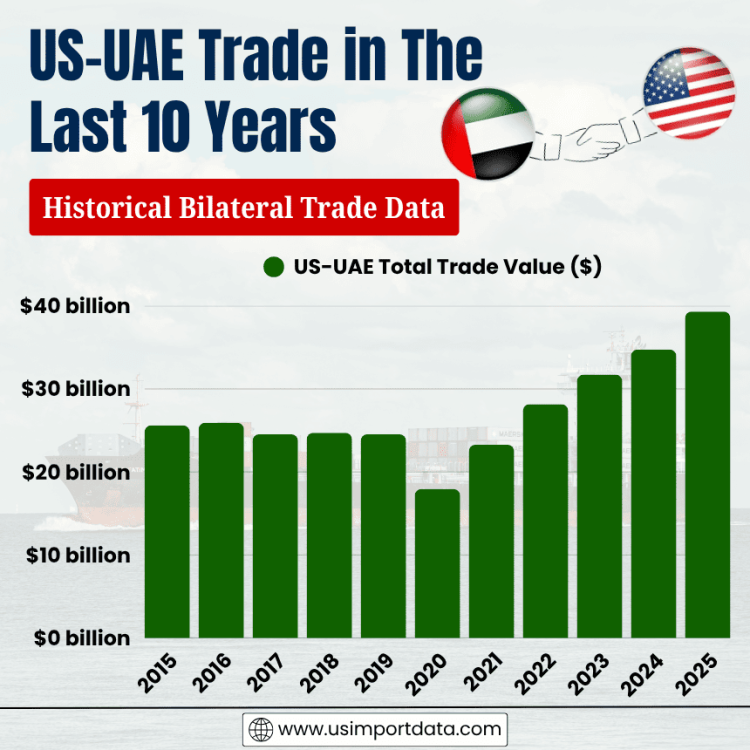
|
Year of Trade |
US-UAE Total Trade Value ($) |
|
2015 |
$25.60 billion |
|
2016 |
$25.93 billion |
|
2017 |
$24.54 billion |
|
2018 |
$24.71 billion |
|
2019 |
$24.54 billion |
|
2020 |
$17.93 billion |
|
2021 |
$23.28 billion |
|
2022 |
$28.16 billion |
|
2023 |
$31.72 billion |
|
2024 |
$34.76 billion |
|
2025 |
$39.32 billion |

UAE Exports to the US: A Snapshot
While the focus is on US exports, it’s important to understand the reverse flow. In 2025, UAE exports to the US totaled approximately $11.69 billion, dominated by:
-
Precious metals and stones ($2.62B)
-
Machinery ($1.97B)
-
Aircraft components ($1.74B)
-
Aluminum ($1.14B)
This relatively lower export volume explains the persistent US trade surplus.
Key Drivers of US–UAE Trade Growth
1. Strategic Economic Alignment
The UAE’s shift toward a diversified, knowledge-based economy aligns well with US strengths in:
-
Technology
-
Manufacturing
-
Innovation
2. UAE as a Regional Trade Hub
The UAE serves as a gateway to:
-
Middle East
-
Africa
-
South Asia
This amplifies US exports, as goods entering the UAE are often re-exported.
3. Trade & Infrastructure Excellence
World-class ports like Jebel Ali and advanced trade networks enable efficient trade flows.
4. Energy & Industrial Cooperation
Although oil is not the dominant trade component, energy collaboration remains important, particularly in:
-
LNG technology
-
Renewable energy investments
5. Rise of Technology Partnerships
The US–UAE trade partnership is increasingly focused on:
-
Artificial Intelligence
-
Semiconductors
-
Cloud computing
Recent AI chip export agreements, or the US-UAE AI chips deal, highlight a strategic pivot toward future technologies.
Trade Agreements & Policy Landscape
Unlike many global trade relationships, the US and UAE do not currently have a full Free Trade Agreement (FTA). However, their economic relationship is governed by multiple frameworks:
1. Trade and Investment Framework Agreement (TIFA)
-
Signed to enhance trade dialogue
-
Focuses on reducing barriers and improving market access
2. Bilateral Investment Treaties
These agreements promote:
-
Foreign direct investment (FDI)
-
Protection of investor rights
3. UAE’s Broader Trade Strategy
The UAE has aggressively pursued Comprehensive Economic Partnership Agreements (CEPAs) with countries like India, Türkiye, and Indonesia, boosting its global trade network. While the US is not part of CEPA, these agreements indirectly benefit US exporters by strengthening the UAE’s role as a global trade hub.
4. Emerging Tech Trade Agreements
Recent policy shifts include:
-
Approval of advanced semiconductor exports
-
Joint investments in AI infrastructure
These developments signal a move toward technology-centric trade agreements rather than traditional tariff-based FTAs.
Sectoral Opportunities for US Exporters
1. Renewable Energy & Sustainability
The UAE’s push toward net-zero emissions opens opportunities in:
-
Solar technology
-
Hydrogen energy
-
Carbon capture systems
2. Defense & Security
The UAE is one of the largest defense importers globally, creating demand for:
-
Military equipment
-
Surveillance systems
3. Digital Economy & AI
With billions being invested in AI, US firms can expand in:
-
Data centers
-
Cloud services
-
AI hardware
4. Healthcare & Biotech
Opportunities exist in:
-
Telemedicine
-
Biopharmaceuticals
-
Medical technology
5. Food Security & Agri-tech
The UAE’s reliance on imports creates demand for:
-
Agri-tech solutions
-
Sustainable farming technologies
Challenges in US–UAE Trade Relations
Despite strong growth, certain challenges persist:
1. Regulatory Differences: Compliance requirements can vary significantly
2. Geopolitical Risks: Regional tensions can impact trade flows
3. Competition from Other Exporters: China, the EU, & India are strong competitors in the UAE market
Future Outlook: What Lies Ahead?
The US–UAE trade relationship is poised for continued expansion, driven by:
-
Digital transformation
-
AI and semiconductor trade
-
Green energy investments
-
Infrastructure development
With bilateral trade already nearing $40 billion annually, it is expected to grow further as both countries deepen cooperation in emerging sectors.
Key Trends to Watch
-
Expansion of AI and semiconductor exports
-
Increased US participation in UAE mega-projects
-
Growth in services trade (finance, tech, tourism)
-
Potential negotiations toward a more formal trade agreement
Impact of the Iran War on US–UAE Trade Relations
The ongoing conflict involving the United States and Iran in 2026 has emerged as a major geopolitical shock influencing US–UAE trade relations. While the bilateral trade partnership remains structurally strong, the war has introduced significant disruptions, risks, and strategic shifts that are reshaping the trade landscape.
1. Disruption of Critical Trade Routes
One of the most immediate impacts has been the instability in the Strait of Hormuz, a strategic maritime chokepoint through which nearly 20% of global oil and LNG shipments pass.
-
Maritime traffic through the strait has collapsed sharply, with ship transits dropping dramatically due to blockades and security threats.
-
Tanker attacks, naval restrictions, and rising insurance costs have significantly slowed down trade flows.
For the UAE, whose economy heavily depends on trade activities, this creates a direct bottleneck in imports, exports, and re-export activities, including US goods entering the region.
2. Rising Trade Costs and Inflationary Pressures
The conflict has triggered a surge in:
-
Shipping costs and insurance premiums
-
Energy prices (oil and LNG)
-
Trade and supply chain disruptions
These cost increases quickly translate into higher import prices in the UAE, affecting demand for US exports such as machinery, vehicles, and consumer goods. Additionally, global warnings suggest that prolonged disruption could lead to higher food prices and inflation worldwide, indirectly impacting trade volumes.
3. Decline in Trade Activity and Economic Slowdown
The broader Gulf economy, including the UAE, has experienced:
-
Reduced oil and gas exports
-
Slower industrial output
-
Disruptions in port operations
Economic analyses indicate that trade activity and economic growth in the Gulf are being negatively affected, particularly due to restricted access to ports and reduced shipping flows.
For US–UAE trade, this means:
-
Short-term decline in trade volumes
-
Delays in high-value shipments (e.g., aircraft parts, industrial equipment)
-
Reduced demand in certain sectors
4. Security Risks and Infrastructure Damage
The conflict has directly impacted the UAE’s infrastructure and business environment:
-
Iranian missile and drone strikes have targeted airports, trade hubs, and commercial centers
-
Key economic zones, including financial and aviation infrastructure, have faced disruptions
Such developments undermine the UAE’s position as a safe and stable trade hub, which is central to US export flows into the Middle East.
5. Strengthening of US–UAE Strategic Alignment
Paradoxically, the US-Iran war & conflict have also strengthened defense and strategic ties between the US and the UAE:
-
The UAE has deepened cooperation with the US on security and maritime protection
-
Discussions around financial support mechanisms (e.g., dollar swap lines) highlight growing economic coordination
-
The UAE has signaled its willingness to collaborate with the US to secure shipping routes and reopen Hormuz if necessary
This alignment reinforces long-term trade relations, even as short-term disruptions persist.
Conclusion and Final Thoughts
In conclusion, the trade relationship between the United States and the United Arab Emirates stands as a model of strategic economic cooperation. With the UAE serving as a critical gateway to global markets and the US providing high-value goods and technological expertise, the partnership is mutually beneficial and rapidly evolving.
From traditional exports like vehicles and aircraft to cutting-edge sectors like artificial intelligence and semiconductors, the scope of US–UAE trade continues to expand. While no formal free trade agreement exists, strong institutional frameworks and shared economic interests ensure sustained growth. As the global trade dynamics shift, the US–UAE partnership is likely to become even more significant, especially in shaping the future of technology-driven trade in the Middle East and beyond.
Note For Our Readers
We hope this blog has provided you with a clear, data-driven understanding of the US–UAE trade relationship, including key export categories, trade volumes, and emerging opportunities. As global trade continues to evolve amid technological advancements, shifting geopolitical alliances, and economic diversification strategies, staying informed with accurate, actionable trade data is more important than ever.
For the latest US trade data insights, or to search live US import-export data by country or HS code, you can connect with USImportdata. Contact us at info@tradeimex.in for customized trade reports & market insights.
What's Your Reaction?