US Textile Exports Data 2025: American Textile Export Trends & USA Textile Manufacturers Database
Explore US Textile Exports Data with insights on US textile exports by country. Discover leading textile manufacturers and suppliers in USA to unlock global textile trade opportunities.

The United States textile industry sits in an interesting position in 2026. It is both a major exporter and a massive importer, deeply embedded in global supply chains while also trying to strengthen domestic manufacturing. According to the latest US export data and Textile export data of the USA, the total value of the US textile exports reached $23.7 billion in 2025, a 1% increase from the previous year. Textiles are the 14th largest exported commodity from the US with a 2.64% global share, as per the US textile export data.
The USA is the 8th largest textile exporter in the world, according to global trade data. If you look at the numbers closely, a clear picture emerges. The US is not competing on volume like China or Bangladesh. Instead, it is moving toward high-value textiles, technical fabrics, and regional trade dominance. This article breaks down the latest US textile export data (2025), key trends shaping the market, and how a USA textile manufacturers database fits into the bigger business strategy.
Snapshot: US Textile Export Data
Let’s start with the most important question: How much textile does the US export?
-
US textile and apparel exports were around $28 billion in 2025, down from $29.7 billion in 2024
-
Pure textile exports alone were about $23.7 billion
-
Historically, exports peaked post-pandemic and are now stabilizing
In 2025, early indicators show:
-
Exports declining slightly in early 2025 due to global demand softness and tariffs
-
Jan–Aug 2025 exports down 4% YoY
What this means
The US textile export market is not collapsing. It is cooling after a strong rebound period as per the data on U.S. exports of textiles and apparel. The textile export slowdown reflects:
-
Reduced demand in key markets
-
Rising competition from Asia
-
Currency and trade policy pressures
At the same time, the US remains:
-
One of the top global textile exporters
-
A leader in high-tech and industrial textiles
American Textile Export Statistics 2025
The latest numbers show a stable but slightly cooling export market.
-
Total US textile and apparel exports (2025): $28 billion
-
Textile-only exports: $23.7 billion
-
Early 2026 exports: 4% decline year-over-year
While exports are slightly down, this is not a collapse. It reflects:
-
Slower global demand
-
Ongoing trade pressures
-
Market correction after post-pandemic growth
Key takeaway
The US remains one of the top textile exporters globally, especially in high-value and technical textile segments.
US Textile Exports by Country: Where Does the US Export Textiles?
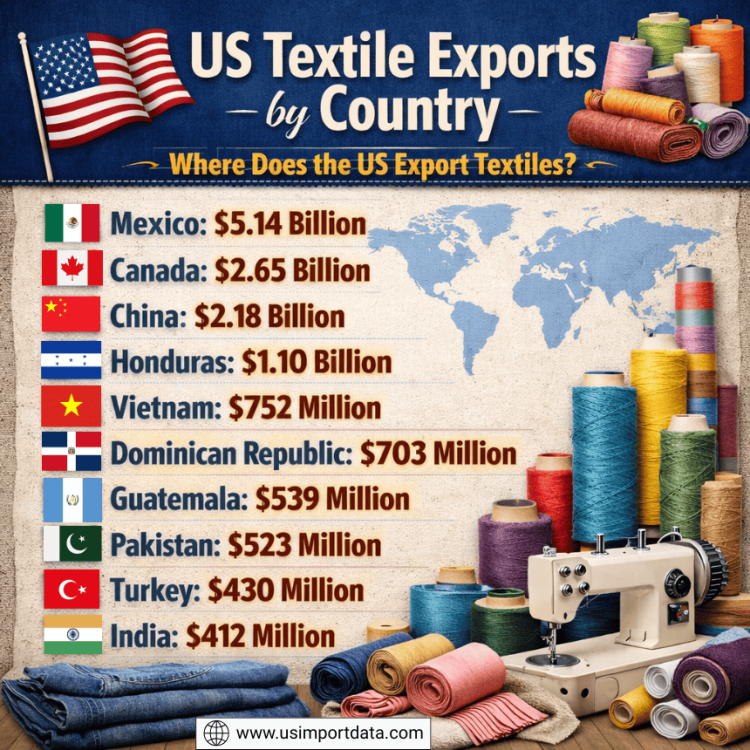
In the global textile industry, the United States plays a significant role as a major exporter of textiles to various countries around the world. US Textile Exports by Country reveals interesting insights into the destinations of American textile exports. As of the most recent data, significant recipients of US textile exports include countries such as Mexico, Canada, Honduras, and China. The detailed breakdown of these textile exports by country highlights the diverse international markets that contribute to the thriving textile industry in the United States. The top 10 American textile export destinations, as per the US shipment data for 2025, include:
1. Mexico: $5.14 Billion (23.2%)
Mexico stands out as the top destination for US textile exports, with a substantial share of $5.14 billion, accounting for 23.2% of the total export value. The proximity of Mexico to the United States makes it an ideal trading partner for textile products, facilitating smooth and efficient trade between the two countries.
2. Canada: $2.65 Billion (12%)
Canada ranks second in terms of US textile exports, with a total export value of $2.65 billion, capturing a 12% share of the market. The strong economic ties between the US and Canada have paved the way for a robust trade relationship in the textile sector, benefiting both countries.
3. China: $2.18 Billion (9.86%)
Despite its own stronghold in the global textile industry, China remains a significant importer of US textile products, with an export value of $2.18 billion, representing 9.86% of the total US textile exports, as per the data on US textile exports to China. The trade dynamics between the US and China have evolved over the years, with both countries playing vital roles in each other's textile markets.
4. Honduras: $1.10 Billion (4.95%)
Honduras emerges as a key player in US textile exports, with a total export value of $1.10 billion, accounting for 4.95% of the market share. The strategic location of Honduras in Central America makes it a lucrative destination for US textile exports, further bolstering trade relations between the two countries.
5. Vietnam: $752 Million (3.4%)
Vietnam has made significant strides in the textile industry, emerging as a prominent destination for US textile exports with a total export value of $752 million, capturing a 3.4% market share. The growing demand for textile products in Vietnam has paved the way for increased trade opportunities between the US and Vietnam.
6. Dominican Republic: $703 Million (3.17%)
The Dominican Republic is a key player in the US textile export market, with an export value of $703 million, representing a 3.17% share of the total market. The favorable trade policies and growing textile industry in the Dominican Republic have fostered a flourishing trade relationship with the United States.
7. Guatemala: $539 Million (2.43%)
Guatemala serves as a significant destination for US textile exports, with a total export value of $539 million, capturing a 2.43% share of the market. The rich textile heritage and skilled workforce in Guatemala have positioned it as a preferred destination for US textile exports.
8. Pakistan: $523 Million (2.36%)
Pakistan emerges as a key player in the US textile export market, with an export value of $523 million, representing a 2.36% share of the total market. The strong bilateral trade relations between the US and Pakistan have facilitated a steady flow of textile exports between the two countries.
9. Turkey: $430 Million (1.94%)
Turkey holds a significant position in the US textile export market, with a total export value of $430 million, capturing a 1.94% share of the market. The strategic location of Turkey as a gateway between Europe and Asia has made it an attractive destination for US textile exports.
10. India: $412 Million (1.86%)
India rounds up the top destinations for US textile exports, with a total export value of $412 million, representing a 1.86% share of the market, as per the data on US textile exports to India. The diverse textile industry in India, coupled with its skilled workforce and manufacturing capabilities, has positioned it as a key player in the global textile trade.
Why these markets dominate
-
Nearshoring advantage: Mexico and Central America are part of integrated supply chains under trade agreements like USMCA.
-
Speed to market: Textile inputs (yarn, fabric) are shipped quickly for garment assembly.
-
Re-export model: US exports raw/intermediate goods, then partners manufacture, and then finished goods return to the US.
This makes the US a key upstream supplier, not just a finished goods exporter.
US Textile Exporters Database & Shipment Records: Top American Textile Manufacturers
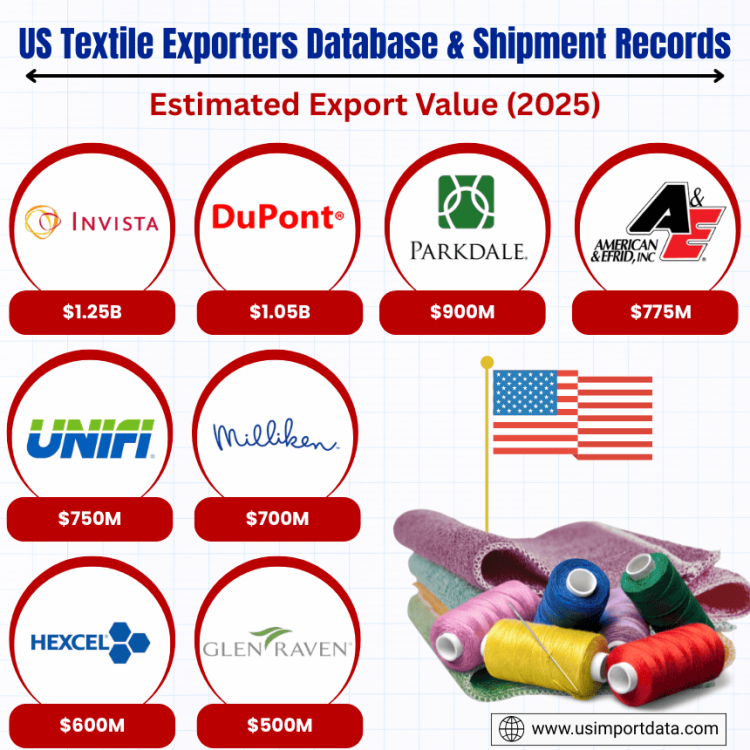
The US Textile Exporters Database & Shipment Records provide valuable insights into the top American Textile Manufacturers. This comprehensive resource offers a detailed overview of the textile industry, showcasing key players and their export activities. By utilizing this database, businesses can access essential data to make informed decisions and establish fruitful partnerships within the American textile market.
Businesses looking for sourcing options often rely on fabric suppliers USA and textile suppliers in USA, which include both small-scale units and the largest textile manufacturers in USA such as Milliken & Company, Unifi Inc., and Parkdale Mills . The country is home to diverse textile companies in USA, and a comprehensive list of textile companies in USA highlights key players involved in fiber production, spinning, weaving, and finishing. The leading textile manufacturers in the USA, as per the US textile suppliers & textile exporters database for 2025, include:
1. INVISTA (Koch Industries)
-
Estimated Export Value: $1.25B
-
Exports: Nylon (CORDURA), performance fibers
-
Top Markets: China, Vietnam, Mexico
2. DuPont (Textile Division)
-
Estimated Export Value: $1.05B
-
Exports: Kevlar, Nomex, advanced fibers
-
Top Markets: Europe, Middle East, Asia
3. Parkdale Mills
-
Estimated Export Value: $900M
-
Exports: Cotton yarns, blended yarns
-
Top Markets: Mexico, Central America
4. American & Efird (A&E)
-
Estimated Export Value: $775M
-
Exports: Industrial threads, yarns
-
Top Markets: Asia, Latin America, Europe
5. Unifi, Inc.
-
Estimated Export Value: $750M
-
Exports: Recycled polyester, synthetic yarns
-
Top Markets: Mexico, Central America
6. Milliken & Company
-
Estimated Export Value: $700M
-
Exports: Technical & industrial textiles
-
Top Markets: Canada, Mexico, Europe
7. Hexcel Corporation
-
Estimated Export Value: $600M
-
Exports: Carbon fiber, composites
-
Top Markets: Europe, aerospace hubs
8. Glen Raven, Inc.
-
Estimated Export Value: $500M
-
Exports: Outdoor & technical fabrics
-
Top Markets: Europe, Australia, Canada
9. Burlington Industries (ITG)
-
Estimated Export Value: $475M
-
Exports: Military fabrics, performance textiles
-
Top Markets: USMCA region, Middle East
10. Cone Denim (Elevate Textiles)
-
Estimated Export Value: $400M
-
Exports: Denim fabrics
-
Top Markets: Mexico, China, Bangladesh
American Textile Exports in the Last 10 Years: Yearly US Textile Export Data
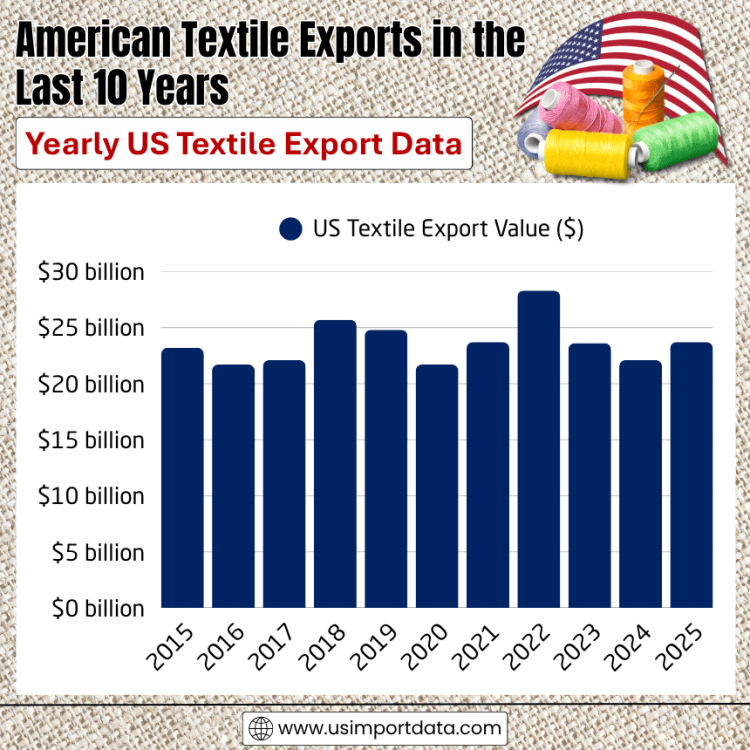
|
Year of Exports |
US Textile Export Value ($) |
|
2015 |
$23.2 billion |
|
2016 |
$21.7 billion |
|
2017 |
$22.1 billion |
|
2018 |
$25.7 billion |
|
2019 |
$24.8 billion |
|
2020 |
$21.7 billion |
|
2021 |
$23.7 billion |
|
2022 |
$28.3 billion |
|
2023 |
$23.6 billion |
|
2024 |
$22.1 billion |
|
2025 |
$23.7 billion |

Export Product Mix: What America Actually Sells
Unlike Asian exporters, the US does not focus heavily on low-cost apparel. Instead, exports are concentrated in:
1. Fibers and yarns
-
Cotton remains a major export category
-
The US is a leading global cotton supplier
2. Technical textiles
-
Automotive fabrics
-
Medical textiles
-
Protective and military fabrics
3. Industrial textiles
-
Geotextiles
-
Filtration materials
-
Composite fabrics
4. High-quality fabrics
-
Specialty woven and knitted materials
This shift toward value over volume is critical to understanding US export trends.
The American Textile Import-Export Paradox
One of the most striking aspects of the US textile sector is this:
-
The US exports $24–28 billion in textiles
-
But imports far more apparel and textile goods
For example:
-
US textile & apparel imports reached $77.88 billion in 2025
-
Imports grew 6.59% to $31.67 billion (Jan–May 2025)
Why this happens
The US plays a dual role:
|
Role |
Description |
|
Exporter |
Raw materials & high-value textiles |
|
Importer |
Finished garments & mass-market products |
This creates a structural trade imbalance, but also a strong global position in upstream production.
Major Trends in US Textile Exports (2025)
Trend 1: Shift Toward High-Value Textiles
US manufacturers are moving away from commodity products.
Instead, they focus on:
-
Smart textiles
-
Performance fabrics
-
Defense-related materials
This helps offset higher labor costs compared to Asia.
Trend 2: Nearshoring and Regional Supply Chains
The US-Mexico-Central America corridor is becoming stronger.
Benefits include:
-
Faster delivery
-
Lower trade risk
-
Reduced dependency on Asia
This trend is accelerating after supply chain disruptions in recent years.
Trend 3: Declining Export Volumes, Stable Value
Even when export volumes fall:
-
Prices and value remain relatively stable
-
Higher-value goods compensate for lower quantity
This reflects a premium positioning strategy.
Trend 4: Rising Global Competition
Asian countries continue to dominate:
-
China remains the largest global exporter
-
Vietnam and Bangladesh are gaining share
Meanwhile:
-
Asia accounts for 73% of US apparel imports in 2025
This puts pressure on US exporters, especially in mid-range products.
Trend 5: Impact of Tariffs and Trade Policies
Trade tensions are reshaping exports:
-
Tariffs have reduced export momentum
-
Some partners are diversifying away from US supply
At the same time:
-
Policy shifts aim to boost domestic production and exports
Trend 6: Sustainability and Compliance
Sustainability is no longer optional.
Export buyers increasingly demand:
-
Eco-friendly materials
-
Transparent supply chains
-
Ethical sourcing
US manufacturers are leveraging this as a competitive advantage.
Market Size and Industry Outlook
The broader US textile market is still growing:
-
Around $274+ billion market size in 2025
-
Expected steady growth in the coming decade
Growth drivers
-
Technical textiles
-
Defense and aerospace demand
-
Healthcare applications
-
Automation and innovation
Exports will likely:
-
Grow slowly
-
Shift further toward specialized products
Challenges Facing US Textile Exporters
Despite strengths, the industry faces real challenges.
1. Cost competitiveness
US production costs remain high compared to Asia.
2. Declining global demand cycles
Economic slowdowns affect textile consumption worldwide.
3. Supply chain disruptions
Shipping costs and exports remain unpredictable.
4. Talent and labor shortages
Manufacturing workforce gaps persist.
5. Export volatility
Year-to-year fluctuations make planning difficult.
Opportunities for Growth
There are still strong opportunities in 2025 and beyond.
1. Technical textile expansion
High-margin sectors are growing fast.
2. Reshoring and nearshoring
Brands want production closer to home.
3. Digital transformation
Automation improves efficiency and competitiveness.
4. Trade agreements
New deals could open export markets.
5. Data-driven sourcing
Buyers are relying more on verified supplier databases.
USA Textile Manufacturers Data: Why It Matters
This is where things get practical. A USA textile manufacturers database is no longer just a directory. It’s a business tool. The textile manufacturers in USA play a vital role in the global supply chain, with numerous USA textile manufacturers offering high-quality products through advanced production systems and innovation-driven processes.
In international trade, textile exports by country show that nations like China, India, and Vietnam remain dominant, ranking among the top exporters of textiles and biggest textile exporters, while textile exporters in USA continue to supply major markets like Mexico and Canada . Overall, whether you are searching for reliable sourcing partners or analyzing global trade, the US remains a significant hub for textile production and exports.
What it typically includes
-
Company name and location
-
Product specialization (yarn, fabric, technical textiles)
-
Production capacity
-
Certifications (ISO, sustainability, etc.)
-
Export markets
Why businesses use it
1. Supplier sourcing
Brands use databases to find reliable US suppliers.
2. B2B lead generation
Manufacturers use it to connect with buyers.
3. Market research
Helps identify trends, clusters, and competitors.
4. Supply chain diversification
Companies reduce reliance on single regions.
Who benefits most
-
Apparel brands
-
Import/export companies
-
Sourcing agents
-
Investors
-
Government trade bodies
Key US Textile Manufacturing Hubs
The US textile industry is geographically concentrated.
Major regions
1. Southeast (North Carolina, South Carolina, Georgia)
-
Largest textile manufacturing cluster
-
Strong in yarn and fabric production
2. California
-
Focus on fashion and innovation
3. Texas
-
Cotton production and industrial textiles
4. Midwest
-
Technical and industrial applications
These clusters are essential for both exports and domestic supply chains.
The Role of Data in Textile Trade
Data is becoming central to textile exports.
Companies now rely on:
-
Trade databases
-
Import-export analytics
-
Supplier intelligence platforms
This allows them to:
-
Identify demand shifts
-
Track competitor activity
-
Optimize pricing strategies
In short, data is now a competitive advantage.
Future Outlook: US Textile Exports Beyond 2025
Looking ahead, the direction is clear.
What will likely happen
-
Export growth will remain moderate
-
High-value textiles will dominate
-
Regional trade will strengthen
-
Automation will reshape manufacturing
What will not change
-
The US will remain a key global textile supplier
-
Imports will continue to exceed exports
Conclusion and Final Thoughts
In conclusion, the US textile export story in 2025 is not about volume. It is about positioning.
-
American textile Exports are stabilizing around $24–28 billion.
-
The industry is shifting toward high-value, specialized textiles.
-
Regional trade and nearshoring are reshaping supply chains.
-
Global competition remains intense.
At the same time, tools like a USA textile manufacturers database are becoming essential for navigating this complex landscape.
For businesses, the takeaway is simple:
-
Competing on cost alone will not work
-
Data, specialization, and supply chain strategy will define success
The US textile industry is evolving. Those who understand the data behind it will be the ones who benefit the most.
Note For Our Readers
We hope you found this blog report on US Textile Exports Data 2025 useful and informative. If you’re looking for deeper insights or need customized US import-export data and US textile exports by country, company, or shipment level, feel free to connect with USimportdata.
We provide detailed and up-to-date USA textile exporters and manufacturers databases, including buyer details, shipment records, product-wise export data, and sourcing trends to support your business decisions. For exclusive access or customized data solutions, reach out to us at info@tradeimex.in today.
What's Your Reaction?