US Milk Exports Driving the Dairy Trade & Largest Exporter of Milk in USA
Explore how US milk exports are driving the dairy trade, the top milk exporters in USA, key export markets, & why America is becoming a major global dairy supplier.
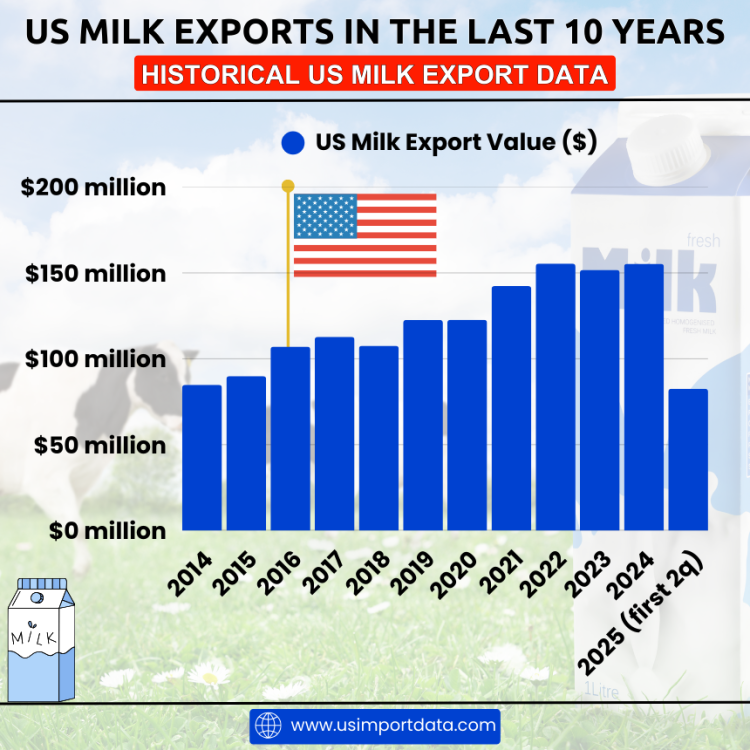
The United States dairy sector is in the middle of one of the most important trade shifts in its history. For decades, American dairy products were consumed mostly within the country. By 2024, this picture had changed. Nearly one-fifth of all US milk produced now leaves the country in the form of cheese, powders, whey, butterfat, lactose, and dozens of processed dairy ingredients. According to the latest US export data and milk export data of the USA, the total value of US milk exports reached $155.30 million in 2024, a 2% increase from the previous year. According to the US milk export data, the US exported milk worth $82.6 million in the first two quarters of 2025.
The total value of US dairy exports accounted for $8.20 billion in 2024 and $3.87 billion in the first two quarters of 2025, making it the second-highest export year the US dairy industry has ever recorded, as per the dairy products export data of USA. The US is the 20th largest exporter of milk and the 5th largest exporter of dairy products worldwide, as per the global trade data. This shift does not come from chance. It reflects structural changes in global food demand, strong processing capacity in the US, and rapid international growth in protein-rich and value-added dairy products. The result is a powerful mix: America has become one of the most influential players in the global dairy trade.
This blog breaks down the data behind that US milk export growth, identifies the largest milk exporters within the United States, examines what drove the increase in exports during 2024–25, and explores the strengths and risks that will define the next phase of US dairy trade.
How Much Dairy Does the US Export?
In 2024, the United States exported dairy products worth about 8.2 billion dollars, as per the US dairy products export report. That figure reflects an increase of about 223 million dollars over 2023. Export volumes in milk-solids-equivalent (MSE) terms dipped slightly, but the total value rose because of stronger performance in high-value products. The dairy export landscape has evolved rapidly, with US dairy exports becoming a major force in global markets. A significant share of US dairy exports to Canada continues to grow each year, raising questions like how much dairy does the US export to Canada, especially as demand strengthens across borders. While the US is not the biggest dairy exporters in the world, it remains highly competitive in milk powder export and other value-added categories.
According to US dairy exports by country data, the U.S. ranks among the most reliable milk exporters, though it is not the largest exporter of milk globally. Still, US milk exports play an important role in supporting global supply chains, guided in part by the US Dairy Export Council. For many wondering does the US export milk, the answer is yes, both in fluid form to nearby markets and in processed dairy products worldwide.
Approximately 18 percent of all US milk produced in 2024 did not stay in the domestic market. It was processed into cheese, whey, butterfat, lactose, powders, and other products and shipped internationally. That share has tripled over the past two decades. The growth is not uniform across all categories. Some products are rising sharply, while others face pressure from global competition.
US Milk Exports by Country: Where Does the US Export Milk?
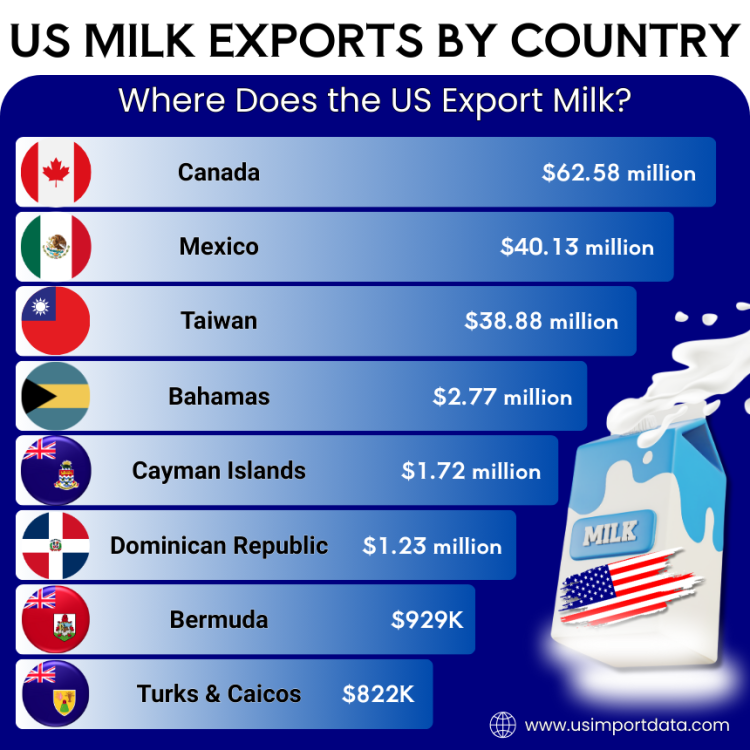
Milk is a staple in the American diet, and the US is not only a major consumer of dairy products but also a significant exporter of milk to countries around the world. US milk exports hold significant value in the global dairy market, and the United States has been actively exporting milk to various countries worldwide. Some of the top destinations for US milk exports include Mexico, Canada, and Taiwan.
These countries have consistently shown a demand for high-quality dairy products from the United States, making them key players in the US export market. The top 10 countries where the US exports milk, as per the US milk exports by country & US shipment data for 2024-25, include:
1. Canada: $62.58 million (40.3%)
Our neighbors to the north are the largest importers of US milk, with over $62 million worth of milk exported to Canada. The proximity and strong trade relationship between the two countries make Canada a natural market for US dairy products.
2. Mexico: $40.13 million (25.8%)
Mexico comes in second as a top importer of US milk, with over $40 million worth of milk making its way south of the border. The demand for dairy products in Mexico continues to grow, providing a lucrative market for US milk exporters.
3. Taiwan: $38.88 million (25%)
Taiwan is a major player in the US milk export market, with close to $39 million worth of milk being shipped to the island nation, as per the data on US milk exports to Taiwan by HS code. The high quality and safety standards of US dairy products make them highly sought after in Taiwan.
4. Bahamas: $2.77 million (1.8%)
Even tropical destinations like the Bahamas are consumers of US milk, with nearly $3 million worth of milk being exported to the island nation. The demand for dairy products in tourist destinations like the Bahamas provides an opportunity for US milk exporters.
5. Cayman Islands: $1.72 million (1.1%)
The Cayman Islands may be small in size, but they still import over $1.7 million worth of US milk. The popularity of US dairy products among locals and tourists alike contributes to the demand for milk in this Caribbean paradise.
6. Dominican Republic: $1.23 million (0.8%)
The Dominican Republic is another important market for US milk exporters, with over $1.2 million worth of milk being shipped to the island nation, as per the data on US milk exports to the Dominican Republic. The demand for dairy products in the Dominican Republic provides a lucrative opportunity for US dairy farmers.
7. Bermuda: $929K (0.6%)
Even the idyllic island of Bermuda imports US milk, with close to $1 million worth of milk being shipped to the island. The demand for high-quality dairy products in Bermuda creates a market for US milk exporters.
8. Turks and Caicos Islands: $822K (0.5%)
The Turks and Caicos Islands may be a popular tourist destination, but they also import US milk, with over $800,000 worth of milk being exported to the islands. The demand for dairy products among locals and tourists alike contributes to the market for US milk in this region.
9. Philippines: $782K (0.5%)
The Philippines is a major consumer of US milk, with close to $800,000 worth of milk being shipped to the Southeast Asian nation. The demand for dairy products in the Philippines provides an opportunity for US milk exporters to tap into this growing market.
10. Hong Kong: $514K (0.3%)
Last but not least, Hong Kong is a market for US milk exports, with over $500,000 worth of milk being shipped to this bustling city. The demand for high-quality dairy products in Hong Kong creates an opportunity for US milk exporters to reach consumers in this vibrant market.
Top Milk Exporters in the USA: US Milk Exporters Database
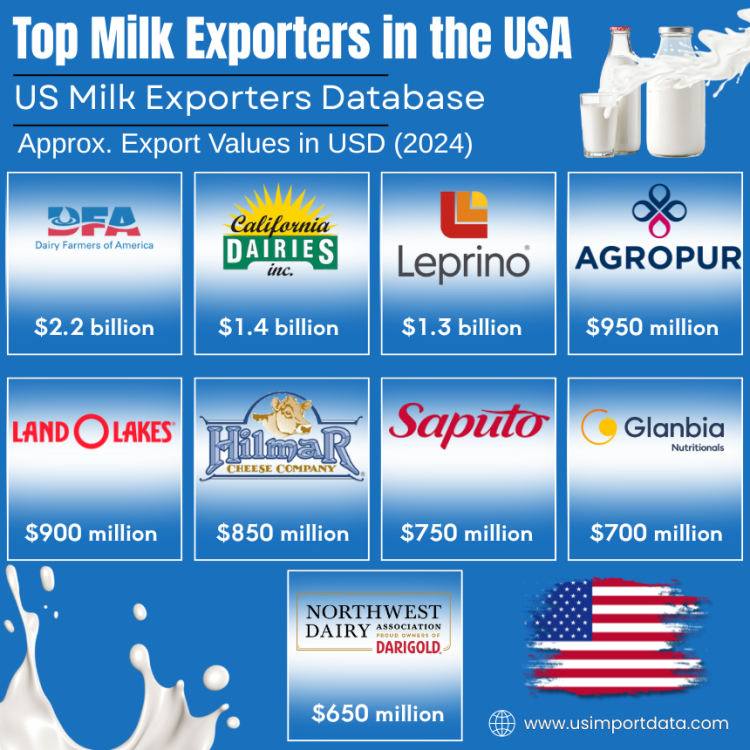
The US Milk Exporters Database provides a comprehensive list of the leading milk exporters and suppliers in the United States. This database is a valuable resource for businesses looking to source high-quality milk products from reputable suppliers. Dairy Farmers of America (DFA) is the largest exporter of Milk in USA. The leading milk exporters in the USA, as per the US milk suppliers list & exporters data for 2024-25, include:
|
Rank |
Company |
Approx. Export Value 2024 (USD) |
Top Export Markets |
|
1 |
$2.2 billion |
Mexico, Canada, Southeast Asia, the Middle East |
|
|
2 |
California Dairies Inc. (CDI) |
$1.4 billion |
Southeast Asia, the Middle East, Mexico, and China |
|
3 |
Leprino Foods |
$1.3 billion |
Mexico, Japan, South Korea, Middle East, & Latin America |
|
4 |
Agropur USA |
$950 million |
Mexico, Southeast Asia, Canada, South America |
|
5 |
Land O’Lakes |
$900 million |
Southeast Asia, Mexico, the Middle East, and Africa |
|
6 |
Hilmar Cheese Company |
$850 million |
China, Southeast Asia, Japan, Mexico |
|
7 |
Saputo USA** (major presence after mergers)** |
$750 million |
Mexico, Middle East, Japan, and Latin America |
|
8 |
Glanbia Nutritionals USA |
$700 million |
Southeast Asia, EU, and the Middle East |
|
9 |
Northwest Dairy Association / Darigold |
$650 million |
Southeast Asia, the Middle East, and Mexico |
|
10 |
Foremost Farms USA |
$400 million |
Southeast Asia, Mexico, Central America |
US Milk Exports in the Last 10 Years: Historical US Milk Export Data
|
Year of Exports |
US Milk Export Value ($) |
|
2014 |
$84.81 million |
|
2015 |
$89.97 million |
|
2016 |
$107 million |
|
2017 |
$112.80 million |
|
2018 |
$107.57 million |
|
2019 |
$122.60 million |
|
2020 |
$122.73 million |
|
2021 |
$142.31 million |
|
2022 |
$155.38 million |
|
2023 |
$151.73 million |
|
2024 |
$155.30 million |
|
2025 (first 2 quarters) |
$82.6 million |
The Scale of US Milk Production
American dairy farms produce more than 220 billion pounds of milk every year. This makes the United States one of the top producers globally. The milk is mainly consumed domestically, but a growing share of it supports the export pipeline. In 2024, close to one-fifth of US milk production was tied to foreign demand in one form or another. This is a major shift from earlier decades, when exports were a niche activity.
A few factors make large-scale milk production possible. Herd productivity continues to rise. Feed efficiency has improved through better genetics and nutrition management. Barn automation and milking technology reduce labor strain and improve consistency. These advantages create a steady, high-quality milk supply that can be processed into shelf-stable products with long shipping life or moved quickly into nearby foreign markets as fluid milk.
A Detailed Breakdown of US Dairy Exports by Product Category
The US does not export large quantities of fluid milk. Instead, most exports are processed dairy products. This gives the industry reliable margins and helps meet diverse global needs.
1. Cheese
Cheese became the star of the US dairy trade in 2024. Exports reached over 508,000 metric tons. This was a 17 percent rise compared to 2023 and the first time the US crossed the half-million-ton level. Nations in Latin America, Asia, and the Middle East increased their demand for American cheese products for use in food service, retail, and manufacturing.
2. Nonfat Dry Milk and Skim Milk Powder
This category has traditionally been one of the pillars of US dairy exports. In 2024, however, NFDM and SMP shipments dropped by about 8 percent. Slower demand from some Asian buyers and stronger competition from Oceania contributed to this decline.
Despite this dip, NFDM and SMP remain essential parts of US exports. These powders are used extensively in food manufacturing, infant nutrition, bakery products, and beverage mixes.
3. Whey Products and Dairy Protein Ingredients
Whey and whey-protein concentrates, including both low and high protein content derivatives, remain valuable export products. They are used in sports nutrition, bakery goods, medical nutrition, and animal feed. Demand for whey fluctuates more than cheese, but interest remains steady, especially from manufacturers who rely on US consistency and quality.
4. Butter and Butterfat
Butterfat exports saw improvement in 2024 after a period of supply tightness. As global baking, confectionery, and food-processing demand continues to rise, US butter and anhydrous milkfat are gaining market traction.
5. Lactose
Lactose exports remain stable and strong. Lactose is a key ingredient in infant formula and pharmaceutical processing. Because of its specialized use, lactose is less vulnerable to global market swings.
The Top Global Markets for American Milk-Based Products
Although US dairy is shipped to more than 145 countries, a few markets dominate the bulk of trade.
1. Mexico
Mexico is the number one buyer of US dairy products. Imports from the US crossed roughly 2.47 billion dollars in 2024. Mexico buys large quantities of cheese, whey, and milk powder and relies heavily on US supply due to both proximity and long-term trade links.
2. Canada
Canada remains the second largest market with imports of around 1.14 billion dollars. Even with a managed dairy sector and import restrictions, Canada remains a major buyer of US cheese, fluid milk used for processing, and specialty ingredients.
Other Significant Markets
Beyond North America, the US has strong and growing export relationships with:
-
Central America
-
South America
-
Southeast Asia
-
The Middle East
-
China (mainly for whey and lactose)
-
Japan and South Korea (high-value cheese and whey ingredients)
This broad market spread helps reduce risk. When one region softens its demand, others often compensate.
Which Companies Drive America’s Dairy Trade?
Several major dairy cooperatives and corporations lead US exports. They manage large-scale production, processing, packaging, and global shipments. While exact rankings shift each year based on product type and commodity conditions, the biggest players in 2024–25 include:
1. Dairy Farmers of America (DFA)
DFA is the largest dairy cooperative in the United States. It handles a massive share of the milk produced across the country and exports significant volumes of cheese, milk powder, butter, whey, and ingredients.
2. California Dairies Inc. (CDI)
California Dairies Inc. is a major exporter of milk powders and butter. With California’s large milk output and strong processing base, CDI ships significant quantities of dairy to Asia and the Middle East.
3. Leprino Foods
Leprino is one of the world’s leading mozzarella producers. It exports cheese and dairy ingredients to major global food manufacturers.
4. Land O’Lakes
Land O’Lakes is a major exporter of powdered milk, butterfat, and value-added dairy ingredients. It has strong trade networks throughout Asia and Latin America.
5. Agropur (USA operations)
The US division of Canadian cooperative Agropur processes high volumes of cheese and whey ingredients in the American Midwest. Much of this output ends up in export markets.
6. Hilmar Cheese Company
Hilmar is known globally for whey-protein products and high-quality cheese. It plays a major role in supplying protein ingredients to food and supplement manufacturers worldwide.
These companies provide the scale, infrastructure, and export know-how that allow the United States to ship dairy products consistently and competitively.
Why US Dairy Exports Are Growing
The increase in US dairy exports is not accidental. It comes from several long-term advantages.
1. High Efficiency in Milk Production
American dairy farms have consolidated over the past decades. The number of farms has fallen, but the average size has grown. Automation, advanced genetics, feed optimization, and technology allow US farms to produce large quantities of milk efficiently and consistently.
2. Massive Processing Capacity
The US has invested more than 8 billion dollars in new processing infrastructure in recent years. This includes cheese plants, whey-protein processing units, milk powder facilities, cold-chain improvements, and export-ready packaging systems. The result is the ability to convert raw milk into a wide variety of exportable products.
3. Product Diversification
The US does not rely on a single export product. Instead, it exports:
-
cheese
-
NFDM and SMP
-
whey products
-
butterfat
-
lactose
-
caseinates and dairy protein ingredients
-
specialized formulations for food manufacturing
This wide product mix shields the industry from market volatility.
4. Strong Global Supply Networks
Decades of trade relationships give US dairy firms a stable customer base across continents. This scale and reliability make the United States a trusted supplier.
5. Alignment with Global Trends
Consumers worldwide are shifting toward:
-
Higher protein consumption
-
More cheese in restaurant and retail markets
-
Greater use of whey in sports and medical nutrition
-
More processed foods require dairy ingredients
The US product portfolio fits these trends.
Key Challenges for US Milk & Dairy Exports
Even with strong exports, several headwinds remain.
Declining Milk Powder Demand
NFDM and SMP exports fell by about 8 percent in 2024. This matters because powder demand historically served as the core of the US dairy trade. Asian markets have become more competitive and sometimes prefer suppliers from Oceania.
Global Competition
The European Union and Oceania exporters remain strong. Price competition can limit US gains in sensitive markets.
Regulatory Pressures
Different countries maintain strict regulations on dairy imports. Any changes in these rules can disrupt shipments or increase costs.
Domestic Factors
US dairy faces pressure from:
-
rising feed and energy costs
-
labor shortages
-
environmental regulations
-
changing consumer preferences within the country
Supply Chain Volatility
Shipping costs, port congestion, and global trade issues can affect competitiveness and delivery times.
The US as a Critical Supplier to World Food Systems
The role of US dairy goes beyond trade values.
Backstop Supplier
When weather events or disease outbreaks hit other exporting nations, global buyers turn to US suppliers because of their scale and reliability.
Support for Global Food Manufacturing
Lactose, whey proteins, milk powders, and specialty ingredients made in the United States are used by infant formula producers, bakery manufacturers, confectioners, beverage companies, and pharmaceutical firms around the world.
Contribution to Nutrition and Food Security
Many countries rely partly on imported dairy to meet protein and nutritional needs. US exports help fill gaps in domestic production.
Stability for US Farmers
Exports provide a buffer for milk producers during periods of low domestic demand. This helps sustain farms and rural economies.
What to Expect in 2025–26
Several forces will influence the trajectory of US dairy exports.
Continued Rise of Cheese
Global cheese demand is rising faster than demand for milk powders. As long as US processors keep expanding capacity, cheese exports will likely continue to hit new highs.
Growth in Whey and Protein Ingredients
Sports nutrition, medical nutrition, and protein beverages are expanding markets worldwide. US whey and protein ingredients remain well-positioned.
Strong Demand in Latin America
Mexico, Central America, and South America will likely remain the most stable and fastest-growing markets for US dairy.
Market Diversification
Efforts to increase exports to Africa, Southeast Asia, and the Middle East will help reduce dependence on any single region.
Higher Value Products
The future of US dairy exports lies in higher-value, processed, and functional ingredients rather than commodity powders.
Final Outlook for US Milk Exports & Dairy Trade
The US dairy export sector closed 2024–25 with solid momentum. Record cheese exports, strong whey shipments, stable lactose demand, and the growth of higher-value products show that the United States has moved past the era of relying mainly on commodity milk powders.
Challenges exist, particularly in global competition and powder markets, yet the long-term fundamentals remain powerful. With efficient farms, world-class processing, wide product diversification, and access to global markets, the United States is well-positioned to remain a key supplier for global dairy demand.
Conclusion: The Role of US Milk Exports in American Dairy Trade
In conclusion, the U.S. fluid milk exports represent the closest and most visible link between American farms and foreign consumers. Though the volumes are small, they carry weight in trade relationships and supply reliability. Milk-equivalent exports, on the other hand, represent the real scale of US dairy influence. Almost one-fifth of US milk production now supports the international market. This makes the United States one of the world’s largest dairy suppliers and a critical part of global food systems.
The combination of strong production, diverse processing, and broad market reach ensures that US milk will remain a central part of global dairy trade. Whether it is shipped as fresh liquid milk across borders or converted into cheese, powders, whey, and butterfat that travel across oceans, the United States has positioned itself as a dependable and influential supplier. The outlook for 2025–26 suggests continued strength in both fluid and milk-equivalent exports, supported by stable demand, high-quality standards, and the flexibility of American dairy processors.
We hope that you liked our interactive blog report on how the US milk exports are driving the dairy trade in America. For more information on the latest US import-export data, or to search live data on US milk exports by country, visit USImportdata. Contact us at info@tradeimex.in for customized trade reports, market insights, & a verified database of the top milk exporters & suppliers in the USA, tailored to your business needs.
What's Your Reaction?