US Cement Imports Data 2025: Exploring the US Cement Industry & the Largest Cement Importers in USA
Explore US Cement Imports Data 2025 with insights into the US cement industry, the largest cement importers in USA, import values, & key market statistics.
The US cement industry entered 2025 in a period of transition. Rising demand from infrastructure projects, commercial construction, and public works remained relatively strong, but residential construction activity slowed in several regions due to elevated financing costs and tighter real estate conditions. At the same time, imports continued to play a critical role in balancing supply gaps across the country. According to the latest US import data and cement import data of the USA, the total value of US cement imports reached $2.33 billion in 2025, a 4% decline from the previous year. The US imported cement worth $480.27 million in the first quarter of 2026, as per the US cement import data under the HS code 2523. The US cement imports totaled 25.38 million tons in 2025 and 5.23 million tons in the first quarter of 2026.
The USA is the largest importer of cement in the world, according to global trade data. Over 20% of the USA's cement is currently imported, with the Houston/Galveston region accounting for the majority of imports due to rising domestic demand. For distributors, construction firms, cement traders, & infrastructure planners, understanding US cement imports data in 2025 offers valuable insight into supply chain trends, pricing pressure, trade dependencies, and the future direction of the American construction materials market. In this article, we will delve into the American cement industry, the trends in US cement imports, and the largest cement importers in the USA, with the latest database for 2025-2026.
Overview of the US Cement Industry in 2025
The United States remains one of the world’s largest consumers of cement. Cement demand is closely tied to highway construction, commercial real estate, manufacturing facilities, housing projects, and government infrastructure spending. Data released through the US Geological Survey (USGS) and industry reports show that cement imports remained historically high throughout 2025, with imports accounting for roughly one-fifth to one-quarter of total US cement consumption. Turkey, Vietnam, and Canada emerged as the dominant foreign suppliers, while Gulf Coast and coastal terminals handled the majority of incoming shipments.
According to industry data, total US shipments of Portland and blended cement reached approximately 101 million metric tons in 2025, slightly lower than 2024 levels. Despite softer overall shipments, imports increased during the year, highlighting the ongoing structural reliance on foreign cement supplies.
Several factors shaped the US cement market in 2025:
-
Continued federal infrastructure investment under long-term transportation and public works programs
-
High demand from industrial manufacturing projects and data center construction
-
Slower residential construction in certain regions due to elevated interest rates
-
Limited domestic clinker production growth
-
Increasing environmental pressure on cement manufacturing operations
-
Growing reliance on imported cement to support coastal and high-growth states
The US cement market remains geographically fragmented. States such as Texas, California, Florida, Arizona, and Georgia consume enormous quantities of cement due to population growth and infrastructure expansion. However, not all of these states have enough local production capacity to meet demand efficiently.
As a result, imported cement has become essential to maintaining supply stability, especially in coastal regions where imported material can often be landed more economically than transporting domestic cement over long distances.
US Cement Imports by Country: Where Does the US Import Cement From?
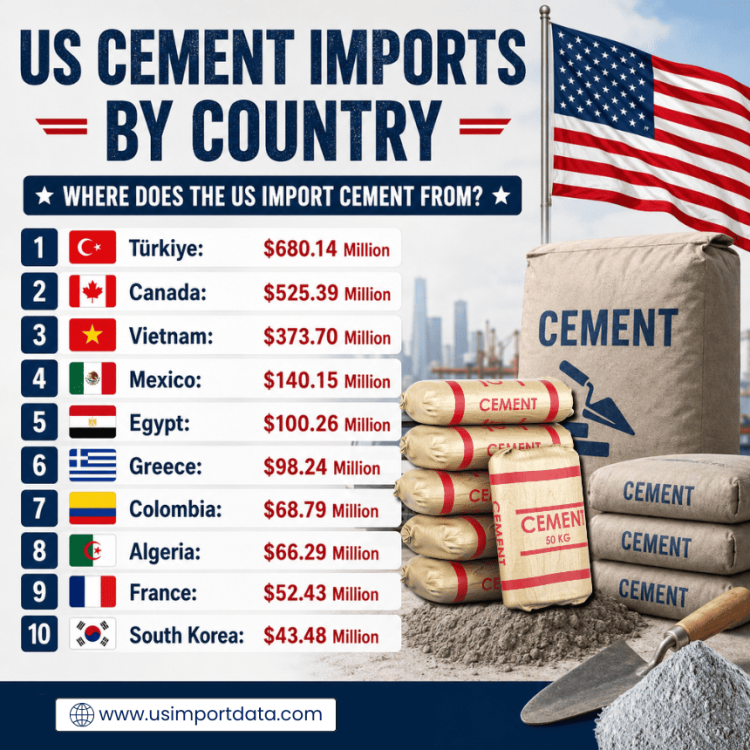
Cement is a crucial building material used in various construction projects across the United States. US cement imports by country reveal the diverse sources of US cement, highlighting the interconnected nature of the global economy. Some of the prominent countries from which the US imports cement include Türkiye, Canada, Vietnam, and Mexico.
These imports play a crucial role in meeting the demands of construction projects nationwide and in maintaining a steady supply chain for the cement industry. The United States sourced cement imports from more than 30 countries during 2025, but a small number of exporters dominated the market. The top 10 cement supplier countries to the US, as per the US cement shipment data for 2025, include:
1. Türkiye: $680.14 million (29.1%)
Türkiye, also known as Turkey, is the leading supplier of cement to the United States, accounting for 29.1% of total cement imports. Turkey has a robust cement industry and produces high-quality cement that meets US construction standards. The US imports a substantial amount of cement from Turkey to support its construction projects.
2. Canada: $525.39 million (22.5%)
Canada is another significant source of cement for the United States, accounting for 22.5% of total cement imports. The proximity of Canada to the US makes it a convenient and cost-effective source of cement. Canadian cement is known for its quality and reliability, making it a popular choice among US construction companies.
3. Vietnam: $373.70 million (16%)
Vietnam is emerging as a major player in the global cement market, with the United States being one of its primary customers. Vietnam's cement industry has seen rapid growth in recent years, leading to an increase in cement exports to the US. Vietnamese cement is competitively priced and meets US quality standards, making it an attractive option for US buyers.
4. Mexico: $140.15 million (6%)
Mexico is a significant supplier of cement to the United States, accounting for 6% of total cement imports. Mexico's proximity to the US and well-established cement industry make it a natural choice for US importers. Mexican cement is known for its affordability and versatility, making it a popular option for a wide range of construction projects in the US.
5. Egypt: $100.26 million (4.3%)
Egypt is a growing exporter of cement to the United States, supplying 4.3% of total cement imports. Egyptian cement is prized for its high quality and durability, making it a preferred choice for infrastructure projects in the US. Egypt's cement industry has seen significant investment in recent years, leading to an increase in cement exports to the US.
6. Greece: $98.24 million (4.2%)
Greece is a relatively small but important supplier of cement to the United States, accounting for 4.2% of total cement imports. Greek cement is known for its strength and longevity, making it a popular choice for construction projects that require durable materials. Despite its smaller size, Greece plays a significant role in meeting the US demand for cement.
7. Colombia: $68.79 million (2.9%)
Colombia is another key supplier of cement to the United States, supplying 2.9% of total cement imports. Colombian cement is valued for its high quality and affordability, making it an attractive option for US construction companies. Colombia's cement industry is known for its innovation and sustainability, further driving its popularity among US buyers.
8. Algeria: $66.29 million (2.8%)
Algeria is a growing exporter of cement to the United States, accounting for 2.8% of total cement imports. Algerian cement is known for its consistency and performance, making it a reliable choice for construction projects in the US. Algeria's cement industry is expanding rapidly, leading to an increase in cement exports to the US.
9. France: $52.43 million (2.2%)
France is a notable supplier of cement to the United States, supplying 2.2% of total cement imports, as per the data on US cement imports from France by HS code. French cement is renowned for its high quality and environmentally friendly production practices, making it a preferred choice for sustainable construction projects in the US. France's cement industry is highly regarded for its innovation and technology, driving its popularity among US importers.
10. South Korea: $43.48 million (1.9%)
South Korea is a minor but important supplier of cement to the United States, accounting for 1.9% of total cement imports. South Korean cement is known for its cutting-edge technology & advanced manufacturing processes, making it a sought-after option for high-tech construction projects in the US. Despite its smaller market share, South Korea plays a significant role in meeting the US demand for specialized cement products.
US Cement Importers Database: Top Cement Buyers in USA with Shipment Records
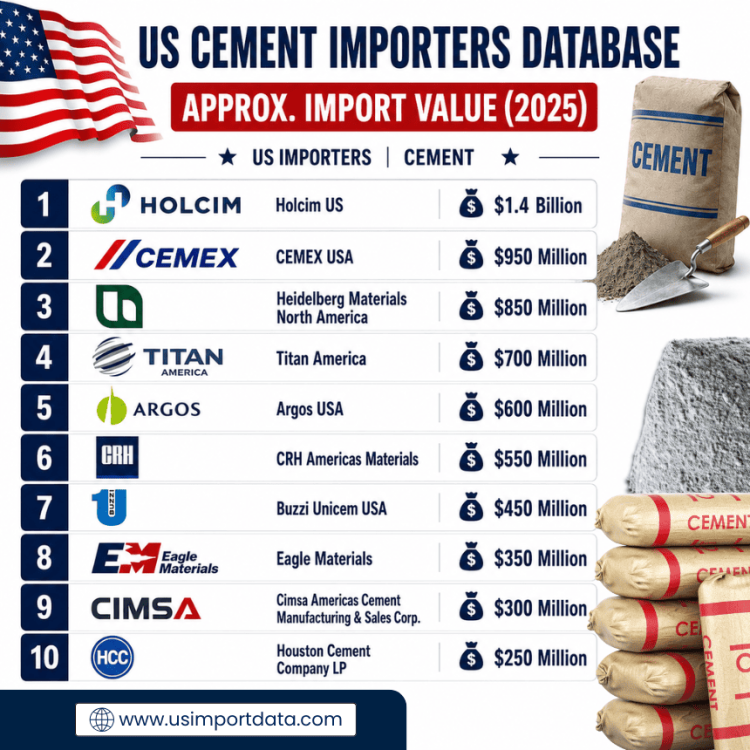
The US Cement Importers Database provides valuable insights into the top cement buyers in the USA, along with their shipment records. This resource is essential for businesses looking to target key players in the American cement import industry. The leading cement buyers & importers in the USA, as per the US cement importers data for 2025, include:
1. Holcim US
-
Approx. Import Value (2025): $1.4 Billion
-
Top Import Types: Portland Cement, Blended Cement, Clinker
-
Top Import Sources: Turkey, Canada
2. CEMEX USA
-
Approx. Import Value (2025): $950 Million
-
Top Import Types: Portland Cement Type I/II, Clinker
-
Top Import Sources: Mexico, Turkey
3. Heidelberg Materials North America
-
Approx. Import Value (2025): $850 Million
-
Top Import Types: Clinker, Blended Cement
-
Top Import Sources: Canada, Greece
4. Titan America
-
Approx. Import Value (2025): $700 Million
-
Top Import Types: Bulk Cement, Masonry Cement
-
Top Import Sources: Turkey, Greece
5. Argos USA
-
Approx. Import Value (2025): $600 Million
-
Top Import Types: Portland Cement, Clinker
-
Top Import Sources: Colombia, Turkey
6. CRH Americas Materials
-
Approx. Import Value (2025): $550 Million
-
Top Import Types: Blended Cement, Clinker
-
Top Import Sources: Canada, Vietnam
7. Buzzi Unicem USA
-
Approx. Import Value (2025): $450 Million
-
Top Import Types: Portland Cement, White Cement
-
Top Import Sources: Turkey, Italy
8. Eagle Materials
-
Approx. Import Value (2025): $350 Million
-
Top Import Types: Clinker, Portland Cement
-
Top Import Sources: Vietnam, Mexico
9. Cimsa Americas Cement Manufacturing & Sales Corp.
-
Approx. Import Value (2025): $300 Million
-
Top Import Types: White Cement, Gray Cement
-
Top Import Source: Turkey
10. Houston Cement Company LP
-
Approx. Import Value (2025): $250 Million
-
Top Import Types: Bulk Portland Cement
-
Top Import Sources: Turkey, Vietnam
US Cement Imports Data 2025: How Much Cement Does the US Import?
US cement and clinker imports remained elevated during 2025. According to the latest data, total cement and clinker imports reached around 25.4 million metric tons in 2025, up slightly from 2024. Imports represented roughly 24% of total USA cement shipments during the year. The import trend confirms a long-term structural shift in the US cement industry, according to the American Cement Association.
Domestic production capacity has not expanded quickly enough to fully match rising demand from infrastructure and commercial construction projects. Industry analysts note that imports now supply more than one-fifth of total US cement consumption, significantly above post-financial-crisis lows seen in the early 2010s.
Key 2025 Cement Import Figures
|
Metric |
2025 Data |
|
Total US cement & clinker imports |
25.4 million metric tons |
|
Share of US cement consumption from imports |
24% |
|
Largest supplier country |
Turkey |
|
Major import terminals |
Houston/Galveston, San Francisco, New Orleans, New York, Tampa |
|
Top cement-consuming state |
Texas |
|
Major import growth regions |
Gulf Coast and Southeast US |
Imports fluctuated throughout the year based on construction activity and regional inventory needs.
For example:
-
June 2025 imports reached approximately 2.61 million metric tons, up 11% year-over-year.
-
September 2025 imports totaled roughly 2.34 million metric tons, up 9% year-over-year.
-
Full-year imports ultimately exceeded 25 million metric tons.
These figures demonstrate that import dependency remains deeply embedded in the US cement supply chain.
US Cement Import Data in The Last 10 Years
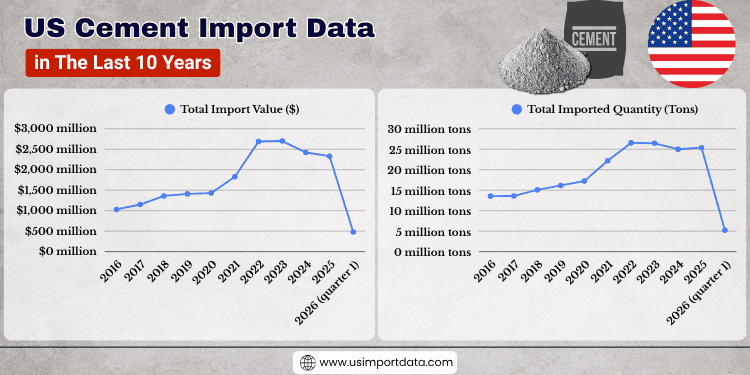
|
Year of Imports |
Total Import Value ($) |
Total Imported Quantity (Tons) |
|
2016 |
$1.03 billion |
13.54 million tons |
|
2017 |
$1.15 billion |
13.59 million tons |
|
2018 |
$1.36 billion |
15.08 million tons |
|
2019 |
$1.41 billion |
16.16 million tons |
|
2020 |
$1.43 billion |
17.22 million tons |
|
2021 |
$1.83 billion |
22.20 million tons |
|
2022 |
$2.69 billion |
26.56 million tons |
|
2023 |
$2.70 billion |
26.45 million tons |
|
2024 |
$2.42 billion |
25.01 million tons |
|
2025 |
$2.33 billion |
25.38 million tons |
|
2026 (quarter 1) |
$480.27 million |
5.23 million tons |

Why the United States Imports So Much Cement
Many people assume the United States can fully meet domestic cement demand internally. In reality, the economics of cement manufacturing and transportation make imports highly competitive. Several structural factors explain why the US continues to import large volumes of cement.
1. Regional Supply Imbalances
Cement production facilities are unevenly distributed across the country. Some fast-growing regions consume far more cement than nearby plants can economically supply. Texas, Florida, California, and the Gulf Coast states consistently require supplemental imported material to satisfy infrastructure and commercial demand.
2. High Transportation Costs
Cement is a relatively low-value but heavy commodity. Shipping cement over long distances by truck or rail inside the United States can become expensive quickly. For coastal markets, importing cement by sea from Turkey, Vietnam, or Greece is often more economical than transporting domestic cement from inland plants.
3. Environmental and Regulatory Constraints
Building new clinker plants in the United States is increasingly difficult because of environmental permitting, emissions regulation, & high capital costs. Cement production is one of the most carbon-intensive industrial processes globally. Environmental scrutiny surrounding carbon emissions continues to rise. Industry discussions around carbon capture and low-carbon cement intensified during 2025 as manufacturers explored decarbonization investments.
4. Infrastructure Spending Boom
Federal infrastructure investment continues to support demand for cement-intensive projects, such as:
-
Highways
-
Bridges
-
Airports
-
Ports
-
Manufacturing facilities
-
Energy infrastructure
-
Data centers
Large-scale industrial reshoring initiatives also boosted demand for construction materials.
Largest US Cement Import Hubs and Ports
Imported cement enters the United States through a network of specialized terminals and customs districts. According to industry reports, the Houston/Galveston customs district handled more than 20% of US cement imports in 2025, making it the country’s largest cement import gateway.
Other major import hubs included:
-
San Francisco
-
New Orleans
-
New York City
-
Tampa
-
Los Angeles/Long Beach
-
Seattle/Tacoma
These coastal terminals are strategically important because cement can be unloaded directly into storage silos and distributed regionally. The Gulf Coast has become especially critical due to Texas’s enormous infrastructure and commercial construction demand.
Major Players in the US Cement Industry
The US cement industry includes both domestic manufacturers and multinational building materials companies. Some of the largest cement producers operating in the United States, or the largest cement companies in the US, include:
-
Heidelberg Materials
-
Holcim
-
CEMEX
-
Eagle Materials
-
Buzzi Unicem USA
-
CRH
-
Titan America
-
Argos USA
Several major international companies expanded investment plans in the US market during 2025. For example, Heidelberg Materials emphasized continued growth opportunities tied to infrastructure investment and industrial expansion in the United States. Holcim also highlighted strong expectations for long-term US construction demand and infrastructure spending. Many of these companies operate both domestic production facilities & import terminal networks, acting as the largest cement companies in the US.
Challenges Facing the US Cement Industry
Despite strong long-term demand fundamentals, the US cement industry faces several significant challenges.
1. Carbon Emissions and Sustainability
Cement manufacturing contributes heavily to global carbon emissions. The calcination process used to produce clinker releases substantial CO2 emissions, making decarbonization difficult. Governments, investors, and major construction customers increasingly demand lower-carbon cement products.
This trend is accelerating investment into:
-
Carbon capture technology
-
Alternative fuels
-
Supplementary cementitious materials
-
Blended cement products
-
Low-carbon concrete solutions
Industry experts expect sustainability pressures to reshape cement production strategies over the next decade.
2. Energy Costs
Cement manufacturing is highly energy-intensive. Volatility in fuel prices, electricity costs, and shipping expenses can significantly affect profitability.
3. Import Dependence
Heavy reliance on imported cement creates supply chain vulnerabilities. Potential risks include:
-
Shipping disruptions
-
Geopolitical instability
-
Trade disputes
-
Port congestion
-
Currency fluctuations
-
Freight rate volatility
Because imports now account for nearly one-quarter of US cement consumption, supply disruptions could have serious construction market implications.
4. Capacity Constraints
Building new cement plants requires massive capital investment and lengthy regulatory approval. As a result, domestic production expansion has been relatively slow.
Future Outlook for US Cement Imports
Most industry analysts expect the United States to remain heavily dependent on imported cement throughout the remainder of the decade. Several long-term trends support continued import growth:
Infrastructure Spending
Federal infrastructure programs continue supporting long-duration demand for cement-intensive construction projects. Roads, bridges, airports, energy projects, and industrial manufacturing facilities will likely sustain elevated cement consumption levels.
Population Growth in Southern States
States such as Texas, Florida, Arizona, and Georgia continue experiencing population growth and urban expansion. These regions are also among the country’s largest cement-consuming markets.
Industrial Reshoring
New manufacturing facilities, semiconductor plants, trade hubs, and data centers are driving additional demand for concrete and cement.
Slow Domestic Capacity Expansion
Because new cement plants are expensive and environmentally challenging to develop, imports will likely continue filling the gap between demand and domestic production.
The Shift Toward Blended Cement
One notable trend in 2025 was the growing use of blended cement products. Blended cement combines traditional clinker with supplementary materials such as slag, fly ash, or limestone. This approach offers several advantages:
-
Lower carbon emissions
-
Reduced energy consumption
-
Improved sustainability metrics
-
Lower clinker usage
Our latest reports indicated blended cement shipments increased during 2025, even while total shipments declined slightly. This suggests the market is gradually shifting toward more environmentally sustainable cement solutions.
How Cement Imports Affect Construction Costs
Cement pricing directly influences concrete costs, which in turn affect nearly every major construction project. Import availability can significantly impact regional pricing dynamics. When imports increase:
-
Supply availability improves
-
Price spikes may moderate
-
Contractors gain sourcing flexibility
-
Coastal markets become more competitive
However, rising freight costs or supply disruptions can quickly increase import prices. Because cement is such a foundational construction material, even modest price changes can influence infrastructure budgets and commercial development costs.
Conclusion and Final Thoughts
In conclusion, the US cement imports data for 2025 highlights a clear reality: the United States remains heavily reliant on imported cement to support its construction and infrastructure economy. Despite being one of the world’s largest cement consumers, the country continues importing more than 25 million metric tons of cement and clinker annually. Turkey, Vietnam, and Canada dominate the supplier landscape, while Gulf Coast and coastal terminals serve as critical supply chain hubs.
At the same time, the industry is evolving. Environmental pressures, carbon reduction goals, infrastructure spending, and industrial reshoring are reshaping the future of the US cement sector. Blended cement adoption is increasing, multinational producers are investing more heavily in US operations, and import dependency remains structurally important. For construction firms, importers, distributors, investors, and policymakers, understanding cement import trends is increasingly essential. The direction of the US cement industry in the coming years will likely depend on four major forces:
-
Infrastructure demand
-
Environmental regulation
-
Domestic production investment
-
Global trade dynamics
As long as demand continues exceeding domestic production growth, imported cement will remain a vital pillar of the American construction economy.
Frequently Asked Questions (FAQs)
1. How much cement did the United States import in 2025?
According to the latest US cement imports data, the United States imported cement worth $2.33 billion in 2025, totaling approximately 25.38 million tons under HS Code 2523. Cement imports continued to account for nearly 24% of total US cement consumption, highlighting the country’s strong dependence on foreign cement supplies.
2. Which countries were the largest suppliers of cement to the USA in 2025?
The top cement-exporting countries to the United States in 2025 were Türkiye, Canada, Vietnam, Mexico, and Egypt. Türkiye led the market with $680.14 million in exports, supplying over 29% of total US cement imports, followed by Canada at 22.5% and Vietnam at 16%.
3. Why does the US import so much cement despite having domestic production?
The US imports large volumes of cement due to regional supply shortages, high domestic transportation costs, limited clinker production expansion, environmental restrictions on new cement plants, and strong infrastructure demand. Coastal states such as Texas, Florida, and California often find imported cement more cost-effective than transporting domestic supplies from inland plants.
4. Who are the largest cement importers in the USA?
The largest cement importers in the United States include Holcim US, CEMEX USA, Heidelberg Materials North America, Titan America, and Argos USA. These companies manage extensive import networks to meet rising demand for Portland cement, blended cement, and clinker across major construction markets.
5. What is the future outlook for US cement imports?
Industry analysts expect the United States to remain heavily reliant on imported cement through the coming decade due to infrastructure spending, industrial reshoring, population growth in high-demand states, and slow domestic production expansion. Trends such as the adoption of blended cement and sustainability-focused construction are also expected to shape the future of US cement imports.
Note For Our Readers
We hope this blog on US cement import data for 2025, the evolving US cement industry, and the USA cement importers database is useful for understanding the latest market trends and trade dynamics. With the United States continuing to rely heavily on imported cement to support infrastructure development, commercial construction, and industrial expansion, access to accurate and timely trade intelligence has become increasingly important for manufacturers, importers, distributors, and construction businesses alike.
If you’re looking for deeper insights, customized US export-import data, or want to explore live US cement imports data by country, company, port, or HS code, feel free to connect with USImportdata. We provide comprehensive and up-to-date US trade databases designed to support market research, competitive analysis, and global business expansion. For exclusive access or tailored trade data solutions, contact us at info@tradeimex.in and make smarter business decisions with confidence.
What's Your Reaction?