US Truck Import Data 2024-25: American Truck Imports & Top Truck Buyers & Importers in USA
Explore US truck import data and market insights. Know top truck importers & buyers in USA and trends in American truck imports driving growth in 2024–25.

The American trucking sector is the backbone of U.S. transportation and manufacturing. From moving raw materials to delivering finished goods, trucks are indispensable to the nation’s economy. While the U.S. is home to some of the world’s largest truck manufacturers, imports remain a major part of the supply chain. According to the US import data and the Truck import data of the USA, the total value of the US truck imports reached 1.32 million units valued at $47.75 billion in 2024, a 9% increase from the previous year. According to US truck import data and quarterly US import statistics, the US imported trucks worth $21.42 billion in total, with a quantity of 606.94 thousand units, in the first two quarters of 2025. Importing truck from Canada to USA has become increasingly common as buyers look for affordable, high-quality vehicles that meet U.S. standards. Many mini truck importers USA are also expanding their sourcing options to include both Canadian and Asian markets.
In recent years, Japanese truck imports USA have grown steadily, driven by demand for fuel-efficient and durable compact trucks. At the same time, businesses frequently import truck from Mexico to US due to competitive pricing and strong cross-border trade networks, making North America a key hub for truck import activity. The US is the largest truck importer in the world, as per the global trade data. As global trade patterns shift, truck import data offers a clear lens into what’s changing, who’s exporting to the U.S., which American companies are buying, and how policy and economics are reshaping this multi-billion-dollar industry. This detailed analysis breaks down U.S. truck import data for 2024–25, covering total import values, growth trends, major supplier countries, top importers, and the broader economic context influencing these movements.
U.S. Truck Import Overview: 2024–25 Snapshot
In 2024, the United States imported around a record high $47.8 billion worth of trucks, including both finished vehicles and specialized work trucks. This represents a growth rate of around 9% compared to 2023, a significant jump in a sector already valued in the tens of billions.
Shipments of trucks and related components have also risen sharply. Between June 2024 and May 2025, customs data indicate that the U.S. recorded over 53,000 import shipments of trucks, representing deliveries from more than 5,000 foreign exporters to roughly 4,600 U.S. truck buyers. This 25% increase in shipment volume year-over-year reflects both rising domestic demand and greater diversification in sourcing.
The import surge isn’t limited to heavy trucks. It includes medium-duty, delivery, and specialty work trucks, along with a substantial volume of truck parts, kits, and accessories.
US Truck Imports by Country: Where Does the US Import Trucks From?
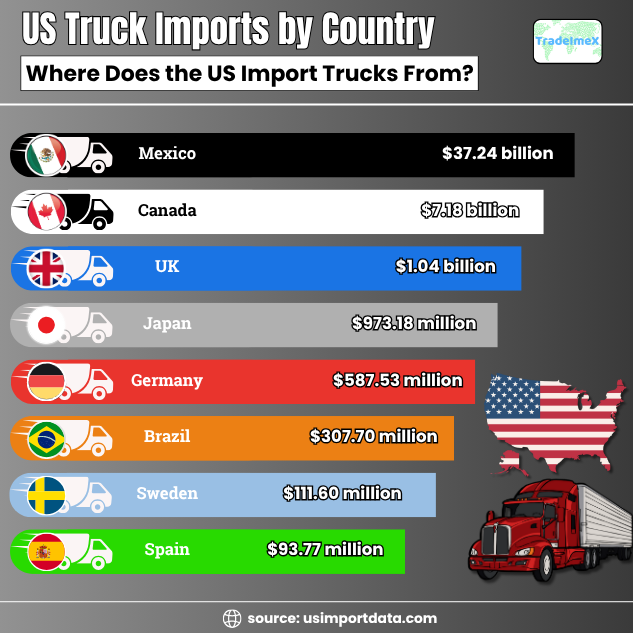
US truck imports are sourced from various countries and play a significant role in the transportation industry. The United States primarily imports trucks from Mexico, Canada, Japan, and Germany. These countries are key suppliers of trucks to the US market due to their advanced manufacturing technologies and high-quality vehicles. The top 10 suppliers of Trucks to the US, as per the data on US truck imports by country and US shipment data for 2024-25, include:
1. Mexico: $37.24 billion (78%)
Mexico tops the list as the largest supplier of trucks to the US, accounting for a staggering 78% of total imports. With its proximity to the US and well-established trade agreements such as the USMCA, Mexico has become a key partner in providing trucks for the American market. The country's robust manufacturing industry and competitive pricing make it a top choice for US importers.
2. Canada: $7.18 billion (15%)
Canada comes in second, capturing 15% of the US truck import market. As a neighboring country, Canada enjoys strong trade relations with the US, making it a natural choice for importing trucks. For importing truck from USA to Canada, Canadian manufacturers are known for producing high-quality vehicles, making them a popular choice among American consumers.
3. United Kingdom: $1.04 billion (2.2%)
The United Kingdom may be a smaller player in the US truck import market, but it still holds a significant share at 2.2%, as per the data on US truck imports from the United Kingdom. British manufacturers are known for their innovation and technology, offering American buyers a unique set of options when it comes to truck imports.
4. Japan: $973.18 million (2%)
Japan is another key player in the US truck import market, with a 2% share of total imports, as per the data on US truck imports from Japan by HS code. Japanese trucks are known for their reliability and fuel efficiency, making them a popular choice among US consumers looking for quality and performance.
5. Germany: $587.53 million (1.2%)
Germany is renowned for its engineering expertise and precision manufacturing, making it a top choice for US truck imports. German trucks are known for their durability and cutting-edge technology, appealing to American consumers who value quality and craftsmanship.
6. Brazil: $307.70 million (0.6%)
Brazil may have a smaller share of the US truck import market at 0.6%, but it still plays a significant role in supplying trucks to American buyers. Brazilian manufacturers offer a unique set of trucks tailored to the needs of the US market, providing consumers with a diverse range of options.
7. Sweden: $111.60 million (0.2%)
Sweden may be a smaller player in the US truck import market, but it still holds a 0.2% share of total imports. Swedish trucks are known for their safety features and advanced technology, making them a popular choice among US consumers who prioritize safety and innovation.
8. Spain: $93.77 million (0.2%)
Spain is another key player in the US truck import market, capturing a 0.2% share of total imports. Spanish manufacturers offer a unique blend of style and performance, providing American buyers with attractive options for their transportation needs.
9. Norway: $41.26 million (0.1%)
Norway may have a small share of the US truck import market at 0.1%, but it still plays a role in supplying trucks to the American market. Norwegian manufacturers offer a range of environmentally friendly and energy-efficient trucks, appealing to US consumers concerned about sustainability.
10. Finland: $37.83 million (0.1%)
Finland rounds out the list of top countries from which the US imports trucks, capturing a 0.1% share of total imports. Finnish manufacturers are known for their commitment to quality and innovation, providing American buyers with reliable and cutting-edge vehicles.
Top Truck Buyers & Importers in the USA: US Truck Importers Database
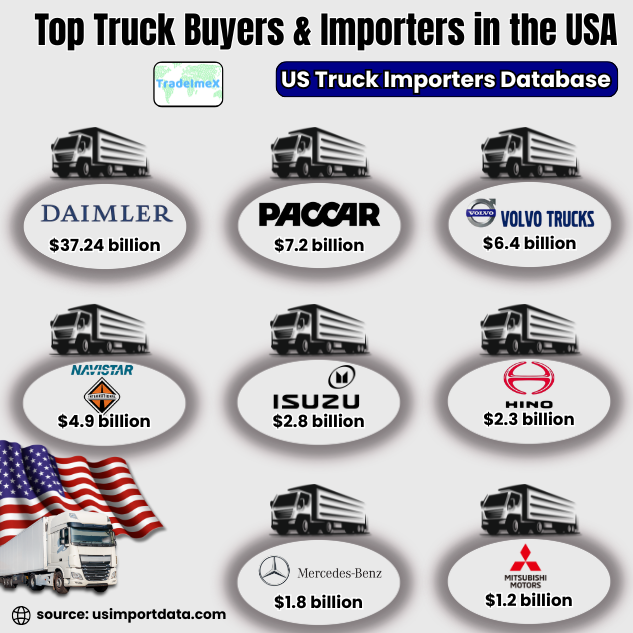
Truck importers have seen a significant rise in demand, particularly with the increase in truck imports and the growing interest in American truck imports. Many American truck importers specialize in offering high-quality vehicles to meet the needs of both individual and commercial Truck Buyers in USA. For businesses looking to import mini truck models, several mini truck importers USA cater to niche markets that require compact yet powerful options. The overall growth in US truck imports reflects the expanding market, with many Truck Buyers actively seeking durable and efficient models. Additionally, importing truck from USA to Canada has become a common practice, further highlighting the strong cross-border demand in North America.
The US Truck Importers Database provides a comprehensive list of top truck purchasers and importers in the United States. This database serves as a valuable resource for businesses looking to establish partnerships within the truck industry. The leading truck buyers or truck importing companies in the US, as per the US truck buyers list and truck importers data for 2024-25, include:
|
Rank |
Company Name |
Approx. Import Value (2024) |
Main Imported Types |
Top Import Source Countries |
|
1 |
$8.5 billion |
Heavy-duty and medium-duty trucks, chassis, & truck parts |
Mexico, Germany, Canada |
|
|
2 |
PACCAR Inc. (Kenworth, Peterbilt) |
$7.2 billion |
Heavy-duty trucks, cab assemblies, engines |
Mexico, Canada |
|
3 |
Volvo Trucks North America |
$6.4 billion |
Finished trucks, truck engines, powertrains |
Sweden, Belgium, Mexico |
|
4 |
Navistar International Corp. |
$4.9 billion |
Medium and heavy trucks, specialized work trucks |
Mexico, Brazil, Germany |
|
5 |
Isuzu Motors America |
$2.8 billion |
Medium-duty trucks, diesel engines, and truck parts |
Japan, Thailand |
|
6 |
Hino Motors Manufacturing USA (Toyota Group) |
$2.3 billion |
Cab-over trucks, components, and diesel engines |
Japan, Mexico |
|
7 |
Mercedes-Benz USA (Commercial Vehicle Division) |
$1.8 billion |
Sprinter trucks, chassis, and truck body kits |
Germany, Belgium, Spain |
|
8 |
Mitsubishi Fuso Truck of America |
$1.2 billion |
Light and medium-duty trucks, parts |
Japan, Thailand |
|
9 |
Michelin North America / Bridgestone Americas |
$900 million |
Truck tires and related components |
Thailand, Vietnam, China |
|
10 |
Sailun Group / TireCo Inc. (Import Division) |
$700 million |
Truck tires, rubber parts, accessories |
China, Malaysia, Vietnam |
Key Insights
-
Mexico dominates as the top truck supplier to the U.S., driven by strong USMCA trade integration.
-
OEMs (Daimler, PACCAR, Volvo, Navistar) import complete vehicles and major assemblies.
-
Asian brands like Isuzu, Hino, and Fuso focus on medium-duty and cab-over models.
-
Tire and parts importers like Michelin and Sailun account for the bulk of non-vehicle imports.
-
Imports are expected to shift further toward North American production following the new 25% tariff on imported medium and heavy-duty trucks announced by Donald Trump in October 2025 (effective November 2025).
What Counts as “Truck Imports”?
The U.S. Customs and Border Protection (CBP) classifies imported trucks primarily under Harmonized System (HS) Code 8704, which covers “motor vehicles for the transport of goods. This includes a wide range of vehicles, from light delivery trucks and cab chassis to full-size heavy-duty tractors.
Other related import categories include:
-
HS code 870490 – Trucks not elsewhere specified (e.g., specialized vehicles, multi-purpose work trucks)
-
HS code 870990 – Parts of work trucks and components
-
HS code 8708 – General automotive parts and accessories, including those for trucks
-
HS code 842710 / 842720 – Forklift trucks and similar work vehicles
Collectively, these categories account for tens of billions of dollars in annual trade, serving industries from logistics and construction to mining and agriculture.
U.S. Truck Imports by Country of Origin
Mexico Dominates the Market
Mexico is by far the largest supplier of trucks to the United States. In 2024, trucks imported from Mexico under HS Code 8704 were valued at roughly $33 billion, representing around 70% of the total U.S. truck import value.
This dominance is due to several factors:
-
Geographic proximity and low logistics costs
-
Integrated North American supply chains under the USMCA trade agreement
-
Established automotive clusters in northern Mexico that supply both the American and Canadian markets
Trucks produced in Mexico often include a high percentage of U.S.-made components, allowing them to qualify for tariff advantages under USMCA rules of origin.
Canada Holds Second Place
Canada remains a significant source of imported trucks, accounting for roughly $6.5 billion in 2024 imports. Most of these are heavy-duty vehicles and specialty trucks that move across the border through integrated production and distribution networks.
Rising Share from Asia
Asian countries, led by Japan, China, Thailand, and South Korea, have a growing footprint in the U.S. truck import market, particularly in parts and specialized work trucks.
-
Japan supplies high-quality truck parts and specialized light-duty vehicles valued at over $1 billion annually.
-
Thailand has become a hub for truck component exports, especially for Japanese and U.S. brands operating regional manufacturing centers.
-
China continues to supply truck components and low-cost vehicles, though tariff pressures and compliance concerns have limited its share in finished truck imports.
Europe’s Specialized Role
European countries such as Germany and Belgium export smaller quantities of trucks and truck parts to the U.S., but these tend to be high-value vehicles and advanced components, including electric and hydrogen-based truck prototypes.
US Truck Imports in the Last 10 Years: Historical US Truck Import Data
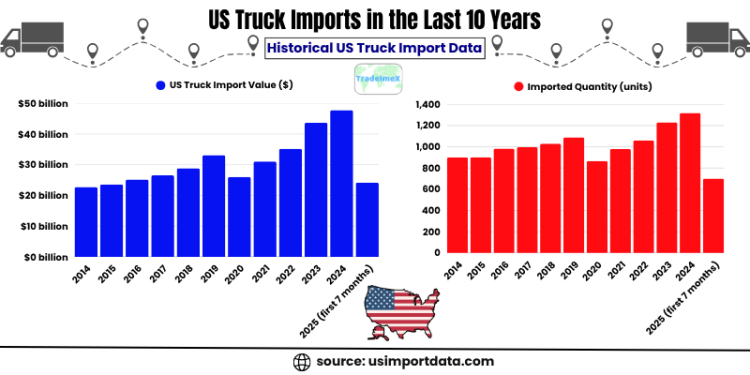
|
Year of Imports |
US Truck Import Value ($) |
Imported Quantity (units) |
|
2014 |
$22.71 billion |
900.21 thousand units |
|
2015 |
$23.54 billion |
902.33 thousand units |
|
2016 |
$25.17 billion |
983.22 thousand units |
|
2017 |
$26.52 billion |
996.32 thousand units |
|
2018 |
$28.84 billion |
1.03 million units |
|
2019 |
$33.07 billion |
1.09 million units |
|
2020 |
$26.01 billion |
866.79 thousand units |
|
2021 |
$31.08 billion |
979.11 thousand units |
|
2022 |
$35.16 billion |
1.06 million units |
|
2023 |
$43.67 billion |
1.23 million units |
|
2024 |
$47.75 billion |
1.32 million units |
|
2025 (first 7 months) |
$24.16 billion |
700.72 thousand tons |
Truck Import Volumes and Growth Trends
Between 2023 and 2024, the total volume and value of truck imports rose across all categories. Three primary factors are driving this growth:
-
Fleet Replacement Demand: Many U.S. logistics and construction firms are renewing their fleets after delays caused by pandemic-era shortages. This has driven up imports of both new trucks and parts for refurbishment.
-
E-commerce and Last-Mile trade: Demand for light and medium-duty delivery trucks continues to surge, fueled by the growth of e-commerce and urban trade. Much of this demand is met by imported models that balance efficiency and cost.
-
Shift to Electric and Alternative Fuel Trucks: Imports of electric trucks, hybrid drivetrains, and related parts have increased substantially. Several foreign manufacturers, particularly from Asia and Europe, are exporting electric delivery trucks and battery systems to U.S. buyers.
Top U.S. Truck Importers and Buyers
The truck import ecosystem in the United States involves thousands of buyers, from major vehicle manufacturers to logistics companies and parts distributors. Based on customs and trade data for 2024–25, the leading categories of importers include:
1. Major OEMs and Distributors
Large vehicle manufacturers and distributors import completed trucks, chassis, or sub-assemblies for domestic sale or final assembly. These include:
-
Daimler Truck North America
-
PACCAR Inc. (Kenworth, Peterbilt)
-
Navistar International
-
Volvo Trucks North America
While these companies produce trucks domestically, they also import certain models and components, especially from plants in Mexico and Canada.
2. Parts & Components Importers
Thousands of U.S. businesses import truck components and assemblies. These include:
-
Aftermarket suppliers
-
Repair and maintenance companies
-
Distributors of replacement parts
Truck parts imports are especially active from Japan, Thailand, China, and Mexico. The value of imported truck parts (HS 870990) exceeded $250 million in 2024, with strong year-over-year growth.
3. Tire and Accessory Importers
A notable portion of truck-related imports comes from tire and rubber companies such as Michelin North America, Sailun Group, and Bridgestone Americas. These firms import truck tires and accessories, both for OEM supply and aftermarket sales.
4. Specialized Work Truck Buyers
Companies in the construction, mining, and logistics sectors import specialized vehicles, forklifts, flatbeds, and heavy-lift trucks. These tend to come from manufacturers in Japan, Germany, and South Korea.
US Truck Import Categories and Product Mix
The breakdown of U.S. truck imports by type highlights how the market is segmented:
|
Category |
Description |
2024 Import Value (Approx.) |
Key Suppliers |
|
Finished trucks (HS 8704) |
Complete vehicles for goods transport |
$47.8 billion |
Mexico, Canada, Germany |
|
Truck parts (HS 870990) |
Frames, bodies, mechanical parts |
$250 million |
Japan, Thailand, China |
|
Specialized trucks (HS 870490) |
Vehicles not elsewhere specified |
$300 million |
Canada, Mexico, Japan |
|
Forklift trucks (HS 842710/842720) |
Warehouse & construction vehicles |
$800 million |
Japan, South Korea, China |
|
Truck tires & accessories |
Tires, rubber components, fittings |
$1.2 billion |
China, Thailand, Vietnam |
The data shows that finished vehicles account for the bulk of the total import value. Still, parts and components are growing faster, indicating a trend toward cross-border assembly and aftermarket growth.
Trump Announces 25% Tariff on Imported Medium and Heavy-Duty Trucks
In October 2025, former President Donald Trump announced that the U.S. government would impose a 25% tariff on imported medium- and heavy-duty trucks, effective November 1, 2025.
This move aims to protect U.S. truck manufacturers from overseas competition and encourage domestic production. However, it has sent ripples through global supply chains and raised concerns among logistics operators and importers.
What the Tariff Covers
The 25% duty applies to:
-
Medium-duty and heavy-duty trucks (HS 8704 classification)
-
Certain truck chassis and cab assemblies are imported as semi-finished units
-
Both diesel and electric variants
Expected Impact
-
Price Increases: Imported trucks could become 20–25% more expensive, pressuring logistics companies and fleet operators.
-
Sourcing Shifts: Importers are expected to accelerate shipments before the tariff deadline, while others will move production to Mexico or Canada to qualify for USMCA exemptions.
-
Domestic Investment Surge: The policy could prompt manufacturers to expand or reopen assembly lines in the U.S., especially in Southern states with established automotive clusters.
-
Trade Friction: The new tariffs may trigger countermeasures from major trading partners and affect cross-border supply chains that rely heavily on shared North American production.
This announcement marks one of the most significant trade policy shifts in the trucking sector in years, one likely to redefine sourcing, costs, and competitive dynamics throughout 2026 and beyond.
Policy Landscape and Tariff Impact
Tariff Environment
Truck imports into the U.S. face a complex tariff structure, shaped by both historical and new policy moves. The “chicken tax”, a 25% tariff on light trucks, remains in force, protecting domestic pickup manufacturers.
In addition, a new 25% tariff on imported medium- and heavy-duty trucks is expected to take effect in late 2025, a move designed to protect American manufacturers from lower-cost imports further.
USMCA Advantage
Under the United States–Mexico–Canada Agreement (USMCA), trucks assembled in North America with sufficient regional content are exempt from these tariffs. This has incentivized manufacturers to expand assembly operations in Mexico, ensuring compliance while keeping costs competitive.
Trade Tensions and Supply Chains
The evolving tariff environment could reshape sourcing patterns. Importers that previously relied on Asian suppliers may shift procurement to Mexico or Canada to reduce tariff exposure and shipping costs. Similarly, U.S. firms are increasingly evaluating “nearshoring” strategies for components previously sourced from China.
Economic Context and Market Drivers
Strong Domestic Demand
The U.S. economy’s continued expansion in 2024–25, particularly in e-commerce, manufacturing, and construction, is sustaining robust truck demand. Import growth mirrors this trend, especially for medium-duty and delivery trucks.
Electrification and New Technologies
Global manufacturers are ramping up exports of electric trucks and components to the U.S. market. Imports of EV drivetrains, lithium-ion battery modules, and hybrid systems are growing rapidly. Many of these components come from Japan, China, and Germany.
Cost and Labor Advantages Abroad
Despite efforts to reshore production, it remains cheaper to produce many trucks and truck components in Mexico and Asia. Lower labor costs, established supply networks, and logistical efficiency keep imported vehicles price-competitive.
Replacement and Refurbishment Cycles
Fleet operators facing aging vehicles are turning to imports for both complete trucks and parts. The shift toward refurbished and repurposed trucks also supports demand for imported parts and subassemblies.
Challenges and Risks
While imports are growing, the industry faces several looming challenges:
-
Tariff Uncertainty: The upcoming 25% duty on heavy trucks could dramatically reshape the cost structure and sourcing strategies of importers.
-
Regulatory Complexity: Compliance with U.S. customs classifications and USMCA rules of origin remains intricate and burdensome.
-
Currency Fluctuations: Exchange rate volatility affects landed costs and competitiveness, particularly for Asian exporters.
-
Supply Chain Disruptions: Shipping delays, component shortages, and port congestion remain recurring issues.
-
Competitive Pressure from Domestic Production: U.S.-based truck manufacturers are expanding capacity, especially for electric and specialized trucks, which could offset import volumes over time.
Outlook for 2025–26
Looking ahead, several trends are expected to define U.S. truck imports:
-
Shift Toward North American Sourcing: Manufacturers are expected to relocate or expand production within Mexico or Canada to maintain tariff-free access to the U.S. market.
-
Moderation in Import Growth: The anticipated 2025 tariffs may slow overall import volume growth after mid-2025, as companies rush to import ahead of the new duties.
-
Expansion of Electric Truck Imports: Demand for zero-emission trucks, including small delivery EVs and heavy-duty electric vehicles, will rise sharply, drawing imports from Europe and Asia.
-
Higher Import Values but Fewer Units: Rising costs, tariff burdens, and inflationary pressures may result in higher dollar-value imports but fewer individual shipments, especially in the heavy-duty segment.
-
Aftermarket Growth: Imports of truck parts and components will continue expanding as U.S. fleets age and maintenance demand rises.
Conclusion and Final Thoughts
The U.S. truck import market in 2024–25 is defined by rising demand, regional integration, and policy turbulence. Mexico remains the undisputed leader in supplying the American market, but Asia’s role in parts and components continues to grow. The market’s value, nearly $48 billion in 2024, underscores the scale and importance of truck imports in sustaining U.S. logistics and industrial operations.
As the industry braces for a new tariff regime in 2025, companies are adjusting supply chains, accelerating imports, and optimizing production footprints across North America. Electric and hybrid trucks are opening new trade channels, while aftermarket parts imports continue to thrive. In short, the U.S. truck import sector is evolving, not shrinking. It’s becoming more regional, more technologically advanced, and more sensitive to trade policy. The next 12 months will likely bring continued growth, followed by strategic realignment as tariff pressures reshape how and where America sources its trucks.
We hope you liked our data-driven and interactive blog report on US truck import data 2025. For more information on the latest US export-import data, or to search live data on US truck imports by country or company, visit USImportdata. Contact us at info@tradeimex.in for customized US trade reports, a verified database of top truck importers & buyers in the USA, and exclusive market insights.
What's Your Reaction?