US Free Trade Agreements & Trade Policies: Their Impact on Business
Top 5 US Free Trade Agreements (USMCA, CAFTA-DR, KORUS, AUSFTA, USSFTA). Their impact on business & US trade policies. See how these FTAs shape US imports-exports.
In today's global economy, free trade agreements play a crucial role in shaping the business landscape. The United States has entered into numerous free trade agreements over the years, each with its own set of terms and conditions. These agreements not only facilitate the movement of goods and services across borders but also have a significant impact on American businesses. As far as the US trade data is concerned, the US had a total trade volume of $5.67 trillion in 2025. The US imported goods worth $3.50 trillion, as per the US import data, while the US exports reached $2.17 trillion in 2025, as per the US export data. In this article, we will explore the top five US free trade agreements and their impact on business and global trade.
Overview of the Top 5 US Free Trade Agreements
The United States has established several Free Trade Agreements (FTAs) to reduce tariffs, boost exports, and strengthen economic ties with partner nations. These agreements significantly influence import-export trade, pricing, and business operations. US Trade agreements can make it easier for American companies to participate and compete in the global market by opening markets and increasing opportunities for American workers and businesses. By including pledges to lower and remove tariffs as well as several non-tariff trade barriers that restrict trade flows, trade agreements help improve the business environment.
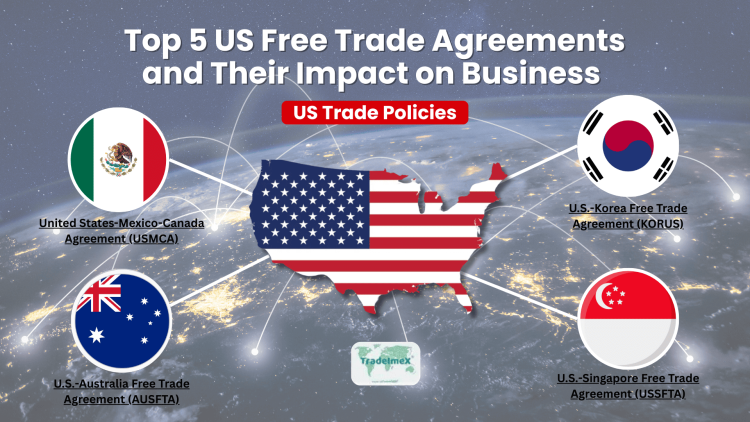
The United States has established several Free Trade Agreements (FTAs) to enhance economic cooperation, reduce trade barriers, and promote mutual growth with partner countries. Among these, five stand out for their significant impact on U.S. trade dynamics:
-
United States-Mexico-Canada Agreement (USMCA)
-
Dominican Republic-Central America Free Trade Agreement (CAFTA-DR)
-
U.S.-Korea Free Trade Agreement (KORUS)
-
U.S.-Australia Free Trade Agreement (AUSFTA)
-
U.S.-Singapore Free Trade Agreement (USSFTA)
This report delves into each agreement, analyzing its effects on import-export volumes, pricing trends, market dynamics, and overall business impact.
The top 5 most impactful U.S. FTAs are:
|
FTA |
Partner Countries |
Effective Year |
Tariff Impact on US Trade |
Key Sectors Affected |
|
USMCA |
U.S., Canada, Mexico |
2020 |
Reduced auto tariffs, eliminated agricultural tariffs |
Automotive, Agriculture, Manufacturing |
|
CAFTA-DR |
Dominican Republic, Costa Rica, El Salvador, Guatemala, Honduras, Nicaragua |
2006 |
Eliminated 80%+ tariffs on U.S. exports |
Textiles, Agriculture, Energy |
|
KORUS |
South Korea |
2012 |
Eliminated 95% of tariffs within 5 years |
Automotive, Technology, Electronics |
|
AUSFTA |
Australia |
2005 |
99% of U.S. goods enter duty-free |
Pharmaceuticals, Agriculture, Services |
|
USSFTA |
Singapore |
2004 |
Immediate duty-free trade for all goods |
Technology, Financial Services, IT |
1. United States-Mexico-Canada Agreement (USMCA)
The USMCA, which replaced the North American Free Trade Agreement (NAFTA), is a trilateral trade agreement between the United States, Mexico, and Canada. This agreement aims to modernize and strengthen trade relations between the three countries by addressing issues related to intellectual property rights, labor rights, and environmental protections. The USMCA has had a significant impact on businesses in all three countries by reducing trade barriers and increasing market access for various industries. It replaced NAFTA in 2020 to modernize trade between the U.S., Mexico, and Canada.
Trade Impact
-
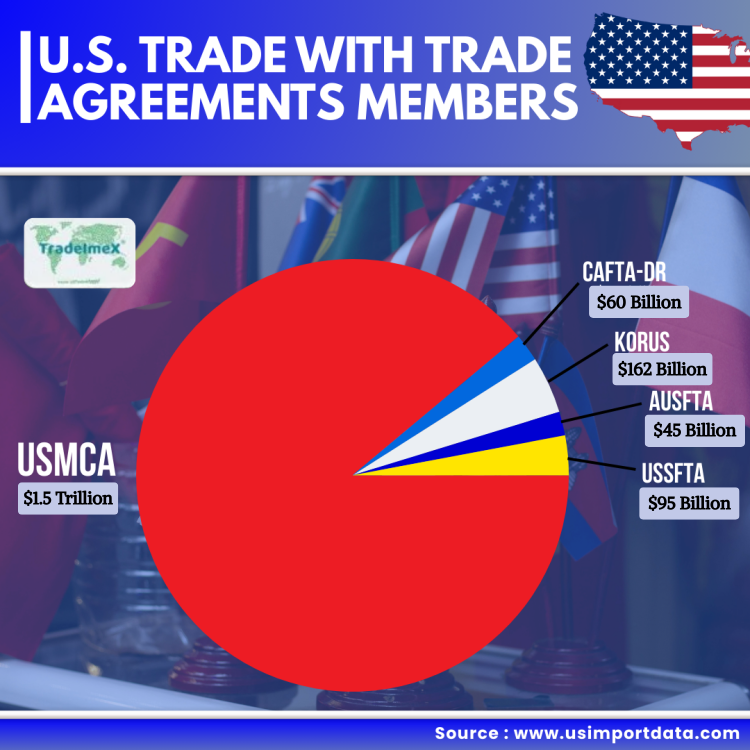
Total U.S. trade with USMCA nations (2025): $1.5 trillion
-
Exports: US exports to Mexico and Canada rose by 12% in key industries.
-
Imports: US imports from USMCA partners grew by 8%, driven by automotive and electronics.
Market Trends
✔ Automotive: Stricter rules of origin boosted U.S. car manufacturing.
✔ Agriculture: U.S. dairy exports to Canada increased 9% due to market access improvements.
✔ Energy & Manufacturing: Lower tariffs increased trade volumes in industrial goods.
Pricing Trends
-
Automotive costs increased due to stricter manufacturing regulations.
-
Agricultural goods saw price stability due to tariff-free market access.
Business Impact
✔ Strengthened North American supply chains.
✔ More U.S. jobs in auto & manufacturing.
✔ Boosted cross-border e-commerce growth.
2. Dominican Republic-Central America Free Trade Agreement (CAFTA-DR)
The CAFTA-DR is a free trade agreement between the United States and six Central American countries (Costa Rica, El Salvador, Guatemala, Honduras, Nicaragua, and the Dominican Republic). This agreement has helped to promote economic development and trade relations between the US and the Central American region. The CAFTA-DR has benefited businesses by eliminating tariffs on a wide range of goods and services, thus increasing market access and boosting trade volumes. Enhances U.S. trade with Central America & the Dominican Republic.
Trade Impact
-
Total U.S. exports to CAFTA-DR (2025): $35 billion
-
Imports from CAFTA-DR: $25 billion (textiles & agricultural goods lead).
Market Trends
✔ Textile & Apparel Industry: 15% growth in U.S. exports of yarns & fabrics.
✔ Agriculture: U.S. meat and grain exports expanded due to tariff reductions.
Pricing Trends
-
Lower textile costs for U.S. importers due to duty-free agreements.
-
Affordable agricultural products benefiting U.S. and Central American consumers.
Business Impact
✔ Expanded trade for U.S. exporters in textiles & food sectors.
✔ Better protection for U.S. investments in Central America.
✔ Reduced operational costs for U.S. businesses importing raw materials.
3. U.S.-Korea Free Trade Agreement (KORUS)
The KORUS agreement is a free trade agreement between the United States and South Korea that aims to promote bilateral trade and investment between the two countries. This agreement has had a positive impact on businesses by reducing tariffs and other trade barriers, thus facilitating the flow of goods and services between the US and South Korea. The KORUS agreement has also enhanced cooperation in various sectors such as automotive, electronics, and agriculture, benefiting businesses in both countries. Boosts trade between the U.S. and South Korea, particularly in tech and auto sectors.
Trade Impact
-
U.S. exports to Korea (2025): $72 billion
-
U.S. imports from Korea: $90 billion
Market Trends
✔ Automotive: U.S. car exports to Korea are up 18%.
✔ Semiconductors: U.S. chip exports rose 22%, benefiting from reduced tariffs.
✔ Consumer Electronics: Strong demand for U.S. high-tech goods.
Pricing Trends
-
Lower prices on Korean electronics & vehicles in the U.S. due to tariff reductions.
-
Cheaper U.S. agricultural exports to Korea.
Business Impact
✔ Easier access to the South Korean market for U.S. businesses.
✔ Boosted high-tech exports.
✔ Lowered costs for South Korean imports, benefiting U.S. consumers.
4. U.S.-Australia Free Trade Agreement (AUSFTA)
The AUSFTA is a free trade agreement between the United States and Australia that aims to strengthen economic ties between the two countries. This agreement has had a significant impact on businesses by increasing market access and reducing trade barriers for various industries, such as agriculture, manufacturing, and services. The AUSFTA has also helped to promote foreign direct investment and enhance cooperation in areas such as intellectual property rights and government procurement. Strengthens US-Australia trade with zero tariffs on key industries.
Trade Impact
-
U.S. exports to Australia (2025): $30 billion
-
U.S. imports from Australia: $15 billion
Market Trends
✔ Pharmaceuticals: U.S. pharma exports to Australia grew 25%.
✔ Agriculture: U.S. beef exports increased 20% due to zero tariffs.
✔ Energy & Resources: Increased trade in natural gas & minerals.
Pricing Trends
-
Lower pharmaceutical costs in Australia due to streamlined regulations.
-
Stable agricultural prices benefiting U.S. farmers & Australian consumers.
Business Impact
✔ Increased U.S. exports in pharmaceuticals & agriculture.
✔ Stronger investment protections for U.S. firms in Australia.
✔ Boosted trade in financial services & professional industries.
5. U.S.-Singapore Free Trade Agreement (USSFTA)
The USSFTA is a free trade agreement between the United States and Singapore that aims to promote trade and investment between the two countries. This agreement has had a positive impact on businesses by eliminating tariffs and other trade barriers, thus facilitating the flow of goods and services between the US and Singapore. The USSFTA has also enhanced cooperation in areas such as financial services, telecommunications, and e-commerce, benefiting businesses in both countries. The first U.S. FTA in Asia, boosting financial & technology sectors.
Trade Impact
-
U.S. exports to Singapore (2025): $50 billion
-
U.S. imports from Singapore: $45 billion
Market Trends
✔ Financial Services: U.S. banking & insurance exports grew 30%.
✔ Technology: U.S. IT & software exports up 28%.
✔ Aerospace & Defense: Increased cooperation on aviation and military tech.
Pricing Trends
-
Lower costs on tech goods for businesses & consumers.
-
Cheaper financial services for U.S. firms in Singapore.
Business Impact
✔ Enhanced digital trade & cybersecurity cooperation.
✔ Greater IP protections for U.S. businesses operating in Asia.
✔ Boosted the financial services sector between both nations.
The Big Picture of the USA Free Trade Agreements
|
FTA |
Trade Value (2025) |
Key Benefits |
|
USMCA |
$1.5 Trillion |
Boosts auto & agriculture, strengthens regional supply chains |
|
CAFTA-DR |
$60 Billion |
Enhances textile & agriculture exports, investment protection |
|
KORUS |
$162 Billion |
Expands automotive & semiconductor trade |
|
AUSFTA |
$45 Billion |
Strengthens pharmaceuticals & agriculture |
|
USSFTA |
$95 Billion |
Grows financial services & technology exports |
US Trade Policies: Evolution
The history of US trade policies dates back to the early days of the nation, with a focus on protectionism and tariffs to promote domestic industries. Over time, there has been a shift towards more liberalized trade policies, with the US becoming a key player in the establishment of international trade agreements such as the NAFTA and WTO.
Impact of US Trade Policies on Domestic Industries
One of the key considerations in US trade policies is the impact on domestic industries. While protectionist measures such as tariffs can help shield domestic producers from foreign competition, they can also lead to higher prices for consumers and retaliatory measures from trading partners. On the other hand, liberalized trade policies can open up new markets for US exporters but may also result in job losses in certain industries.
-
Trade policy tools: Tariffs are levied on imported goods to safeguard home businesses and raise the cost of items from abroad.
-
Quotas: Restrictions on the number of commodities that can be imported; they are meant to safeguard home industries and limit supply.
-
Voluntary Export Restrictions: Agreements where exporting nations voluntarily restrict their shipments to another nation are known as voluntary export restraints, and they are frequently used to get around tariffs or quotas.
-
Subsidies: Government contributions to domestic producers, known as subsidies, can assist them to compete in international markets.
-
Sanitary and Phytosanitary (SPS) Standards: International trade may be impacted by laws on plant, animal, and food safety.
Conclusion and Final Thoughts
In conclusion, the US free trade agreements play a crucial role in shaping the business environment in the United States. While these agreements have brought about numerous benefits for American businesses, they have also faced criticism for certain drawbacks. As the US continues to negotiate new trade agreements, it is important to carefully consider the potential impact on businesses and to strike a balance between promoting trade and protecting domestic industries. As global commerce continues to evolve, these US FTAs will remain powerful catalysts for economic growth, shaping trade dynamics, fostering business expansion, and unlocking new opportunities for industries worldwide.
We hope that by now, you are fully equipped with a comprehensive and insightful understanding of the Top 5 US Free Trade Agreements and Their Impact on Business: U.S. Trade Policies, from their historical significance to their current market influence and future trade potential. If you liked our blog report, then consider following our page and subscribing to USImportdata. Simply contact us at info@tradeimex.in and get insights into the latest US import-export data, market reports on US bilateral trade, and US trade trends.
What's Your Reaction?