US-BRICS Trade Relations Amid Tariff Threats: Impact on Global Trade
US-BRICS Trade Relations face pressure from the Trump BRICS tariff dispute, even as US-BRICS import-export trade grows and new BRICS trade agreements emerge.
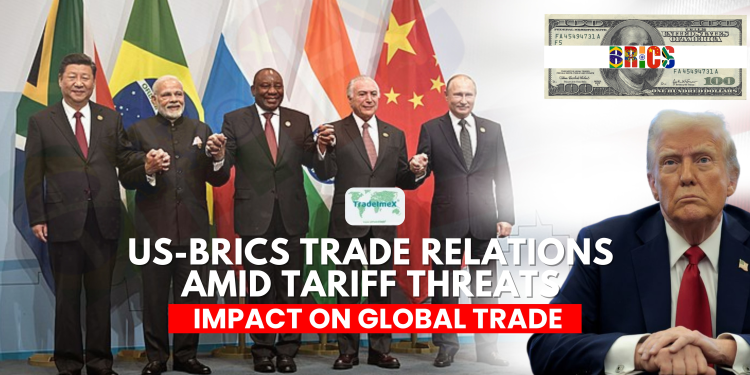
In the recent past, trade relations between the United States and BRICS countries (Brazil, Russia, India, China, and South Africa) have been under strain due to the threat of tariffs imposed by the US government. President Donald Trump has threatened to impose 100% tariffs on BRICS nations should they pursue alternatives to the U.S. dollar as a reserve currency. Analysts project that such tariffs could lead to a 90% reduction in U.S.-BRICS trade, significantly affecting both economies. Debates around BRICS free trade have intensified as the group explores deeper economic cooperation, including the possibility of BRICS local currency trade aimed at reducing reliance on the US dollar.
Although discussions of a BRICS trade agreement continue, the current BRICS trade bloc remains a loose economic coalition rather than a formal BRICS free trade agreement, prompting many to ask, “Is BRICS a free trade agreement?” Analysts also examine what does BRICS mean for the US dollar, especially as de-dollarization efforts advance, while policymakers in Washington evaluate the implications of a US tariff on BRICS and broader US tariffs on BRICS countries as trade tensions evolve. Recent discussions around the BRICS Trump tariffs trade spat highlight growing tensions between the U.S. and the BRICS nations, Brazil, Russia, India, China, and South Africa, over global trade policies and economic influence. The Trump BRICS tariff debate originated during Donald Trump’s presidency, when his administration imposed tariffs aimed at protecting U.S. industries, which in turn strained relations with several BRICS economies. This trade spat not only affected bilateral trade flows but also pushed BRICS countries to strengthen intra-group cooperation and reduce dependence on Western markets, signaling a potential shift in the global economic balance.
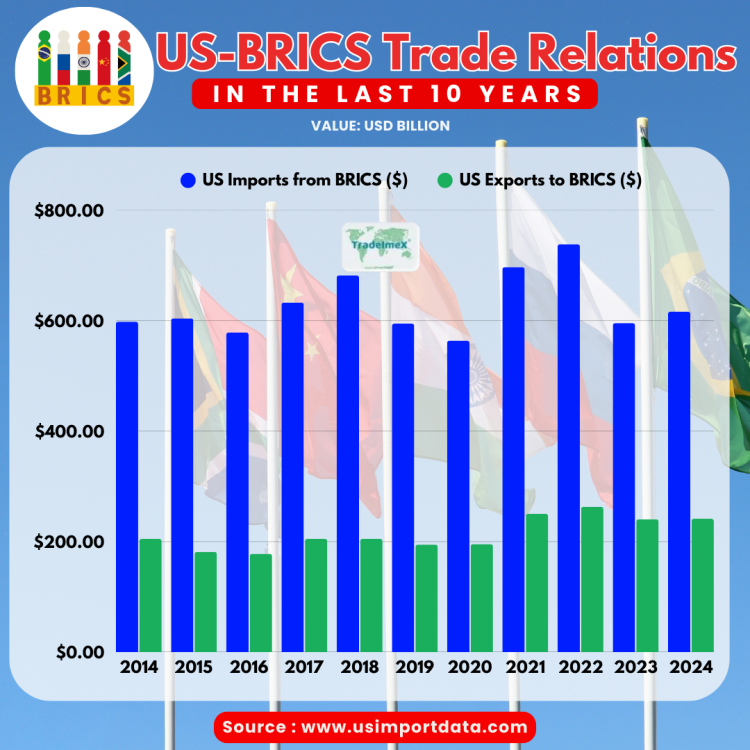
These tariff threats have not only affected the economies of the US and BRICS nations but also had a significant impact on global trade. According to the US import data and the US-BRICS trade data, the total value of US imports from BRICS nations aggregation reached $616.25 billion in 2024, a 3% increase from the previous year. The total value of US exports to BRICS accounted for $241.31 billion in 2024, a 1% increase from the previous year, as per the US export data.
The total trade volume between the US and BRICS aggregation reached $857.56 billion in 2024, including imports and exports, as per the global trade data. In this article, we will delve into the current state of US-BRICS trade relations amid tariff threats and analyze the repercussions on the global trade landscape.
The Landscape of US-BRICS Trade Relations
The United States has historically been a major trading partner for BRICS countries, with each nation exporting goods and services to the US market. However, the imposition of tariffs by the US government on imports from BRICS nations has disrupted this trading relationship. The US has accused countries like China of engaging in unfair trade practices, leading to a trade war between the two economic giants.
Biggest US Imports from BRICS: US-BRICS Top Import Products
The United States imports various products from the BRICS countries – Brazil, Russia, India, China, and South Africa. Among the top import products are electronic equipment, machinery, vehicles, precious metals, and agricultural products. The significant trade relationships between the US and BRICS nations contribute to global economic dynamics. These imports are crucial in meeting consumer demand and fostering international trade partnerships for mutual benefit. The top 10 products that the US imports from BRICS, as per the US-BRICS trade data and US import data for 2024, include:
1. Electrical machinery and equipment (HS code 85): $143.03 billion
2. Nuclear reactors and machinery (HS code 84): $95.42 billion
3. Toys, games, and sports requisites (HS code 95): $32.34 billion
4. Vehicles (HS code 87): $24.13 billion
5. Precious stones and metals (HS code 71): $23.70 billion
6. Plastics and articles thereof (HS code 39): $23.20 billion
7. Furniture, bedding, and mattresses (HS code 94): $22.61 billion
8. Pharmaceutical products (HS code 30): $20.76 billion
9. Articles of iron or steel (HS code 73): $16.38 billion
10. Optical, medical, or surgical instruments (HS code 90): $13.64 billion
Biggest US Exports to BRICS: US-BRICS Top Export Products
The BRICS nations, which consist of Brazil, Russia, India, China, and South Africa, are vital trade partners for the United States. The biggest US exports to the BRICS countries encompass a diverse range of top export products. From machinery and electronics to aircraft and automotive parts, the US bolsters its global presence by exporting a variety of high-quality goods that cater to the specific demands of each BRICS nation. This strategic trade relationship fosters economic growth and strengthens international ties, benefiting both the US and the BRICS countries involved. The top 10 goods that the US exports to BRICS nations, as per the US export data and US shipment data for 2024, include:
1. Mineral fuels and oils (HS code 27): $36.71 billion
2. Aircraft, spacecraft, and parts thereof (HS code 88): $24.80 billion
3. Nuclear reactors and machinery (HS code 84): $23.11 billion
4. Electrical machinery and equipment (HS code 85): $22.38 billion
5. Optical, medical, or surgical instruments (HS code 90): $15.62 billion
6. Oil seeds and oleaginous fruits (HS code 12): $13.47 billion
7. Pharmaceutical products (HS code 30): $12.92 billion
8. Plastics and articles thereof (HS code 39): $12.11 billion
9. Vehicles (HS code 87): $9.16 billion
10. Organic chemicals (HS code 29): $7.45 billion
Overview of US Import-Export Trade with BRICS Nations
US-BRICS Import Trade
US Imports from China (2024): $462.63 billion
Top Imports
-
Electronics : $127.05 billion (as per import data on US imports from China)
-
Nuclear reactors and machinery: $85.12 billion
-
Toys, games, and sports requisites: $32.04 billion
-
Plastics and articles thereof: $21.52 billion
-
Furniture, bedding, and mattresses: $20.93 billion
US Imports from India (2024): $91.23 billion
Top Imports
-
Electrical machinery and equipment: $14.39 billion
-
Pharmaceutical products: $12.72 billion
-
Precious stones and metals: $11.88 billion
-
Nuclear reactors and machinery: $7.10 billion
-
Organic chemicals: $3.63 billion
US Imports from Brazil (2024): $44.18 billion
Top Imports
-
Mineral fuels and oils: $8.80 billion (as per import data on US imports from Brazil)
-
Iron and steel: $4.97 billion
-
Nuclear reactors and machinery: $2.81 billion
-
Coffee, tea, and spices: $2.76 billion
-
Aircraft, spacecraft, and parts thereof: $2.05 billion
US Imports from South Africa (2024): $14.92 billion
Top Imports
-
Precious stones and metals: $8.57 billion
-
Vehicles: $2.26 billion
-
Iron and steel: $518.67 million
-
Aluminum and articles thereof: $399.79 million
-
Ores, slag, and ash: $383.13 million
US Imports from Russia (2024): $3.27 billion
Top Imports
-
Fertilizers: $1.30 billion
-
Precious stones and metals: $878.43 million
-
Inorganic chemicals: $695.71 million
-
Wood and articles of wood: $89.44 million
-
Nuclear reactors and machinery: $80.81 million
US-BRICS Export Trade
US Exports to China (2024): $143.54 billion
Top Exports
-
Electrical machinery and equipment: $15.27 billion
-
Mineral fuels and oils: $14.72 billion
-
Oil seeds and oleaginous fruits: $13.35 billion
-
Nuclear reactors and machinery: $12.85 billion
-
Aircraft, spacecraft, and parts thereof: $11.53 billion
US Exports to Brazil (2024): $49.66 billion
Top Exports
-
Aircraft, spacecraft, and parts thereof: $9.99 billion
-
Mineral fuels and oils: $8.56 billion (as per export data for US exports to Brazil)
-
Nuclear reactors and machinery: $5.86 billion
-
Electrical machinery and equipment: $4.41 billion
-
Plastics and articles thereof: $ 3.01 billion
US Exports to India (2024): $41.75 billion
Top Exports
-
Mineral fuels and oils: $12.60 billion (as per export data on US exports to India)
-
Precious stones and metals: $5.31 billion
-
Nuclear reactors and machinery: $3.28 billion
-
Aircraft, spacecraft, and parts thereof: $2.99 billion
-
Electrical machinery and equipment: $2.21 billion
US Exports to South Africa (2024): $5.81 billion
Top Exports
-
Nuclear reactors and machinery: $1.08 billion
-
Vehicles: $943.77 million
-
Mineral fuels and oils: $817.88 million
-
Electrical machinery and equipment: $467.39 million
-
Optical, medical, or surgical instruments: $278.27 million
US Exports to Russia (2024): $526.06 million
Top Exports
-
Optical, medical, or surgical instruments: $153.05 million
-
Pharmaceutical products: $133.40 million
-
Miscellaneous edible preparations: $72.84 million
-
Essential oils, perfumery, and cosmetics: $21.74 million
-
Miscellaneous chemical products: $19 million
US-BRICS Trade in the Last 10 Years: Yearly US Trade Data
|
Year of Trade |
US Imports from BRICS ($) |
US Exports to BRICS ($) |
|
2014 |
$597.82 billion |
$204.83 billion |
|
2015 |
$603.91 billion |
$181.51 billion |
|
2016 |
$578.41 billion |
$177.86 billion |
|
2017 |
$632.55 billion |
$205.02 billion |
|
2018 |
$681.70 billion |
$205.07 billion |
|
2019 |
$594.41 billion |
$194.68 billion |
|
2020 |
$563.83 billion |
$195.42 billion |
|
2021 |
$696.47 billion |
$250.29 billion |
|
2022 |
$738.01 billion |
$262.97 billion |
|
2023 |
$595.48 billion |
$240.48 billion |
|
2024 |
$616.25 billion |
$241.31 billion |
Impact of US Tariffs on BRICS Economies
The tariffs imposed by the US have had a significant impact on the economies of BRICS countries. China, for example, has faced a decline in exports to the US due to the tariffs, leading to a slowdown in its economic growth. Similarly, Brazil and India have seen their exports to the US market reduced, affecting their trade balance and overall economic performance.
The USA's Policy on BRICS
In the past, Washington saw BRICS as a dispersed group with little geopolitical influence. President Donald Trump has responded sharply to the group's recent growth and attempts to subvert the US dollar's hegemony, threatening to impose taxes on BRICS countries should they seek de-dollarization. Does this tough posture represent a more significant change in US foreign policy, or is it just a temporary pressure tactic?
A Change in the USA's Perspective on BRICS
From a loose coalition sixteen years ago, the BRICS group—a strategic partnership of developing economies—has evolved into a more cohesive bloc that actively seeks alternatives to the US currency and advocates for reforms in global governance. Biden administration officials have mostly minimized the group's significance. The government did not anticipate BRICS becoming a geopolitical rival, according to National Security Advisor Jake Sullivan in 2023, while Treasury Secretary Janet Yellen characterized shifts away from the currency as a "natural desire to diversify."
Donald Trump disagreed with this strategy and saw BRICS as a danger to US financial dominance. According to Trump, the US demands that these BRICS nations pledge not to develop a new BRICS currency or support any other currency as a substitute for the strong U.S. dollar. If they do, they will be subject to 100% tariffs and will likely have to bid farewell to investing in the amazing U.S. economy.
Global Trade Implications
The trade tensions between the US and BRICS countries have sent shockwaves throughout the global trade landscape. The uncertainty surrounding trade relations has led to a decline in investor confidence, causing fluctuations in stock markets worldwide. Moreover, the disruption in supply chains due to tariffs has affected businesses operating on a global scale, leading to increased production costs and reduced profitability.
Projected Economic Impact of US Tariffs on BRICS
|
Indicator |
Pre-Tariff (2023) |
Post-Tariff (2025, Projected) |
% Change |
|
US Imports from BRICS ($) |
$649 billion |
$325 billion |
-50% |
|
US Exports to BRICS ($) |
$286 billion |
$140 billion |
-51% |
|
US Inflation Rate (%) |
3.4% |
5.8% |
+70% |
|
BRICS Export Growth (%) |
5.0% |
1.2% |
-76% |
-
Imports from BRICS could be cut in half, leading to higher prices for U.S. consumers.
-
The cost of electronics, clothing, and pharmaceuticals would rise sharply.
-
BRICS nations would shift trade to other partners, such as the EU, Middle East, and Africa.
Future Outlook and Way Forward for US-BRICS Trade
As the US-BRICS trade relations continue to be marred by tariff threats, the future outlook remains uncertain. While negotiations are ongoing between the US and its trading partners, the specter of trade wars looms large over the global economy. It is essential for all parties involved to find a mutually beneficial solution to the trade dispute to prevent further escalation and minimize the impact on global trade.
Key Takeaways
-
The U.S. has proposed 100% tariffs on BRICS nations, which could disrupt trade flows.
-
BRICS is actively working on alternative payment systems and reducing reliance on Western financial institutions.
-
Tariffs are expected to increase U.S. inflation while reducing GDP growth.
-
Imports from China and India remain strong as per Asia trade data, but Russian trade with the U.S. is at historic lows due to sanctions, as per US-Russia trade data.
-
By diversifying their currencies in trade, BRICS is aggressively fending off threats from U.S. tariffs.
-
India-Brazil relations are growing, particularly in the fields of renewable energy and pharmaceuticals.
-
Despite changes in U.S. policy, COP30 will concentrate on achieving climate targets, obtaining money, & promoting global climate action.
Conclusion and Final Thoughts
In conclusion, the current state of US-BRICS trade relations amid tariff threats has created a challenging environment for global trade. The imposition of tariffs by the US government has disrupted longstanding trading relationships and impacted the economies of both the US and BRICS nations. The repercussions of these tariff threats have reverberated throughout the global trade landscape, leading to uncertainty and volatility in financial markets. Moving forward, all parties must work towards a resolution to the trade dispute to ensure a stable and prosperous global trade environment.
As we conclude, we hope that you liked our insightful and interactive blog report on the US-BRICS trade. To learn more about the exclusive market trends in US trade, visit USImportdata. Contact us at info@tradeimex.in and get a list of top US exporting companies.
What's Your Reaction?