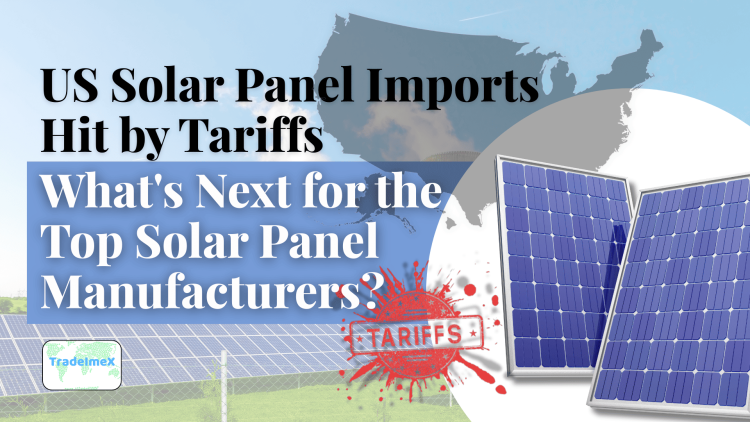
US Solar Panel Imports Hit by Tariffs: What's Next for the Top Solar Panel Manufacturers?
US solar panel imports declined 13% in 2024 amid harsh tariffs. Discover how top solar panel manufacturers are responding to rising costs and market shifts.
The solar panel industry in the United States has been hit with tariffs imposed on imports from key manufacturing countries such as China. These tariffs have significantly impacted the prices and availability of solar panels in the US market, leading to uncertainty and challenges for both consumers and industry players. According to the US import data and USA solar panel import data, the US solar panel imports reached a total value of $23.32 billion in 2024, a 13% decline from the previous year. The US is a leading solar panel importer globally. As global demand for clean energy grows, solar panel importers are expanding their supply chains and focusing on best practices for importing solar panels efficiently and cost-effectively.
Companies evaluating US solar panel import from China must navigate trade, quality standards, and regulatory requirements, including identifying the correct solar panel tariff code and ensuring compliance with the appropriate solar panel HS code used in international trade documentation. The US imported a considerable quantity of solar panels in 2024, mainly from countries in Southeast Asia. In 2024, the total finished US solar panel imports into the US amounted to 54.3 GW (gigawatt). Tariffs on solar panel imports from various Southeast Asian countries were implemented by the US Commerce Department, which could affect future import volumes. As the industry grapples with this new reality, the top solar panel manufacturers are now faced with the question: what's next? Let us find out about the US solar panel imports, tariff impacts, and the future of solar panel manufacturers with this article.
The Impact of Tariffs on US Solar Panel Imports
The imposition of tariffs on solar panel imports has had a direct impact on the cost of solar energy systems in the US. With prices going up due to the increased cost of imported solar panels, consumers are finding it more expensive to invest in solar energy for their homes or businesses. This has resulted in a slowdown in the growth of the solar industry in the US, as fewer consumers are willing to invest.
US Imposes Tariffs of 3521% on Solar Panel Imports from Southeast Asian Countries
The US Commerce Department is gearing up to impose tariffs as high as 3,521% on solar panel imports from four Southeast Asian nations: Cambodia, Thailand, Malaysia, and Vietnam. The tariffs were implemented as a reaction to an inquiry initiated by American solar panel manufacturers who have accused Chinese firms of inundating the market with low-cost, subsidized products.
Solar panel manufacturers, including Hanwha Qcells and First Solar, have alleged that Chinese companies are sending panels to market at prices lower than their production costs, a situation they attribute to inequitable government subsidies. Critics, such as the Solar Energy Industries Association, contend that tariffs would negatively impact US solar producers by increasing the cost of imported cells that are constructed into panels at American factories.
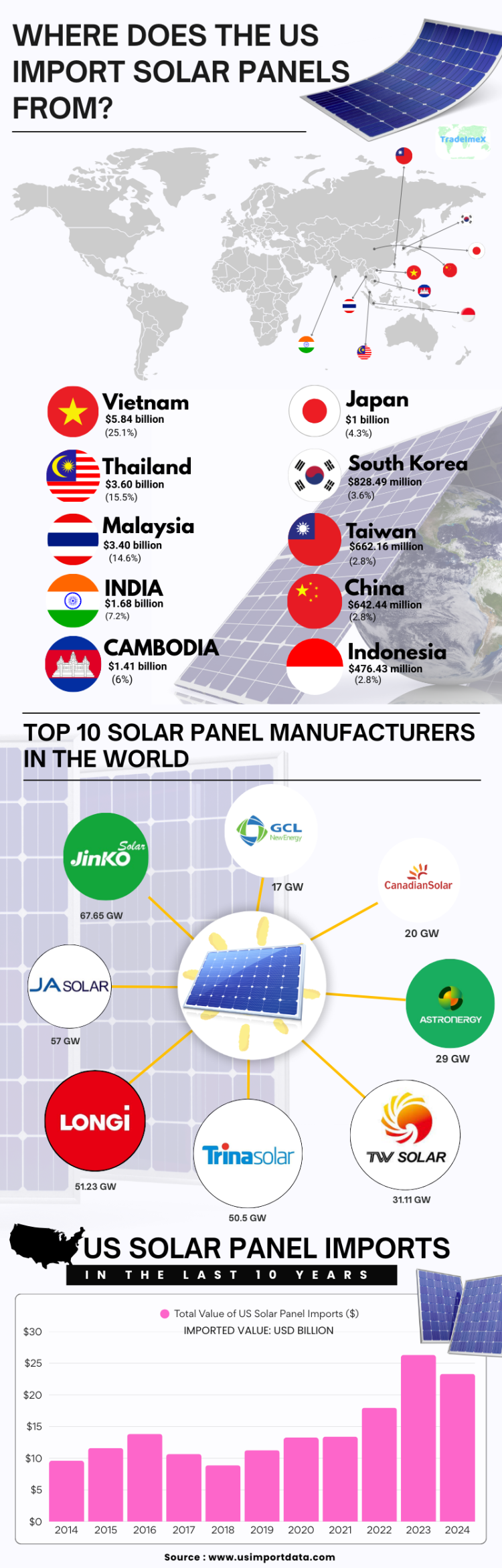
US Solar Panel Imports by Country: Where does the US Import Solar Panels from?
The United States imports solar panels from various countries around the globe. Some of the primary countries that the US imports solar panels from include China, Vietnam, Mexico, South Korea, and Malaysia. These countries are major contributors to the US solar panel market, providing a wide range of solar products to support the increasing demand for renewable energy sources in the country. The top 10 US import partners for solar panel imports into the country, as per the US shipment data and US import data by country for 2024, include:
1. Vietnam: $5.84 billion (25.1%)
Vietnam has emerged as the largest import partner for the US when it comes to solar panels, as per the data on US solar panel imports from Vietnam. With over $5.84 billion in imports, Vietnam accounts for a significant portion of the total solar panel imports into the US.
2. Thailand: $3.60 billion (15.5%)
Thailand is another key player in the US solar panel import market, with $3.60 billion worth of solar panels imported from the country. As one of the top import partners, Thailand plays a crucial role in meeting the growing demand for solar energy in the US.
3. Malaysia: $3.40 billion (14.6%)
With $3.40 billion in US solar panel imports, Malaysia is a major player in the US market, as per import data on US solar panel imports from Malaysia. As a key import partner, Malaysia provides the US with a significant portion of its solar panel needs.
4. India: $1.68 billion (7.2%)
India is another important import partner for the US when it comes to solar panels. With $1.68 billion in imports, India plays a crucial role in meeting the growing demand for renewable energy in the US.
5. Cambodia: $1.41 billion (6%)
Cambodia is a rising star in the US solar panel import market, with $1.41 billion worth of imports. As one of the top import partners, Cambodia is helping to meet the increasing demand for solar energy in the US.
6. Japan: $1 billion (4.3%)
Japan is a key player in the US solar panel import market, with $1 billion in imports. As one of the top import partners, Japan provides the US with a significant amount of its solar panel needs.
7. South Korea: $828.49 million (3.6%)
South Korea is another important import partner for the US when it comes to solar panels. With $828.49 million in imports, South Korea plays a crucial role in meeting the growing demand for renewable energy in the US.
8. Taiwan: $662.16 million (2.8%)
Taiwan is a significant player in the US solar panel import market, with $662.16 million in imports. As one of the top import partners, Taiwan helps to meet the increasing demand for solar energy in the US.
9. China: $642.44 million (2.8%)
China is a major player in the US solar panel import market, with $642.44 million in imports. Despite political tensions, China remains a crucial import partner for meeting the US demand for solar panels.
10. Indonesia: $476.43 million (2%)
Indonesia rounds out the top 10 import partners for the US in terms of solar panel imports, with $476.43 million in imports. As a key player in the US market, Indonesia helps to meet the growing demand for renewable energy.
US Solar Panel Imports in the Last 10 Years: Historical US Import Data
|
Year of Trade |
Total Value of US Solar Panel Imports ($) |
|
2014 |
$9.60 billion |
|
2015 |
$11.61 billion |
|
2016 |
$13.85 billion |
|
2017 |
$10.68 billion |
|
2018 |
$8.90 billion |
|
2019 |
$11.27 billion |
|
2020 |
$13.26 billion |
|
2021 |
$13.41 billion |
|
2022 |
$17.98 billion |
|
2023 |
$26.3 billion |
|
2024 |
$23.32 billion |
Top 10 Solar Panel Manufacturers in the World by Shipment Volume (2024-25)
The top solar panel manufacturing companies supply a bulk quantity of solar panels to the USA, as per the US shipment data. Here is a list of the leading solar panel manufacturers in the world, as per the solar panel shipment data for 2024-25:
|
Rank |
Manufacturer |
Shipment Quantity (2024) (gigawatt) |
Country of Origin |
|
1 |
JinkoSolar |
67.65 GW |
China |
|
2 |
JA Solar |
57 GW |
China |
|
3 |
LONGi Green Energy |
51.23 GW |
China |
|
4 |
Trina Solar |
50.5 GW |
China |
|
5 |
Tongwei Solar |
31.11 GW |
China |
|
6 |
CHINT/Astronergy |
29 GW |
China |
|
7 |
Canadian Solar |
20 GW |
Canada |
|
8 |
GCL System Integration |
17 GW |
China |
|
9 |
Risen Energy |
14–15 GW |
China |
|
10 |
DAS Solar |
14–15 GW |
China |
-
JinkoSolar is the biggest solar panel manufacturer in the world.
-
9 out of the 10 top solar manufacturers in 2024 are Chinese companies.
-
China continues to dominate the global solar PV manufacturing market, contributing most of the top global shipments.
Challenges for Top Solar Panel Manufacturers
The top solar panel manufacturers in the US are facing several challenges as a result of the tariffs on imports. Not only are they dealing with higher production costs due to the increased cost of imported materials, but they are also facing stiff competition from manufacturers in other countries that are not subject to the same tariffs. This has put US manufacturers at a disadvantage in the global market, making it harder for them to compete.
US Solar Panel Market Overview (2024–2025)
1. Import Trends
|
Metric |
Value (2024) |
Notes |
|
Total Solar Panel Imports |
54.3 GW ($23.32 billion) |
Exceeds annual installation demand |
|
Panel Imports from Southeast Asia |
87.5% of imports (13 GW of 14.8 GW) |
Vietnam, Thailand, Malaysia, and Cambodia dominate |
|
Silicon Cell Imports |
13.89 GW |
Reflects the domestic cell production gap |
2. Tariff Summary on US Solar Panel Imports
|
Tariff Type |
Rate (2024–2025) |
Applies To |
|
Section 201 Tariff |
14.25% |
Crystalline silicon PV cells and modules |
|
Section 301 Tariff |
Increased from 25% to 50% |
Solar cells & modules from China as per Chinese solar panel import tariff |
|
Anti-Dumping Duties (Preliminary) |
53.3%–271.28% (Vietnam), 125.37% (Cambodia), 77.85%–154.68% (Thailand), 21.31%–81.24% (Malaysia) |
Modules from Southeast Asia |
3. Pricing Trends
-
Module Cost Increase: Tariffs have led to 91% to 286% price hikes, raising costs from $0.10 to $0.19–$0.38 per watt.
-
Utility-Scale Project Costs: Estimated increase of ~$300/kW, approximately 30% higher.
-
Consumer Impact: Residential solar prices have risen by $0.10–$0.15 per watt, equating to a 20–25% increase.
4. Shipment & Logistics Trends
-
Shipping Costs: A 40-foot container cost surged to ~$5,900 in July 2024, marking a 286% year-over-year increase.
-
Logistical Challenges: Events like the Red Sea crisis and the Francis Scott Key Bridge collapse have disrupted supply chains.
5. Domestic Manufacturing & Policy Response
-
Manufacturing Capacity: U.S. solar module production capacity increased over fivefold to 45 GW by October 2024.
-
Inflation Reduction Act (IRA): Provides tax credits to bolster domestic solar manufacturing, including:
-
Solar cells: $0.04 per watt
-
Solar modules: $0.07 per watt
-
Polysilicon: $3 per kilogram.
Market Outlook & Strategic Implications
-
Installation Projections: Due to increased costs from tariffs, U.S. solar installations may decline to 20–25 GW in 2025, compared to 35–40 GW without tariff impacts.
-
Domestic Manufacturing Growth: Tariffs are incentivizing the expansion of U.S. solar manufacturing, with projections of:
-
5 GW/year increase in wafer capacity
-
12 GW/year in cell capacity
-
19.2 GW/year in module capacity by 2027.
-
Supply Chain Challenges: Despite growth, domestic production cannot yet meet demand, leading to continued reliance on imports.
-
Industry Division: Installers and manufacturers are split on tariff impacts; installers face higher costs, while manufacturers benefit from reduced foreign competition.
Strategic Recommendations
-
For Installers: Diversify supplier base and consider domestic manufacturers to mitigate tariff impacts.
-
For Policymakers: Balance trade protection with the need for affordable solar energy to ensure continued growth in installations.
-
For Investors: Monitor companies expanding U.S. manufacturing, as they may benefit from both IRA incentives and reduced competition from imports.
Analyst Insights
-
Southeast Asia Dominance: Over 80% of panel imports originate from just 4 countries.
-
Tariff Shockwaves: 2025 installations could drop 35–40% if dependency on imports persists.
-
Local Capacity Gap: U.S. manufacturers can't yet meet utility-scale demand without imports.
Strategies for Overcoming Tariffs
To overcome the challenges posed by the tariffs on solar panel imports, top solar panel manufacturers in the US are exploring several strategies. One approach is to focus on innovation and technology to reduce production costs and increase the efficiency of solar panels. By investing in research and development, manufacturers can stay ahead of the competition and offer products that are more competitive in the market.
Another strategy is to diversify their supply chain and sources of materials. By sourcing materials from countries that are not subject to tariffs, manufacturers can reduce their production costs and remain competitive in the market. This may involve changing suppliers or investing in domestic manufacturing to reduce reliance on imported materials.
The Future of the Solar Panel Industry in the US
Despite the challenges posed by tariffs on solar panel imports, the future of the solar panel industry in the US remains bright. The demand for clean and renewable energy sources is on the rise, and solar energy continues to be a popular choice for consumers looking to reduce their carbon footprint and save on energy costs. With continued innovation and investment in research and development, top solar panel manufacturers in the US can overcome the challenges posed by tariffs and remain competitive in the global market.
Final Take: What’s Next for Solar Panel Manufacturers & US Importers?
✅ Manufacturers need to localize production or face exclusion from the US market.
✅ Importers to shift sourcing toward tariff-free nations or expand US partnerships.
✅ Buyers should watch for new rules from the Department of Commerce and USTR decisions in mid-2025.
Conclusion
In conclusion, the tariffs on solar panel imports have presented significant challenges for the top solar panel manufacturers in the US. However, by implementing strategic measures such as focusing on innovation, diversifying the supply chain, and investing in research and development, manufacturers can overcome these challenges and continue to thrive in the growing solar energy market. The future looks bright for the solar panel industry in the US, and manufacturers are ready to face whatever comes next.
In the end, we hope that you liked our insightful blog report on US solar imports and the tariff impacts. Visit USImportdata to get the latest market trends and exclusive US import-export data. Contact us at info@tradeimex.in and get a list of the top solar panel import companies in the US.
What's Your Reaction?