Trump Imposes 25% Tariffs on South Korean Imports: Impact on US-South Korea Bilateral Trade
Explore the latest updates on US–Korea trade tariffs, including the South Korea–US trade deal, Trump’s 25% tariff hike, & its impact on bilateral trade.
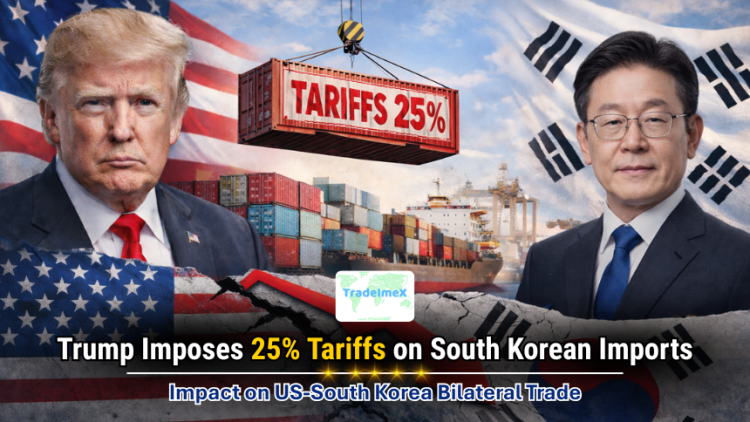
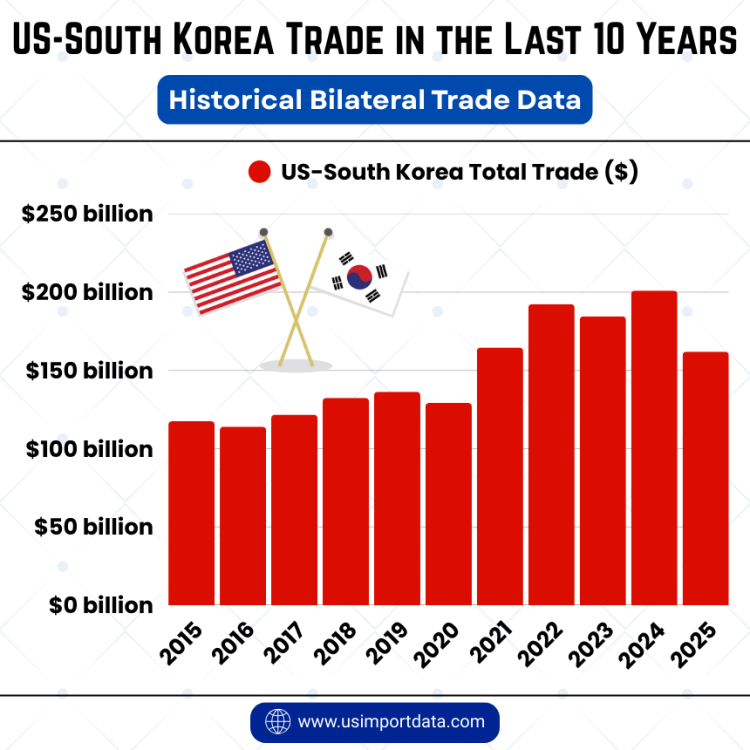
In a dramatic turning point for U.S.–South Korea trade relations, U.S. President Donald Trump has announced an increase in tariffs on South Korean imports from 15% to 25%, citing Seoul’s delay in ratifying a bilateral trade agreement struck in 2025. The announcement has triggered market volatility, diplomatic tension, and fresh concerns about long-term impacts on global trade. As far as bilateral trade is concerned, South Korea exported goods worth $123 billion to the US in 2025, according to the latest US import data and South Korea export data. The total US-South Korea trade value reached $201 billion in 2024 and $162 billion in 2025, as per the US export data.
South Korea is the 7th largest trade partner of the USA, as per the global trade data. This blog analyzes the background of the tariff hike, the precise policy changes, economic data on bilateral trade, reactions from industry and governments, and short- and long-term implications for firms, consumers, and geopolitics.
Background: US–South Korea Trade Ties at a Crossroads
The Korea–U.S. Trade Framework
The U.S. and South Korea have a long-standing trade relationship, established under the United States–Korea Free Trade Agreement (KORUS FTA), which was originally signed in 2012. That pact eliminated most tariffs between the two economies and provided preferential market access.
However, upon taking office for a second term in 2025, President Trump began a sweeping reconfiguration of U.S. trade policy. He initiated broad tariffs on a range of imports, including metals, automobiles, and industrial goods, often citing trade deficits and national security. South Korea, a major exporter, quickly found itself affected.
The 2025 Trade Deal and Tariff Adjustment
In July 2025, Washington and Seoul negotiated a new strategic trade and investment package. As part of that understanding:
-
The U.S. agreed to cut reciprocal tariffs on South Korean imports, including cars and parts, from 25% to 15%.
-
South Korea pledged to invest USD 350 billion in U.S. sectors (semiconductors, shipbuilding, biotech, etc.).
-
Seoul would also expand access for U.S. goods and reduce non-tariff barriers.
That tariff reduction went into effect on November 1, 2025, giving Korean exporters a competitive footing comparable to Japan and the EU.
The 2026 Tariff Reversal: What Changed
On January 26, 2026, President Trump announced on social media that the U.S. would raise tariffs on South Korean automobiles, lumber, pharmaceuticals, and other imports back to 25 % because South Korea’s National Assembly had not yet ratified the 2025 trade agreement. This higher levy would apply to key export categories if implemented. The rationale provided by the White House was that the U.S. had honored its commitments, but South Korea had failed to enact the enabling legislation needed to make the deal binding.
As of January 29, 2026, South Korea has not officially received formal notice of this tariff revision, but diplomatic consultations have been scheduled, including a visit by South Korea’s Industry Minister to Washington. US Korea trade tariff discussions have resurfaced as South Korea US trade deal tariffs are debated alongside the Tariff impact on the US economy, with analysts pointing to the US Tariff deal with South Korea and the South Korea Trump trade deal as context for Trump tariffs on South Korea and broader US-South Korea trade relations.
Meanwhile, the South Korea US trade deal narrative shifted after Trump hiked South Korea Tariffs to 25%, prompting questions about US tariffs on South Korea imports, with critics asking Is Trump putting tariffs on korea as Washington confirms the US imposes tariffs on South Korea.
Highlights of the U.S.–South Korea Trade in 2025
-
Bilateral Trade: Total trade between the U.S. and South Korea reached about $162 billion in 2025, underscoring South Korea’s role as a major U.S. trading partner despite rising tariff pressures.
-
Export Dependence: South Korean exports to the U.S. stood at $122.9 billion, making up roughly 17% of South Korea’s total exports for the year.
-
Trade Balance: The U.S. continued to run a trade deficit with South Korea in 2025.
-
Key Export Sector: Automobiles remained South Korea’s leading export category to the U.S., with shipments valued at $30.2 billion.
-
Tariff Developments: A 15% tariff on South Korean auto imports was introduced after a July 2025 agreement, followed by threats to raise it to 25% amid ongoing trade disputes.
-
Investment Commitments: To secure favorable trade conditions, South Korea pledged a $350 billion investment package targeting U.S. strategic industries such as semiconductors and shipbuilding.
-
Monthly Trade Snapshot: In November 2025, South Korea posted a $4.25 billion trade surplus with the U.S., exporting $10.4 billion worth of goods while importing $6.1 billion.
Top Goods that the US Imports from South Korea
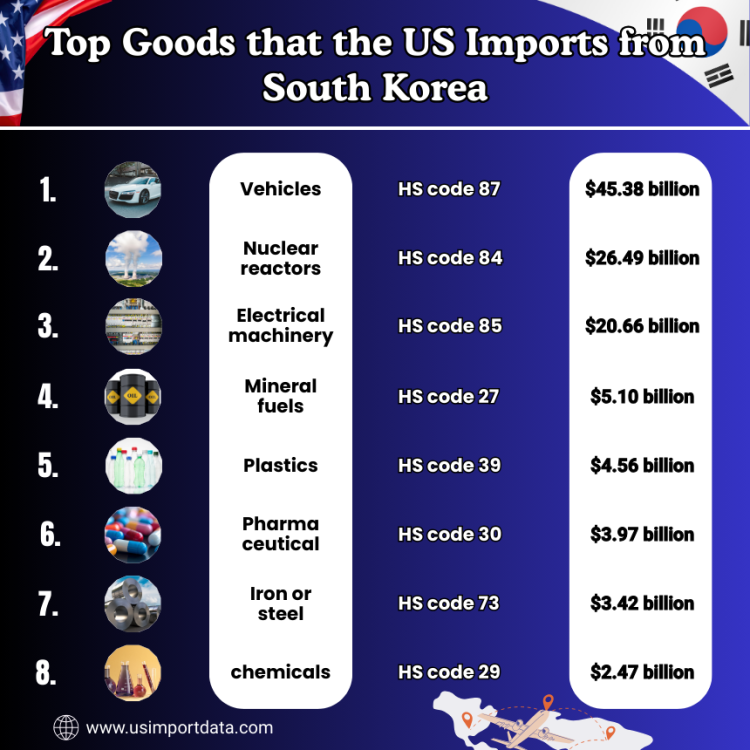
The United States imports a variety of top goods from South Korea, with electronics, automobiles, and machinery ranking high on the list. South Korea is known for producing high-quality consumer electronics such as smartphones, televisions, and computer components that are popular imports in the US market. Additionally, South Korean automakers have gained recognition for their innovation and reliability, making vehicles like Hyundai and Kia sought-after imports in the US automotive industry. The top 10 commodities that the US imports from South Korea, as per the US shipment data for 2025, include:
1. Vehicles (HS code 87): $45.38 billion
One of the top goods that the US imports from South Korea is vehicles. In fact, vehicles are the largest category of goods imported from South Korea, with a total value of $45.38 billion, as per the data on US vehicle imports from South Korea by HS code. South Korea is well-known for its automotive industry, and brands like Hyundai and Kia have a strong presence in the US market.
2. Nuclear reactors & machinery (HS code 84): $26.49 billion
Another significant category of goods imported from South Korea is nuclear reactors and machinery, with a total value of $26.49 billion. South Korea has a strong reputation for producing high-quality machinery and equipment, and the US imports a large amount of these goods for various industries.
3. Electrical machinery & equipment (HS code 85): $20.66 billion
Electrical machinery and equipment are also key goods imported from South Korea, with a total value of $20.66 billion. South Korea is known for its technological advancements, and the US often imports electrical machinery and equipment for use in various sectors such as electronics and telecommunications. These products include items like televisions, smartphones, and other consumer electronics that are popular among American consumers.
4. Mineral fuels & oils (HS code 27): $5.10 billion
Mineral fuels and oils are another category of goods that the US imports from South Korea, with a total value of $5.10 billion. These goods are essential for the US economy, and South Korea is a key supplier of mineral fuels and oils to the US market.
5. Plastics & articles thereof (HS code 39): $4.56 billion
Plastics and articles thereof are also among the top goods imported from South Korea, with a total value of $4.56 billion, as per the data on US plastic imports from South Korea. South Korea produces a wide range of plastic products, and the US imports a significant amount of these goods for various purposes.
6. Pharmaceutical products (HS code 30): $3.97 billion
Pharmaceutical products are another important category of goods imported from South Korea, with a total value of $3.97 billion. South Korea is known for its pharmaceutical industry, and the US often imports medicines and other healthcare products from South Korea.
7. Articles of iron or steel (HS code 73): $3.42 billion
Articles of iron or steel are also key goods that the US imports from South Korea, with a total value of $3.42 billion. South Korea produces a variety of iron and steel products, which are often used in construction and manufacturing in the US.
8. Organic chemicals (HS code 29): $2.47 billion
Organic chemicals are another category of goods imported from South Korea, with a total value of $2.47 billion. These chemicals are used in various industries, including pharmaceuticals, agriculture, and manufacturing.
9. Miscellaneous chemical products (HS code 38): $2.23 billion
Miscellaneous chemical products are also among the top goods imported from South Korea, with a total value of $2.23 billion. South Korea is a major producer of chemical products, and the US imports a variety of these goods for different applications.
10. Optical, medical, surgical instruments (HS code 90): $2.13 billion
Lastly, optical, medical, or surgical instruments are important goods imported from South Korea, with a total value of $2.13 billion. South Korea is known for its advanced medical technology, and the US often imports these instruments for healthcare facilities.
South Korea’s Trade Exposure to the United States: The Data
The tariff shock must be understood in the context of how deeply South Korea’s exports are tied to the U.S. market.
Export Volumes and Values
-
South Korea’s total exports reached a record USD 709.4 billion in 2025, up 3.8 % from 2024.
-
Exports to the United States stood at USD 122.9 billion, down 3.8 % from the prior year but still the second-largest destination after China.
-
The automotive sector alone accounted for USD 30.2 billion in U.S. auto exports (about 25 % of total U.S. shipments), despite a 13.2 % year-on-year decline.
Sector Sensitivities
-
Automobiles and auto parts are especially vulnerable, historically commanding a large U.S. market share.
-
Electronics, semiconductors, and components also form a significant share of bilateral trade and can indirectly feel tariff pressure through supply chain disruptions.
-
Pharmaceuticals and lumber, cited explicitly in the tariff announcement, represent smaller but meaningful categories in U.S. imports.
These figures underline how critical U.S. access is for South Korea’s export-driven economy.
US-South Korea Trade in the Last 10 Years: Historical Bilateral Trade Data
|
Year of Trade |
US-South Korea Total Trade ($) |
|
2015 |
$117.54 billion |
|
2016 |
$114.14 billion |
|
2017 |
$121.77 billion |
|
2018 |
$132.49 billion |
|
2019 |
$136.43 billion |
|
2020 |
$129.31 billion |
|
2021 |
$164.71 billion |
|
2022 |
$192.34 billion |
|
2023 |
$184.55 billion |
|
2024 |
$201 billion |
|
2025 |
$162 billion |
Market Reacts: Financial and Corporate Responses
The news of the tariff threat triggered volatile market reactions:
-
South Korean automaker stocks (e.g., Hyundai, Kia) dropped sharply in early trading on reports of tariff escalation, before partly recovering.
-
The Korean won weakened against the U.S. dollar, reflecting investor concern over export competitiveness and economic growth prospects.
Analysts suggested that markets were interpreting not just the direct impact on exports but also the broader implications for investor confidence and global risk.
Potential Economic Impacts
Consumers and Businesses in the U.S.
Higher tariffs on Korean products are likely to:
-
Increase costs for American consumers on goods like automobiles and electronics that incorporate Korean imports.
-
Disrupt U.S. supply chains, especially in automotive and technology sectors, where South Korean parts are integrated upstream.
-
Possibly lead to inflationary pressures on consumer prices as import levies are passed downstream.
South Korean Economy
For South Korea:
-
The tariff hike could reduce export competitiveness, especially in price-sensitive markets like automobiles.
-
Industries may be forced to shift production strategies, source alternative markets, or absorb tariff costs, squeezing margins.
-
Potential for retaliatory tariffs on U.S. goods can escalate trade friction further, affecting agricultural exports and machinery.
Bilateral Investment
The tariff dispute complicates the implementation of the USD 350 billion investment plan promised in 2025:
-
Uncertainty about legislative ratification in Korea muddies investor certainty.
-
Firms hesitant about regulatory risk may delay or cancel deployment of capital.
-
Investment decisions in high-value sectors (semiconductors, biotech) may be postponed.
Political and Diplomatic Fallout
Seoul’s Domestic Politics
South Korea’s National Assembly had not approved the enabling legislation, a key reason cited for the tariff reversal. This reflects domestic debate and political maneuvering over whether to commit to the terms negotiated with Washington.
Seoul has responded by sending officials to negotiate and emphasize a collaborative approach rather than retaliation.
U.S. Alliance Considerations
The tariff action has raised questions about alliance stability:
-
Analysts and commentators (including Chinese experts) argue that unilateral tariff threats against a key security ally risk undermining trust and introducing uncertainty beyond trade.
-
Treasury officials have publicly encouraged South Korea to move forward with trade deal ratification, tying the tariff status directly to legislative action.
Legal and Policy Mechanics
The procedural aspects of implementing a tariff hike, such as issuance of an executive order or Federal Register notice, have not yet been formalized as of late January 2026. This means the 25 % rate is a political signal as much as a finalized policy.
There’s also a pending U.S. Supreme Court case on the president’s authority to impose sweeping, country-specific tariffs under the International Emergency Economic Powers Act (IEEPA), which could impact the legal grounding of these tariff actions.
Long-Term Strategic Implications
This episode fits into a larger narrative of shifting global trade relations under “America First” policy priorities:
-
Trade policy is increasingly used as leverage in negotiations over investment and regulatory access.
-
Allies like South Korea find themselves balancing security cooperation with economic dependence on large U.S. markets.
-
Competitors such as the EU and India are pursuing liberalized trade deals, potentially leaving the U.S. more isolated if its tariff approach continues.
What’s Next?
Ratification Watch
-
South Korea’s parliament is expected to debate the enabling trade legislation in early February 2026, a pivotal moment that could determine whether tariffs revert to 15%.
Diplomatic Engagement
-
Bilateral meetings between South Korean ministers and U.S. trade officials are planned, but high stakes, with both sides negotiating timing and terms.
Market Signals
-
Both investors and industries will monitor whether this tariff threat becomes concrete and assess pricing, supply chain rerouting, and production reshoring strategies accordingly.
Major Highlights of the US Tariffs of 25% on South Korean Imports
-
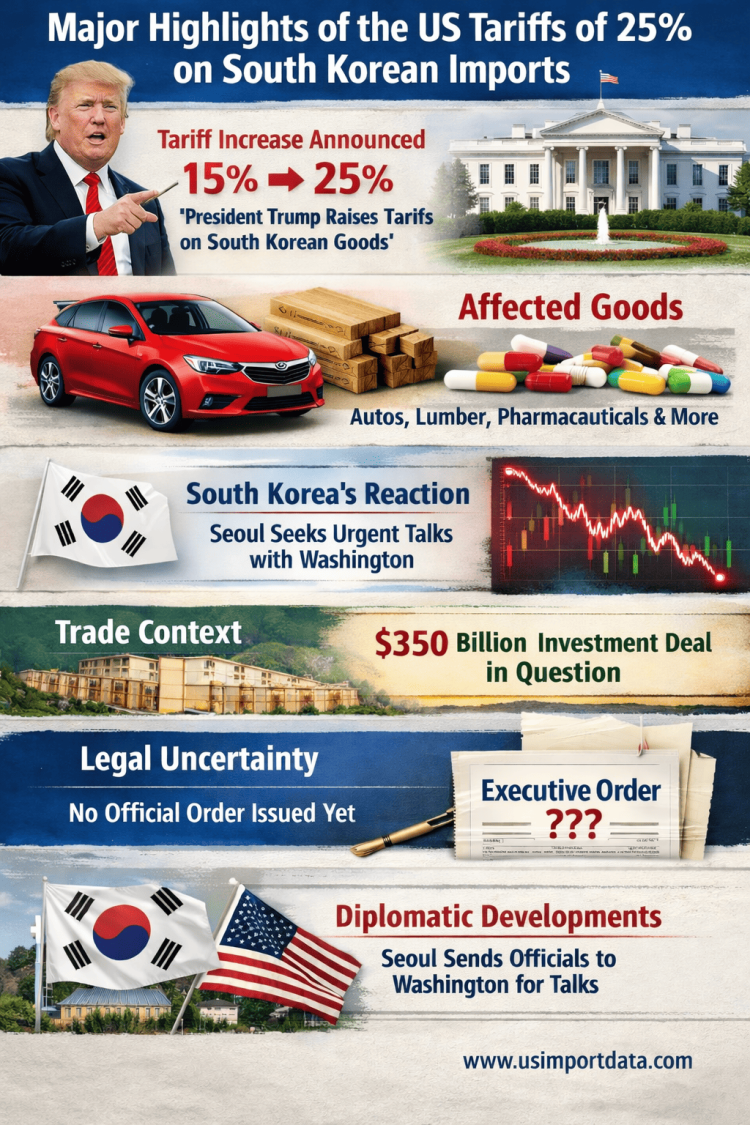
Tariff Increase Announced: U.S. President Donald Trump said he is raising tariffs on South Korean imports from 15% to 25%, marking a significant shift in trade policy.
-
Reason Cited: The White House framed the move as a response to delays by the South Korean legislature in ratifying a trade deal previously agreed upon in July 2025.
-
Affected Goods: The higher tariffs target a wide range of products, including automobiles, lumber, pharmaceuticals, and other goods.
-
South Korea’s Reaction: Officials in Seoul said they had not received formal official notice of the tariff hike and sought urgent talks with Washington to clarify the situation.
-
Market Impact: South Korean markets initially reacted with stock losses, particularly for major automakers, before some recovery.
-
Trade Context: The tariff move comes amid broader trade tensions and discussions of a deal that included a promise by South Korea of $350 billion in U.S. investments in return for tariff reductions.
-
Legal and Timing Uncertainty: As of the reports, no executive order had yet been issued formally implementing the tariff hike, leaving the timing and legal specifics unclear.
-
Diplomatic Developments: South Korea planned to send officials to Washington for consultations to resolve the issue.
Conclusion and Final Verdict
In conclusion, the Trump administration’s move to impose 25 % tariffs on South Korean imports marks a serious escalation in trade policy that reverberates across industries, markets, and diplomatic channels. It underscores how trade instruments like tariffs are now used not only for economic protectionism but also as leverage in negotiating broader bilateral commitments.
For South Korea, a highly trade-dependent economy, and for the U.S., intent on reshaping global trade norms, this episode could redefine how allies negotiate trade, investment, and industrial cooperation in an increasingly uncertain world.
We hope that you liked our data-driven and insightful blog report on the US tariffs on South Korean imports imposed by Trump. For more insights into the latest US trade data, or to search live US import-export data by country, visit USImportdata. Contact us at info@tradeimex.in for customized trade reports and market insights.
What's Your Reaction?