Data-Driven Analysis of US Lithium Imports by Country 2024-25: Where America Gets its Lithium From?
Data-driven analysis of US lithium imports by country in 2024–25. Explore top suppliers like China, Singapore, Israel, Japan, and Canada, import values, 10-year trade trends, tariffs, and America’s lithium supply chain challenges.
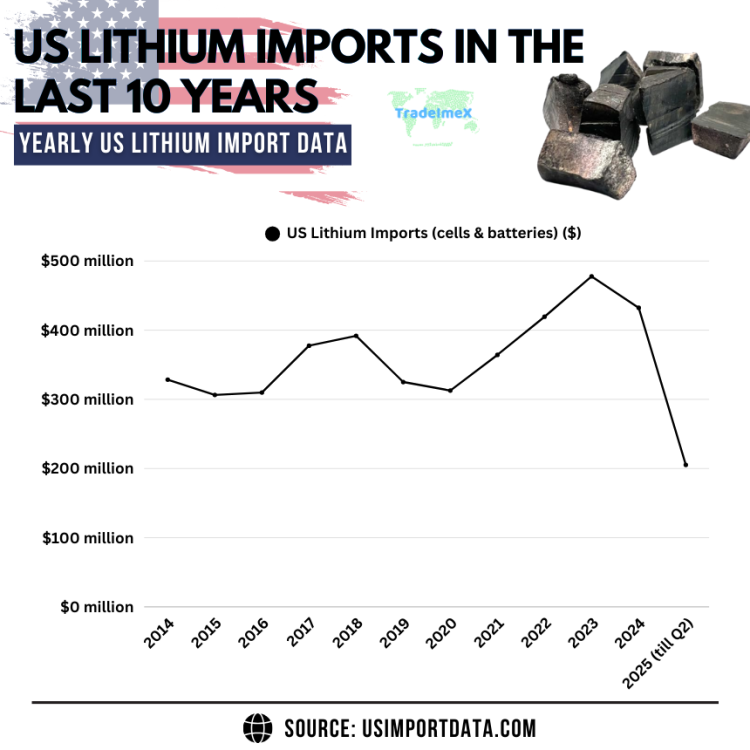
Lithium isn’t just another commodity, it’s the backbone of modern life. From smartphones and laptops to electric vehicles and renewable energy storage, lithium cells and batteries fuel the technology that powers our daily routines and America’s clean energy ambitions. According to the US import data and Lithium import data of USA, the total value of US lithium imports reached $432.36 million in 2024, a 9% decline from the previous year. The total value of US lithium imports (cells & batteries) accounted for $205.29 million in the first 6 months of 2025. As demand for clean energy grows, many ask Where does the US import lithium from, a question closely tied to the rapid rise in importing lithium batteries for electric vehicles and electronics.
Regulations and supply chains around importing lithium batteries into US continue to evolve, while every major lithium battery importer plays a crucial role in meeting industrial, automotive, and consumer energy needs. The global lithium supply by country is dominated by nations like Australia, Chile, and China, which collectively produce the majority of the world’s lithium. As demand for electric vehicles and renewable energy storage rises, identifying reliable lithium buyers and long-term partners has become increasingly important. In particular, lithium buyers in USA are actively seeking sustainable sources to support domestic battery production and reduce dependency on foreign suppliers. Additionally, lithium importers play a vital role in connecting producers with manufacturers, ensuring a steady flow of high-quality raw materials for the growing clean energy sector.
While the U.S. is investing heavily in domestic gigafactories and lithium mining projects, the reality in 2024–25 is clear: America still relies on imports for most of its lithium batteries. These fall under HS Code 850650, which specifically covers primary lithium cells and batteries (excluding spent units). The big question is: where do these imports actually come from, and how is the U.S. supply chain evolving as demand skyrockets? The US is the biggest importer of lithium in the world, as per the global trade data.
This blog takes a data-driven look at US lithium battery imports by country, using trade codes, importer/supplier records, and global market snapshots.
The Scale of the US Lithium Imports (Cells & Batteries)
Import Volumes and Value
Lithium batteries under HS 850650 represent a multi-billion-dollar global trade category.
-
Global context: In 2024, worldwide imports of lithium primary cells and batteries (HS 850650) totaled about $3.80 billion, with shipments weighing 46.87 kilotonnes.
-
U.S. trade snapshots: Global records show that back in July 2020, U.S. imports under HS 850650 amounted to $29.8 million (CIF) in a single month, with exports of $45.9 million (FOB). Even at that time, America was already both a major importer and exporter, as per the data on US lithium importers.
-
Fast-forward to 2024–25: The US lithium imports reached over $432 million in 2024.
US Lithium Imports by Country in 2024-25: Where Does the US Import Lithium From?
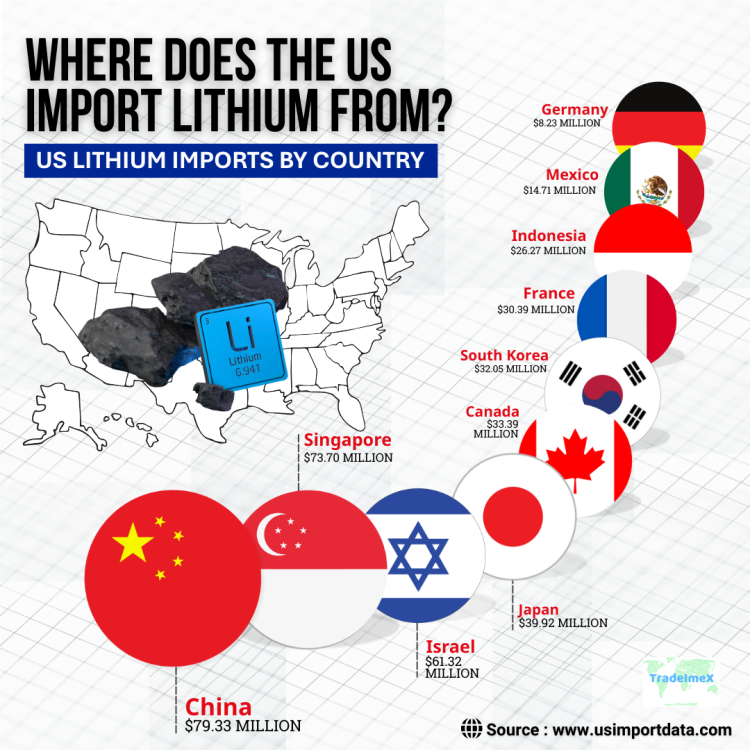
In examining US Lithium Imports by Country, it is crucial to understand where the US imports lithium from. The United States primarily sources its lithium imports from various countries across the globe, with the main suppliers being Chile, Argentina, and Australia. These countries are major producers of lithium, providing the US with a significant portion of this essential mineral for industries such as electronics, electric vehicles, and energy storage. The top 10 suppliers of lithium cells & batteries to the US, as per the US lithium imports by country and US lithium import statistics for 2024-25, include:
1. China: $79.33 million (18.3%)
China tops the list as the leading supplier of lithium to the US, accounting for 18.3% of total imports, as per US lithium imports from China. China's dominance in the lithium market can be attributed to its vast reserves of lithium and its position as a major producer of lithium-ion batteries.
2. Singapore: $73.70 million (17%)
Singapore is the second-largest source of lithium imports for the US, accounting for 17% of total imports. Singapore serves as a key hub for the distribution of lithium products in the Asia-Pacific region, making it a strategic partner for the US in securing a stable supply of lithium.
3. Israel: $61.32 million (14.2%)
Israel follows closely behind Singapore as the third-largest supplier of lithium to the US, with a market share of 14.2%. Israel is known for its advanced technologies in lithium extraction and battery production, making it a reliable source of high-quality lithium products.
4. Japan: $39.92 million (9.2%)
Japan ranks fourth in terms of lithium imports to the US, contributing 9.2% to the total imports. Japan is renowned for its innovative approach to lithium battery technology and its strong network of suppliers, making it a valuable partner for the US in meeting its lithium needs.
5. Canada: $33.39 million (7.7%)
Canada is the fifth-largest source of lithium imports for the US, accounting for 7.7% of total imports. Canada's vast reserves of lithium and its proximity to the US market make it an attractive option for securing a stable supply of lithium in the coming years.
6. South Korea: $32.05 million (7.4%)
South Korea closely follows Canada as the sixth-largest supplier of lithium to the US, with a market share of 7.4%, as per the data on US lithium imports from South Korea by HS code. South Korea is home to several leading lithium battery manufacturers, making it a key player in the global lithium supply chain.
7. France: $30.39 million (7%)
France is the seventh-largest source of lithium imports for the US, contributing 7% to the total imports. France's focus on renewable energy technologies and sustainable practices has helped it emerge as a significant player in the lithium market.
8. Indonesia: $26.27 million (6.1%)
Indonesia ranks eighth in terms of lithium imports to the US, with a market share of 6.1%. Indonesia's rich deposits of lithium ore and its growing presence in the global lithium market make it a promising source of lithium for the US.
9. Mexico: $14.71 million (3.4%)
Mexico is the ninth-largest supplier of lithium to the US, accounting for 3.4% of total imports. Mexico's proximity to the US market and its increasing investments in lithium production make it an important player in the North American lithium supply chain.
10. Germany: $8.23 million (1.9%)
Germany rounds out the top ten countries from which the US imports lithium, with a market share of 1.9%. Germany's strong focus on sustainable technologies and its expertise in lithium battery manufacturing make it a valuable partner for the US in meeting its lithium requirements.
US Lithium Imports in the Last 10 Years: Yearly US Lithium Import Data
|
Year of Imports |
US Lithium Imports (cells & batteries) ($) |
|
2014 |
$328.51 million |
|
2015 |
$306.45 million |
|
2016 |
$309.87 million |
|
2017 |
$377.59 million |
|
2018 |
$391.83 million |
|
2019 |
$325.09 million |
|
2020 |
$312.72 million |
|
2021 |
$364.28 million |
|
2022 |
$419.39 million |
|
2023 |
$477.71 million |
|
2024 |
$432.36 million |
|
2025 (till Q2/first 6 months) |
$205.29 million |
Importance of Lithium Imports for the US
Lithium is a critical component in the production of rechargeable batteries, particularly those used in electric vehicles. As the US seeks to transition to a greener economy, the demand for lithium is expected to continue growing. However, the US does not have significant domestic lithium reserves, making it reliant on imports to meet its needs, as per the reports of Lithium Statistics and Information.
Why US Lithium Imports Still Dominate
The U.S. has invested in lithium battery gigafactories from Tesla, Panasonic, LG Energy Solution, and others. But these factories mainly assemble cells, they don’t fully eliminate the need for imported finished lithium cells or specialized battery types. Certain niches, like coin cells, button batteries, and industrial lithium primaries used in medical devices or defense applications are overwhelmingly imported, often from Asia and Europe.
Where Do America’s Lithium Batteries Come From?
Let’s look at the supplier landscape.
Key Exporting Countries to the U.S.
Trade data from the US highlights that the U.S. imports lithium cells and batteries from a diverse mix of countries. The leading ones include:
-
China – Dominates global lithium battery production, especially primary cells and consumer-grade batteries. Companies like CATL and multiple tier-2 suppliers are central here.
-
Japan – Home to Panasonic, Maxell, and other electronics giants supplying specialized lithium batteries.
-
South Korea – A hub for advanced battery manufacturing, with companies like LG Energy Solution and Samsung SDI.
-
Singapore & Indonesia – Important regional trade hubs, often acting as re-export points for Asian-produced batteries.
-
Israel – Known for defense-grade and specialized battery technologies.
-
European players (France, Switzerland, U.K.) – Companies like Saft supply industrial lithium primaries used in energy, aerospace, and defense.
In short: most of America’s lithium primary batteries in 2024–25 still arrive from Asia, with niche but critical supplies from Europe and Israel.
Top U.S. Importers of Lithium
Who’s bringing these batteries into the country? Data shows:
-
Duracell – One of the biggest U.S. brands for lithium primaries.
-
Panasonic Corporation of North America – Supplies a wide spectrum of consumer and industrial batteries.
-
Maxell Corporation of America – Specializes in smaller lithium cells.
-
Mouser Electronics – A major distributor importing batteries for integration into electronics products.
-
NextEra – Tied to energy storage and infrastructure applications.
This reveals an interesting split: part consumer brands, part distributors, part industrial users.
Trade Mechanics: Tariffs and Costs
Lithium batteries (HS 850650) face a Most Favored Nation (MFN) tariff rate of 2.7% in the United States.
However, under free trade agreements (FTAs), such as with Chile, some imports can qualify for tariff exemptions. This tariff structure matters because a 2.7% duty on a $30 million monthly import bill equates to nearly $810,000 in duties per month, influencing sourcing decisions.
Given the competitive nature of lithium battery supply chains, even small tariff margins can push U.S. buyers toward FTA partners where available.
Geopolitical and Supply Chain Factors
The story of lithium imports isn’t just about trade numbers, it’s about geopolitics, supply risk, and policy.
The China Factor
China is the undisputed leader in lithium cell production. For the U.S., this creates a dilemma: while Chinese suppliers are often the cheapest and most available, policymakers want to reduce dependency on Chinese critical minerals and components.
The Inflation Reduction Act (IRA) provides incentives for sourcing from free trade partners or domestic suppliers, potentially reshaping import patterns by 2025.
Asian Allies as Balancers
Japan and South Korea remain vital U.S. allies in technology supply chains. Both supply critical lithium batteries and are politically safer sources than China. Expect imports from these countries to remain stable or grow.
European & Niche Suppliers
For defense, aerospace, and medical devices, the U.S. relies on trusted European suppliers like Saft (France). While small in volume, these imports are critical for high-reliability applications.
The Shift Toward Domestic Production
While US lithium imports under HS 850650 remain high, the U.S. is scaling domestic lithium battery output:
-
Gigafactories by Tesla, GM, and Panasonic in Nevada, Texas, and Michigan.
-
New projects under construction in Kentucky, Georgia, and North Carolina.
-
Policy incentives: billions in DOE loans and IRA subsidies.
But here’s the catch: most of these projects focus on secondary (rechargeable) lithium-ion batteries (HS 850760) rather than the primary lithium batteries (HS 850650) that are still heavily imported. This distinction means imports of HS 850650 will remain structurally necessary, even as the U.S. builds out EV supply chains.
Looking at 2024–25: What the Data Suggests
Based on the trends, here’s what a 2024–25 analysis of U.S. lithium imports under HS 850650 points to:
-
Import Values Remain Strong
Likely above $350–400 million annually, given historical data and global demand growth. -
Asia Dominates
China, Japan, and South Korea supply the bulk of volumes, with Singapore and Indonesia serving as trade intermediaries. -
Specialized European Suppliers
A small but steady share comes from France, Israel, and the U.K. for defense, aerospace, and medical applications. -
Policy May Shift Flows
Incentives may nudge imports toward FTA partners (e.g., Chile) or non-China suppliers, though practical alternatives are limited. -
No Near-Term Domestic Substitution
Since U.S. battery factories focus on lithium-ion (rechargeable) cells, imports of primary lithium batteries will stay critical.
Risks and Vulnerabilities
-
Geopolitical risk: If U.S.–China relations sour further, imports from China could face tariffs or restrictions.
-
Supply concentration: Heavy dependence on a few countries creates vulnerability.
-
Technology risk: Shifts in consumer electronics or military tech could change demand patterns unexpectedly.
Conclusion: America’s Lithium Battery Dependence
In conclusion, in 2025, the U.S. continues to import the vast majority of its lithium in the form of primary cells and batteries under HS 850650. The data shows a supply chain dominated by Asian producers (China, Japan, South Korea), supplemented by niche but critical suppliers in Europe and Israel. US lithium imports are worth hundreds of millions annually, with top American importers including Duracell, Panasonic, Maxell, Mouser Electronics, and NextEra. While U.S. policy is pushing for domestic self-reliance in lithium and batteries, the focus is overwhelmingly on rechargeable EV-grade lithium-ion cells. For primary lithium batteries, the kinds that power watches, medical implants, defense devices, and countless small electronics, the US will remain import dependent for years to come.
The challenge now is balancing cost, supply security, and geopolitical alignment while building resilience in one of the most strategically important supply chains of the 21st century.
Contact USImportdata at info@tradeimex.in for customized trade reports on the latest US export-import data, market insights, and a verified list of the top lithium importers in the US.
What's Your Reaction?