US Lumber Import Report 2025: Database of US Lumber Imports by Country under HS Code 4407
Discover US lumber imports by country with accurate lumber import data and major lumber importers & buyers in USA shaping the US lumber imports industry.

The United States is one of the world’s largest consumers of wood and wood-based products. From residential construction to furniture manufacturing, lumber plays a critical role in the American economy. In 2025, global trade dynamics, supply chain adjustments, tariffs, and housing demand continued to influence the flow of lumber into the U.S. According to the latest US import data and Lumber import data of the USA, the total value of US lumber imports reached $7.44 billion in 2025, a 5% decline from the previous year. The US imported lumber at a total quantity of 30.68 million cubic meters in 2025, according to US lumber import data.
-
Import trends and market size
-
Major supplier countries
-
Trade patterns and supply chains
-
Tariffs and regulatory factors
-
A structured database-style overview of U.S. lumber imports by country
The insights are useful for importers, exporters, forestry companies, and trade analysts looking to understand opportunities in the global lumber market.
Understanding HS Code 4407 in the Lumber Trade
HS Code 4407 refers to:
Wood sawn or chipped lengthwise, sliced or peeled, whether or not planed, sanded, or end-jointed, of a thickness exceeding 6 mm.
This category includes:
-
Softwood lumber (pine, spruce, fir)
-
Hardwood lumber (oak, maple, tropical hardwoods)
-
Rough and processed timber used in construction
-
Lumber used in industrial processing
Globally, lumber under HS Code 4407 represents one of the largest traded wood commodities. According to international trade data, more than 136,000 export shipments of lumber under HS 4407 were recorded worldwide, supplied by over 7,400 exporters to more than 8,000 buyers.
Major exporting countries include:
-
Russia
-
Canada
-
United States
-
Brazil
-
European Union countries
Meanwhile, the United States ranks among the top importing markets globally, alongside China and Vietnam.
Overview of the US Lumber Import Market
The U.S. lumber market is heavily tied to:
-
Residential construction
-
Infrastructure development
-
Furniture manufacturing
-
Packaging industries
Demand for lumber remains high because the United States continues to experience significant housing development and renovation activity. US trade data shows that the United States imported more than 82,000 lumber shipments in recent trade records, making it the largest lumber importer globally.
Key characteristics of the U.S. lumber import market include:
1. Strong dependence on imports
Although the United States has large forest resources, the domestic supply does not fully meet demand, especially for specific species and grades of lumber.
2. Regional supply chains
North America dominates supply, particularly Canada, but imports from South America, Europe, & Asia are growing, which answers the question of where does the US get lumber from.
3. Housing-driven demand
Lumber consumption strongly correlates with housing starts, renovation activity, and infrastructure projects.
4. Trade policy influence
Tariffs, anti-dumping duties, and environmental regulations frequently shape import patterns.
US Lumber Imports by Country: Where Does the US Import Lumber From?
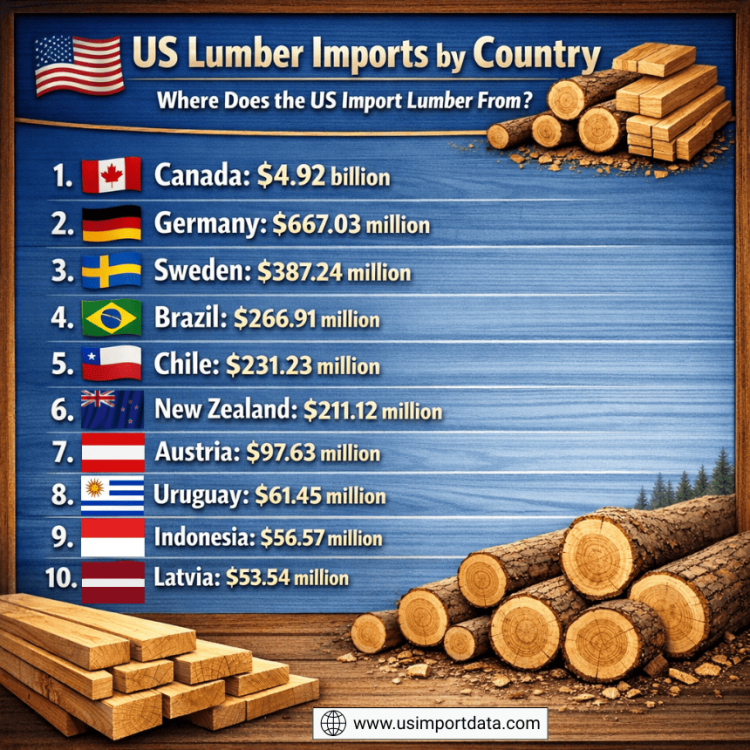
Lumber is an essential commodity in the construction industry, and the United States heavily relies on imports to meet its demand for this crucial material. US lumber imports by country reveal the diverse sources from which the United States acquires its lumber. The countries from which the US imports lumber vary, with Canada being the largest supplier, followed by countries such as Germany, Sweden, and Brazil. Understanding the dynamics of American lumber imports by country is crucial for stakeholders in the lumber industry to track trends and make informed decisions. The top 10 suppliers of lumber wood to the USA, as per the US shipment data for 2025, include:
1. Canada: $4.92 billion (66.2%)
Canada is the largest exporter of lumber to the United States, accounting for a significant portion of the total imports, as per the data on US lumber imports from Canada by HS code. The proximity of Canada to the US, as well as its vast forest resources, makes it an ideal source for high-quality lumber products. The answer to the question, how much lumber does the US import from Canada, lies in the strong trade relationship between the two countries, which further solidifies Canada's position as the top supplier of lumber to the US.
2. Germany: $667.03 million (9%)
Germany is another key player in the US lumber market, providing a substantial amount of lumber products to meet the demands of American consumers, as per the data on US lumber imports from Germany. With a reputation for excellence in manufacturing and sustainability, German lumber is highly sought after in the US market.
3. Sweden: $387.24 million (5.2%)
Sweden is known for its high-quality lumber products and efficient production processes. The country's commitment to sustainable forestry practices has made it a reliable source of lumber for the US market. Swedish lumber is valued for its durability and aesthetic appeal, making it a popular choice among American consumers.
4. Brazil: $266.91 million (3.6%)
Brazil has emerged as a significant player in the US lumber market, thanks to its vast forest reserves and competitive pricing. Brazilian lumber is favored for its unique grain patterns and rich color variations, making it a popular choice for a wide range of construction projects in the US.
5. Chile: $231.23 million (3.1%)
Chile is a key supplier of lumber to the United States, offering a diverse range of wood species to meet the specific needs of American consumers. Chilean lumber is prized for its strength and durability, making it an excellent choice for construction projects that require high-performance materials.
6. New Zealand: $211.12 million (2.8%)
New Zealand is known for its sustainably managed forests and high-quality lumber products. The country's commitment to environmental stewardship has earned it a reputation as a responsible source of lumber for the US market. New Zealand lumber is valued for its consistency and reliability, making it a preferred choice among American builders.
7. Austria: $97.63 million (1.3%)
Austria is a key supplier of lumber to the United States, offering a wide range of wood products to meet the diverse needs of American consumers. Austrian lumber is valued for its superior quality and precision craftsmanship, making it a popular choice for a variety of construction projects in the US.
8. Uruguay: $61.45 million (0.8%)
Uruguay is a relatively small but important player in the US lumber market, providing high-quality wood products to meet the demands of American consumers. Uruguayan lumber is valued for its strength and durability, making it an attractive option for construction projects that require long-lasting materials.
9. Indonesia: $56.57 million (0.8%)
Indonesia is a growing supplier of lumber to the United States, offering a unique selection of wood species to cater to the diverse needs of American consumers. Indonesian lumber is prized for its exotic appearance and natural beauty, making it a popular choice for interior design and furniture-making projects in the US.
10. Latvia: $53.54 million (0.7%)
Latvia is a small but significant supplier of lumber to the US market, providing high-quality wood products to meet the demands of American consumers. Latvian lumber is valued for its exceptional quality and reliability, making it a preferred choice for a variety of construction projects in the US.
Canada: The Largest Lumber Supplier to the United States
Canada has long dominated the U.S. lumber supply chain.
Key reasons include:
-
Shared border
-
Integrated forestry supply chains
-
Lower transportation costs
-
Similar wood species
Most Canadian lumber exports consist of softwood lumber used in home construction, especially spruce-pine-fir (SPF). However, trade disputes between the two countries have been common. U.S. tariffs on Canadian softwood lumber have periodically increased costs. In 2025, total effective duties on some Canadian softwood lumber shipments approached nearly 50% when combining new tariffs and anti-dumping duties. Despite these tariffs, Canada remains the dominant supplier due to its proximity and production scale.
Rising Suppliers: Brazil and Latin America
Latin American countries have expanded their presence in the U.S. lumber market in recent years.
Brazil
Brazil is one of the fastest-growing lumber exporters, supplying:
-
Tropical hardwood
-
Plantation-grown pine
-
Construction-grade lumber
Brazilian lumber exports include a significant share of HS Code 4407 sawn wood, which accounted for over $494 million in exports in 2025 trade data.
Brazil’s competitive advantage comes from:
-
Large plantation forests
-
Lower production costs
-
Increasing investment in timber processing
Chile
Chile is another important supplier. The United States is often the largest export destination for Chilean sawn wood, representing over 40% of export value in some months.
Chilean radiata pine is widely used in:
-
pallets
-
construction framing
-
packaging materials
European Lumber Suppliers
European countries supply high-quality softwood and engineered lumber to the U.S.
Major exporters include:
-
Sweden
-
Finland
-
Germany
-
Austria
-
Latvia
These countries specialize in:
-
kiln-dried lumber
-
precision-cut timber
-
sustainable forestry products
European lumber is often used in:
-
structural construction
-
prefabricated housing
-
engineered wood products
The EU forestry industry benefits from strong environmental certification systems, such as:
-
FSC
-
PEFC
This sustainability focus appeals to environmentally conscious American buyers.
Asia’s Role in the US Lumber Supply Chain
Asian countries are not major raw lumber suppliers but play a growing role in processed wood products and the secondary lumber trade. Countries such as Vietnam, Indonesia, and Malaysia often import raw lumber from other regions and export processed or semi-processed wood products to the United States. For example, Vietnam has become a major hub for wood processing and re-exporting finished wood goods to the U.S.
US Lumber Imports in the Last 10 Years: Historical Import Data
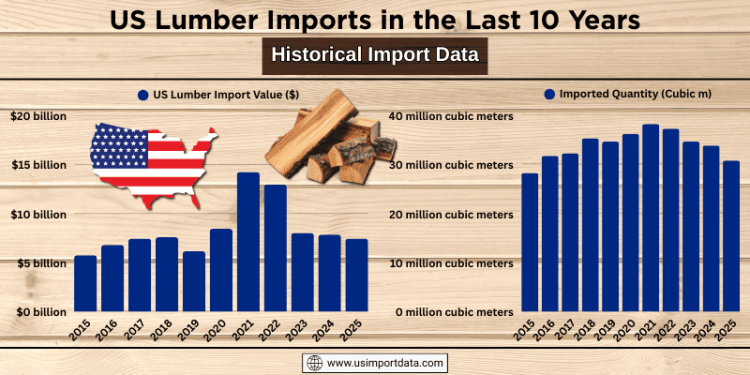
|
Year of Imports |
US Lumber Import Value ($) |
Imported Quantity (Cubic m) |
|
2015 |
$5.73 billion |
$28.18 million cubic meters |
|
2016 |
$6.80 billion |
$31.65 million cubic meters |
|
2017 |
$7.45 billion |
$32.15 million cubic meters |
|
2018 |
$7.58 billion |
$35.20 million cubic meters |
|
2019 |
$6.14 billion |
34.54 million cubic meters |
|
2020 |
$8.44 billion |
36.13 million cubic meters |
|
2021 |
$14.25 billion |
38.13 million cubic meters |
|
2022 |
$12.97 billion |
37.18 million cubic meters |
|
2023 |
$8.01 billion |
34.56 million cubic meters |
|
2024 |
$7.85 billion |
33.73 million cubic meters |
|
2025 |
$7.44 billion |
30.68 million cubic meters |

Market Trends Shaping US Lumber Imports in 2025
Several key trends have shaped the lumber import market in 2025.
1. Rising Import Demand
Trade data shows that the U.S. continues to expand its import volumes. For example, shipment-level data shows over 1,100 lumber shipments imported in a single month in 2025, representing more than 50% year-on-year growth compared with the previous year.
This growth reflects:
-
housing construction demand
-
renovation activity
-
infrastructure spending
2. Tariffs and Trade Policies
Trade policy remains one of the most important factors influencing lumber imports.
Examples include:
-
Anti-dumping duties on Canadian softwood lumber
-
Tariffs on Chinese wood products
-
Reciprocal tariffs on some EU wood products
These policies affect sourcing strategies and encourage importers to diversify suppliers.
3. Supply Diversification
To reduce risk, many U.S. importers are diversifying supply sources.
Emerging suppliers include:
-
New Zealand
-
Baltic states
-
South American producers
This diversification helps reduce exposure to tariffs or trade disruptions.
4. Sustainability and Certification
Environmental regulations are increasingly influencing the lumber trade.
U.S. importers often require:
-
FSC certification
-
PEFC certification
-
complies with the Lacey Act, which regulates illegal timber imports.
Violations of the Lacey Act can lead to penalties up to $250,000 for false declarations, making compliance essential.
Opportunities for Exporters
The U.S. lumber import market presents significant opportunities for exporters.
Key opportunities include:
1. Construction lumber
Demand for structural softwood remains extremely strong.
2. Sustainable wood products
Certified sustainable lumber commands premium prices.
3. Engineered wood
Products such as laminated lumber and prefabricated wood components are growing rapidly.
4. Hardwood lumber
Furniture and flooring industries drive demand for hardwood species.
Challenges in the US Lumber Import Market
Despite strong demand, exporters face several challenges.
1. Tariffs and trade disputes
Trade tensions can dramatically change market access.
2. Regulatory compliance
Documentation and environmental regulations require strict compliance.
3. Market volatility
Lumber prices fluctuate significantly depending on housing demand and economic conditions.
Conclusion and Final Thoughts
In conclusion, the USA remains the largest importer of lumber in the world, with strong demand driven by construction, infrastructure, and manufacturing industries. Under HS Code 4407, the country imports massive volumes of sawn and processed lumber from a wide range of global suppliers. Key insights from the 2025 U.S. lumber import market include:
-
Canada remains the dominant supplier due to geography & integrated supply chains.
-
Latin American exporters such as Brazil & Chile are rapidly expanding their presence.
-
European suppliers focus on high-quality and certified lumber.
-
Trade policies and tariffs continue to influence sourcing decisions.
-
Sustainability and legal compliance are increasingly important for importers.
For exporters, the U.S. lumber market represents a large, dynamic, & opportunity-rich destination, particularly for suppliers that can offer consistent quality, competitive pricing, and certified sustainable wood products. As global construction demand continues to grow, the database of U.S. lumber imports under HS Code 4407 will remain a valuable tool for trade intelligence, market entry strategy, and supply chain optimization.
Note for Our Readers
We hope this data-driven overview of U.S. lumber imports under HS Code 4407 helped you understand global supply trends, major supplier countries, and the evolving dynamics of the U.S. timber trade. For businesses involved in the lumber, forestry, construction, or wood processing industries, access to reliable trade data is essential for identifying new markets, tracking competitors, and optimizing sourcing strategies. If you’re looking for deeper insights & data on US lumber imports by country, or a verified US lumber buyers & importers database, visit USImportdata.
Our platform provides detailed US export-import data, shipment-level trade data, company-level importer databases, and market insights designed to support exporters, importers, and market analysts in making informed decisions. Turn global trade data into a competitive advantage with our specialized U.S. trade intelligence solutions. For inquiries, partnerships, or sample datasets related to lumber trade, HS Code 4407 imports, or forestry products, feel free to contact us at info@tradeimex.in today!
Read also about:
What's Your Reaction?