US-Netherlands Trade Relations: Top US Exports to Netherlands & Insights into US Tariffs on Netherlands
Get detailed insights into US-Netherlands trade relations, including the top US exports to Netherlands and US tariffs on Netherlands.

The United States and the Netherlands maintain one of the most dynamic economic relationships in the world. Although the Netherlands is geographically small, it plays an outsized role in global trade due to its strategic location, advanced trade infrastructure, and strong industrial base. According to US-Netherlands trade data, total trade between the US and the Netherlands reached a record high of $131.41 billion in 2025, making the Netherlands one of America’s top trading partners. According to the latest US export data and Netherlands import data, the total value of US exports to Netherlands reached $95.64 billion in 2025, a 10% increase from the previous year.
As a gateway to Europe, the Netherlands serves as a crucial entry point for American goods entering the European Union market. The flow of Netherlands export to US includes key sectors such as machinery, pharmaceuticals, and agricultural products, reflecting a strong transatlantic trade relationship. Trade flows between the two economies are large and diversified. The U.S. also recorded a trade surplus of nearly $74.9 billion, one of the largest surpluses it maintains with any country. This article explores the structure of U.S.–Netherlands trade, the top American exports to the Netherlands, and the implications of U.S. tariffs affecting Dutch goods.
Overview of US–Netherlands Trade Relations
The economic ties between the two nations are deep & longstanding. The Netherlands is consistently ranked among the top 15 trading partners of the United States, and the U.S. is one of the most significant non-EU partners for the Netherlands, according to the latest data on U.S.-Netherlands trade.
In 2024:
-
Total bilateral trade (goods and services): $175.9 billion
-
U.S. exports to the Netherlands: $125.4 billion
-
U.S. imports from the Netherlands: $50.5 billion
-
U.S. trade surplus with the Netherlands: $74.9 billion
These numbers highlight a key characteristic of the relationship: the United States exports far more to the Netherlands than it imports. The trade relationship also supports jobs and investment. According to U.S. economic data, more than 1.07 million American jobs are linked to trade and investment ties with the Netherlands.
Another important factor is the Netherlands’ role as a European trade hub. With major ports like Rotterdam and Schiphol Airport, the country often acts as a distribution center for U.S. products across Europe.
Composition of US Exports to the Netherlands
U.S. exports to the Netherlands consist of both goods and services.
In 2025:
-
Goods exports: about 70.4% of total exports
-
Services exports: about 29.6% of total exports
The major export categories include:
-
Industrial supplies and materials
-
Capital goods (machinery and equipment)
-
Consumer goods
-
Business services
Industrial supplies dominate the trade structure, accounting for 34.2% of U.S. exports to the Netherlands.
Top Goods US Exports to Netherlands: What Does the US Export to the Netherlands?
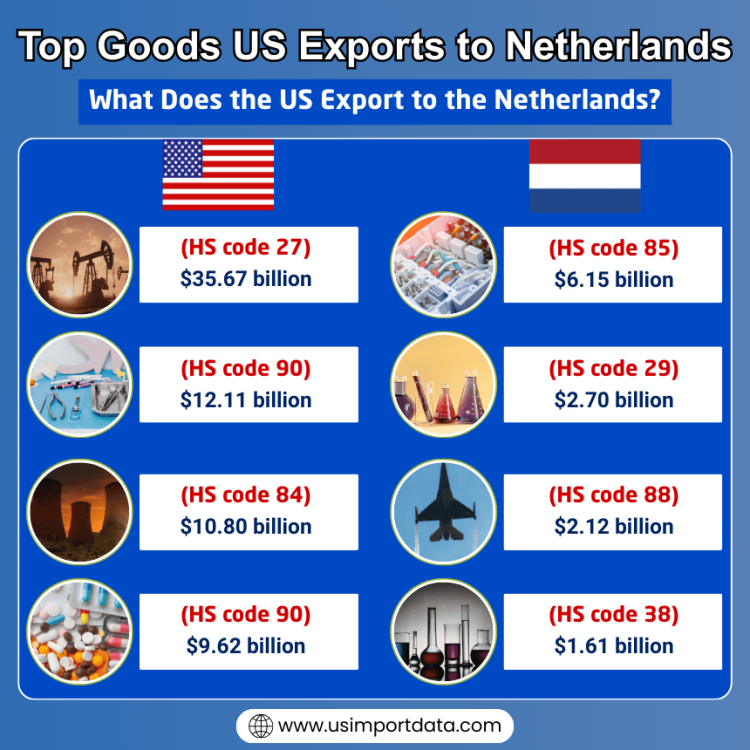
The United States has a strong trading relationship with the Netherlands, with a variety of goods being exported from the US to the European country. The USA exports a variety of goods to the Netherlands, with some of the top categories being machinery, mineral fuels, pharmaceutical products, optical and medical instruments, and organic chemicals. These exports represent the strong trade relationship between the two countries, contributing to economic growth and fostering cooperation. The top 10 goods that the US exports to the Netherlands, as per the US shipment data for 2025, include:
1. Mineral fuels & oils (HS code 27): $35.67 billion
Mineral fuels and oils are the top goods exported from the US to the Netherlands, accounting for a significant portion of the total export value. These products include petroleum oils, natural gas, and coal. The Netherlands is a key importer of energy products, and this category plays a crucial role in the trade relationship between the two countries. Energy exports account for nearly 40% of all U.S. goods exports to the Netherlands.
This surge reflects Europe’s shift away from Russian energy sources following geopolitical tensions. As a result, European countries, including the Netherlands, significantly increased purchases of U.S. LNG. For example, European demand drove record LNG shipments from the US, with the Netherlands among the leading importers. Energy exports dominate U.S. shipments to the Netherlands. These include:
-
Crude oil
-
Refined petroleum products
-
Liquefied natural gas (LNG)
2. Optical, medical, & surgical instruments (HS code 90): $12.11 billion
The second-largest category of goods exported from the US to the Netherlands is optical, medical, and surgical instruments. These products are highly valued for their quality and innovation, making them popular among Dutch consumers and medical professionals. The US is known for its cutting-edge technology in the healthcare industry, and this is reflected in the export numbers for this category.
These products support the Netherlands’ strong biotechnology, medical, and research sectors. Given the country’s advanced healthcare system and pharmaceutical industry, demand for high-tech medical equipment from the United States remains strong. Another major export category includes:
-
Medical devices
-
Laboratory instruments
-
Optical equipment
-
High-precision measurement tools
3. Nuclear reactors & machinery (HS code 84): $10.80 billion
Nuclear reactors and machinery are another significant export category for the US in its trade with the Netherlands, as per the data on US exports to the Netherlands by HS code. These goods are essential for various industries, including energy production and manufacturing. The Netherlands has a strong demand for advanced machinery and equipment, making this a lucrative sector for US exporters. These exports play a key role in supporting Dutch manufacturing and trade operations. Because the Netherlands hosts major European supply chains, many of these machines are used for production or redistributed across EU markets. Machinery exports include:
-
Industrial production equipment
-
Turbines
-
Pumps
-
Semiconductor manufacturing machinery
-
Agricultural machinery
4. Pharmaceutical products (HS code 90): $9.62 billion
Pharmaceutical products are in high demand in the Netherlands, leading to a substantial export value for this category. The US is a top producer of pharmaceuticals, with a reputation for quality and innovation in this industry. The Dutch market provides a valuable opportunity for American pharmaceutical companies to expand their reach and increase their exports. The United States is a global leader in pharmaceutical innovation, and the Netherlands imports a large volume of American medicines. These medicines support both domestic consumption and pharmaceutical manufacturing within the Netherlands. Exports include:
-
Vaccines
-
Biotechnology drugs
-
Active pharmaceutical ingredients
-
Specialized therapeutics
5. Electrical machinery & equipment (HS code 85): $6.15 billion
Electrical machinery and equipment are essential goods exported from the US to the Netherlands, encompassing a wide range of products such as appliances, electronics, and telecommunications devices. The Netherlands is a tech-savvy country with a strong appetite for cutting-edge technology, making this category a key component of the export trade. These exports are crucial to Europe’s advanced technology sectors. The Netherlands is particularly important in the semiconductor industry due to its strong ecosystem of chip manufacturing and equipment suppliers. The United States exports a range of electronic equipment to the Netherlands, including:
-
Computer components
-
Telecommunications equipment
-
Semiconductor components
-
Industrial electronics
6. Organic chemicals (HS code 29): $2.70 billion
Organic chemicals are another important category of goods that the US exports to the Netherlands. These products are widely used in various industries, including pharmaceuticals, agriculture, and manufacturing. The Netherlands has a robust chemical industry, presenting opportunities for US exporters to supply high-quality organic chemicals to meet local demand. Organic chemical exports are especially important for the Netherlands because many are used as intermediate inputs for industrial production. Several chemical-related export categories together represent a significant portion of U.S. exports. These products support industries such as:
-
Manufacturing
-
Pharmaceuticals
-
Agriculture
-
Energy production
7. Aircraft, spacecraft, & parts thereof (HS code 88): $2.12 billion
Aircraft, spacecraft, and parts thereof are valuable exports from the US to the Netherlands, reflecting the strong aerospace industry in both countries. The Netherlands is home to several aerospace companies and plays a vital role in the European aviation sector. US exports in this category include airplanes, helicopters, and related components, contributing significantly to the trade relationship. These exports support Dutch aviation services and trade networks. The United States exports aerospace products to the Netherlands, including:
-
Aircraft components
-
Aviation electronics
-
Maintenance equipment
8. Miscellaneous chemical products (HS code 38): $1.61 billion
Miscellaneous chemical products form another category of goods exported from the US to the Netherlands, covering a diverse range of chemical substances and compounds. These products are used in various industrial processes and consumer goods, making them an important component of the export trade. The US maintains a competitive edge in the chemical industry, ensuring a steady flow of exports to the Dutch market. Key exports in this category include:
-
Water treatment chemicals
-
Prepared binders for foundry molds
-
Industrial catalysts
-
Diagnostic and laboratory reagents
-
Specialized chemical formulations used in manufacturing
9. Plastics & articles thereof (HS code 39): $1.51 billion
Plastics and articles thereof are essential products exported from the US to the Netherlands, supporting key industries such as packaging, construction, and automotive. The US is a leading producer of plastics, offering a wide variety of products for export, as per the data on US plastics exports to the Netherlands. The Netherlands is a significant importer of plastics, creating a lucrative market for US exporters in this category. These exports commonly include:
-
Plastic resins and polymers
-
Packaging materials
-
Industrial plastic components
-
Plastic sheets and films
-
Engineering plastics used in manufacturing
10. Beverages, spirits, & vinegar (HS code 22): $1.42 billion
Beverages, spirits, and vinegar are popular exports from the US to the Netherlands, catering to the discerning tastes of Dutch consumers. This category includes a range of products such as wine, spirits, and non-alcoholic beverages. The US is known for its diverse and high-quality beverages, making it a preferred supplier for the Dutch market. Major American beverage exports to the Netherlands include:
-
Whiskey and other distilled spirits
-
Wine
-
Craft beverages
-
Soft drinks and specialty beverages
-
Vinegar and fermented products
US-Netherlands Trade in the Last 10 Years: Historical Bilateral Trade Data
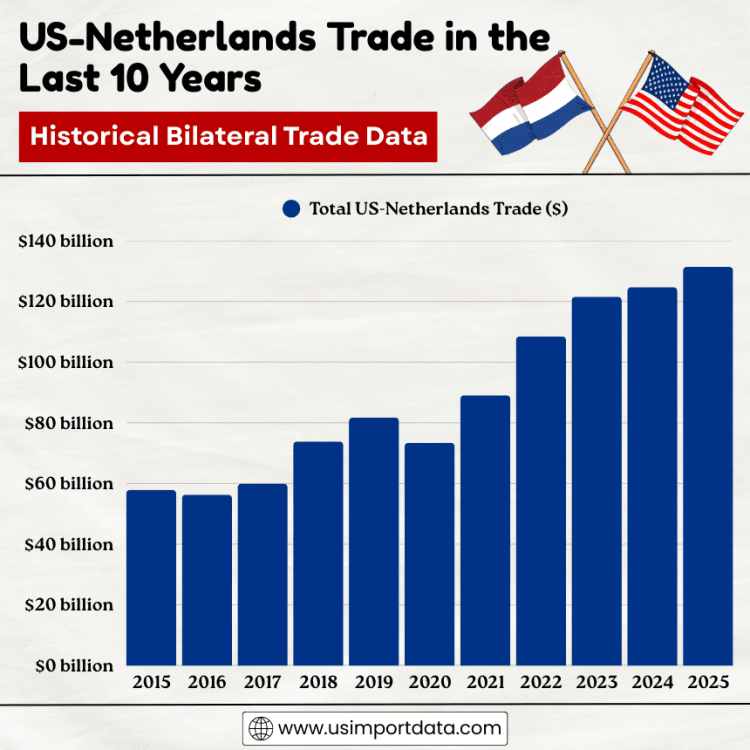
|
Year of Trade |
Total US-Netherlands Trade ($) |
|
2015 |
$57.86 billion |
|
2016 |
$56.31 billion |
|
2017 |
$59.95 billion |
|
2018 |
$73.84 billion |
|
2019 |
$81.74 billion |
|
2020 |
$73.44 billion |
|
2021 |
$89.08 billion |
|
2022 |
$108.51 billion |
|
2023 |
$121.55 billion |
|
2024 |
$124.69 billion |
|
2025 |
$131.41 billion |

Why the Netherlands Imports So Much from the USA
Several factors explain the large volume of U.S. exports to the Netherlands.
1. Gateway to Europe
The Netherlands hosts one of the world’s largest ports, Rotterdam, which serves as a primary entry point for goods entering the European Union. Many U.S. imports are re-exported to other EU countries, making the Netherlands a regional trade hub.
2. Energy Demand
European energy demand has increased dramatically since the reduction of Russian energy supplies. As a result, U.S. oil and LNG exports to Europe have surged, with the Netherlands becoming a key buyer. In 2023 alone, the Netherlands imported €14.7 billion worth of U.S. oil and natural gas.
3. Advanced Industrial Economy
The Netherlands hosts world-class industries in:
-
Semiconductors
-
Chemicals
-
Agriculture
-
Pharmaceuticals
-
Machinery
These sectors require advanced equipment and materials, many of which come from U.S. companies.
US Tariffs on Netherlands & Dutch Goods
While trade between the two countries is generally open and cooperative, tariffs and trade disputes occasionally arise. The United States applies tariffs on certain imports from the European Union, including the Netherlands. Understanding US tariff on Netherlands is essential for analyzing bilateral trade dynamics, as tariff policies directly influence pricing, competitiveness, and market access. When evaluating US Netherlands tariffs, businesses can better assess cost structures and regulatory impacts, while insights into the US trade balance with Netherlands help determine whether the United States runs a surplus or deficit in its trade with the Netherlands.
General Tariff Framework
Trade between the U.S. and the Netherlands falls under the broader U.S.–EU trade relationship, meaning tariffs apply to EU goods collectively.
Typical tariff levels include:
-
Average U.S. tariff on EU goods: around 2–4%
-
Higher tariffs on specific sectors such as:
-
Steel
-
Aluminum
-
Agricultural goods
Steel and Aluminum Tariffs
One of the most notable trade disputes involved U.S. tariffs on European metals.
The United States imposed:
-
25% tariff on steel
-
10% tariff on aluminum
These tariffs were applied to imports from several countries, including EU members. Such measures raised costs for European exporters and sparked retaliatory tariffs from the EU.
Proposed Broad Tariffs on EU Imports
More recently, policy proposals have suggested wider tariffs on imports from EU countries. Trump slaps tariffs on the Netherlands of 10% on imports.
For example:
-
A proposed 10% baseline tariff on most imports
-
Potential 20% tariffs on EU goods
Economic analysts estimate such tariffs could reduce Dutch economic growth by about 1 percentage point by 2026. However, the overall impact may be limited because only about 6% of Dutch exports go directly to the United States.
Impact of Tariffs on US–Netherlands Trade
Tariffs can influence trade patterns in several ways.
1. Higher Costs for Exporters
Tariffs increase the price of imported goods, which can make Dutch products less competitive in the U.S. market. Industries potentially affected include:
-
Machinery
-
Pharmaceuticals
-
Automotive components
2. Supply Chain Shifts
Companies may adjust supply chains to avoid tariffs. For example:
-
Relocating manufacturing
-
Using alternative export routes
-
Sourcing inputs from other countries
3. Potential EU Retaliation
The European Union has previously responded to U.S. tariffs with countermeasures targeting American exports. Such actions can escalate trade tensions and affect global markets.
Future Outlook for US–Netherlands Trade
Despite occasional tariff disputes, the long-term outlook for U.S.–Netherlands trade remains strong. Several trends are expected to shape the relationship.
1. Energy Trade Expansion
U.S. LNG exports to Europe are expected to continue growing as Europe diversifies its energy sources.
2. Technology Collaboration
The Netherlands plays a major role in the global semiconductor supply chain. As demand for advanced chips grows, trade in high-tech equipment and components is likely to expand.
3. Digital and Service Trade Growth
Services, including cloud computing, software licensing, and consulting, will likely become a larger share of bilateral trade.
Conclusion and Final Thoughts
In conclusion, the United States and the Netherlands share a highly integrated and mutually beneficial trade relationship. With total bilateral trade approaching $176 billion annually, the Netherlands serves as a crucial European gateway for American exports.
Key U.S. exports to the Netherlands include:
-
Energy products (oil and LNG)
-
Medical and optical instruments
-
Industrial machinery
-
Pharmaceuticals
-
Electronics and chemicals
Energy exports dominate the trade structure, reflecting Europe’s increasing reliance on American energy supplies. At the same time, tariffs remain a potential source of tension in the broader US–EU trade relationship. Measures affecting metals, manufacturing goods, or broader import categories could influence future trade flows.
Nevertheless, strong economic ties, extensive investment links, and shared strategic interests suggest that U.S.–Netherlands trade will remain a cornerstone of transatlantic trade in the years ahead.
Note for Our Readers
We hope this data-driven overview of US–Netherlands trade relations, including the top U.S. exports to the Netherlands and insights into U.S. tariffs on Dutch goods, helped you better understand the structure and dynamics of this important transatlantic trade partnership.
If you're looking to search live data on US exports by country, deeper insights into bilateral trade trends, and HS-code level export data, visit USImportdata. Our platform offers comprehensive US import-export data, shipment-level trade records, company-level buyer and supplier databases, and actionable market insights designed to help exporters, importers, and analysts make smarter business decisions.
Turn trade data into a competitive advantage with our specialized US trade database solutions. For inquiries, partnerships, or sample datasets related to U.S.–Netherlands trade, tariff analysis, or industry-specific export data, feel free to contact us at info@tradeimex.in today.
Read also about:
What's Your Reaction?