US Egg Import Data 2025: Latest Statistics & US Egg Imports by Country Report
Discover the latest US Egg Imports by Country and US egg import data. See where the US imports eggs from & identify leading egg importers in USA.
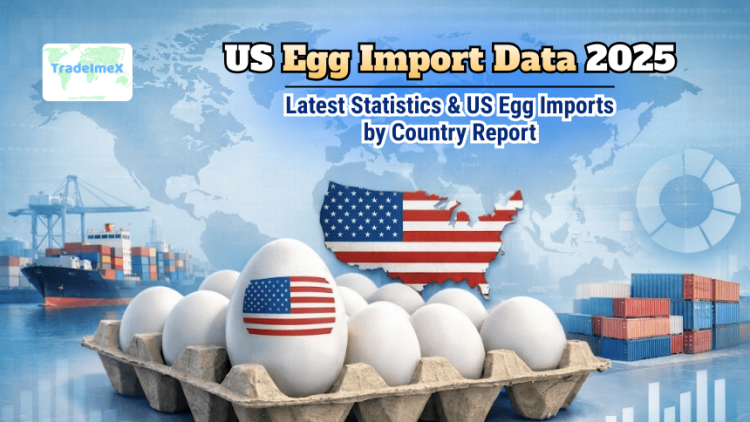
The United States is one of the largest egg producers in the world, but 2025 brought unusual shifts in the global egg trade. Supply disruptions, avian influenza outbreaks, and rising domestic prices forced the U.S. to sharply increase egg imports. As a result, egg import volumes surged compared with previous years, bringing new trading partners and changing the structure of the U.S. egg supply chain. According to the latest US import data and Egg import data of the USA, the total value of US egg imports reached $221.49 million in 2025, a massive increase of 142% from the previous year.
The USA is the 18th largest egg importer in the world, according to global trade data. This blog presents a detailed, data-driven analysis of US egg imports in 2025, including import volume trends, key supplier countries, trade statistics, and the factors driving the increase in American egg imports. It also highlights emerging egg trade patterns and what they mean for the global poultry market.
Overview of the U.S. Egg Market: How Many Eggs Does The US Import
The United States is normally a net exporter of eggs and egg products. Domestic production is massive, supported by advanced poultry farming systems and a large commercial laying flock. In 2024, the country produced over 93 billion table eggs, with around 311 million commercial laying hens in operation. On average, each hen produced about 301 eggs annually, demonstrating the efficiency of the U.S. egg industry. In 2025, the US egg imports hit the highest import level since 2015.
Despite this large production capacity, the market faced disruptions in recent years. Disease outbreaks, especially Highly Pathogenic Avian Influenza (HPAI), significantly reduced the number of laying hens and tightened supply. Since 2022, bird flu outbreaks have led to the loss of nearly 170 million poultry birds, affecting egg production and pushing prices higher across the country. To stabilize domestic supply and control prices, the United States increased egg imports in 2025.
US Egg Import Statistics 2025
Total Import Volume
The most striking trend in 2025 was the sharp rise in imports.
-
The U.S. imported approximately 139 million dozen egg equivalents in 2025, the highest level since 2015.
-
Import volumes were revised upward during the year as supply shortages continued.
-
Imports included both shell eggs (table eggs) and processed egg products used by food manufacturers.
Earlier in the year, government reports indicated that the U.S. had already imported:
-
26 million shell eggs (dozens)
-
14 million dozen equivalents of egg products
This brought the total to over 40 million egg-equivalent imports early in 2025, demonstrating the rapid increase compared with previous years. In fact, during the first half of 2025, the U.S. imported nearly ten times more eggs than in the same period of 2024, highlighting the severity of the supply shortage. The growing demand for eggs has raised several questions in the global poultry trade, such as does the US import eggs and does the US import eggs from other countries. In reality, the US imports eggs when domestic supply becomes tight due to factors like disease outbreaks, seasonal demand, or price fluctuations.
In recent years, the US importing eggs from nearby and international markets has helped stabilize supply and maintain food security. This has also led many analysts to ask how many eggs does the US import each year and how those volumes change depending on market conditions. With supply challenges and rising consumption, another common question is the US importing eggs in larger quantities than before, highlighting the role of global trade in meeting America’s egg demand.
US Egg Imports by Country: Where Does the US Import Eggs From?
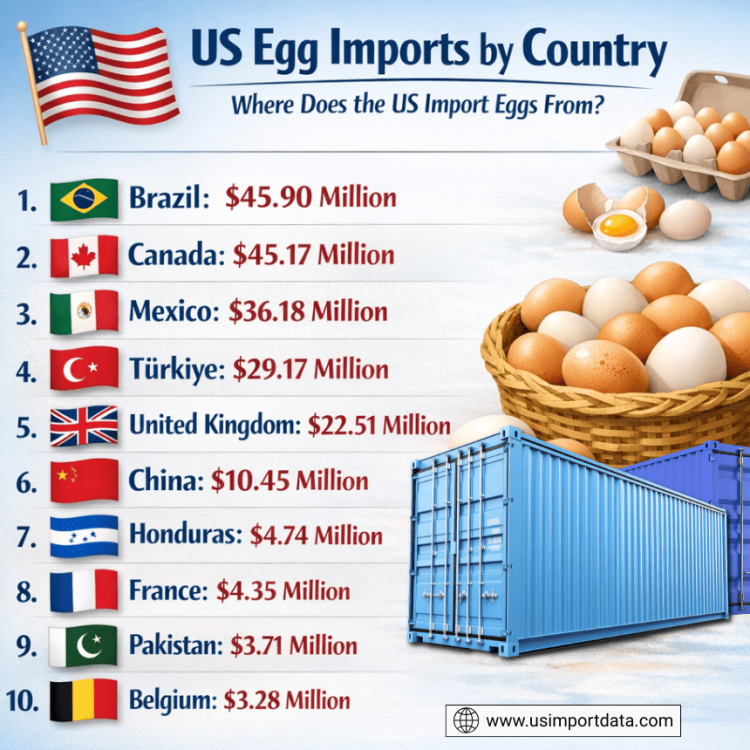
When considering US egg imports by country, it is important to recognize the diverse sources of eggs the United States imports. The top countries from which the US imports eggs include Canada, the Netherlands, and Denmark. Each of these countries plays a significant role in supplying the US market with a variety of egg products. The top 10 egg supplier countries to the USA, as per the US shipment data for 2025, include:
1. Brazil: $45.90 million (20.7%)
Brazil is one of the largest exporters of eggs to the United States. The tropical climate in Brazil allows for year-round egg production, making it an ideal source for the US market. Additionally, Brazil's strict quality control measures ensure that the eggs imported are of high quality, which appeals to American consumers.
2. Canada: $45.17 million (20.4%)
Canada is another major supplier of eggs to the United States. Proximity plays a significant role in this trade relationship, as Canada is located right next to the US. This proximity reduces transportation costs and ensures fresh eggs reach American consumers on time.
3. Mexico: $36.18 million (16.3%)
With its proximity to the US and a large poultry industry, Mexico is a significant exporter of eggs to the United States. The USMCA has also facilitated trade between the two countries, making it easier for Mexico to export eggs to the US market.
4. Türkiye: $29.17 million (13.2%)
Turkey, also known as Türkiye, is emerging as a key player in the global egg trade. Turkish eggs are known for their quality and taste, making them popular among American consumers, as per the data on US egg imports from Turkey by HS code. The increasing demand for Turkish eggs in the US has led to a steady rise in imports from this country.
5. United Kingdom: $22.51 million (10.2%)
Despite the distance between the United Kingdom and the United States, the UK remains a significant supplier of eggs to the US market. British eggs are valued for their high nutritional content and top-notch production standards, making them a sought-after commodity in the US.
6. China: $10.45 million (4.7%)
China, with its massive population and booming poultry industry, is also a notable exporter of eggs to the United States. Chinese eggs are competitively priced, making them an attractive option for American importers looking to diversify their egg sources.
7. Honduras: $4.74 million (2.1%)
Honduras may be a smaller player in the global egg trade, but it has carved out a niche for itself as a reliable supplier of eggs to the United States. Honduran eggs are prized for their freshness and quality, making them a popular choice among American consumers.
8. France: $4.35 million (2%)
France, known for its culinary expertise, is also a source of high-quality eggs for the US market. French eggs are often favored for their rich flavor and superior texture, making them a premium choice for American consumers who appreciate gourmet ingredients.
9. Pakistan: $3.71 million (1.7%)
Pakistan may not be a top-tier egg exporter, but it still plays a role in supplying eggs to the United States. Pakistani eggs are known for their affordability and taste, making them an attractive option for American consumers looking for value.
10. Belgium: $3.28 million (1.5%)
Belgium rounds out the top 10 countries from which the US imports eggs. Despite its small size, Belgium boasts a strong poultry industry that produces high-quality eggs desired by American consumers. The unique taste and texture of Belgian eggs make them a popular choice in the US market.
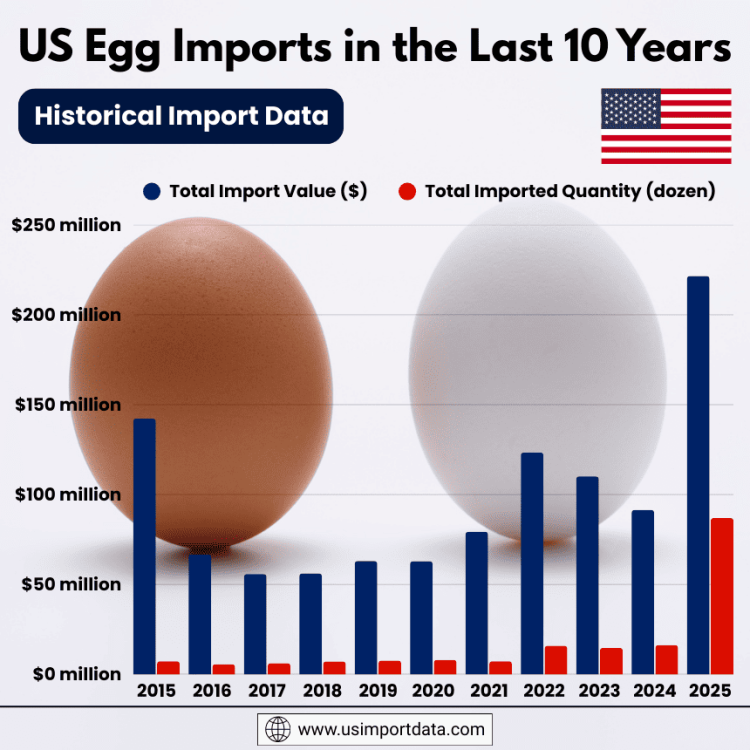
US Egg Imports in the Last 10 Years: Historical Import Data
|
Year of Imports |
Total Import Value ($) |
Total Imported Quantity (dozen) |
|
2015 |
$142.21 million |
7.24 million dozen |
|
2016 |
$66.84 million |
5.65 million dozen |
|
2017 |
$55.83 million |
6.21 million dozen |
|
2018 |
$56.15 million |
7.15 million dozen |
|
2019 |
$63.04 million |
7.68 million dozen |
|
2020 |
$62.92 million |
8.04 million dozen |
|
2021 |
$79.27 million |
7.33 million dozen |
|
2022 |
$123.39 million |
15.92 million dozen |
|
2023 |
$110.14 million |
14.74 million dozen |
|
2024 |
$91.50 million |
16.32 million dozen |
|
2025 |
$221.49 million |
86.95 million dozen |

Key Factors Driving U.S. Egg Imports
Several economic and agricultural factors contributed to the surge in egg imports.
1. Avian Influenza Outbreaks
The largest factor was the widespread outbreak of avian influenza. The disease forced poultry farms to cull millions of birds to stop the spread. This reduced egg production and tightened the domestic supply. When production drops, imports become a quick way to stabilize supply.
2. Decline in Egg Production
In 2025, some months recorded significant declines in egg production. For example, one report showed monthly production falling by around 6% compared with the previous year. Lower production combined with strong consumer demand created supply gaps that imports helped fill.
3. Rising Egg Prices
Egg prices increased sharply in many parts of the United States during 2024 and early 2025. High prices encouraged policymakers and retailers to seek international suppliers to expand supply and stabilize the market.
4. Food Industry Demand
Egg products are widely used in processed foods such as:
-
Bakery products
-
Ice cream
-
Salad dressings
-
Mayonnaise
-
Prepared meals
Food manufacturers often rely on imported liquid or powdered egg products when the domestic supply tightens.
5. Government Policy Measures
The U.S. government also implemented policies to support egg imports:
-
Inspection approval for new processing facilities handling imported eggs
-
Trade negotiations with foreign suppliers
-
Temporary adjustments to import requirements
These measures allowed imports to increase quickly during supply shortages.
Monthly Trends in US Egg Imports (2025)
Egg imports did not increase evenly throughout the year. Instead, imports rose sharply during certain months.
Key trends included:
Early 2025
Imports surged as the U.S. responded to supply shortages caused by avian influenza.
Mid-2025
Import levels increased further as domestic egg prices peaked.
Late 2025
Import projections were adjusted to 139 million dozen equivalents for the year as additional shipments arrived.
Some monthly spikes were driven by imports of egg products used in food manufacturing.
U.S. Egg Trade Balance
Despite the rise in imports, the United States remained a net exporter of eggs.
For example:
-
In November 2025, the U.S. exported $47.5 million worth of eggs and imported $6.55 million.
This indicates that while imports increased, the U.S. egg industry still maintained strong export capacity.
Major export destinations included:
-
Canada
-
Mexico
-
Caribbean countries
-
Japan
-
The European Union
Types of Eggs Imported by the United States
The U.S. imports different forms of eggs depending on industry needs.
1. Shell Eggs
These are whole eggs sold directly to consumers. Shell eggs account for a smaller share of imports because the U.S. usually produces enough domestically.
2. Liquid Egg Products
These include pasteurized egg mixtures used by food manufacturers. They are widely used in:
-
Bakeries
-
Restaurant chains
-
Food processing plants
3. Powdered Eggs
Egg powder is used in packaged foods and long-shelf-life products.
4. Frozen Egg Products
Frozen eggs are used by large-scale food manufacturers. The majority of imports during supply shortages are typically egg products rather than retail shell eggs.
Supply Chain Adjustments in the U.S.
To accommodate rising imports, the United States made several trade adjustments. The USDA approved new egg processing facilities capable of receiving imported eggs for breaking and pasteurization. This increased the number of approved facilities in the country to six major locations handling imported eggs. These facilities process imported eggs into liquid or powdered products for food manufacturers.
Impact of Imports on US Egg Prices
Egg imports helped stabilize prices in the U.S. market. When domestic supply falls, prices can rise sharply. By increasing imports, the government aimed to:
-
Increase overall egg supply
-
Reduce market volatility
-
Support food manufacturers
-
Protect consumers from extreme price spikes
Although prices remained high during parts of 2025, imports played a role in preventing even larger shortages.
Global Egg Trade Context
Eggs are a relatively small segment of global agricultural trade compared with grains or meat, but they remain an important commodity.
In 2025:
-
Global egg import value exceeded $3.33 billion worldwide.
The international egg trade involves hundreds of exporters and thousands of buyers. Major egg-exporting regions include:
-
Europe
-
Latin America
-
Asia
The United States participates in both sides of the market as a major exporter and occasional importer.
Future Outlook for US Egg Imports
Looking ahead, several factors will determine U.S. egg import trends.
Recovery of Domestic Flocks
If poultry populations recover from avian influenza outbreaks, imports may decline.
Biosecurity Improvements
The U.S. government has invested heavily in disease prevention to protect poultry farms.
Trade Policy
Tariffs or trade agreements could affect the cost and volume of imported eggs.
Consumer Demand
Egg consumption remains strong due to the food’s nutritional value and affordability compared with meat.
Conclusion and Final Thoughts
The year 2025 marked a significant shift in the U.S. egg trade landscape. While the United States remains one of the world’s largest egg producers, supply disruptions have forced the country to increase imports dramatically.
Key highlights from the US Egg Import Data 2025 include:
-
Total imports are projected at 139 million dozen egg equivalents, the highest in a decade.
-
Imports rose sharply due to avian influenza outbreaks and reduced domestic production.
-
Major supplier countries included Turkey, Brazil, Mexico, South Korea, and Honduras.
-
Brazil’s exports to the U.S. increased more than 800% year-over-year.
-
Imports helped stabilize the domestic supply and support the food processing industry.
The events of 2025 show how global agricultural trade can quickly adjust when supply disruptions occur. For importers, exporters, and policymakers, monitoring egg trade data will remain essential in understanding future food supply trends.
Note for Our Readers
We hope this detailed overview of U.S. egg import data for 2025 helped you understand the latest trade statistics, major supplier countries, and the factors shaping the U.S. egg import market. For businesses operating in the poultry, food processing, agriculture, and retail sectors, access to accurate and up-to-date trade data is essential for identifying supply opportunities, monitoring competitors, & making smarter sourcing decisions in a rapidly changing market. Our platform offers comprehensive US export-import data, company-level databases, shipment records, and actionable market intelligence designed to help exporters, importers, and analysts stay ahead in the global trade landscape.
If you're looking for in-depth insights on U.S. egg imports by country, shipment-level trade statistics, or a verified database of US egg importers and buyers, visit USImportdata. Turn global poultry trade data into a strategic advantage with our specialized U.S. trade intelligence solutions. For inquiries, partnerships, or sample datasets related to egg imports, poultry trade, or HS Code egg products, feel free to reach out to us at info@tradeimex.in today.
Also Read About:
What's Your Reaction?