How much Oil does the US import? US Petroleum Imports by Country 2024-25
Explore the latest US petroleum import data for 2024-25, including US crude oil imports by country, oil trade trends, and the impact on US energy security.
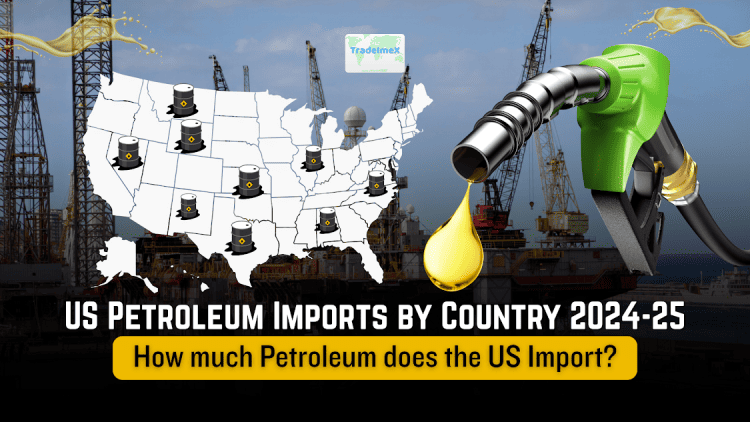
In recent years, the United States has been one of the largest consumers of petroleum in the world. Despite efforts to increase domestic production, the US still relies heavily on imports to meet its energy needs. Understanding where the US imports its petroleum from can provide valuable insights into the country's energy security and geopolitical relationships. According to the US import data and petroleum import data of the USA, the total value of the US petroleum imports reached $58.71 billion in 2024, a 15% decline from the previous year. The US imported petroleum worth $11.90 billion in the first quarter of 2025, as per the US petroleum import statistics. As per the global trade data, the US ranks number 1 as the largest petroleum importer in the world. In this article, we will explore the data on US petroleum imports by country for the years 2024-25.
Overview of US Petroleum Imports
The United States imports petroleum from a variety of countries around the world. These include both traditional oil-producing nations in the Middle East, as well as newer sources in Africa, South America, and Asia. The US also imports petroleum products such as gasoline, diesel, and jet fuel to meet domestic demand. The United States imported 8.42 million barrels of petroleum per day on average in 2024, with a slight decline from the previous year. With over 4.7 million barrels per day, Canada continues to be the biggest supplier of oil to the United States. Approximately 1.3 million barrels per day were imported by the US from OPEC nations. U.S. imports of crude oil and petroleum products decreased 39% between 2006 and 2024, from roughly 14 million barrels per day (b/d) to around 8 million b/d, as per the U.S. Energy Information Administration (EIA).
The oil imports United States receives play a crucial role in its energy landscape, and understanding where does US import oil from offers insights into geopolitical and economic ties. Data on United States oil imports by country and US oil imports by country reveals that Canada consistently ranks among the top oil suppliers to the US, followed by nations like Mexico and Saudi Arabia. When analyzing America oil imports by country, it's clear that regional proximity and trade agreements influence supply chains. Over time, United States oil imports by year show fluctuations based on domestic production and global oil prices. As of recent data, what percentage of US oil is imported has decreased due to increased local output, but how much oil does the US import remains significant. Overall, oil import to USA remains a critical topic in energy policy and economic strategy.
US Petroleum Imports by Country: Where Does US Import Oil From?
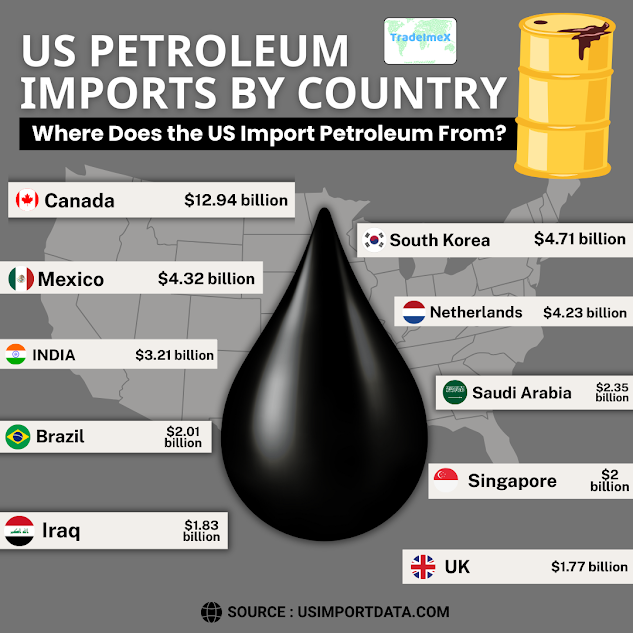
The United States is one of the world's largest consumers of petroleum products, with a significant portion of its oil supply coming from imports. The US petroleum Imports by Country play a crucial role in the United States' energy landscape. The US significantly depends on various countries for its petroleum needs, with Canada, Saudi Arabia, Mexico, and Russia being among the top suppliers. Canada tops the list as the largest exporter of petroleum to the US, followed closely by imports from South Korea, as per the data on united states oil imports by country and America oil imports by country. The top 10 import partners for US petroleum imports, as per the US shipment data and US petroleum import data for 2024-25, include:
1. Canada: $12.94 billion (22%)
Canada is the largest supplier of petroleum to the United States, accounting for 22% of total imports in 2024-25. The proximity of Canada to the US, as well as the strong trade relationship between the two countries bound by the USMCA, makes Canada a reliable and essential source of petroleum for the US.
2. South Korea: $4.71 billion (8%)
South Korea is the second-largest supplier of petroleum to the US, providing 8% of total imports in 2024-25, as per US petroleum imports from South Korea. South Korea's well-developed refining industry and strategic location make it a key player in the global oil market.
3. Mexico: $4.32 billion (7.4%)
Mexico is another significant source of petroleum for the US, accounting for 7.4% of total imports in 2024-25. The proximity of Mexico to the US and the strong trade relationship between the two countries make Mexico a crucial partner in ensuring a stable and reliable oil supply for the US.
4. Netherlands: $4.23 billion (7.2%)
The Netherlands is an important supplier of petroleum to the US, providing 7.2% of total imports in 2024-25. The Netherlands serves as a key hub for oil trading and distribution in Europe, making it a strategic partner for the US in securing its oil supply.
5. India: $3.21 billion (5.5%)
India is a growing source of petroleum for the US, accounting for 5.5% of total imports in 2024-25, as per the data on US petroleum imports from India. The increasing demand for oil in India, coupled with its growing refining capacity, makes India an important player in the global oil market. We’ll see if the US tariffs of 50% on Indian goods will affect the India-US trade tensions in the petroleum trade or not.
6. Saudi Arabia: $2.35 billion (4%)
Saudi Arabia has long been a major supplier of petroleum to the US, providing 4% of total imports in 2024-25. The close political and economic ties between the US and Saudi Arabia make Saudi Arabia a key partner in ensuring a stable and secure oil supply for the US.
7. Brazil: $2.01 billion (3.4%)
Brazil is another significant source of petroleum for the US, accounting for 3.4% of total imports in 2024-25. The growing oil production in Brazil, particularly in offshore fields, has made Brazil an increasingly important supplier of oil to the US.
8. Singapore: $2 billion (3.4%)
Singapore is a key player in the global oil market, serving as a major oil trading hub and refining center. Singapore provided 3.4% of total petroleum imports to the US in 2024-25, highlighting the strategic importance of Singapore in ensuring a stable oil supply for the US.
9. Iraq: $1.83 billion (3.1%)
Iraq is a significant source of petroleum for the US, accounting for 3.1% of total imports in 2024-25. The vast oil reserves in Iraq, combined with its growing production capacity, make Iraq an essential supplier of oil to the US.
10. United Kingdom: $1.77 billion (3%)
The United Kingdom is another important supplier of petroleum to the US, providing 3% of total imports in 2024-25. The strong historical ties between the US and the UK, as well as the UK's strategic location in the North Sea, make the UK a reliable partner in ensuring a stable and secure oil and petroleum supply for the US.
US Petroleum Imports in the Last 10 Years: Historical US Petroleum Import Data
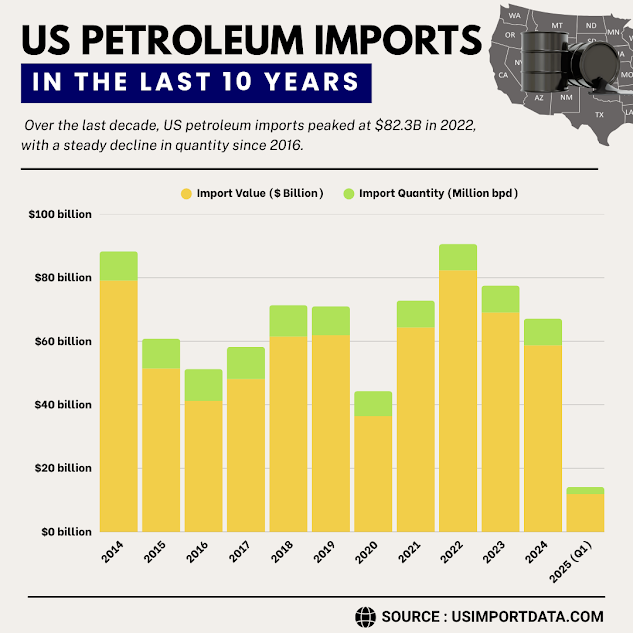
|
Year of Imports |
US Petroleum Import Value ($) |
Total import quantity (bpd) |
|
2014 |
$79.07 billion |
9.24 million barrels per day |
|
2015 |
$51.41 billion |
9.44 million barrels per day |
|
2016 |
$41.23 billion |
10.05 million barrels per day |
|
2017 |
$48.08 billion |
10.14 million barrels per day |
|
2018 |
$61.47 billion |
9.94 million barrels per day |
|
2019 |
$61.90 billion |
9.14 million barrels per day |
|
2020 |
$36.44 billion |
7.86 million barrels per day |
|
2021 |
$64.34 billion |
8.47 million barrels per day |
|
2022 |
$82.30 billion |
8.32 million barrels per day |
|
2023 |
$69.02 billion |
8.52 million barrels per day |
|
2024 |
$58.71 billion |
8.42 million barrels per day |
|
2025 quarter 1 |
$11.90 billion |
2.2 million barrels per day |
U.S. net petroleum imports: Is US a Net Importer of Petroleum?
In 2024, the United States imported a negative import volume of 2.34 million barrels of petroleum per day, which was a negative sum. In 2020, the North American nation's net import volume of petroleum fell to a minus 651 thousand barrels per day, turning it into a net exporter. After peaking at 12.55 million barrels per day in 2005, net imports have significantly declined throughout the period shown. The United States was able to attain a trade surplus after the introduction of unconventional shale extraction.
Trends in US Petroleum Imports
The US petroleum imports landscape is constantly evolving, with shifting geopolitical dynamics and changing market conditions. In recent years, the US has increased imports from countries such as Brazil, Nigeria, and Kazakhstan, as traditional suppliers like Venezuela have seen production decline. Looking ahead to 2024-25, experts predict that the US will continue to diversify its sources of petroleum imports. The rise of renewable energy and electric vehicles is putting pressure on traditional oil producers, forcing the US to seek new partners for its energy needs.
Implications for US Energy Security
Understanding where the US imports its petroleum from is crucial for assessing the country's energy security. Dependence on a small number of suppliers can leave the US vulnerable to supply disruptions and price shocks. Diversifying sources of petroleum imports can help reduce these risks and ensure a stable energy supply for the country.
U.S. Petroleum Imports in 2024–25: A Sharp Look
How Much Petroleum Is the U.S. Importing?
-
In 2024, the U.S. imported about 8.42 million barrels per day (b/d) of petroleum (crude + products), while exporting around 10.15 million b/d, so the U.S. has been a net petroleum exporter by 1.6 million b/d.
-
Total crude oil imports fluctuated between 8.1–8.8 million b/d in 2021, underlining consistent reliance.
Shifts Over Time: The Canada Story
-
U.S. imports from Canada peaked in the mid-2000s and then fell until 2014, when imports from Canada first surpassed those from OPEC.
-
Since then, Canadian imports have kept climbing, buoyed by pipeline expansions and integrated refinery demand.
Petroleum Products & Motor Fuels
-
Petroleum product imports dropped by 210,000 b/d in 2024, averaging 1.8 million b/d, driven by declines across gasoline, diesel, jet fuel, and unfinished oils.
-
Notably, the U.S. is a net exporter of gasoline, exporting 226,000 b/d more than it imports.
Refinery Realities & Infrastructure Lock-In
-
Over 70% of U.S. refineries are configured for heavy crude, mostly from Canada and Mexico, not lighter domestic shale oil.
-
Retooling refineries is costly and slow: ExxonMobil spent $2 billion and four years to process Permian shale; Chevron shelled out $475 million for upgrades.
US Tariffs, Trade Policy, and Market Risks
-
In 2025, the U.S. imposed 25% tariffs on oil imports from Canada and Mexico, with Canada also facing a 10% energy product levy.
-
These moves could raise gasoline prices by 20–40 cents per gallon, especially in the Northeast, as refiners pass on added costs.
-
Disruption risks extend as supply chains might shift to other heavy-crude producers like Colombia, but refinery matching remains a constraint.
What It All Means
-
Reliance on Canada: over half of all petroleum imports and the bulk of U.S. heavy refinery feedstock.
-
Net-exporter status: but still relies on imports to balance refinery needs and regional supply mismatches.
-
Infrastructure inertia: heavy crude configurations limit the shift toward domestic light crude.
-
Policy shocks can disrupt supply: tariffs ripple through prices, refinery economics, and alternative sourcing strategies.
National Energy Context: Shrinking Reliance on Imports
-
In 2024, imports accounted for just 17% of the U.S. energy supply, the lowest proportion since 1985.
-
The U.S. remains a net energy exporter, hitting production records across natural gas, biofuels, renewables, and more.
Big Numbers—Imports & Exports at a Glance
|
Metric |
Value |
|
Total petroleum imports |
8.42 million b/d |
|
Of which crude oil imports |
6.48 million b/d |
|
Total petroleum exports |
10.15 million b/d |
|
Net petroleum export surplus |
1.64 million b/d |
Product-Level Picture & Regional Patterns
-
Total petroleum product imports (gasoline, diesel, jet fuel, and unfinished oils) dropped by 210,000 b/d in 2024, to an average of 1.8 million b/d.
-
Motor gasoline, though the largest share of product imports, was down to 651,000 b/d, 36% of product imports, and 75,000 b/d lower than in 2023.
-
The U.S. exported 226,000 b/d more gasoline than it imported, continuing a trend of strong product exports.
-
Products primarily flow from Gulf Coast refineries, with export by tankers, while some regions, like parts of the Northeast, depend on imports due to logistical constraints.
Trends Over Time: A Story of Peak, Pivot, and Plateau
-
U.S. petroleum imports peaked in 2005, then declined thanks to domestic shale drives. Imports from OPEC dwindled, while Canadian imports climbed steadily.
-
By 2025, net crude imports are expected to drop 20%, hitting the lowest levels since 1971, driven by record U.S. production, restrained refinery demand, and export growth.
Policy Shocks & Tariff Risks—Exposing Fragility
-
Proposed 25% tariffs on Canadian and Mexican oil in February 2025 threaten refinery economics, especially in the Midwest.
-
A 10% energy levy on Canadian products may further hit costs.
-
These moves could redirect volumes to Europe and Asia, where refineries are better positioned to process heavy crude.
-
Midwest refiners, handling 70% of Canadian imports, may cut throughput or raise prices; estimates predict a 10–25¢/gal fuel price bump.
-
European and Asian players could capitalize, gaining a trading edge as U.S. refining margins shrink.
In Summary: What the Data Tells Us
-
Canada leads by a mile, the single largest supplier of U.S. petroleum, and is tailored to refinery needs.
-
The U.S. has become self-reliant energy-wise, but still needs targeted imports for refinery balance.
-
Product exports remain strong; product imports (like gasoline) continue to fall.
-
Tariff politics are a potential crack in the current system, threatening refinery capacity, trade flows, and consumer fuel costs.
-
The industry is at a pivotal junction: steadily tuning out dependency while staying tied to specialized foreign input.
Conclusion and Final Words
In conclusion, US petroleum imports by country for the years 2024-25 will be influenced by a complex interplay of economic, political, and environmental factors. By closely monitoring these trends and diversifying its sources of petroleum, the US can strengthen its energy security and adapt to a rapidly changing global energy landscape. Even as the U.S. surges in oil output, petroleum imports, especially from Canada, play a critical role. They keep refineries humming, stabilize fuel supply, and challenge policy with trade dependencies. Tariff upheaval could unsettle those carefully balanced systems and hit your wallet.
We hope that you liked our insightful and data-driven blog on US petroleum imports 2024-25. For more such insights into the latest US export-import data or to search live data on US petroleum imports by country or company, visit USImportdata. Contact us at info@tradeimex.in to get a customized database report along with a verified list of the top US petroleum importers at your fingertips!
What's Your Reaction?