US Importers Data 2025: Impact of New Trade Compliance Laws on US Importers
Discover how new US trade compliance laws in 2025 are impacting the US importers. Explore US importers data, trends, & top importers to stay ahead.
With the rise of globalization and advancements in technology, the United States has become a major player in the global market. As a result, US importers have had to adapt to new trade compliance laws and regulations to ensure they are operating within the legal boundaries. New US trade compliance regulations will have a big effect on importers in 2025, especially those who deal with e-commerce and low-value items. Increased tariffs and the removal of the de minimis exemption will raise import costs, requiring companies to modify their sourcing, pricing, and operational strategies, impacting the US import data.
To handle duty payments and reporting, importers, shippers, and customs officials will also need to work closely together during these adjustments. In this article, we will explore the importance of understanding US Importers Data in 2025 and how these new trade compliance laws will affect importers in the USA.
The Importance of Trade Compliance for US Importers
Trade compliance is essential for US importers to avoid costly fines, penalties, and even criminal charges. By abiding by trade laws, importers can ensure they are conducting business ethically and responsibly. Additionally, compliance with trade regulations can help importers build a positive reputation in the industry and among customers.
Current Trade Compliance Laws in the US
In the United States, importers must comply with a myriad of laws and regulations, including but not limited to the Tariff Act of 1930, the Customs Modernization Act, and the Trade Facilitation and Trade Enforcement Act. These laws govern various aspects of importing goods into the US, including tariffs, taxes, product safety standards, and intellectual property rights.
Top 10 US Import Companies (2025): US Importers Database
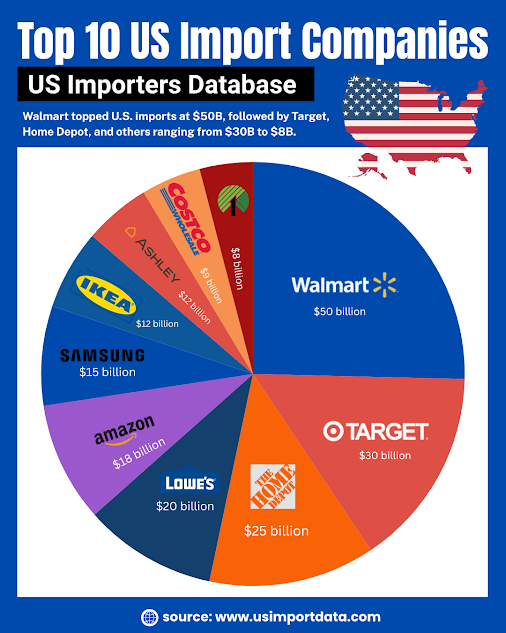
The Top 10 leading US Import Companies, as listed in the US Importers Database, represent a diverse range of industries and trade sectors. These leading importers demonstrate a strong presence in the global market, importing a wide array of products to meet the demands of consumers and businesses alike. Walmart imports the most goods in the USA, making it the largest US importer. The top 10 importers in the US, as per the US buyers list and US importers data for 2025, include:
|
Rank |
Company |
Approx. 2024-25 Import Value ($) |
TEU Volume est. |
|
1 |
Walmart Inc. |
$50 billion |
720 k |
|
2 |
Target Corporation |
$30 billion |
450 k |
|
3 |
The Home Depot |
$25 billion |
400 k |
|
4 |
Lowe’s Companies |
$20 billion |
350 k |
|
5 |
Amazon.com, Inc. |
$18 billion |
300 k |
|
6 |
Samsung Electronics USA |
$15 billion |
250 k |
|
7 |
IKEA North America |
$12 billion |
200 k |
|
8 |
Ashley Furniture Industries |
$10 billion |
180 k |
|
9 |
Costco Wholesale Corp. |
$9 billion |
150 k |
|
10 |
Dollar Tree, Inc. |
$8 billion |
140 k |
Important Effects on US Importers of New Trade Compliance Laws
-
Higher Expenses: The loss of the de minimis exemption and the imposition of new tariffs will have the biggest effect on the price of importing low-value goods, particularly from China and Hong Kong.
-
Operational Changes: In addition to possibly streamlining their supply chains, importers have to adjust to new customs entry regulations, duty collection, and reporting requirements.
-
Changes in Strategy: To adapt to the new environment, businesses might need to look into different sourcing possibilities, change their pricing policies, and possibly spend money on new services or technology.
-
Carrier Coordination: To handle duty payments and guarantee correct reporting to customs, importers who depend on global postal networks will have to engage closely with carriers.
-
Flexibility: Companies must be nimble and flexible to adjust to the shifting trade environment, which includes geopolitical conflicts and sustainability issues.
The Value of Compliance Instruments
For importers to guarantee correct customs documentation and compliance, they must use digital customs solutions and stay current on tariff changes.
Particular Modifications and Their Effects
-
Removal of the De Minimis Exemption: E-commerce and companies that import tiny amounts will be impacted by the removal of the de minimis exemption, which permitted duty-free imports of low-value items (now valued at USD 800 or less).
-
Higher levies: Importers may have to adjust prices and profitability to account for increased levies on goods, especially those originating from China and Hong Kong.
-
Steel & Aluminum Tariffs: Import taxes on steel and aluminum have increased under President Trump, which has an effect on companies operating in those industries, as per the U.S. Steel import data.
-
Section 232 Tariffs: Importers must modify their tactics due to increased taxes imposed on specific industries, such as steel, aluminum, and autos.
-
More Audits: Customs and Border Protection (CBP) is conducting more importer audits, which will increase vigilance and could result in fines for noncompliance.
-
Machine Learning and AI in Trade Compliance: Cutting-edge technologies are being applied to expedite trade compliance procedures and increase the accuracy of third-party screening.
-
Adjusting to the Novel Trade Situation: Importers must keep up with any changes to trade laws and new tariff developments.
-
Sustaining Flexible Supply Chains: Companies want to think about expanding their supply chain options and diversifying their sourcing.
-
Asking for Professional Guidance: Importers can improve their import plans and manage the intricacies of the current trade compliance environment by speaking with customs specialists.
The Impact of New Trade Compliance Laws on US Importers
As we look ahead to 2025, new trade compliance laws are set to come into effect that will significantly impact US importers. These laws are designed to enhance security, promote fair trade practices, and protect intellectual property. Importers must be prepared to adapt to these changes to remain competitive in the global market.
Increased Scrutiny on Supply Chains
One of the key changes importers can expect in 2025 is increased scrutiny on their supply chains. With the rise of global terrorism and cyber threats, governments are cracking down on supply chain security to prevent illicit goods from entering the market. Importers will need to invest in secure supply chain management systems and conduct regular audits to ensure compliance.
Stricter Tariff Regulations
Another area of focus for new trade compliance laws in 2025 will be stricter tariff regulations. With growing tensions between the US and its trading partners, importers can expect higher tariffs and increased duties on imported goods. This can have a significant impact on profit margins and pricing strategies, making it crucial for importers to stay informed about changes in tariff rates.
Emphasis on Sustainability and Environmental Compliance
In line with the global push for sustainability, new trade compliance laws in 2025 will place a greater emphasis on environmental compliance. Importers will be required to adhere to stricter regulations on waste management, carbon emissions, and product recycling. Failure to comply with these laws could result in fines and damage to the brand reputation.
US Import Shipment Data & Trends 2025
-
May 2025 ocean or maritime imports declined notably:
-
Seaborne imports dropped 7.2% to 2.18 M TEUs
-
China-origin sea imports plunged 28.5% YoY, the sharpest since the pandemic, as per the data on US imports from China.
-
Key US ports hit: Long Beach (-20.9%), LA (-8.5%), Seattle (-17.3%), NY/NJ (-15.3%).
-
Imports paused: early April saw a 64% drop in container bookings, as businesses wait on tariff policy.
-
Tariff-driven strategy shift: importers like Amazon, Nike pulling or re-routing orders.
Importer Behavior & Compliance Costs
-
Compliance burdens:
-
Customs brokers are in high demand; fees up $1–$5 per HTS code; UPS/FedEx raised rates by 4%.
-
In-house teams growing: Firms like Nike, Amazon, Lowe’s are expanding trade/compliance staff.
-
Origin-washing risk: Mislabeling Chinese goods to evade tariffs rising; CBP is enforcing with AI, Korea reported $20.8M violations.
-
De minimis changes: As of May 2, low-value parcels (< $800) from China/HK are subject to duties and full customs filing.
Tariffs & Trade Compliance Laws
-
Liberation Day Tariffs:
-
Flat 10% tariff on nearly all imports effective April 5, 2025.
-
Additional "reciprocal" rates on 60 countries effective April 9, 2025.
-
Steel & Aluminum Duties:
-
Raised from 25% to 50% as of June 4, 2025.
-
Projected $100 B added annual import cost.
-
China Tariff Spikes:
-
Tariffs reached 145%; later eased via a 90-day truce and a 30% baseline due to the US-China trade war.
-
De minimis termination:
-
China/HK parcels < $800 are now duty-inclusive and CBP-processed.
-
Legal pushback:
-
The court struck down tariff powers (V.O.S. Selections et al.) May 28, 2025; injunction stayed pending appeal.
-
The Trade Review Act was introduced in June 2025 to reassert Congressional oversight.
Compliance & Supply Chain Impacts on USA Importers
-
Brokers and automation: Rise in cost, digital HTS mgmt, AI‑enabled CBP checks.
-
Labeling & origin trace: Forced labor rules (Uyghur, etc.) and "Made-in-USA" enforcement tightened.
-
Shift in sourcing: Companies moving orders to Vietnam/Mexico/Cambodia, rerouting away from China.
-
Inbound cost pass-through: Consumers facing higher prices; Texas importers paid $1.5 B in March 2025 tariffs, a 167% rise YoY.
Summary & Outlook
-
Total US imports (2024): $3.35 trillion (up by 6% from the previous year)
-
Policy uncertainty: Surging and receding tariffs (China, steel/alum, de minimis) have disrupted sourcing and inventory strategies.
-
Forecast: NRF projects a 20% import decline in H2 2025 due to ongoing tariff unpredictability.
-
Legislative mitigation: The Trade Review Act may temper executive tariff power, and legal rulings could limit future unilateral moves.
Key Takeaways
-
US import volumes, especially from China, dropped sharply in 2025.
-
Compliance costs, brokerage, documentation, and labeling have escalated.
-
Leading importers pivoting supply chains; high-value tech, vehicles, and pharma still dominate.
-
Top country partners remain Mexico, China, and Canada.
-
Tariff waves (Liberation Day, steel & aluminum, de minimis) have created turbulence.
-
Legal and legislative actions are starting to constrain executive trade authority.
-
Forecasts point to a continued import slowdown in late 2025.
How US Importers Can Prepare for 2025
To navigate the evolving landscape of trade compliance laws, US importers can take proactive steps to prepare for 2025. This includes investing in automated compliance software, conducting regular training for employees, and staying up-to-date on regulatory changes. By taking a proactive approach to compliance, importers can mitigate risks and ensure a smooth transition into the new era of trade regulations.
Conclusion and Final Verdict
In conclusion, US importers must be prepared to adapt to new trade compliance laws in 2025. By understanding the impact of these regulations and taking proactive steps to comply, importers can ensure they remain competitive and sustainable in the global market. Compliance is not just a legal requirement; it is a strategic imperative for success in the import business.
We hope that you liked our insightful blog report on the impact of new trade compliance laws on US importers in 2025. To get more exclusive insights into the US export-import data, visit USImportdata. Contact us at info@tradeimex.in and get a customized US trade database report and a verified list of the top US importers, as per your business needs!
What's Your Reaction?