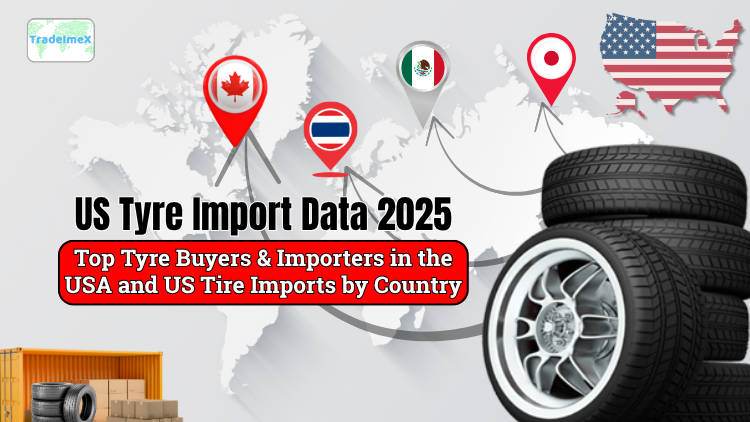
US Tyre Import Data 2025: Top Tyre Buyers & Importers in the USA and US Tire Imports by Country
Explore US Tyre Import Data 2024-25—$19.96B in imports led by top Tyre Buyers in the USA. Discover key tire importers in the USA & US tire imports by country.
The tire import market in the United States is changing more quickly than before. Tire imports into the United States are not only increasing in quantity but also shifting in structure due to changes in the global supply chain, more emphasis on localized manufacturing, and expanding freight demand. While big global importers continue to influence the flow of tires into the U.S. market, Southeast Asia has emerged as the primary production base. The overall value of US tire imports totaled $19.96 billion in 2024, up 2% from the year before, according to US import data and the USA's tire import data. In the first two quarters of 2025, the US imported tires valued at $10.5 billion. Many businesses in the US looking to import tyres from Japan are drawn to the country’s reputation for high-quality manufacturing and advanced rubber technology.
As importing tires into the US continues to rise, companies increasingly seek reliable overseas suppliers to meet consumer demand. Not only does the US import tires from major Asian producers, but it also relies on global trade networks to support its automotive industry, making tire imports a crucial part of the nation’s supply chain. According to global trade data, the USA is the world's biggest importer of tires. The situation of U.S. tire imports for 2024–2025 is examined in this extensive analysis, which focuses on overall import volumes, supplier nations, top importers and buyers, significant growth trends, and their implications for the industry's future.
Overview of the U.S. Tyre Import Market
The United States imported around 273 million tyres in 2024 across all vehicle categories, passenger, truck and bus, motorcycle, bicycle, and off-the-road. This marks a year-on-year growth of about 7.3%, continuing the upward trend seen since 2022. While inflation and logistics costs exerted pressure on margins, demand for replacement tyres and heavy-vehicle tyres kept import activity strong.
Passenger car tyres made up roughly 168.7 million units, representing a modest 2.1% annual increase. Truck and bus radial tyres showed the most robust growth, reaching about 58.7 million units, an 18.3% surge over the prior year. Motorcycle and bicycle tyres grew even faster, by 30% and 31% respectively, reflecting shifts in consumer mobility preferences and recreational use, as per the reports of the U.S. Tire Manufacturers Association (USTMA).
The total import value for all tire categories in 2024 was approximately 20 billion U.S. dollars, up 6–7% from the year before. New pneumatic rubber tyres, classified under HS Code 4011, account for the majority of this value. Over the next decade, total imports are projected to approach 500 million units and nearly 40 billion dollars in value if current trends hold.
While passenger car tyres remain dominant in volume, the most exciting momentum is in the truck, bus, and specialty tyre segments, which are benefiting from booming logistics and construction activity.
US Tire Imports by Country: Where Does the US Import Tyres From?

Tire imports to the US originate from various countries worldwide. The leading countries that the US imports tires from include Thailand, Japan, Canada, South Korea, and Mexico. These nations have established themselves as key players in the tire manufacturing industry, providing a variety of high-quality tyres to meet the diverse needs of consumers in the US market. The top 10 countries from where the US imports tyres, as per the US shipment data and the data on US tire imports by country for 2024-25, include:
1. Thailand: $3.93 billion (19.7%)
Thailand leads the pack as the biggest source of tire imports for the US, accounting for almost 20% of the total imports, as per the data on US tyre imports from Thailand. The country has a well-established tire manufacturing industry and produces a wide range of tires for various applications.
2. Mexico: $2.21 billion (11.1%)
Mexico is the second-largest source of tire imports for the US, with over $2 billion worth of tires being imported from the country. The proximity of Mexico to the US and the USMCA has made it a popular choice for sourcing tires.
3. Canada: $1.86 billion (9.4%)
Canada comes in third place, accounting for around 9% of the total tire imports into the US. The strong trade relationship between the US and Canada makes it easy for tires to be imported across the border.
4. Japan: $1.53 billion (7.7%)
Japan is another significant player in the tire import market, with a market share of 7.7% in the US. Japanese tire manufacturers are known for their high-quality products and innovative technology.
5. Vietnam: $1.50 billion (7.5%)
Vietnam has emerged as a key player in the tire industry, with a growing share of the US market. The country offers competitive pricing and a wide range of tire options for US consumers.
6. Indonesia: $941.60 million (4.7%)
Indonesia is another important source of tire imports for the US, with a market share of almost 5%. The country's growing manufacturing sector has made it an attractive destination for sourcing tires.
7. South Korea: $926.33 million (4.6%)
South Korea is known for its advanced technology and high-quality tires, making it a popular choice for US consumers, as per the data on US tyre imports from South Korea by HS code. The country holds a significant share of the US tire import market.
8. China: $856.01 million (4.3%)
China is a major player in the tire industry, with a market share of over 4% in the US. The country's competitive pricing and large manufacturing capacity make it a top choice for tire imports.
9. Cambodia: $770.98 million (3.9%)
Cambodia is a relatively newer player in the tire import market, but has quickly gained popularity due to its competitive pricing and diverse range of tire products.
10. India: $551.85 million (2.8%)
India rounds out the list of top countries from which the US imports tires, with a market share of 2.8%. The country's growing manufacturing sector and emphasis on quality make it an attractive source for US tire imports.
List of Top Tyre Buyers & Importers in the USA: US Tyre Importers Database
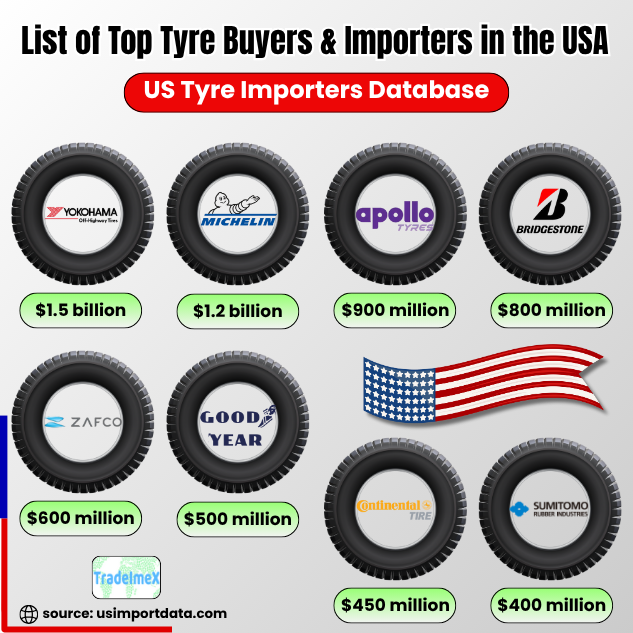
When it comes to sourcing tires in the USA, having access to a comprehensive database of top tire buyers and importers is paramount for successful business endeavors. The US Tyre Importers Database is a valuable resource that offers detailed insights into key players in the industry. From established tire distributors to emerging importers, this database provides essential information to help you navigate the competitive market with confidence. The leading tyre buyers & importers in the USA, as per the US tyre importers data and the tyre buyers list for 2025, include:
|
Company Name |
Approx. Import Value (2024) |
Top Imported Tyre Types |
Top Import Sources |
|
Yokohama Off-Highway Tires America Inc. |
$1.5 billion |
Off-Road/Construction, Agricultural, Industrial tyres |
India, Vietnam, Thailand |
|
Michelin North America Inc. (and Canada affiliate) |
$1.2 billion |
Passenger car tyres, Truck & Bus tyres |
Thailand, Mexico, Canada |
|
Apollo Tyres US Inc. |
$900 million |
Passenger car & light truck tyres |
India, Hungary |
|
Bridgestone Americas Tire Operations LLC |
$800 million |
Passenger car tyres, Light truck, Specialty tyres |
Japan, Thailand, Indonesia |
|
Zafco International LLC |
$600 million |
Passenger car tyres (import/distribution) |
Thailand, Vietnam, India |
|
Goodyear Tire & Rubber Company (imports) |
$500 million |
High-performance tyres, Specialty passenger tyres |
Mexico, Europe |
|
Continental Tire the Americas LLC |
$450 million |
Commercial vehicle tyres, Passenger tyres |
Mexico, Europe |
|
Sumitomo Rubber North America Inc. |
$400 million |
Passenger car & light truck tyres |
Thailand, Japan |
|
Nokian Tyres North America Inc. |
$300 million |
Premium winter/all-season tyres |
Finland, Southeast Asia |
|
Kumho Tire USA Inc. |
$200 million |
Passenger car & light truck tyres |
South Korea, Vietnam |
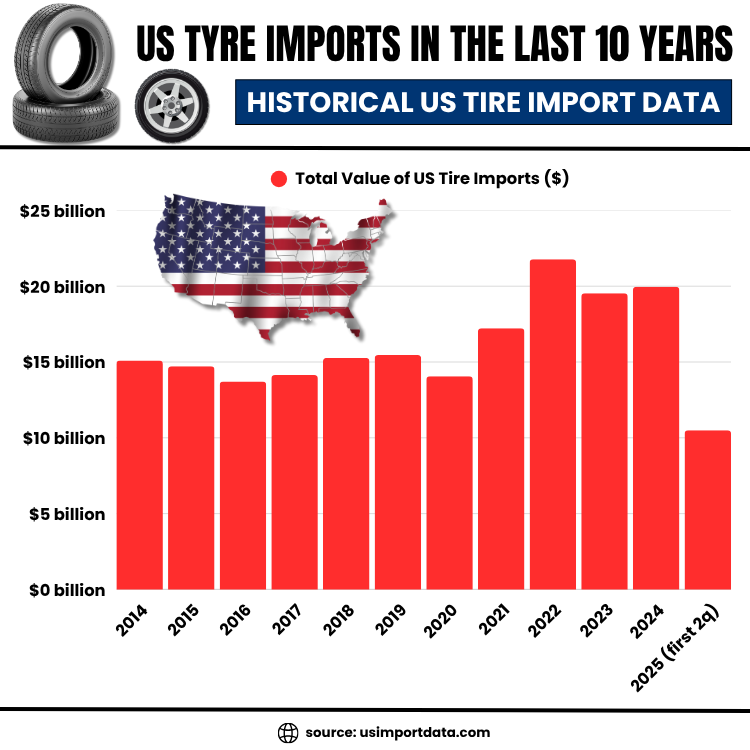
US Tyre Imports in the Last 10 Years: Historical US Tire Import Data
|
Year of Imports |
Total Value of US Tire Imports ($) |
|
2014 |
$15.10 billion |
|
2015 |
$14.72 billion |
|
2016 |
$13.72 billion |
|
2017 |
$14.14 billion |
|
2018 |
$15.27 billion |
|
2019 |
$15.46 billion |
|
2020 |
$14.06 billion |
|
2021 |
$17.22 billion |
|
2022 |
$21.77 billion |
|
2023 |
$19.53 billion |
|
2024 |
$19.96 billion |
|
2025 (first 2 quarters) |
$10.50 billion |
Exploring the Leading Tyre Suppliers to the United States
The United States sources tyres from over 40 countries worldwide, but the market is heavily concentrated. Five nations, Thailand, Vietnam, Mexico, Canada, and Japan, collectively supply more than half of all tyres imported into the country. The balance comes from China, Indonesia, India, South Korea, and several emerging exporters such as Cambodia.
Thailand
Thailand remains the number-one source of tyres for the U.S. market. In 2024, it exported roughly 65 million units to the U.S., accounting for nearly a quarter of total import volume. The total value of these shipments is estimated at 3.6 billion dollars.
Thailand’s success as a tyre manufacturing hub is rooted in its abundant natural rubber resources, mature industrial ecosystem, and extensive presence of global brands such as Bridgestone, Goodyear, Michelin, and Sumitomo. Over the past decade, tyre exports from Thailand to the U.S. have increased by about 14% per year on average. Its mix of passenger, truck, and specialty tyres covers nearly every segment of the market.
Vietnam
Vietnam has rapidly ascended to become the second-largest tyre supplier to the U.S., shipping approximately 28 million units in 2024. Its export value is around 1.25 billion dollars, and its share of the total U.S. tyre import market now sits close to 10%.
Vietnam’s rise is the direct result of global manufacturers relocating production from China due to tariffs, rising labor costs, and trade restrictions. Over the last decade, tyre exports from Vietnam to the U.S. have expanded at an average annual rate exceeding 30%. Vietnam is now home to plants operated by major international tyre producers that serve the North American market almost exclusively.
Mexico
Mexico holds a strong regional advantage under the U.S.-Mexico-Canada Agreement (USMCA). In 2024, it supplied around 25 million tyres to the U.S., representing roughly 9% of the total import volume and an estimated value of 2.2 billion dollars.
Mexico’s tyre manufacturing base includes large facilities operated by Goodyear, Bridgestone, and Continental, among others. Its geographic proximity provides cost savings and flexibility compared to trans-Pacific supply chains. For many importers, Mexico serves as a nearshore hub for passenger and light truck tyres.
Canada
Canada remains a reliable source of high-value tyres, exporting about 1.7 billion dollars’ worth of tyres to the United States in 2024. While its volume share is smaller compared to Asian sources, Canada focuses on premium and commercial-grade tyres, especially those used in trucks, buses, and specialty applications. Strong regulatory alignment and efficient logistics keep Canada among the U.S.’s top five tyre suppliers.
Japan
Japan continues to play a vital role as a supplier of high-performance and premium tyres. Its exports to the U.S. in 2024 were valued at approximately 1.8 billion dollars. Japanese tyres tend to occupy the upper end of the market, serving sports cars, luxury vehicles, and advanced technology segments. While volumes are smaller, the per-unit value of tires imported from Japan remains among the highest globally.
China
China, once the dominant tyre supplier to the United States, has seen its share decline steadily due to ongoing tariffs and trade restrictions. In 2024, U.S. tyre imports from China stood at around 25 million units, down 3% from 2023. Passenger car tyre imports from China fell even more sharply, by over 30%.
Despite the contraction, China remains significant in certain categories, particularly low-cost trailer tyres, off-road tyres, and private-label brands. Some Chinese manufacturers have also established satellite plants in Thailand, Vietnam, and Cambodia to maintain U.S. market access.
Emerging Suppliers
Several smaller but fast-growing exporters are reshaping the tail end of the market. Cambodia, for example, has experienced exponential growth in tyre shipments to the U.S., expanding from a negligible base to over two million units in 2024. Indonesia’s exports are also increasing, particularly in motorcycle and truck tyres. India contributes a mix of commercial and agricultural tyres through brands like Apollo and JK Tyre, which are expanding their American distribution networks.
About 60% of all U.S. tyre imports come from just three countries: Thailand, Vietnam, and Mexico. This concentration shows both the reliance on Southeast Asian manufacturing and the strategic role of regional partners under North American trade frameworks.
Leading Tyre Importers and Buyers in the United States
While supply origins define one side of the equation, the importers and buyers within the U.S. complete the picture. The American tyre import landscape is dominated by a small group of powerful distributors and multinational corporations’ regional subsidiaries. Together, these firms handle the bulk of inbound shipments and act as key gateways for overseas manufacturers.
There are roughly 10,000 registered tyre importers in the United States, but the top 10 companies account for more than half of total imports.
-
Yokohama Off-Highway Tires America Inc. is the largest single importer by shipment volume, accounting for roughly one-fifth to one-quarter of total U.S. tyre imports. Its portfolio includes off-highway, agricultural, and industrial tyres sourced mainly from manufacturing plants in India, Vietnam, and Israel. Yokohama’s dominance in the off-road segment makes it a vital player in U.S. agricultural and construction equipment supply chains.
-
Michelin North America Inc. and its Canadian affiliate are the next largest importers, responsible for around 15–17% of total shipments. Michelin imports a balanced mix of passenger, truck, and specialty tyres from its global network in Thailand, Mexico, and Europe.
-
Apollo Tyres US Inc. leads the car tyre import category with nearly 40% of shipments in that segment. It focuses heavily on passenger and light truck tyres, primarily manufactured in India and Hungary. Apollo’s strategy combines direct imports with a strong U.S. distribution infrastructure.
-
Bridgestone Americas Tire Operations LLC also remains a major importer, controlling about 10% of passenger car tyre imports. Bridgestone sources primarily from Japan, Indonesia, and Thailand while also operating U.S. production facilities.
-
Zafco International LLC stands out among independent distributors. Handling roughly a quarter of independent market shipments, it sources tyres from Vietnam, Thailand, and India for resale across the U.S. retail network.
Other notable importers include Goodyear Tire & Rubber Company, Continental Tire the Americas, Sumitomo Rubber North America, Nokian Tyres North America, and Kumho Tire USA. Together, these firms represent most of the inbound tyre flow into the U.S. market.
The high level of concentration means that a handful of companies shape the import ecosystem. For exporters, establishing relationships with these key buyers can unlock access to significant U.S. market volumes.
Trends Shaping the U.S. Tyre Import Market
The shift away from Chinese manufacturing remains the defining trend. Tariffs, anti-dumping duties, and rising production costs have pushed both global tyre makers and independent brands to diversify into Southeast Asia. Thailand, Vietnam, and Cambodia are now the preferred manufacturing hubs for tyres destined for the United States.
Southeast Asia’s dominance is underpinned by a reliable rubber supply, favorable trade terms, and lower energy and labor costs. Vietnam, in particular, has become a magnet for new tyre factories, supported by substantial foreign direct investment from Japan, South Korea, and Europe.
Regional production within North America is also gaining ground. Mexico’s exports to the U.S. are rising steadily as manufacturers leverage duty-free trade and short supply chains. Canada maintains a focus on higher-value products, particularly commercial tires.
Another defining trend is the faster growth of commercial and specialty tyres compared to passenger tyres. Truck and bus tyre imports rose over 18% in 2024, reflecting increased trade activity and freight transport demand. Motorcycle and bicycle tyre imports expanded even more rapidly, underscoring the diversification of mobility preferences.
Electric vehicle (EV) adoption is another emerging influence. EV tyres require specific materials and designs, creating demand for new product lines. Manufacturers with advanced R&D capabilities are expected to capture this future growth.
Challenges and Market Pressures
Despite consistent import growth, the U.S. tyre market faces several challenges. Trade policy uncertainty continues to loom large, with periodic investigations into imports from countries such as Thailand and Vietnam. Any new duties could shift sourcing patterns once again.
Currency volatility affects cost competitiveness, while high freight rates and shipping constraints continue to add pressure. Compliance with U.S. safety and environmental standards, such as DOT and NHTSA regulations, remains a non-negotiable requirement for importers and exporters alike.
The market is also extremely price-sensitive. Passenger car tyres are a mature, commoditized segment, leaving little room for price premiums unless tied to technology or brand reputation. Smaller suppliers often struggle to secure scale without significant marketing or distribution partnerships.
The Outlook for 2025 and Beyond
The outlook for 2025 remains positive. Total U.S. tyre imports are expected to increase by another 4-6%, reaching approximately 285 to 290 million units. Growth will remain strongest in the truck, bus, and off-highway categories, with moderate expansion in passenger tyres.
Southeast Asia’s role will continue to strengthen, particularly for Vietnam and Indonesia. China’s share is expected to stagnate or decline further. North American production in Mexico and Canada will keep expanding to mitigate logistical risk and reduce lead times.
Large importers like Yokohama, Michelin, Apollo, and Bridgestone will continue to dominate inbound volumes, though new entrants may find opportunities in niche markets, especially EV, performance, and sustainable tires.
Innovation in manufacturing, focused on recycled materials, low rolling resistance, and energy-efficient designs, will likely shape the next phase of tyre trade growth. The U.S. market, while competitive, will remain one of the most attractive and diversified destinations for global tyre exports.
Key Insights in Summary
The United States imported about 273 million tyres in 2024, worth roughly 20 billion dollars. The biggest suppliers were Thailand, Vietnam, and Mexico, which together made up more than half of total imports. Southeast Asia’s share continues to rise as manufacturers shift production out of China.
Truck, bus, and specialty tyres are the fastest-growing import categories, outpacing passenger tyres. The U.S. importer base is highly concentrated, with a small number of multinational companies managing most inbound volumes.
Looking ahead, steady demand, regional diversification, and ongoing innovation will keep tire imports strong through 2025 and beyond. For exporters, success will depend on competitiveness, compliance, and the ability to align with key U.S. importers who drive the bulk of trade in this dynamic and highly competitive market.
Conclusion and Final Thoughts
The U.S. tyre import market continues to expand, shaped by evolving trade dynamics, regional diversification, and sustained domestic demand. Southeast Asia, especially Thailand and Vietnam, has become the backbone of U.S. tyre sourcing, while North American trade partners like Mexico and Canada add strategic stability.
The biggest buyers, including Yokohama, Michelin, Apollo, Bridgestone, and Goodyear, dominate import volumes through globalized supply chains and long-term supplier partnerships. At the same time, new entrants from emerging economies are finding opportunities in niche segments such as EV-compatible, off-road, and specialty tires.
As we move into 2025, the tyre industry faces both opportunity & complexity. Importers and exporters alike will need accurate, real-time data to make smart sourcing & pricing decisions in a market that changes by the month. Staying informed about who’s buying, what’s selling, and where it’s coming from has never been more critical.
Access and search live data on US tire imports by country with USImportData, your trusted source for detailed US shipment records, importer insights, and trade analytics. For the latest U.S. export–import data, customized trade reports, and the US tyre importers database, contact info@tradeimex.in and gain the data advantage your business deserves.
What's Your Reaction?