Whey Protein Suppliers & Manufacturers in USA: Top US Protein Powder Suppliers & Export Data 2025
Explore top whey protein suppliers & manufacturers in the USA with 2025 export data, market insights & leading US protein powder exporters.
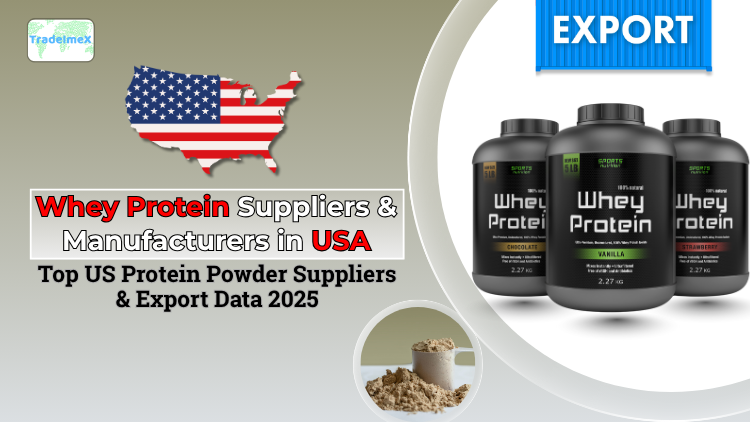
The United States is one of the global powerhouses of whey protein production. With a combination of advanced dairy processing infrastructure, consistent milk supply, and a thriving nutrition industry, America plays a critical role in the worldwide protein market. According to the US export data and Whey protein export data of the USA, the total value of US whey protein exports reached $844.05 million in 2024, a 4% increase from the previous year. The US exported whey protein worth $452.87 million in the first two quarters of 2025, as per the US whey protein export data. The growing demand for sports nutrition and functional foods has increased the visibility of whey protein manufacturers USA, as businesses actively source from reliable whey protein powder suppliers that meet quality and compliance standards, while many protein manufacturing companies continue to expand capacity and innovation to serve domestic and global markets.
The USA is the largest whey protein exporter in the world, as per the global trade data. As of 2025, the global whey protein market is valued at roughly $11 billion, up from around $9.8 billion in 2024. Analysts expect the category to continue expanding at an average annual growth rate of about 8-12% through the end of the decade. North America remains the largest regional market, holding close to 40% of the global share. Within that, the U.S. contributes the lion’s share thanks to its vast dairy network, technological capacity, and export reach. The U.S. exported around 512,000 metric tons of whey in 2024.
In the domestic market, the U.S. whey protein ingredients segment, covering concentrates (WPC), isolates (WPI), and hydrolysates (WPH), is valued at about $1 billion in 2025. When consumer-ready protein powders and supplements are included, the total U.S. protein powder market exceeds $11 billion, and is projected to continue growing at 8–9% annually.
Demand is being fueled by an increasingly health-conscious population, a booming fitness sector, and the mainstream adoption of protein-enriched foods. At the same time, global buyers, especially in Asia, Latin America, and the Middle East, continue to look to the United States as a reliable source of high-quality whey proteins for food manufacturing and nutritional applications. Let’s explore more about the top whey protein suppliers & manufacturers in the US, with a key focus on protein powder suppliers data & protein supplement suppliers data of the USA in 2025.
The US Whey Protein Supply Chain
Whey protein begins its life in the dairy industry as a byproduct of cheese-making. When milk is curdled and strained to make cheese, the liquid portion left behind is whey. What was once a waste material has become one of the most valuable derivatives of milk.
Raw whey is collected from cheese plants and transported to specialized facilities for processing. There, it undergoes several filtration and purification steps, typically using ultrafiltration, microfiltration, and ion exchange membranes. These processes remove fats, lactose, and minerals, leaving a concentrated protein-rich liquid.
The largest whey protein manufacturers play a vital role in meeting the growing demand for fitness and health products across the globe. In particular, whey protein manufacturers and Whey Protein Suppliers are key players in producing high-quality nutritional supplements. The market in the United States is highly competitive, with numerous protein supplement manufacturers USA and protein powder manufacturers USA setting the benchmark for global standards.
These protein powder manufacturers in USA not only cater to local needs but also export globally, collaborating with various protein supplement suppliers and protein powder suppliers to ensure widespread distribution. As a result, the U.S. has become a hub for top-tier protein powder manufacturers and protein supplement manufacturers, reinforcing its status in the global supplement industry.
Depending on the filtration intensity, manufacturers can produce:
-
Whey Protein Concentrate (WPC): typically 35–80% protein content.
-
Whey Protein Isolate (WPI): 90% or higher protein content.
-
Whey Protein Hydrolysate (WPH): pre-digested protein with improved digestibility and absorption.
After concentration, the product is spray-dried into powder and packaged in bulk or further blended with flavors, vitamins, and other nutrients by supplement manufacturers. The United States has one of the most advanced whey processing networks in the world, with strict adherence to food safety and quality standards.
US Whey Protein Exports by Country: Where Does the US Export Whey Protein?
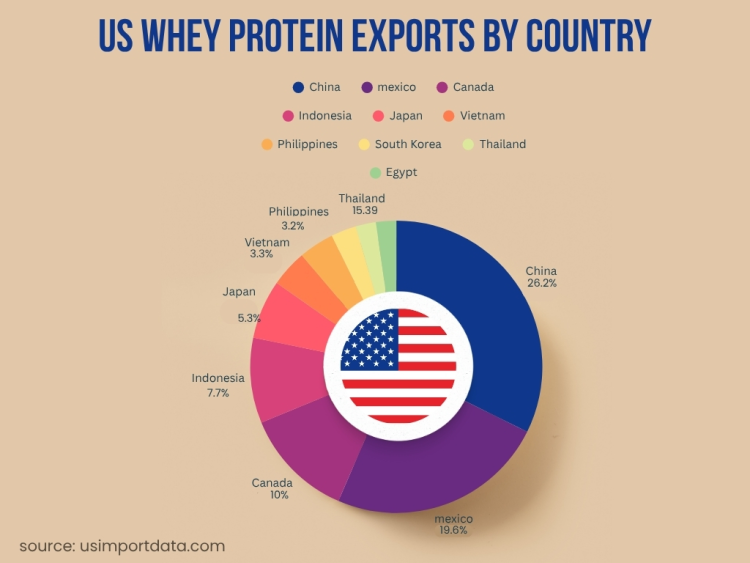
The United States is a major player in the global whey protein market, with exports being distributed across various countries. Whey protein has gained immense popularity over the years as a nutritional supplement, known for its numerous health benefits and muscle-building properties. The United States, being one of the largest producers of whey protein, also exports a significant amount of this product to various countries around the world.
US Whey Protein exports by country reveal a diversified market reach, with significant exports to countries such as China, Canada, Mexico, Japan, and South Korea. These countries represent key destinations for US whey protein products, showcasing the importance of international trade in the whey protein industry. The top 10 export destinations for the US whey protein exports by country, as per the US shipment data for 2024-25, include:
1. China: $221.52 million (26.2%)
China tops the list as the largest importer of US whey protein, accounting for a substantial 26.2% of total exports, as per the data on US whey protein exports to China by HS code. The increasing demand for sports nutrition products and dietary supplements in China has driven the growth of whey protein exports from the US to this market.
2. Mexico: $165.51 million (19.6%)
Coming in second place is Mexico, with $165.51 million worth of US whey protein exports, making up 19.6% of the total. The proximity of Mexico to the US and the popularity of whey protein among Mexican consumers have contributed to the significant export volumes to this country.
3. Canada: $84.10 million (10%)
Canada follows closely behind, importing $84.10 million worth of whey protein from the US, accounting for 10% of total exports. The strong trade relations between the US and Canada, along with the growing health and fitness trends in the country, have fueled the demand for US whey protein.
4. Indonesia: $64.65 million (7.7%)
Indonesia ranks fourth on the list of top importers of US whey protein, with $64.65 million in exports, representing 7.7% of the total. The increasing health consciousness among Indonesian consumers and the popularity of fitness and bodybuilding in the country have driven the demand for US whey protein.
5. Japan: $44.66 million (5.3%)
Japan is another significant market for US whey protein exports, with $44.66 million worth of exports, accounting for 5.3% of the total. The advanced sports nutrition and dietary supplement market in Japan has created opportunities for US whey protein exporters to tap into this lucrative market.
6. Vietnam: $27.92 million (3.3%)
Vietnam is emerging as a key destination for US whey protein exports, with $27.92 million in exports, representing 3.3% of the total. The growing fitness industry and increasing disposable income in Vietnam have driven the demand for high-quality whey protein products from the US.
7. Philippines: $26.87 million (3.2%)
The Philippines also ranks among the top importers of US whey protein, with $26.87 million worth of exports, making up 3.2% of the total. The rising health and wellness trends in the Philippines have created opportunities for US whey protein exporters to cater to the growing demand in this market.
8. South Korea: $19.17 million (2.3%)
South Korea is another important market for US whey protein exports, with $19.17 million in exports, accounting for 2.3% of the total. The increasing focus on fitness and health among South Korean consumers has boosted the demand for US whey protein in the country.
9. Thailand: $15.39 million (1.8%)
Thailand imports $15.39 million worth of US whey protein, representing 1.8% of the total exports. The growing fitness and wellness industry in Thailand has led to an increased consumption of whey protein products, creating opportunities for US exporters in this market.
10. Egypt: $15.36 million (1.8%)
Rounding out the top 10 list is Egypt, with $15.36 million in US whey protein exports, making up 1.8% of the total. The growing awareness about the benefits of whey protein for health and fitness among Egyptian consumers has driven the demand for US whey protein in the country.
List of Top Whey Protein Suppliers & Manufacturers in USA: US Whey Protein Exporters Database
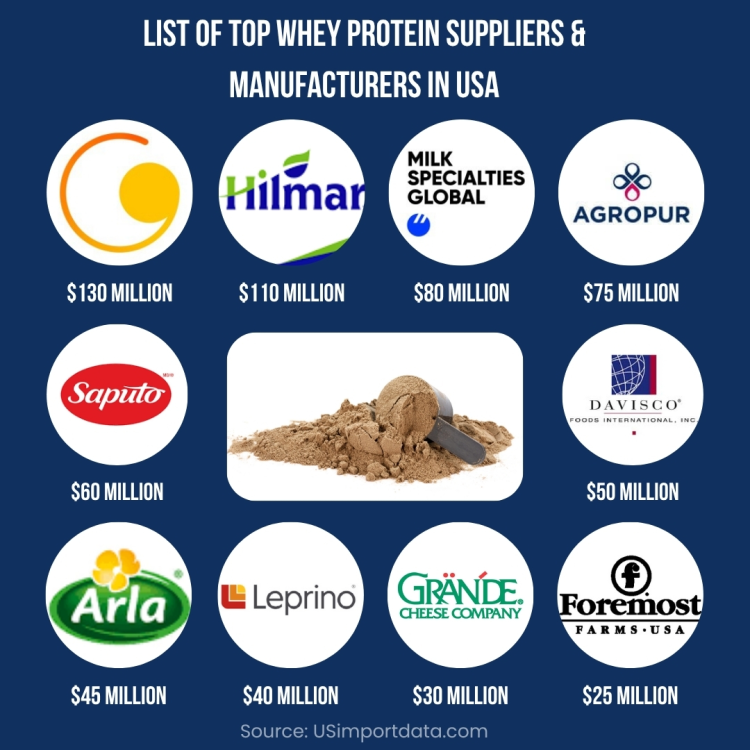
The US Whey Protein Exporters Database provides a comprehensive resource for individuals and businesses seeking high-quality whey protein products in the United States. With a focus on connecting buyers with reputable suppliers, this database is a valuable tool for sourcing top-notch whey protein products. Whether you are an athlete seeking premium supplements or a retailer looking for reliable whey protein manufacturers in the US, this database provides a streamlined approach to finding reputable suppliers in the competitive whey protein industry. The leading whey protein suppliers & manufacturers in the US, as per the US whey protein exporters data & whey protein suppliers list for 2024-25, include:
|
Company Name |
Approx. Export Value (2024) |
Top Exported Types |
Top Export Markets |
|
$130 million |
Whey Protein Concentrate (WPC), Whey Protein Isolate (WPI), functional protein blends, brands like Optimum Nutrition |
India, China, Brazil, Germany, South Korea |
|
|
Hilmar Cheese Company / Hilmar Ingredients |
$110 million |
WPC, WPI, customized whey ingredients for sports and functional foods |
China, Japan, Mexico, the Netherlands |
|
Milk Specialties Global |
$80 million |
High-purity WPI, hydrolyzed whey protein, performance nutrition blends |
India, Malaysia, Brazil, UK, Mexico |
|
Agropur Cooperative (US Operations) |
$75 million |
WPC, WPI, cheese-derived whey products |
Canada, China, Europe, Southeast Asia |
|
Saputo Inc. (US Division) |
$60 million |
Dairy proteins, WPC, WPI, milk protein blends |
Latin America, Canada, Europe |
|
Davisco Foods / AMPI |
$50 million |
WPC80, whey protein hydrolysates, food-grade whey |
China, India, South Korea, South America |
|
Arla Foods Ingredients (USA) |
$45 million |
Infant nutrition-grade whey, hydrolyzed whey proteins, functional isolates |
China, Southeast Asia, Europe |
|
Leprino Foods Company |
$40 million |
Whey permeate, WPC, functional dairy proteins |
Asia-Pacific, Middle East, South America |
|
Grande Cheese Company |
$30 million |
Sweet whey powder, WPC, custom whey blends |
Japan, Taiwan, South Korea, the EU |
|
Foremost Farms USA |
$25 million |
Whey powder, WPC, lactose-rich whey blends |
China, Mexico, Southeast Asia |
US Whey Protein Exports in the Last 10 Years: Yearly US Whey Protein Export Data
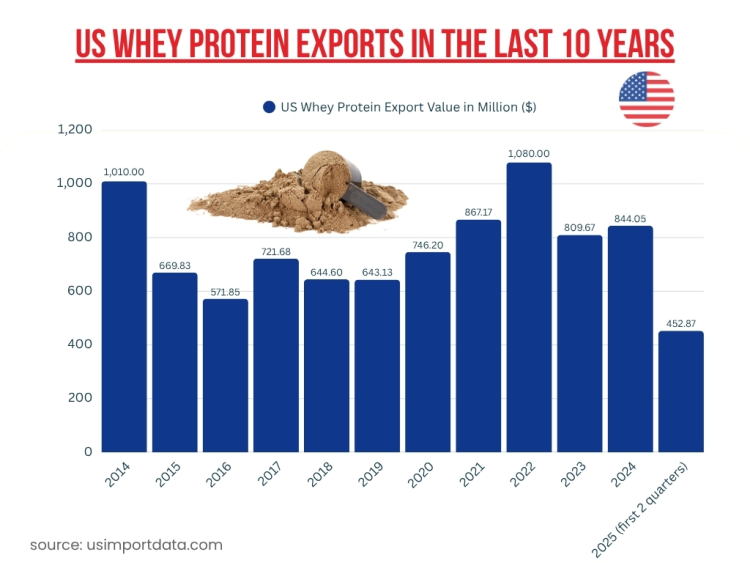
|
Year of Exports |
US Whey Protein Export Value ($) |
|
2014 |
$1.01 billion |
|
2015 |
$669.83 million |
|
2016 |
$571.85 million |
|
2017 |
$721.68 million |
|
2018 |
$644.60 million |
|
2019 |
$643.13 million |
|
2020 |
$746.20 million |
|
2021 |
$867.17 million |
|
2022 |
$1.08 billion |
|
2023 |
$809.67 million |
|
2024 |
$844.05 million |
|
2025 (first 2 quarters) |
$452.87 million |
Leading Whey Protein Manufacturers in the USA
The U.S. whey protein industry is large but dominated by a few major players that set the benchmark for quality and capacity.
-
Hilmar Cheese Company: Hilmar is one of America’s largest independent dairy processors and a leader in whey protein production. Its facilities in California and Texas produce both cheese and high-purity whey ingredients. Hilmar specializes in WPC, WPI, and functional whey proteins used in sports nutrition, infant formula, and functional foods. The company’s vertically integrated operations and advanced filtration technologies make it a cornerstone of the U.S. whey supply chain.
-
Glanbia Nutritionals: Glanbia operates extensive U.S. facilities, manufacturing a wide portfolio of dairy and performance nutrition products. In addition to producing whey protein ingredients, Glanbia owns globally recognized consumer brands such as Optimum Nutrition. This vertical integration, from dairy to branded supplements, gives it unmatched control over quality, traceability, and innovation.
-
Milk Specialties Global: Headquartered in Minnesota, Milk Specialties Global is one of the largest American producers of WPC, WPI, and hydrolyzed proteins. The company serves the sports nutrition, food, and beverage industries, with an emphasis on functional ingredient solutions. Its expertise in high-purity isolates and formulation support has positioned it among the most reliable suppliers in the market.
-
Agropur Cooperative: Agropur is a North American dairy cooperative operating major whey protein and cheese production plants in the United States. Its U.S. facilities convert millions of pounds of milk into cheese and whey ingredients every year. The cooperative also provides private-label and contract manufacturing for major food and nutrition companies.
-
Davisco Foods / Associated Milk Producers (AMPI): Once an independent leader in whey innovation, Davisco is now part of Agropur. Associated Milk Producers Inc. continues to process significant whey volumes as part of its large-scale cheese operations. Its network of plants across the Midwest supplies whey protein ingredients to domestic and global buyers.
-
Arla Foods Ingredients: While based in Europe, Arla maintains a strong presence in the U.S. through partnerships and facilities that produce functional whey proteins. Arla focuses on specialized applications like infant formula, clinical nutrition, and high-performance sports protein powders.
-
Saputo Inc.: Saputo is another major dairy processor with extensive U.S. operations. The company manufactures cheese, milk proteins, and whey derivatives from plants in Wisconsin and California, supplying food processors and nutrition brands across North America.
These companies represent the core of U.S. whey production capacity, supported by hundreds of smaller processors, co-packers, and private-label manufacturers serving niche and regional markets.
Top Whey Protein Export Brands in the USA (2024-25)
|
Brand / Company |
Approx. Export Value (2024) |
Product Type |
Main Export Markets |
|
Optimum Nutrition (Glanbia Nutritionals) |
$100 million |
Whey Protein Isolate (Gold Standard 100% Whey), performance blends |
India, China, Brazil, UK, UAE |
|
Dymatize Nutrition (Post Holdings) |
$80 million |
Whey Isolate, Hydrolyzed Whey, Elite Whey |
Europe, the Middle East, Australia |
|
MuscleTech (Iovate Health Sciences) |
$70 million |
NitroTech Whey Gold, Performance Series Whey |
India, China, UAE, Southeast Asia |
|
BSN (Bio-Engineered Supplements / Glanbia) |
$50 million |
Syntha-6 Whey Blends |
Asia-Pacific, Europe, Latin America |
|
MyProtein (The Hut Group – U.S. distribution) |
$45 million |
Impact Whey Protein, Whey Isolate |
Europe, Australia, the Middle East |
|
Body Fortress (NBTY / The Bountiful Company) |
$40 million |
WPC, WPI-based budget protein powders |
Latin America, Caribbean, Asia |
|
NOW Sports (NOW Foods) |
$35 million |
Pure Whey Protein Isolate, Unflavored WPC |
Canada, Europe, Asia |
|
Isopure (Glanbia Performance Nutrition) |
$30 million |
Whey Protein Isolate (Zero Carb, Low Carb) |
Asia, the Middle East, and Latin America |
|
MusclePharm |
$25 million |
Combat Whey Protein |
Asia-Pacific, Middle East, Latin America |
|
Jarrow Formulas / California Gold Nutrition |
$20 million |
WPC and WPI powders, clean-label formulations |
Japan, Singapore, EU |
U.S. Whey Protein Export Landscape
The United States is consistently one of the world’s top three exporters of whey proteins, alongside Germany and France. Exports include both lower-protein whey powders used in animal feed and food applications, as well as premium WPC and WPI for nutrition products.
Annual U.S. whey protein export values hover around $780–800 million, with shipments increasing in both volume and diversity of destinations. In early 2025, dairy export data showed a nearly 20% year-on-year increase, reflecting strong global demand recovery after pandemic disruptions.
A key trend is the rapid growth of high-protein whey exports, specifically WPC80+ and WPI. These products grew by more than 15% year-on-year in 2024 and continue to outpace lower-grade whey. The shift toward high-purity proteins mirrors global consumer demand for premium, clean-label, and high-performance nutrition products.
The United States exports whey proteins to more than 50 countries, but the largest buyers include China, India, Brazil, Germany, and the Netherlands. India now accounts for more than one-quarter of U.S. whey export shipments, driven by explosive growth in its domestic supplement industry. China’s demand has also rebounded, particularly in the infant formula and fitness segments. Latin American markets such as Brazil and Mexico continue to expand as protein consumption becomes more mainstream.
There are roughly 579 active U.S. whey protein exporters, according to customs and shipping data. While the majority are small or specialized, a few large firms handle the majority of shipments. Globerrunners Inc. alone accounts for over half of all U.S. whey protein export consignments, followed by Nissin International Transport and OL USA LLC. These companies coordinate logistics for ingredient manufacturers and ensure compliance with international trade requirements.
Competitive Advantages of the U.S. Whey Industry
The United States maintains its leadership in whey protein for several structural and strategic reasons.
-
Dairy Infrastructure: With over 200 billion pounds of milk produced annually, the U.S. has one of the world’s most efficient dairy ecosystems. Cheese manufacturing provides a steady source of liquid whey for conversion into protein ingredients.
-
Technology and R&D: American plants utilize advanced membrane filtration, spray drying, and hydrolysis systems. Many facilities incorporate automation, data analytics, and energy recovery systems to improve efficiency and consistency.
-
Quality and Traceability: U.S. manufacturers adhere to stringent FDA and USDA standards, and most maintain third-party certifications such as GMP, ISO, HACCP, and SQF. The traceability of dairy inputs, from farm to finished product, is a strong selling point for global buyers.
-
Export and Port Capacity: With ports on both coasts and advanced cold-chain infrastructure, the United States is well-positioned to serve markets across the Pacific & Atlantic. Experienced export intermediaries and freight operators help move whey efficiently and compliantly worldwide.
Industry Challenges in 2025
While the fundamentals are strong, the U.S. whey sector faces challenges that shape pricing, competitiveness, and long-term growth.
-
Raw Material Volatility: Because whey is a byproduct of cheese production, any fluctuation in milk prices or cheese demand directly affects whey availability and cost. Feed price inflation and climate-related supply constraints can tighten margins.
-
International Competition: European producers, particularly in Germany and the Netherlands, remain formidable rivals. They benefit from regional subsidies and proximity to key European and Middle Eastern markets. Some emerging producers in South America and Asia are also ramping up capacity.
-
Product Safety and Regulation: As consumer scrutiny increases, manufacturers must maintain consistent testing for contaminants such as heavy metals and microbes. Meeting the clean-label and allergen-free standards of global buyers adds cost and complexity.
-
Sustainability Pressures: Large-scale dairy production is resource-intensive. Companies are under growing pressure to reduce greenhouse gas emissions, water consumption, and energy use. Sustainability certifications are becoming a differentiating factor for international buyers.
-
Market Fragmentation: Hundreds of smaller ingredient suppliers and contract manufacturers operate in the U.S., often competing on price. This fragmentation makes it harder for smaller firms to scale or invest in technology upgrades.
Future Outlook: 2025–2030
The future of the U.S. whey protein industry looks strong, but it will demand continued innovation and investment. Market projections suggest the U.S. whey protein and supplement industry could exceed $14 billion by 2030, fueled by consumer demand for clean protein, better-for-you snacks, and functional beverages.
Premium and specialty whey products, such as isolates, hydrolysates, and bioactive peptides, will see the fastest growth, while commodity-grade whey may face price pressure. Asia and Latin America are expected to remain the primary growth regions for exports, potentially accounting for half of U.S. shipments by the end of the decade.
Technological innovation will play a major role. New membrane systems, low-temperature drying, and enzymatic fractionation techniques will allow producers to increase yield while reducing energy use. Sustainability reporting, carbon tracking, and farm-level data transparency will also become standard requirements for global buyers.
How to Source Whey Protein from the U.S.
For importers, supplement brands, or food manufacturers looking to source U.S.-made whey protein, the process requires precision and due diligence.
-
Define product requirements: Identify the protein type (WPC, WPI, or WPH), purity level, flavor needs, and certifications required for your target market.
-
Shortlist suppliers: Focus on companies with proven export experience, solid quality systems, and the capacity to meet your volume needs.
-
Request documentation: Always obtain Certificates of Analysis, test results, and compliance documentation such as GMP or ISO certification.
-
Negotiate port plans and terms: Decide on shipment terms (FOB, CIF, etc.), port of loading, and expected lead times.
-
Verify regulations: Ensure that the product complies with labeling, health claims, and import standards in your destination country.
-
Establish quality monitoring: Build long-term relationships with suppliers and periodically test incoming batches to ensure consistency.
Key Takeaways
-
The U.S. whey protein industry is valued at about $1 billion for ingredients and over $11 billion for supplements in 2025.
-
The U.S. exports $750-800 million in whey proteins annually, supported by nearly 600 exporters.
-
Hilmar, Glanbia, Milk Specialties Global, Agropur, and Saputo are the leading manufacturers.
-
Globerrunners Inc., Nissin International, and OL USA LLC dominate export shipments.
-
The fastest-growing segment is high-protein whey (WPC80+ and WPI).
-
The next phase of growth will be driven by premiumization, sustainability, and technology innovation.
With unmatched dairy resources, advanced processing technology, and a global reputation for quality, the United States remains the undisputed leader in whey protein supply and innovation. From high-purity isolates for sports nutrition to functional proteins for food and health applications, American whey continues to shape the future of global nutrition.
Conclusion and Final Words
In conclusion, Whey protein has evolved from a dairy byproduct into one of the world’s most valuable nutritional ingredients, and the United States remains at the center of that transformation. With a robust dairy foundation, cutting-edge processing technologies, and world-class quality systems, American producers continue to set the global standard for purity, performance, and reliability.
As global demand for high-protein and functional foods accelerates, the U.S. industry is positioned not just to meet market needs but to lead the next generation of innovation in protein nutrition. From high-performance isolates powering athletes to sustainable dairy systems feeding the world, the story of U.S. whey protein is one of science, scale, and continuous evolution, and it’s only gaining momentum in 2025 and beyond.
We hope that you liked our insightful blog on the top whey protein manufacturers & suppliers in the US in 2025. For more information on the latest US import-export data, or to search live data on US whey protein exports by country or company, visit USImportdata. Contact us at info@tradeimex.in and get a customized US trade report, market insights, and a verified database of the top whey protein suppliers & exporters in the USA, as per your requirements.
What's Your Reaction?