US Car Import Data 2025: American Car Imports by Country & USA Car Importers Database
Explore US car imports by country with our USA car importers database. Get detailed insights on American automobile import trends and top car importers.

The United States remains one of the world's largest automotive markets, with millions of vehicles sold annually and a strong reliance on global supply chains. While domestic manufacturers such as Ford, General Motors, and Tesla dominate certain segments, a large share of vehicles sold in the U.S. are imported from overseas manufacturing hubs. According to the latest US import data and Car import data of the USA, the total value of US car imports reached $183.82 billion in 2025, a 16% decline from the previous year. The US imported cars totaling 7.17 million units in 2025, according to US car import data. The U.S. automotive market is highly dependent on global trade, with importing cars to USA playing a crucial role in meeting domestic demand. Leading automobile importers in USA source vehicles from multiple countries, with importing cars from Mexico being especially significant due to strong manufacturing ties and favorable trade agreements.
Overview of U.S. Car Imports in 2025
The United States imported $183.8 billion worth of passenger cars in 2025, sourced from around 68 countries worldwide. Over the past five years, the total value of imported cars has increased significantly compared with earlier years, reflecting rising vehicle prices, supply chain adjustments, and consumer demand for diverse vehicle models.
However, 2025 also saw a year-on-year decline of about 16.3% compared with 2024, when U.S. car imports reached roughly $219.5 billion. This decline reflects changing economic conditions, trade policies, and efforts to increase domestic production.
Another notable aspect of the U.S. automotive trade balance is the widening gap between imports and exports. In 2024, U.S. car imports reached approximately $216.8 billion, far exceeding the $59.2 billion in car exports, resulting in a trade deficit of more than $157 billion in the automotive sector. These numbers highlight the U.S. market’s dependence on international automobile production.
US Car Imports by Country: Where Does the US Import Cars From?
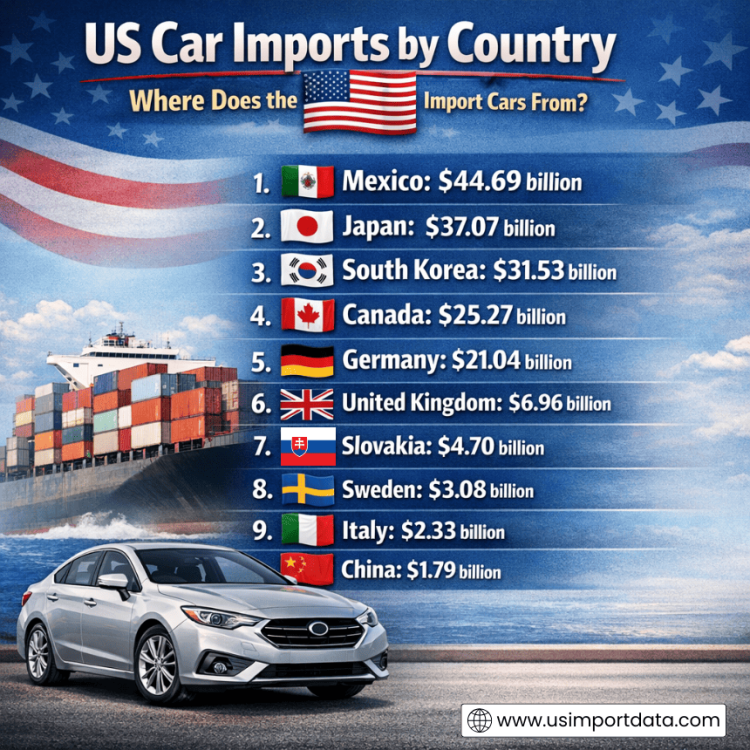
American car imports by country reflect the diverse global market from which the United States sources its vehicles. The US imports cars from various countries worldwide, with a significant portion coming from Mexico, Japan, Canada, Germany, and South Korea. This cross-border trade plays a vital role in meeting the American consumer demands for a wide range of automotive choices and price points. A small group of countries dominates U.S. automotive imports. In fact, the top ten supplier nations account for the majority of vehicles imported into the U.S. market. The top 10 car supplier countries to the USA, as per the US shipment data for 2025, include:
1. Mexico: $44.69 billion (24.3%)
Mexico is the largest source of car imports for the United States, accounting for 24.3% of the total imports. With its proximity to the US and a robust auto manufacturing industry, Mexico has become a key player in supplying vehicles to the American market.
2. Japan: $37.07 billion (20.2%)
Japan is another major player in the US car import market, contributing 20.2% of the total imports, as per the data on US car imports from Japan. Known for its quality and innovative car brands such as Toyota, Honda, and Nissan, Japan has established itself as a top choice for American consumers.
3. South Korea: $31.53 billion (17.2%)
South Korea is also a significant contributor to the US car import market, accounting for 17.2% of the total imports. With popular brands like Hyundai and Kia, South Korean cars have gained popularity among American consumers for their reliability and affordability.
4. Canada: $25.27 billion (13.7%)
Canada is a close neighbor and trading partner of the United States, making it a natural source of car imports, as per the data on US car imports from Canada by HS code. Canada contributes 13.7% of the total imports, with American consumers often opting for Canadian-made vehicles from brands like Ford and Chevrolet.
5. Germany: $21.04 billion (11.4%)
Germany is known for its luxury car brands such as BMW, Mercedes-Benz, and Audi, making it a popular choice for American consumers looking for high-end vehicles. Germany contributes 11.4% of the total car imports to the US market.
6. United Kingdom: $6.96 billion (3.8%)
The United Kingdom may be a smaller player in the US car import market compared to other countries, but it still holds a significant share of 3.8% of the total imports. British car brands like Jaguar and Land Rover are well-known for their craftsmanship and design.
7. Slovakia: $4.70 billion (2.6%)
Slovakia may not be a traditional source of car imports for the United States, but it has been gaining traction in recent years. With brands like Volkswagen and Porsche manufacturing vehicles in Slovakia, the country contributes 2.6% of the total car imports.
8. Sweden: $3.08 billion (1.7%)
Sweden is home to Volvo, a well-respected car brand known for its safety features and Scandinavian design. Sweden contributes 1.7% of the total car imports to the US market, making it a niche player in the industry.
9. Italy: $2.33 billion (1.3%)
Italy may be best known for its fashion & cuisine, but it also has a thriving auto industry. Brands like Fiat and Ferrari are popular choices among American consumers, contributing 1.3% of the total car imports.
10. China: $1.79 billion (1%)
China rounds out the top 10 countries from which the US imports cars, with a 1% share of the total imports. As China continues to develop its auto industry and produce more affordable vehicles, its presence in the US car import market is expected to grow.
US Car Importers Database & Shipment Records: Top Car Buyers in USA

The US Car Importers Database & Shipment Records highlight the key players in the automotive industry as top car buyers in the USA. This comprehensive database provides valuable insights into the market trends and preferences of American car importers, helping businesses to make informed decisions and forge successful partnerships. Toyota Motor North America and General Motors Company are the biggest car importers in the US. The leading car importers in the USA, as per the US car importers & car buyers data for 2025, include:
1. Toyota Motor North America
-
Approx. Import Value (2025): $32–35 Billion
-
Top Imported Brands/Models: Toyota RAV4, Toyota Corolla, Lexus RX
-
Top Import Sources: Japan, Mexico, Canada
2. General Motors Company (GM)
-
Approx. Import Value (2025): $28–30 Billion
-
Top Imported Brands/Models: Chevrolet Silverado, Chevrolet Equinox, Chevrolet Trax
-
Top Import Sources: Mexico, South Korea, Canada
3. Hyundai Motor America
-
Approx. Import Value (2025): $24–26 Billion
-
Top Imported Brands/Models: Hyundai Tucson, Hyundai Elantra, Hyundai Santa Fe
-
Top Import Sources: South Korea
4. Kia America Inc.
-
Approx. Import Value (2025): $22–24 Billion
-
Top Imported Brands/Models: Kia Sportage, Kia Sorento, Kia Soul
-
Top Import Sources: South Korea, Mexico
5. Nissan North America Inc.
-
Approx. Import Value (2025): $20–22 Billion
-
Top Imported Brands/Models: Nissan Rogue, Nissan Altima, Nissan Sentra
-
Top Import Sources: Japan, Mexico
6. Mazda Motor of America Inc.
-
Approx. Import Value (2025): $17–19 Billion
-
Top Imported Brands/Models: Mazda CX-5, Mazda CX-30, Mazda3
-
Top Import Sources: Japan, Mexico
7. Volkswagen Group of America
-
Approx. Import Value (2025): $16–18 Billion
-
Top Imported Brands/Models: Volkswagen Tiguan, Jetta, Audi Q5
-
Top Import Sources: Germany, Mexico, Slovakia
8. BMW of North America
-
Approx. Import Value (2025): $14–16 Billion
-
Top Imported Brands/Models: BMW 3 Series, BMW X3, BMW X5
-
Top Import Sources: Germany, Austria
9. Mercedes-Benz USA LLC
-
Approx. Import Value (2025): $13–15 Billion
-
Top Imported Brands/Models: Mercedes-Benz C-Class, GLE, E-Class
-
Top Import Sources: Germany
10. Subaru of America Inc.
-
Approx. Import Value (2025): $12–14 Billion
-
Top Imported Brands/Models: Subaru Outback, Subaru Forester, Subaru Crosstrek
-
Top Import Sources: Japan
US Car Import Data For The Last 10 Years
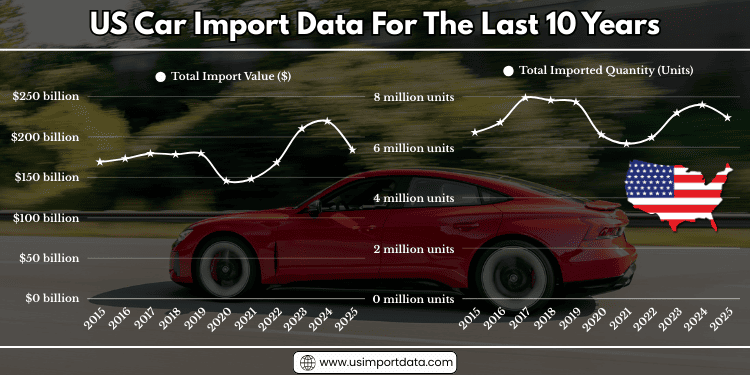
|
Year of Imports |
Total Import Value ($) |
Total Imported Quantity (Units) |
|
2015 |
$169.19 billion |
6.59 million units |
|
2016 |
$173.28 billion |
6.98 million units |
|
2017 |
$179.58 billion |
7.96 million units |
|
2018 |
$178.48 billion |
7.86 million units |
|
2019 |
$179.48 billion |
7.79 million units |
|
2020 |
$145.74 billion |
6.50 million units |
|
2021 |
$148.03 billion |
6.14 million units |
|
2022 |
$168.33 billion |
6.39 million units |
|
2023 |
$210.28 billion |
7.36 million units |
|
2024 |
$219.49 billion |
7.68 million units |
|
2025 |
$183.82 billion |
7.17 million units |

Regional Analysis of US Car Imports
When analyzing car imports by region, three major regions dominate the U.S. automotive supply chain.
Asia
Asian countries collectively account for approximately 38.5% of total U.S. car imports.
Major contributors include:
-
Japan
-
South Korea
-
China
Asia’s automotive strength comes from large-scale manufacturing capacity and competitive pricing.
North America
North America, primarily Mexico and Canada, accounts for around 38.1% of U.S. car imports.
The North American automotive ecosystem benefits from:
-
Regional trade agreements
-
Integrated supply chains
-
Geographic proximity
This allows automakers to efficiently manufacture vehicles across borders.
Europe
European countries supply roughly 23% of cars imported into the United States. Most European imports fall into premium or luxury categories.
Key exporters include:
-
Germany
-
United Kingdom
-
Italy
-
Sweden
-
Slovakia
Key Trends Shaping American Car Imports
1. Growing Demand for Imported Vehicles
Nearly half of all vehicles sold in the United States are imported, highlighting the strong reliance on global automotive manufacturing. Consumers often prefer imported vehicles for:
-
Unique designs
-
Advanced technology
-
Brand reputation
2. Rising Electric Vehicle Imports
Electric vehicle production is expanding globally, and many EV models entering the U.S. are produced overseas. Major EV manufacturing hubs include:
-
South Korea
-
China
-
Germany
-
Japan
As EV demand grows, imports from these countries are expected to increase.
3. Impact of Trade Policies and Tariffs
Trade policies continue to influence automotive imports. For example, proposed U.S. tariffs on imported vehicles could raise car prices significantly & disrupt existing supply chains. Some estimates suggest tariffs could increase vehicle prices by $5,000 to $15,000, depending on the model. Such policies could encourage manufacturers to shift production to the United States.
U.S. Car Import Tariffs in 2025
Tariffs have become one of the most significant policy factors affecting the U.S. automotive import market in 2025. Recent trade measures introduced by the U.S. government have increased duties on imported vehicles and key automotive components, potentially reshaping global automotive supply chains and pricing strategies. Since 2025, U.S. tariffs have cost automakers roughly $35.4 billion, a staggering amount that illustrates how swiftly and drastically President Donald Trump's trade policies have affected the sector.
1. 25% Tariff on Imported Cars
In March 2025, the U.S. government announced a 25% tariff on imported passenger vehicles and light trucks under Section 232 of the Trade Expansion Act, citing national security concerns related to dependence on foreign automotive production. The tariff officially took effect on April 3, 2025.
This tariff applies to a wide range of imported vehicles, including:
-
Sedans
-
Sport utility vehicles (SUVs)
-
Crossovers
-
Minivans
-
Cargo vans
-
Light trucks
The 25% duty is applied in addition to the existing Most Favored Nation (MFN) tariff rate of 2.5% on passenger cars, meaning the effective tariff on many imported cars could reach around 27.5%.
2. Tariffs on Auto Parts
The tariff policy also includes automobile parts, which are essential components for vehicle assembly and manufacturing.
Key parts subject to tariffs include:
-
Engines and engine components
-
Transmissions
-
Powertrain systems
-
Electrical components
A 25% tariff on these auto parts took effect on May 3, 2025, impacting manufacturers that rely heavily on global supply chains.
3. Special Rules Under the USMCA Agreement
The United States–Mexico–Canada Agreement (USMCA) provides some flexibility for vehicles produced within North America.
Under this rule:
-
Vehicles that meet USMCA requirements are not fully taxed at 25%.
-
Instead, the tariff applies only to the portion of the vehicle that contains non-U.S. content.
For example, if a vehicle imported from Mexico contains 40% U.S.-made parts, the tariff applies only to the remaining 60% foreign content. This provision helps protect the integrated North American automotive manufacturing system.
4. Impact on Automakers and Car Prices
The tariff policy has major implications for automakers, importers, and consumers.
Key expected impacts include:
-
Higher production costs for manufacturers
-
Increased prices for imported vehicles
-
Pressure on global supply chains
-
Incentives for automakers to expand U.S. production
Industry analysts estimate the tariffs could generate around $100 billion in annual revenue for the U.S. government while encouraging more domestic manufacturing. However, some industry experts warn that tariffs could raise vehicle prices by several thousand dollars and reduce the competitiveness of imported brands in the U.S. market.
5. Tariffs and the Future of U.S. Automotive Trade
The long-term impact of these tariffs will depend on several factors:
-
Future trade negotiations
-
Automakers shifting production to the U.S.
-
Changes in global supply chains
-
The growth of electric vehicle manufacturing
Some automakers are already considering relocating production facilities to the United States to avoid the new tariffs and maintain competitive pricing.
This tariff policy represents one of the most significant changes to U.S. automotive trade in decades, and it is likely to influence global car production, supply chains, and vehicle pricing in the coming years.
Understanding the USA Car Importers Database
A USA car importers database is an essential resource for automotive manufacturers, exporters, and trade analysts. This database typically contains detailed information about companies importing vehicles into the United States.
Key Data Points Included
A comprehensive car importers database usually contains:
-
Importer company name
-
Importer address and contact details
-
Import shipment date
-
Vehicle type and model
-
HS code classification
-
Shipment quantity and value
-
Country of origin
-
Port of entry
This data is typically collected from U.S. trade records and shipping manifests.
Benefits of Using a US Car Import Database
Market Research
Automotive companies can identify:
-
Active vehicle importers
-
Key distribution channels
-
Potential business partners
Competitive Analysis
Businesses can analyze:
-
Competitor supply chains
-
Import volumes by company
-
Market share of major importers
Lead Generation
Exporters looking to enter the U.S. market can use import databases to find:
-
Verified buyers
-
Distributors
-
Automotive wholesalers
Trade Intelligence
Trade analysts use import data to track:
-
Shipping routes
-
Seasonal import patterns
-
Market demand
Future Outlook for US Car Imports
The future of U.S. car imports will likely be influenced by several major factors.
1. Electric Vehicle Expansion
The global EV transition will reshape automotive trade flows. Countries investing heavily in EV manufacturing could become dominant suppliers to the U.S.
2. Supply Chain Diversification
Automakers are increasingly diversifying production locations to reduce risk. This could lead to new export hubs emerging in Southeast Asia and Eastern Europe.
3. Trade Agreements and Tariffs
Future trade agreements and tariffs will play a major role in determining which countries remain top exporters to the United States.
Conclusion and Final Thoughts
The U.S. automotive market remains deeply interconnected with global manufacturing networks. In 2025, the United States imported $183.8 billion worth of cars, with the majority coming from Mexico, Japan, South Korea, Canada, and Germany. These five countries dominate the U.S. car import landscape thanks to their strong manufacturing capabilities, trade agreements, and established automotive brands.
At the same time, the growing importance of electric vehicles, shifting trade policies, and evolving supply chains are reshaping global automotive trade. For businesses operating in the automotive sector, access to a U.S. car importers database provides valuable insights into import trends, buyers, and market opportunities.
Note for Our Readers
We hope this comprehensive analysis of US car import data for 2025 helped you better understand the latest trade statistics, leading automobile supplier countries, and the evolving trends shaping the American automotive import market. For businesses in the automotive, dealership, manufacturing, and global trade sectors, having access to accurate & up-to-date import data is critical for identifying market opportunities, tracking competitor activity, and making informed sourcing and distribution decisions in an increasingly competitive industry.
Our platform provides detailed U.S. export-import data, shipment-level automotive trade records, and actionable market intelligence designed to support exporters, importers, automotive suppliers, and market analysts.
If you are looking for deeper insights into US car imports by country, shipment-level vehicle trade statistics, or a verified US car importers & buyers database, visit USImportdata. Transform global automotive trade data into a strategic advantage with our specialized U.S. trade intelligence solutions. For inquiries, partnerships, or sample datasets related to automobile imports, vehicle trade analysis, or HS Code automotive products, feel free to contact us at info@tradeimex.in today.
Read also about:
What's Your Reaction?