US Timber Exports by Country: Top Timber Suppliers & Exporters in the USA
Explore 2025 US timber exports data by country, major timber suppliers, export values, & market trends. Discover US timber exporters data & trade insights.
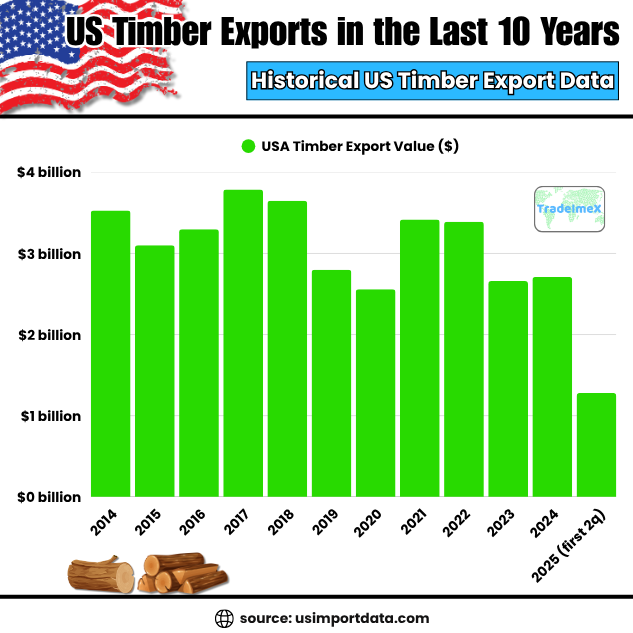
In 2024, the United States remained a major player in global forest-product trade. Total U.S. forest-product exports in 2024 were roughly US$9.5 billion, with timber and wood products forming a substantial portion of that value. The largest destination markets by value were Canada, the United Kingdom, China, the European Union, Mexico, and Japan. According to the US export data and timber export data of the USA, the total value of US timber exports reached $2.71 billion in 2024, a 2% increase from the previous year. According to the US timber export data, the US exported timber worth $1.28 billion in the first 2 quarters of 2025. The biggest timber exporters in the world continue to shape global supply chains, influencing prices and availability for construction and manufacturing industries.
As lumber exports rise in many regions, questions often come up about the U.S. market, specifically, how much lumber does the US export and does the US export lumber at all. In reality, US lumber exports do play a significant role internationally, though the country is better known for being a major timber consumer. The USA is the 4th largest timber exporter in the world, as per the global trade data. Distinct product segments, Southern Pine lumber, hardwood logs and lumber, and wood pellets/biomass showed divergent performance: Southern Pine exports grew strongly, hardwood exports were volatile (surging mid-2024, then softening in early-2025), and wood-pellet exports continued to expand. For U.S. exporters, the path forward centers on value-added products, market diversification, supply chain efficiency, and sustainability credentials.
The Big Picture: Scale & Composition of US Timber Exports
In 2024, the total U.S. forest-product export market was on the order of US$9.5 billion. If you isolate timber and timber-derived goods (raw and processed wood products: logs, lumber, engineered wood, panels, and some pulp derivatives used in construction and manufacturing), the U.S. shipped tens of millions of metric tons worldwide. The export footprint is broad: North America (Canada, Mexico), Europe (UK and EU), and Asia (China, Japan, Vietnam, India) are the dominant importers of U.S. wood and wood products, as per the USDA Forest Products Export Report. At the same time, the U.S. imports large volumes of wood products, so the timber economy is highly bilateral and integrated.
Why this matters: Timber exports are sensitive to construction cycles (global housing demand), industrial demand (furniture, pallets, manufacturing feeds), energy policy (biomass demand), and trade/regulatory shifts (phytosanitary rules, sustainability standards). That makes export strategy both an operational and a geopolitical exercise.
The United States plays a key role among global timber exporters, with US timber exports continuing to grow steadily due to rising global construction demand. Many leading timber suppliers in the country provide high-quality softwood and hardwood products to international markets. As the timber export industry expands, building timber suppliers are focusing on sustainable sourcing and efficient distribution to meet global standards. While the US ranks among the top timber exporting countries, it competes closely with Canada, Russia, and New Zealand for the position of the largest exporter of timber in the world, showcasing the strong competitiveness of the American forestry sector.
US Timber Exports by Country: Where Does the US Export Timber?
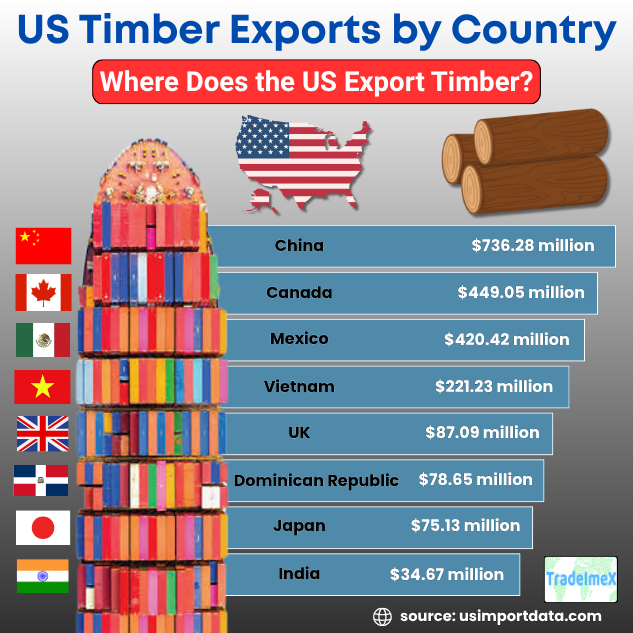
Timber exports from the United States are directed to a variety of countries worldwide, showcasing the nation's role as a significant player in the global timber market. Key export destinations for US timber include countries like Canada, China, Japan, Mexico, and South Korea. These countries are among the top recipients of American timber products, highlighting the diverse market reach of US timber exports. The top 10 export destinations for the US timber exports by country, as per the US shipment data for 2024-25, include:
1. China: $736.28 million (27.1%)
China stands out as the top destination for US timber exports, accounting for 27.1% of the total value, as per the data on US timber exports to China by HS code. With a booming construction industry and high demand for wood products, China continues to be a key market for US timber suppliers.
2. Canada: $449.05 million (16.6%)
As a neighbor to the US, Canada has long been a vital trading partner in the timber industry. With proximity and strong economic ties, Canada remains a significant destination for US timber exports, making up 16.6% of the total value.
3. Mexico: $420.42 million (15.5%)
With its growing construction sector and demand for wood products, Mexico has become a key market for US timber exports. Accounting for 15.5% of the total value, Mexico offers a lucrative opportunity for US timber suppliers.
4. Vietnam: $221.23 million (8.2%)
Vietnam has emerged as a promising market for US timber exports, with a rapidly developing economy and increasing demand for wood products. Making up 8.2% of the total value, Vietnam presents a growing opportunity for US timber suppliers.
5. United Kingdom: $87.09 million (3.2%)
Despite its smaller size compared to other countries on the list, the United Kingdom remains a significant destination for US timber exports, accounting for 3.2% of the total value. With a strong demand for high-quality wood products, the UK continues to be an important market for US timber suppliers.
6. Dominican Republic: $78.65 million (2.9%)
The Dominican Republic is another key market for US timber exports, making up 2.9% of the total value. With a growing construction industry and demand for wood products, the Dominican Republic offers opportunities for US timber suppliers to expand their market reach.
7. Japan: $75.13 million (2.8%)
Japan has a long history of importing timber from the US, and it continues to be a valuable market for US timber exports, accounting for 2.8% of the total value. With a strong demand for high-quality wood products, Japan presents opportunities for US timber suppliers to establish long-lasting partnerships.
8. India: $34.67 million (1.3%)
India is a growing market for US timber exports, with a developing infrastructure and increasing demand for wood products. Accounting for 1.3% of the total value, India offers potential for US timber suppliers to tap into a new and emerging market.
9. Jamaica: $34.11 million (1.3%)
Jamaica may be a smaller market compared to others on the list, but it remains a valuable destination for US timber exports, making up 1.3% of the total value. With a demand for wood products in construction and other industries, Jamaica presents opportunities for US timber suppliers to expand their market presence.
10. Italy: $26.65 million (1%)
Italy rounds out the top 10 countries for US timber exports, accounting for 1% of the total value. With a strong demand for wood products and a focus on sustainability, Italy offers opportunities for US timber suppliers to provide high-quality products to meet market needs.
Top Timber Suppliers & Exporters in USA: US Timber Exporters Database
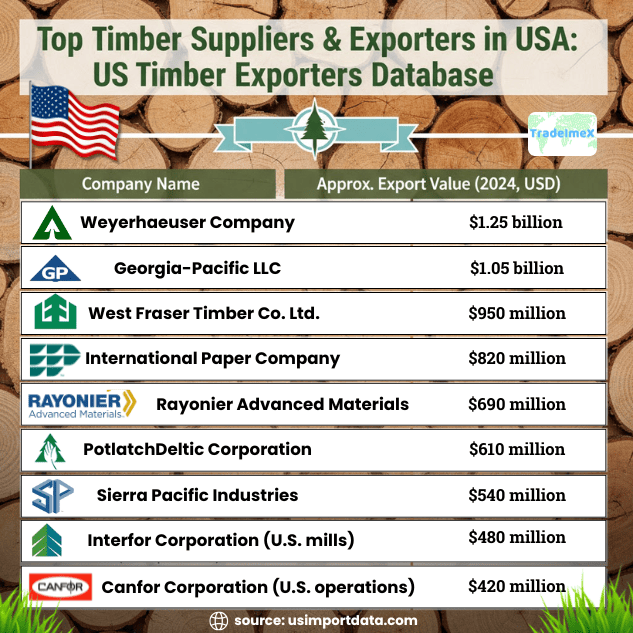
The Top Timber Suppliers & Exporters in the USA can be easily accessed through the US Timber Exporters Database, making it a valuable resource for businesses in the timber industry. This comprehensive database not only provides information on the top players in the market but also offers insights into key trends and market dynamics. The leading timber suppliers & exporters in the USA, as per the verified US timber exporters data & timber suppliers list for 2024-25, include:
|
Rank |
Company Name |
Approx. Export Value (2024, USD) |
Top Exported Timber Types |
Top Export Markets (2024–25) |
|
1 |
$1.25 billion |
Southern Yellow Pine lumber, engineered wood, logs |
China, Japan, Mexico, Canada |
|
|
2 |
Georgia-Pacific LLC |
$1.05 billion |
Softwood lumber, plywood, oriented strand board (OSB) |
Canada, Mexico, Caribbean, UK |
|
3 |
West Fraser Timber Co. Ltd. (U.S. operations) |
$950 million |
Spruce-Pine-Fir lumber, Southern Pine lumber |
China, Japan, Mexico |
|
4 |
International Paper Company |
$820 million |
Hardwood logs, pulpwood, paper-grade timber |
China, India, the EU |
|
5 |
Rayonier Advanced Materials / Rayonier Inc. |
$690 million |
High-grade softwood and hardwood logs, specialty wood |
Japan, South Korea, the EU |
|
6 |
PotlatchDeltic Corporation |
$610 million |
Southern Yellow Pine lumber, panels, engineered wood |
Mexico, Canada, Caribbean |
|
7 |
Sierra Pacific Industries |
$540 million |
Douglas Fir, Cedar, Pine lumber, engineered wood |
China, Japan, Vietnam |
|
8 |
Interfor Corporation (U.S. mills) |
$480 million |
Spruce-Pine-Fir, Hem-Fir lumber |
China, Japan, Australia |
|
9 |
Canfor Corporation (U.S. operations) |
$420 million |
Southern Pine lumber, kiln-dried lumber |
China, UK, Mexico |
|
10 |
Enviva Inc. |
$400 million |
Wood pellets and biomass (renewable energy feedstock) |
UK, Netherlands, Denmark, Japan |
Summary Insights
-
Export concentration: The top five companies account for over half of the total U.S. timber export value.
-
Product dominance: Southern Yellow Pine and Spruce-Pine-Fir (SPF) remain the backbone of exports, driven by construction and manufacturing demand.
-
Biomass growth: Enviva’s pellet exports highlight the expanding renewable energy segment.
-
Main trade corridors: North America (Canada, Mexico), East Asia (China, Japan, Vietnam), and Europe (UK, EU) dominate.
US Timber Exports in the Last 10 Years: Historical US Timber Export Data
|
Year of Exports |
USA Timber Export Value ($) |
|
2014 |
$3.53 billion |
|
2015 |
$3.10 billion |
|
2016 |
$3.30 billion |
|
2017 |
$3.79 billion |
|
2018 |
$3.65 billion |
|
2019 |
$2.80 billion |
|
2020 |
$2.56 billion |
|
2021 |
$3.42 billion |
|
2022 |
$3.39 billion |
|
2023 |
$2.66 billion |
|
2024 |
$2.71 billion |
|
2025 (first 2 quarters) |
$1.28 billion |
Product-level performance and trends
Trade in forest products is not monolithic; different product categories follow different trajectories.
Southern Pine lumber (softwood segment)
-
Volume: About 565.7 million board feet exported in 2024, an increase of roughly 11% year-on-year.
-
Value: Approximately US$211.5 million, up about 6% year-on-year.
-
Top buyers (by volume): Mexico (largest, 150 million board feet, up 23%), the Dominican Republic (92 million board feet, up 19%), India (37 million board feet, modest increase).
Takeaway: Southern Pine is a successful export niche for the U.S., with substantial gains into nearby markets (Mexico, Caribbean) and a growing footprint in South Asia.
Hardwood logs and lumber
-
Mid-2024: hardwood log and lumber exports experienced notable year-over-year increases (double-digit in some months), driven by demand from furniture and specialty wood markets.
-
Early 2025: signs of slowdown appeared: quarterly comparisons in Q1 2025 showed a small decline in log volume and a larger drop in lumber volume versus Q1 2024.
Takeaway: Hardwood exports spiked but are showing sensitivity to global demand cycles; they require market monitoring and flexible supply strategies.
Wood pellets and biomass
-
Jan–Sept 2024: U.S. exported 7.4 million metric tons of wood pellets, up from roughly 7.1 million in the same nine-month window the previous year. Export value for pellets was in the order of US$1.3–1.4 billion for that period.
-
Takeaway: Bioenergy demand (especially in Europe and parts of Asia) continues to support pellet exports. This is a growth segment tied to renewable energy policies abroad.
Panels, engineered wood, and other value-added products
-
Demand is rising for engineered wood products (CLT, LVL, OSB, MDF in some niches). These products command higher unit values and are favored in markets emphasizing modern timber construction and sustainability.
Country-by-country dynamics and strategy implications
Here’s a deeper look at the major markets and strategic implications.
Canada
-
Dynamics: High trade volume, strong trade ties, sometimes both competitor and customer to U.S. exporters.
-
Strategy: Maintain competitiveness via timely trade, competitive pricing, and products tailored to Canadian manufacturing and construction standards.
United Kingdom & Europe
-
Dynamics: High standards on sustainability and legality; preference for certified and traceable supplies; appetite for value-added materials.
-
Strategy: Emphasize certification, low-carbon supply chains, and higher-margin finished products.
China
-
Dynamics: Large potential market but cyclical; exposed to macroeconomic shifts and policy moves.
-
Strategy: Avoid over-concentration; develop alternative Asian and global channels to hedge risk.
Mexico
-
Dynamics: Rapidly growing demand for Southern Pine and construction lumber; geographic and tariff advantages.
-
Strategy: Scale trade, customize products to Mexican construction needs, and leverage near-shoring trends.
Japan
-
Dynamics: Stable, quality-sensitive buyers; long-term procurement relationships matter.
-
Strategy: Prioritize consistent quality, grade specifications, and relationship selling.
Vietnam & India
-
Dynamics: Important growth markets as manufacturing and furniture production, expand; emerging middle-class and construction demand.
-
Strategy: Invest in sales channels, local partnerships, and smaller initial consignments to gain share.
Competitive landscape and supply-side issues
Several supply-side realities shape export competitiveness:
-
Global competition: U.S. timber exporters compete with Canada, Chile, Brazil, New Zealand, Scandinavia, and Southeast Asia. Cost and species mix matter: some countries undercut on price, others compete on specialized species or certification.
-
Domestic costs: U.S. harvesting and trade costs can be relatively high (labor, regulation, distance to ports). Efficiency gains and strategic port use are essential.
-
Regulation and sustainability: Buyers increasingly require legality verification and forest certification. U.S. suppliers with credible sustainability practices have an advantage in premium markets.
-
Resource constraints: Extreme weather, fires, pests, and domestic policy shifts can constrain harvest volumes or shift costs.
Opportunities & Risks: Practical Guidance for US Timber Exporters
Opportunities
-
Move up the value chain: Engineered wood, finished lumber, and specialty products fetch higher margins and are less price-sensitive than commodity logs.
-
Expand biomass exports thoughtfully: Wood-pellet demand is growing internationally; scaling this while adhering to sustainability standards offers a steady revenue stream.
-
Target emerging markets early: India and Vietnam show expanding consumption; early market entry pays dividends.
-
Leverage certification: Forest Stewardship Council (FSC), Sustainable Forestry Initiative (SFI), and traceability solutions can unlock European and premium Asian markets.
-
Capitalize on near-markets: Strengthen supply to Canada and Mexico, where trade and trade frameworks reduce friction.
Risks
-
Market concentration risk: Heavy dependence on China or any single buyer exposes to rapid demand reversals. Diversification is essential.
-
Price pressure from low-cost competitors: South American and Southeast Asian suppliers can undercut prices; differentiation matters.
-
Trade policy volatility: Tariffs, quotas, or stricter import requirements (e.g., for phytosanitary reasons) can upend planned flows.
-
Supply shocks at home: Fires, pests, or new harvest regulations can suddenly limit exportable volumes.
-
Trade cost spikes: Unfavorable shipping markets can turn a profitable deal into a loss.
What to monitor in 2025
Exporters and policymakers should monitor the following indicators closely:
-
Quarterly export values and volumes by country to detect shifts in buyer demand.
-
Certification and sustainability regulations in major import markets (EU, UK, Japan) that could change eligibility or cost.
-
Domestic timber supply indicators (harvest volumes, forest health reports).
-
Policy moves in China and large consumer markets that affect housing and industrial activity.
-
Growth in renewable energy procurement abroad could influence pellet demand.
Conclusion and Bottom Line
In conclusion, the US timber export industry is a vital component of the country's economy, providing jobs, revenue, and sustainable forestry practices. With top timber suppliers such as Georgia-Pacific, Weyerhaeuser, and International Paper, the US remains a major player in the global timber trade. By exporting timber to countries such as Canada, China, and Mexico, the US maintains its position as one of the world's leading timber suppliers and exporters.
-
The U.S. timber export sector in 2024 held steady with around US$9.5 billion in forest-product exports, a large share of which was sold to Canada, the UK, China, the EU, Mexico, and Japan.
-
Southern Pine proved a high-performance niche in 2024; hardwoods were more volatile; wood pellets continue to expand.
-
For exporters to thrive in 2025 and beyond: diversify markets, focus on value-added products, strengthen sustainability credentials, and optimize trade. Those moves reduce exposure to cyclical buyers, lift margins, and align the U.S. timber trade with the sustainability-driven purchasing that dominates major import markets.
We hope that you liked our insightful blog report on US timber export data by country 2025. For more insights into the US import-export data, or to search live data on US timber exports by country, visit USImportdata. Contact us at info@tradeimex.in for customized US trade reports, market insights, and our verified database of the top timber exporters & suppliers in the USA, as per your requirements.
Also read about:
What's Your Reaction?