Malaysia Walks Out of US Trade Deal: What the Malaysia-US Trade Deal Collapse Means for Tariff Policies
Trade tensions rise as Malaysia exits US trade agreement and calls the Malaysia-US reciprocal trade agreement void following a US tariff ruling.
Introduction
In March 2026, Malaysia made headlines by walking away from its trade agreement with the United States, marking a rare reversal in modern bilateral trade diplomacy. The decision effectively declared the Agreement on Reciprocal Trade (ART) between the two countries “null and void,” signaling a major shift in Malaysia’s trade strategy and raising questions about the future of tariff negotiations worldwide. As far as bilateral trade is concerned, the total value of US imports from Malaysia reached $61.18 billion in 2025, as per the latest US import data. According to the US export data, the total value of US exports to Malaysia accounted for $28.86 billion in 2025.
The collapse is more than a bilateral dispute. It reflects broader tensions in the global trade system: the rise of tariff-based bargaining, legal challenges to unilateral trade policies, and growing skepticism among smaller economies toward asymmetric agreements with major powers.
This article provides a detailed, data-driven analysis of the Malaysia–US trade deal collapse. It explains the origins of the agreement, why Malaysia withdrew, how tariff policies shaped the dispute, and what the decision means for global trade and future negotiations.
Background: The US–Malaysia Reciprocal Trade Agreement
The US–Malaysia trade agreement was signed in October 2025 during a wave of bilateral deals between the United States and several Southeast Asian nations. These agreements were part of a broader strategy by Washington to reshape global trade relationships through reciprocal tariffs and bilateral commitments rather than multilateral frameworks.
Under the agreement, the United States maintained a 19 percent reciprocal tariff on most Malaysian exports, although certain products received exemptions and were allowed to enter the US tariff-free. Malaysia, in return, committed to several concessions, including:
-
Reducing tariffs on selected US imports
-
Facilitating US investments in key sectors such as infrastructure and energy
-
Cooperating with the US export control and economic security measures
-
Addressing non-tariff barriers affecting American goods
The deal also included broader economic commitments. Malaysia pledged to facilitate roughly $70 billion in investment into the United States over the next decade, reflecting Washington’s effort to attract foreign capital while maintaining protective tariffs.
From the US perspective, the agreement strengthened access to Southeast Asian markets and aligned regional partners with its strategic economic policies. For Malaysia, the agreement was largely a defensive move aimed at mitigating higher tariffs threatened by Washington earlier in 2025.
Tariff Pressure: The Real Catalyst
To understand the collapse of the deal, it is necessary to look at the tariff environment that preceded it. In early 2025, the United States imposed “reciprocal tariffs” on Malaysian exports, initially threatening rates as high as 24 percent and later adjusting them to 19 percent as negotiations progressed. In some cases, tariffs had even reached 47 percent during earlier stages of negotiation, forcing Malaysia to accept concessions in exchange for lower rates. For Malaysia’s export-driven economy, these tariffs posed a serious risk. The country relies heavily on exports in sectors such as:
-
Semiconductors and electronics
-
Palm oil products
-
Machinery and electrical equipment
-
Chemicals and industrial components
If tariffs remained high, Malaysian goods would become less competitive in the US market. Higher tariffs raise the price of imports, making them less attractive compared with domestic or third-country products. This dynamic is central to protectionist trade policy. Governments use tariffs to shield domestic industries from foreign competition, though critics argue that such measures distort global markets and increase costs for consumers.
In this context, Malaysia accepted the deal as a way to stabilize market access to the United States, even though tariffs remained relatively high compared with traditional free trade agreements.
Legal Shock: The Court Ruling That Changed Everything
The turning point came in early 2026 when a US court ruling undermined the legal basis for the tariff framework underpinning the agreement. Because the trade deal had been negotiated primarily to manage those tariffs, the decision effectively removed the foundation of the agreement. Without the tariff regime, the reciprocal trade arrangement no longer made legal or economic sense.
Malaysia’s Minister of Investment, Trade and Industry subsequently declared the agreement “null and void,” making Malaysia the first country to abandon a bilateral trade pact negotiated under the US reciprocal tariff strategy. This development highlighted an important reality of modern trade policy: many bilateral deals are not purely economic agreements but political responses to tariff pressure. Once the legal basis for those tariffs disappeared, so did the incentive to maintain the agreement.
Why Malaysia Chose to Walk Away from the US Trade Deal
Several economic and strategic factors explain this decision, as Malaysia exits US trade agreement.
1. Limited Tariff Benefits
Even under the agreement, Malaysian exporters still faced a 19 percent tariff on most goods entering the United States. In traditional free trade agreements, tariffs are often eliminated. The US–Malaysia arrangement, however, simply reduced tariffs from higher threatened levels. Critics argued that Malaysia gained little in return for major policy concessions.
2. Market Access Imbalance
The agreement also required Malaysia to open its markets further to American goods, including agricultural products, machinery, and vehicles. Analysts warned that this could increase imports and pressure local industries, especially in the agriculture and manufacturing sectors.
For a mid-sized economy like Malaysia, maintaining balanced trade relations is crucial. A deal perceived as overly favorable to one side can quickly become politically unpopular.
3. Strategic Autonomy
Malaysia has historically pursued a diversified trade strategy, maintaining economic ties with:
-
China
-
the European Union
-
ASEAN partners
-
the United States
Walking away from the deal allows Malaysia to maintain flexibility rather than aligning too closely with a single trade framework.
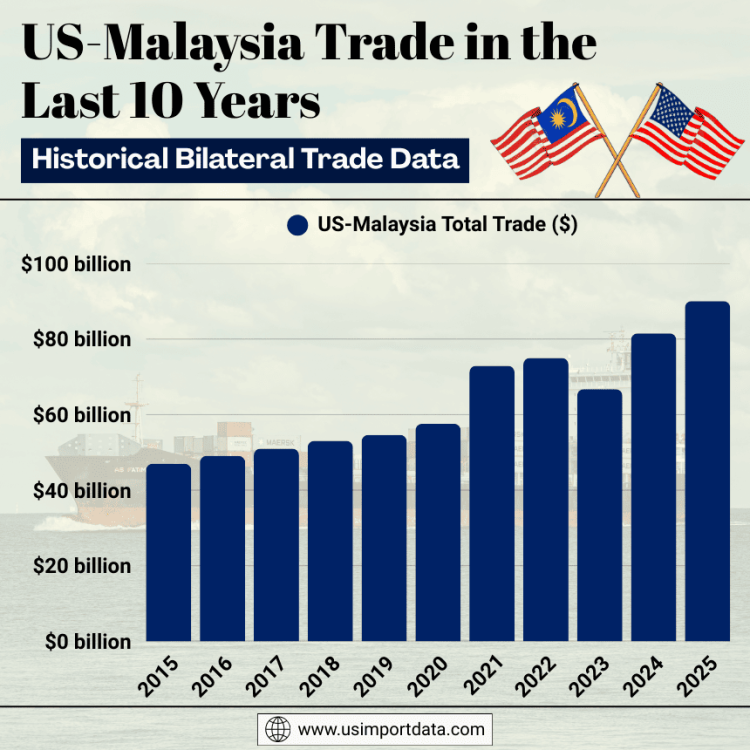
US-Malaysia Trade in the Last 10 Years: Historical Bilateral Trade Data
|
Year of Trade |
US-Malaysia Total Trade ($) |
|
2015 |
$46.99 billion |
|
2016 |
$49.07 billion |
|
2017 |
$50.96 billion |
|
2018 |
$53.07 billion |
|
2019 |
$54.61 billion |
|
2020 |
$57.58 billion |
|
2021 |
$72.92 billion |
|
2022 |
$74.99 billion |
|
2023 |
$66.76 billion |
|
2024 |
$81.54 billion |
|
2025 |
$90.04 billion |

The Bigger Picture: Tariffs as Negotiation Tools
The Malaysia–US trade dispute reflects a broader shift in global trade strategy. For decades, international trade policy emphasized multilateral agreements through institutions like the World Trade Organization (WTO). Tariffs were gradually reduced through negotiated frameworks.
In recent years, however, many major economies have returned to bilateral tariff diplomacy. Instead of broad multilateral agreements, countries increasingly use tariffs as leverage to secure concessions from trading partners. The US reciprocal tariff policy represents one of the most prominent examples of this approach. The strategy works as follows:
-
Impose or threaten high tariffs on imports
-
Offer lower tariffs in exchange for concessions
-
Negotiate bilateral agreements to formalize the arrangement
This model can produce short-term political wins but often creates unstable agreements. If the underlying tariff policy changes or is challenged legally, the agreement itself may collapse. The Malaysia case demonstrates this vulnerability.
Economic Implications for Malaysia
The immediate economic impact of the US-Malaysia trade deal’s collapse depends on how tariff policies evolve after the court ruling. If US tariffs are rolled back or modified, Malaysian exporters could regain competitive access to American markets without needing to maintain the bilateral agreement. Key sectors affected include:
Electronics and Semiconductors
Malaysia is one of the world’s major exporters of semiconductor components and electronics. The US is a critical destination for these products, as per the data on US electronics imports from Malaysia. Tariff changes can directly affect supply chains in the global technology industry.
Palm Oil
Palm oil is another major Malaysian export. Although the US is not the largest market, tariffs can still influence global price competitiveness and affect the US palm oil imports from Malaysia.
Manufacturing
Malaysia’s manufacturing sector relies heavily on international trade. Lower tariffs generally support export growth, while higher tariffs can shift production to other countries.
Implications for US Trade Policy
Malaysia’s withdrawal also creates political and economic challenges for the United States. The agreement was part of a broader strategy to reshape trade relations with Southeast Asia. If other countries reconsider their own deals, Washington could face difficulties maintaining its tariff-based negotiation model.
Trade analysts have warned that Malaysia’s decision could encourage other US trading partners to reevaluate similar agreements. Several countries in the region, including Thailand, Vietnam, and Indonesia, have also been negotiating tariff-related frameworks with the United States. If confidence in these agreements weakens, the US may need to rethink its trade diplomacy strategy.
Regional Impact in Southeast Asia
The collapse of the deal could also reshape trade dynamics within Southeast Asia. ASEAN economies often coordinate trade policies to maintain regional competitiveness. If one country gains tariff advantages, others may seek similar deals to avoid losing export market share.
Malaysia’s withdrawal may encourage ASEAN members to push for:
-
multilateral agreements rather than bilateral deals
-
reduced reliance on tariff diplomacy
-
stronger regional trade frameworks
At the same time, countries may become more cautious about signing agreements that depend heavily on tariff threats rather than long-term economic integration.
Global Trade Lessons
Several broader lessons emerge from the Malaysia–US trade deal collapse.
1. Tariff-Based Agreements Are Fragile
Trade agreements built around tariff threats can quickly unravel if the underlying policy changes.
2. Legal Systems Matter
Domestic court rulings can have major consequences for international trade agreements, especially when tariffs are imposed through executive authority.
3. Middle Powers Are Becoming More Assertive
Countries like Malaysia are increasingly willing to challenge major powers in trade negotiations when agreements appear unbalanced.
4. Multilateral Trade May Return
If bilateral tariff deals continue to face instability, governments may reconsider the value of broader multilateral trade frameworks.
Conclusion and Final Verdict
Malaysia’s decision to walk away from its trade deal with the United States marks a significant moment in the evolution of global trade policy. What began as a strategy to reduce tariffs ultimately exposed the limits of tariff-based diplomacy. When legal changes undermined the tariff framework supporting the agreement, the entire deal collapsed. For Malaysia, the move restores policy flexibility and may allow the country to pursue more balanced trade relationships. For the United States, it raises questions about the sustainability of its reciprocal tariff strategy.
Most importantly, the episode highlights a broader shift in the global economy. Trade negotiations are no longer just about reducing barriers; they are increasingly shaped by geopolitics, legal challenges, and strategic economic competition. Whether Malaysia’s withdrawal becomes an isolated event or the start of a wider reassessment of tariff-based trade agreements remains to be seen. What is clear is that the future of global trade will depend on finding a more stable balance between national economic interests and cooperative international frameworks.
Note for Our Readers
We hope this data-driven overview of the Malaysia–US trade deal collapse and its implications for tariff policies helped you better understand how modern trade agreements are shaped by tariffs, legal frameworks, and strategic economic interests. By examining the factors behind Malaysia’s decision to walk away from the agreement, along with the potential impact on exports, tariffs, and global trade negotiations, this analysis aims to provide clear insights into an evolving trade landscape.
If you're looking to search live data on US imports and exports by country, detailed tariff structures, and HS-code level trade insights, visit USImportdata. Transform trade data into a competitive advantage with our specialized US trade database solutions. For inquiries, partnerships, or sample datasets related to Malaysia–US trade flows, tariff analysis, or sector-specific export trends, feel free to contact us at info@tradeimex.in today.
What's Your Reaction?