US–Mexico Trade Deal 2025: Latest Trends in US Imports from Mexico
Get detailed insights into the US–Mexico trade deal, including US imports from Mexico, Mexico exports to the US, and bilateral trade trends.
The trade relationship between the United States and Mexico is one of the largest and most complex in the world. By 2024, Mexico had become the top supplier of goods to the U.S., overtaking China and Canada. This marks a structural shift in North American supply chains, driven by nearshoring trends, the USMCA trade framework, and Mexico’s rising competitiveness in manufacturing for Mexico exports to US. According to the latest Mexico export data and US import data, the total value of Mexico exports to the US reached $503.26 billion in 2024, a 6% increase from the previous year. Mexico exported goods worth a record high $313 billion to the US in the first half of 2025, as per the Mexico customs data and the US trade data. Mexico ranks first in terms of total trade, making it the United States' largest trading partner. The Mexico and USA trade agreement has played a crucial role in shaping regional supply chains, and discussions about American trade with Mexico continue to focus on balancing competitiveness with cooperation; recent debates on US Mexico trade tariff policies highlight how sensitive industries respond to regulatory changes, while overall America and Mexico trade remains a cornerstone of North American economic integration.
The relationship between the U.S. and its southern neighbor continues to evolve, and USA and Mexico trade remains one of the most significant economic partnerships in North America. When examining the us balance of trade with Mexico, the U.S. often runs a trade deficit, largely because of strong American demand for Mexican manufactured goods and agricultural products.
Still, the question of how much does US export to Mexico highlights the depth of cross-border integration, as the U.S. sends everything from machinery to energy supplies and consumer goods. The trade between Mexico and USA is deeply interconnected, supporting millions of jobs on both sides of the border. Much of this framework is shaped by the US Mexico trade deal, which reinforces cooperation, modernizes trade rules, and aims to keep supply chains strong and competitive across the region.
The US-Mexico combined trade volume reached a record $843 billion in 2025, with Mexico serving as both the greatest supplier of U.S. imports and the top destination for U.S. exports, as per the US-Mexico trade data. Significant cross-border trade occurs in industries including agriculture, electronics, and automobiles as a result of these close economic ties, as per the global trade data. This blog examines Mexico’s exports to the U.S. in 2024–25, looking closely at the numbers, the leading product categories, growth trends, and what it means for both countries.
The Big Picture: How Much Does the US Import from Mexico?
In 2024, the U.S. imported approximately $506 billion worth of goods from Mexico, up more than 6 percent compared to 2023. That put Mexico’s share of total U.S. imports at roughly 15.5 percent, making it the number one source of U.S. imports.
U.S. exports to Mexico, meanwhile, totaled about $334 billion, which means the U.S. ran a trade deficit with Mexico of around $172 billion. This imbalance has been a persistent feature of U.S.-Mexico trade but is widening as Mexican exports grow faster than U.S. exports southward.
By the first half of 2025, the trend was accelerating. Mexican exports to the U.S. reached nearly $313 billion in just six months, another 6.3 percent increase over the same period in 2024. U.S. exports to Mexico grew at a much slower pace, around 1 percent, widening the deficit further.
Top 10 Mexico Exports to US: What Does Mexico Export to the US?
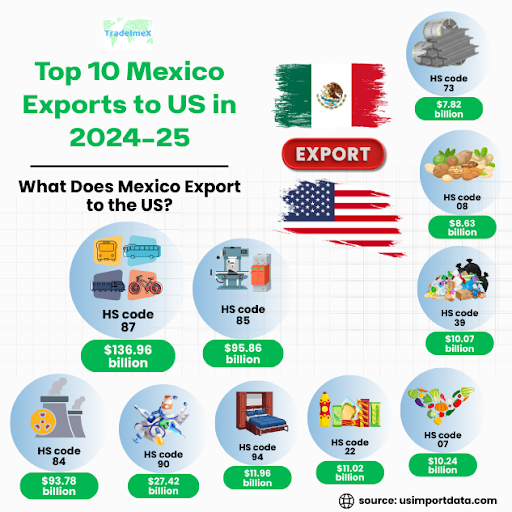
Mexico has become a significant trading partner with the United States, with a range of top exports making their way across the border. Some of the primary Mexican exports to the US include vehicles, electrical machinery, machinery, mineral fuels, and optical and medical instruments, from the top Mexico exporters. These exports play a crucial role in driving economic activity and strengthening the relationship between the two countries.
The trade flow between Mexico and the US continues to evolve, demonstrating the importance of both economies in the global market. The top 10 goods that the US imports from Mexico or Mexico exports to US, as per the USA shipment data and Mexico-America trade data for 2025, include:
1. Vehicles (HS code 87): $136.96 billion
One of the most significant exports from Mexico to the US is vehicles. Mexico has a strong automotive industry, with many major car manufacturers establishing production plants in the country. From cars to trucks, Mexico supplies a vast array of vehicles to the US market. In 2024–25, this category generated a massive $136.96 billion in export value, as per the data on US vehicles imports from Mexico by HS code.
2. Electrical machinery (HS code 85): $95.86 billion
Electrical machinery is another crucial export category for Mexico. This includes products such as electrical transformers, switches, and lighting equipment. Mexico's proximity to the US and its skilled workforce make it an ideal location for manufacturing electrical machinery for export. These exports were valued at $95.86 billion during the 2024–25 period.
3. Nuclear reactors & machinery (HS code 84): $93.78 billion
Nuclear reactors and machinery form a significant portion of Mexico's exports to the US. This category includes items such as boilers, machinery parts, and steam turbines. Mexico's expertise in producing these goods has made it a key supplier to the US market. In 2024–25, machinery exports totaled $93.78 billion, as per the data on US machinery imports from Mexico.
4. Optical, medical, & surgical instruments (HS code 90): $27.42 billion
Mexico is also known for its production of optical, medical, and surgical instruments. From eyeglasses to medical devices, Mexico's exports in this category are in high demand in the US. The country's skilled workforce ensures that these products meet international standards of quality. This category earned Mexico $27.42 billion in exports to the US.
5. Furniture, bedding, & mattresses (HS code 94): $11.96 billion
Furniture, bedding, and mattresses are also significant exports from Mexico to the US. Mexico produces a wide range of furniture items, from sofas to dining tables, catering to different tastes and preferences. The quality and affordability of Mexican furniture make it a popular choice for US consumers. In 2024–25, these exports were worth $11.96 billion.
6. Beverages, spirits, & vinegar (HS code 22): $11.02 billion
Mexico is famous for its beverages, spirits, and vinegar, which are exported in large quantities to the US. Tequila, beer, and various types of vinegar are among the products that Mexico exports across the border. The unique flavors and high quality of Mexican beverages make them sought after by US consumers. Exports in this category amounted to $11.02 billion.
7. Edible vegetables (HS code 07): $10.24 billion
Mexican-grown edible vegetables are also in demand in the US market. Fresh produce such as tomatoes, cucumbers, and avocados is exported from Mexico to the US in significant quantities. The fertile soil and favorable climate in Mexico make it an ideal location for cultivating a wide range of vegetables for export. This sector contributed $10.24 billion to Mexico's export earnings.
8. Plastics and articles thereof (HS code 39): $10.07 billion
Plastics and plastic articles make up another important export category for Mexico. From plastic packaging to household items, Mexico produces a wide range of plastic products for the US market. The country's advanced manufacturing capabilities ensure that these goods meet strict quality standards. These plastic-related exports reached a value of $10.07 billion.
9. Edible fruit and nuts (HS code 08): $8.63 billion
Edible fruit and nuts are sought-after commodities that Mexico exports to the US. Fruits such as strawberries, oranges, and mangoes, along with nuts like almonds and pistachios, are among the products that Mexico supplies to the US market. The freshness and flavor of Mexican fruits and nuts make them a favorite among US consumers. In total, this category brought in $8.63 billion in export value.
10. Articles of iron or steel (HS code 73): $7.82 billion
Lastly, Mexico exports a significant amount of articles of iron or steel to the US. This category includes products such as steel bars, pipes, and wire rods. Mexico's well-established steel industry and access to raw materials make it a key supplier of iron and steel products to the US. Exports of iron and steel articles were valued at $7.82 billion in 2024–25.
Mexico Exports to US in the Last 10 Years: Historical US-Mexico Trade Data
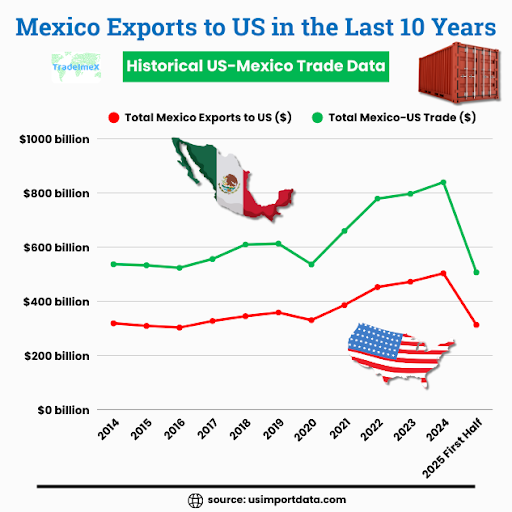
|
Year of Trade |
Total Mexico Exports to US ($) |
Total Mexico-US Trade ($) |
|
2014 |
$318.65 billion |
$536.73 billion |
|
2015 |
$309.19 billion |
$532.89 billion |
|
2016 |
$302.97 billion |
$523.72 billion |
|
2017 |
$327.37 billion |
$556.26 billion |
|
2018 |
$344.91 billion |
$609.64 billion |
|
2019 |
$358.63 billion |
$612.76 billion |
|
2020 |
$330.43 billion |
$535.98 billion |
|
2021 |
$386.16 billion |
$659.75 billion |
|
2022 |
$452.29 billion |
$779.02 billion |
|
2023 |
$472.21 billion |
$796.53 billion |
|
2024 |
$503.26 billion |
$839.55 billion |
|
2025 (first half) |
$313 billion |
$506.9 billion |
What Does the U.S. Import from Mexico?
The U.S. buys a wide variety of goods from Mexico, but the trade is dominated by manufactured products, particularly automobiles, electronics, and machinery. Agriculture and energy also play a role, though they account for a smaller share by dollar value. Many people ask, What does the US import from Mexico or What does the United States import from Mexico, and the answer includes a wide range of goods such as vehicles, electrical machinery, medical instruments, and agricultural products. If you're wondering how much does the US import from Mexico, the total value reached hundreds of billions of dollars in 2024–25, making Mexico one of America's top trading partners. From fresh produce to industrial equipment, what does America import from Mexico spans both consumer goods and complex manufacturing components.
1. Vehicles and Auto Parts
-
Value in 2024: $137 billion
-
Share of total exports: About 27 percent
The automotive sector is the backbone of Mexico’s export economy. The country produces cars, trucks, and a wide range of auto parts that feed directly into U.S. supply chains. Plants in states like Puebla, Guanajuato, and Nuevo León are hubs for major global automakers such as General Motors, Volkswagen, and Toyota.
In total, automotive exports from Mexico to the U.S. reached about $181 billion in 2024 when including vehicles and components together, representing almost a third of Mexico’s total exports to its northern neighbor.
2. Machinery (Engines, Equipment, Boilers, Industrial Systems)
-
Value in 2024: $94–106 billion
Machinery exports include engines, turbines, construction equipment, and manufacturing systems. These goods are critical for U.S. industries ranging from construction to manufacturing. The machinery trade reflects the deep integration of production across North America, where intermediate goods cross borders multiple times before becoming final products.
3. Electrical and Electronic Equipment
-
Value in 2024: $88–96 billion
This category includes semiconductors, circuit boards, consumer electronics, telecommunications equipment, and electrical components for vehicles and machinery. Mexico has become an increasingly attractive site for electronics assembly, benefiting from U.S. nearshoring strategies as companies diversify away from China and Asia.
Electronics are also a growth sector, as demand for devices, EV components, and renewable energy systems expands.
4. Medical Devices and Precision Instruments
-
Value in 2024: $22–27 billion
Mexico is a leading exporter of medical devices such as syringes, diagnostic equipment, orthopedic implants, and surgical instruments. Cities like Tijuana and Juárez host significant clusters of medical device manufacturers, serving U.S. hospitals and healthcare systems.
5. Mineral Fuels, Oils, and Distillation Products
-
Value in 2024: $17–27 billion
Although Mexico is no longer as dominant in oil production as it once was, it still supplies the U.S. with petroleum and refined products. Exports in this category fluctuate depending on oil prices and U.S. refinery demand.
6. Agricultural Exports: Vegetables, Fruits, and Beverages
-
Vegetables (tomatoes, peppers, cucumbers, avocados): $10 billion
-
Fruits and nuts (berries, citrus, melons, mangos): $9–11 billion
-
Beverages (beer, tequila, mezcal, soft drinks): $11–13 billion
Agriculture is a critical export category by volume, even if dollar values are smaller than those of manufacturing. Mexico supplies the U.S. with year-round fresh produce, filling gaps during the American off-season. Beer is Mexico’s single largest agricultural export, with brands like Corona and Modelo leading sales, while tequila has surged in popularity in recent years.
7. Plastics and Chemicals
-
Plastics exports: $8–10 billion
-
Chemical products: $7–9 billion
These categories supply U.S. industries with raw materials and inputs for packaging, consumer goods, and industrial production.
Mexico-US Trade Performance in 2025
-
Exports: In the first half of 2025, Mexico's total exports to the United States totaled $313 billion, representing a 4.3% rise over the previous year.
-
Imports: Mexico imported $311 billion worth of goods from the United States, a 0.2% rise from the previous year.
-
Trade Balance: During the first half of 2025, Mexico's trade with the United States showed a $1.4 billion surplus.
Important Sectors and Trade Drivers
-
Manufacturing: About 90% of Mexico's total exports come from the manufacturing sector, which continues to be the foundation of its international trade.
-
Agriculture: Mexico's second-most-significant export sector is now the livestock and agriculture sector.
-
Technology: U.S. exports to Mexico have increased significantly due to the need for computer components and related equipment, especially for the artificial intelligence sector.
Factors That Affect US-Mexico Trade
-
USMCA: With new regulations in 2025 to enhance enforcement and transparency for businesses, particularly in the automobile sector, the U.S.-Mexico-Canada Agreement (USMCA) continues to have an impact on trade.
-
U.S. Tariffs: Mexico's trade performance indicates that the tariffs imposed by the U.S. on particular steel and aluminum imports in early 2025 have not substantially slowed the general trade momentum, as Mexico has managed to get preferential status for certain exports.
-
Global Trade Dynamics: Mexico expects to gain from changes in international trade, especially the increased U.S. tariffs on Chinese goods, which may open doors for Mexican exports in industries like manufacturing and technology.
Why Are Mexico’s Exports to the U.S. Growing?
Nearshoring and Supply Chain Shifts
Global companies are reducing dependence on Asian suppliers, particularly China, due to rising labor costs, tariffs, and geopolitical risks. Mexico’s proximity, lower logistics costs, and participation in USMCA make it an ideal alternative.
USMCA Trade Agreement
The United States-Mexico-Canada Agreement (USMCA), which replaced NAFTA in 2020, provides tariff-free trade for most goods, as long as they meet rules of origin requirements. For example, automobiles must have a high percentage of North American-made parts to qualify. This incentivizes investment in Mexico’s auto sector.
Competitive Costs and Workforce
Mexico offers lower labor costs compared to the U.S. or Canada, while maintaining a skilled industrial workforce. This is especially valuable for industries like automotive and electronics, which require large-scale assembly and precision manufacturing.
Strong U.S. Demand
The U.S. economy’s demand for vehicles, electronics, construction materials, and fresh produce continues to fuel imports. Even during periods of economic uncertainty, the need for essential goods keeps trade volumes high.
Year-over-Year Trends: 2023–2025
-
2023 to 2024: Exports from Mexico to the U.S. grew by around 6 percent. Mexico’s share of total U.S. imports inched up, overtaking China, whose exports to the U.S. have been declining.
-
First half of 2025: Mexican exports rose another 6.3 percent in 2025 H1, compared to the first half of 2024, suggesting that Mexico’s role in the US supply chains is strengthening. U.S. exports to Mexico, however, grew just 1 percent in the same period, widening the deficit.
Sector Spotlights
1. Automotive Dominance
The automotive sector is the most significant driver of exports. Mexico’s car and parts exports not only satisfy U.S. consumer demand but also feed into the U.S. manufacturing process. For example, an engine block might be cast in Mexico, sent to the U.S. for machining, and then returned to Mexico for final assembly before being exported again. This integration makes the auto sector highly dependent on cross-border logistics efficiency.
2. Electronics and Semiconductors
With the U.S. pushing to reshore semiconductor and electronics production, Mexico is expected to play an even bigger role as a manufacturing and assembly hub. Already, electronics are Mexico’s second or third largest export category to the U.S., and their growth outpaces traditional categories like oil.
3. Agriculture and Beverages
While smaller in dollar terms, agricultural exports are vital for U.S. consumers. Mexico supplies around two-thirds of the fresh vegetables and nearly half of the fresh fruit consumed in the U.S. Beer exports, especially, symbolize Mexico’s soft power in the U.S. market.
Risks and Challenges
-
Trade Policy Uncertainty: Shifts in U.S. trade policy, such as proposed tariffs on autos or disputes over USMCA rules of origin, could disrupt flows. Mexico has already had to negotiate with U.S. authorities to maintain preferential treatment for certain exports.
-
Infrastructure and Energy Constraints: Mexico’s export capacity depends on infrastructure: highways, railways, ports, and energy supply. Bottlenecks or energy shortages could slow down trade and erode competitiveness.
-
Labor and Environmental Standards: USMCA includes strict labor and environmental requirements. If Mexican producers fail to comply, they risk losing preferential access to U.S. markets.
-
Global Economic Conditions: If U.S. consumer demand slows due to recessionary pressures, Mexican exports of cars, electronics, and durable goods could take a hit.
The US-Mexico Trade Outlook for 2025–2026
Looking ahead, several themes are expected to shape trade:
-
Continued nearshoring: Companies will keep moving production from Asia to Mexico to reduce risk and costs.
-
Expansion in high-tech sectors: Electronics, medical devices, and renewable energy components will likely see double-digit growth.
-
Potential auto policy battles: The U.S. may introduce stricter rules for electric vehicles, which could either boost or hurt Mexico depending on how much production is located there.
-
Infrastructure investment: Mexico will need to improve logistics and energy to sustain export growth.
-
Agriculture’s resilience: Climate pressures and U.S. demand will continue to shape fruit, vegetable, and beverage exports.
Conclusion and Final Thoughts
In 2024, Mexico exported more than half a trillion dollars’ worth of goods to the United States, solidifying its position as America’s top supplier. The bulk of these exports is vehicles, machinery, and electronics, reflecting Mexico’s role as a manufacturing powerhouse. Agriculture, beverages, and fuels add diversity, while sectors like medical devices point to new growth opportunities.
The story of 2024–25 is not just about rising numbers, it’s about structural change. Nearshoring, USMCA, and shifting global supply chains are making Mexico an indispensable trade partner for the U.S. If current trends hold, Mexico’s export presence in the U.S. market will only deepen in 2025 and beyond, though risks from policy shifts and global economics remain.
For more insights into the latest US export-import data, US-Mexico trade data analysis, search live data on the US import-export by country, and get the latest customized trade reports, contact USImportdata at info@tradeimex.in, as per your business needs.
Also read about:
Top Olive Oil Importers & Buyers in USA
What's Your Reaction?