What does Australia export to USA? Major US Imports from Australia
Discover what the US imports from Australia in 2024–25. Explore major Australia exports to US, key industries, Australia–US trade agreement, and overall Australia–US trade trends.
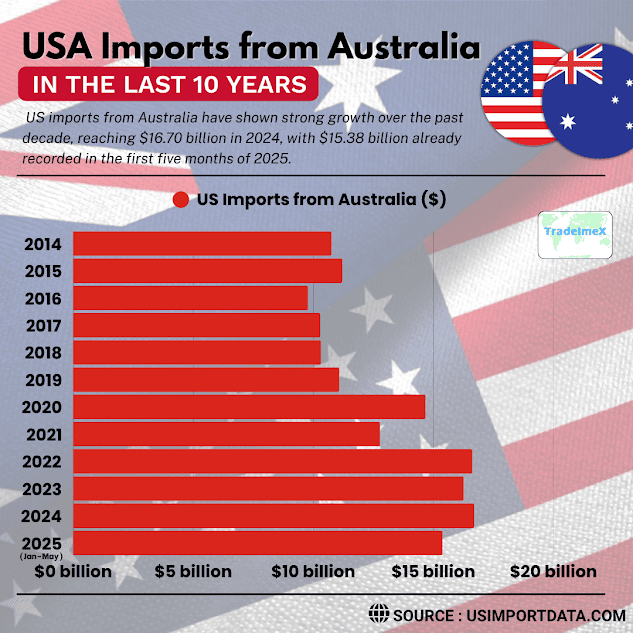
The United States and Australia share a robust trade relationship, with both countries benefiting from the exchange of various commodities. Australia is a major trading partner of the United States, with a significant portion of Australian exports making their way to American shores. According to the US import data and data from the United States Trade Representative, the total value of US imports from Australia reached a record high of $16.7 billion in 2024, an increase of 4.7% from the previous year. According to US import statistics and Australia export data, the USA imported $15.38 billion from Australia in the first five months of 2025. Meanwhile, U.S. exports to Australia stood at roughly $34.6 billion, yielding a bilateral trade surplus of around $17.9 billion in favor of the U.S.
U.S. Census monthly trade with Australia records total goods imports of about $22.75 billion in 2024, which reflects both COMTRADE data and suggests a slight divergence due to data-sourcing methodologies. The surplus underscores how the U.S. imports predominantly raw and commodity-based goods, whereas it exports higher-value manufactured machinery, vehicles, and medical apparatus. According to the global trade data, Australia is the 29th largest import partner of the US. This article will explore the key imports that the USA receives from Australia, shedding light on the bilateral trade relationship between the two nations in 2024-25.
What Does the US Import from Australia: What Are the Major US Imports from Australia in 2024-25?
Are you curious about the top imports from Australia to the United States in the coming year? Let's take a closer look at the major products that make their way across the Pacific Ocean. From meat and pharmaceutical products to precious stones and steel, Australia has a diverse range of exports that are highly sought after by American consumers. The major US imports from Australia comprise a diverse range of goods, predominantly including meat, pharmaceuticals, precious metals, iron & steel, and agricultural products, as per the latest US import shipment data.
Australia is a significant supplier of commodities such as refined petroleum, gold, and wine to the United States, contributing to the bilateral trade relationship between the two nations. According to the US-Australia trade data and data on US imports by country or US shipment data, the top 10 goods that the US imports from Australia in 2024-25 include:
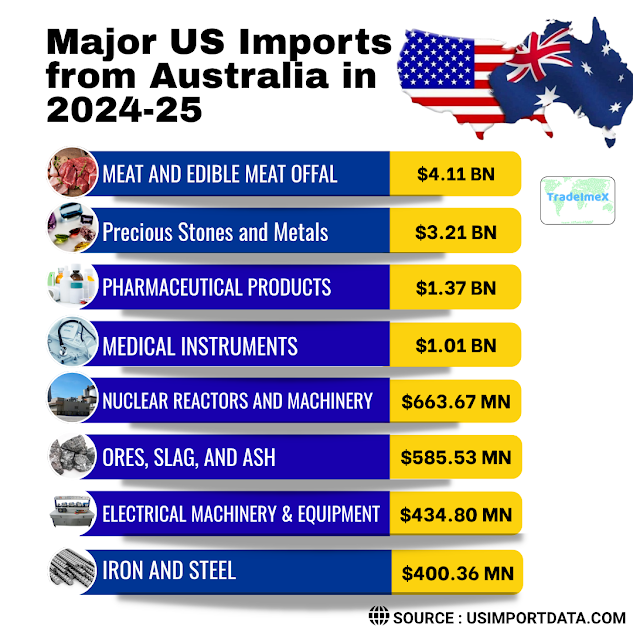
1. Meat and Edible Meat Offal (HS Code 02): $4.11 Billion
Meat and edible meat offal are among the top imports from Australia to the US, with a value of $4.11 billion, as per the data on US meat imports from Australia by HS code. Australian beef and lamb are known for their high quality and are commonly used in various culinary dishes across the country. Australia is a key supplier of beef (including chilled, frozen, and offal) into the U.S. market. In 2024, this category alone accounted for nearly 25% of total US imports from Australia.
This surge was significantly aided by a drought-linked decline in U.S. beef production, the lowest cattle herd size since the 1950s, which opened opportunities for Australian exporters to capture market share at higher prices.
2. Precious Stones and Metals (HS Code 71): $3.21 Billion
Australia is rich in precious stones and metals, making it a major exporter to the US with a value of $3.21 billion. From diamonds to opals, Australian gemstones are highly prized for their beauty and quality.
Encompassing natural pearls, precious metals (notably gold), coins, and high-value minerals, this sector is the second-largest import category. A jump in gold exports to the U.S., partly as a safe-haven during global trade tensions, helped push this figure upward in early 2025, contributing to Australia posting a temporary trade surplus with the U.S. in January ($2.2B surplus).
3. Pharmaceutical Products (HS Code 30): $1.37 Billion
Pharmaceutical products are another significant import from Australia to the US, with a value of $1.37 billion. Australian companies are known for producing high-quality medications and healthcare products that are in demand in the American market.
Australia’s growing biotech and pharmaceutical sector, especially in vaccines and innovative drugs, supplied roughly $1.4 billion worth of goods to the U.S. in 2024. These biopharma exports continue to trend upward thanks to long-term investments in biotech innovation.
4. Optical, Medical, & Surgical Instruments (HS Code 90): $1.01 Billion
Australia also exports a significant amount of optical, medical, and surgical instruments to the US, with a value of $1.01 billion. These products play a crucial role in the healthcare industry and are essential for medical professionals across the country. Includes high-precision medical imaging, instruments, technical optical devices, and photonics equipment, reflecting Australia’s strength in precision manufacturing and specialized R&D close to global standards.
5. Nuclear Reactors and Machinery (HS Code 84): $663.67 Million
Nuclear reactors and machinery are among the top imports from Australia to the US, with a value of $663.67 million. These products are essential for various industries, including energy production and manufacturing. Imports include industrial machinery, mining-equipment components, and parts for power generation systems, fitting Australia’s role as both a mining economy and a trading partner with engineering ties.
6. Ores, Slag, and Ash (HS Code 26): $585.53 Million
Australia is a major exporter of ores, slag, and ash to the US, with a value of $585.53 million. These materials are used in various industrial processes and are crucial for the production of metals and other goods. Raw minerals, including nickel and other ore residues, are shipped partly for U.S. reprocessing and refining.
7. Electrical Machinery & Equipment (HS Code 85): $434.80 Million
Electrical machinery and equipment are also significant imports from Australia to the US, with a value of $434.80 million, as per the data on US electronics imports from Australia by HS Code. These products are essential for the functioning of various electronic devices and appliances. Includes specialized electronics, telecommunication equipment, and some automation systems sourced from Australian suppliers.
8. Iron and Steel (HS Code 72): $400.36 Million
Iron and steel are important imports from Australia to the US, with a value of $400.36 million. These materials are used in construction, manufacturing, and other industries, making them essential for the American economy. Australian steel and iron exports to the U.S. remain modest by value, though tariffs have amplified concerns in 2025.
9. Aircraft, Spacecraft, & Parts Thereof (HS Code 88): $346.70 Million
Australia also exports aircraft, spacecraft, and parts thereof to the US, with a value of $346.70 million. These products are crucial for the aviation industry and play a vital role in transportation and defense. Exports here include aircraft parts, aerospace components, and occasionally entire small aircraft or UAVs.
10. Beverages, Spirits, & Vinegar (HS Code 22): $302.83 Million
Finally, beverages, spirits, and vinegar are popular imports from Australia to the US, with a value of $302.83 million. Australian wines and spirits are renowned for their quality and are enjoyed by consumers across the country.
USA Imports from Australia in the Last 10 Years: Yearly US-Australia Bilateral Trade Data
|
Year of Imports |
US Imports from Australia ($) |
|
2014 |
$10.76 billion |
|
2015 |
$11.21 billion |
|
2016 |
$9.78 billion |
|
2017 |
$10.29 billion |
|
2018 |
$10.32 billion |
|
2019 |
$11.08 billion |
|
2020 |
$14.67 billion |
|
2021 |
$12.78 billion |
|
2022 |
$16.62 billion |
|
2023 |
$16.26 billion |
|
2024 |
$16.70 billion |
|
2025 (first 5 months) |
$15.38 billion |
Key Exports from Australia to the USA
1. Mineral Resources: Australia is known for its rich mineral resources, and the USA is a significant importer of Australian minerals such as iron ore, coal, and gold. These resources are essential for various industries in the US, including construction, manufacturing, and energy production.
2. Agricultural Products: Australia is also a major exporter of agricultural products to the USA. Wheat, beef, and dairy products are among the top agricultural exports that find their way to American markets. These products contribute to the food supply chain in the USA, meeting the demand for high-quality Australian produce.
3. Energy: As a leading producer of liquefied natural gas (LNG), Australia plays a crucial role in meeting the energy needs of the USA. LNG exports from Australia have been on the rise in recent years, supporting the US energy sector and contributing to energy security.
4. Medical Equipment: The healthcare industry is another sector where Australia excels in exports to the USA. Medical equipment such as diagnostic devices, surgical instruments, and pharmaceuticals is in high demand in American hospitals and healthcare facilities, with Australian products meeting these needs.
US-Australia Trade Drivers & Strategic Context
AUSFTA’s Legacy & Export Patterns
The Australia–U.S. Free Trade Agreement (AUSFTA) has been in force since January 2005, substantially reducing tariffs on non-agricultural goods (97% duty‑free) and eliminating two-thirds of agricultural tariffs. That foundation enabled tariff-free preferential access across most categories, though recent political shifts have disrupted its efficacy.
Between 2005 and 2024:
-
Australian goods exports to the U.S. grew by 157%.
-
Imports from the U.S. grew by 136%.
-
Two‑way merchandise trade reached $74.4 billion, as per the Australian Bureau of Statistics.
New Tariff Regime in 2025: “Reciprocal Tariffs”
In April 2025, the U.S. introduced a 10% baseline tariff on most imports from Australia, overriding AUSFTA’s duty-free commitments.
Additionally, sector‑specific tariffs under Section 232 include:
-
25% on steel and aluminum (up to 50% on certain steel/aluminum products effective June 2025).
-
25% on automobiles, light trucks, and related parts.
Some exemptions apply to coins and bullion, energy products, and items still under investigation (e.g., mobile phones, lumber, pharmaceuticals).
Emerging Trends & Risks for US-Australia Trade in 2025
Commodities vs. Value-Added
Australian exports to the U.S. remain concentrated in primary commodities, meat, metals, ores, and pearls, while U.S. exports to Australia skew toward machinery, vehicles, aircraft, and electronics.
These dynamic drives a persistent U.S. trade surplus (approximately $17.9 billion in 2024).
Gold Surge & Temporary Australian Surplus
In early 2025, unexpected high gold exports to U.S. investors (valued at about $2.9 billion) triggered Australia’s first trade surplus with the U.S. in decades, but that spike is likely short-lived and mostly related to investor behavior rather than underlying demand shifts.
Beef Boom & Vulnerability of the U.S. Herd
Australian beef exports capitalized on reduced U.S. production in 2024, but as American herds recover, Australian suppliers may face downward pressure or need to shift strategy.
Tariff Shock & Policy Volatility
With U.S. trade policy shifts under the Trump administration, including sweeping reciprocal tariffs and unpredictable escalation, Australian exporters, particularly in steel, aluminum, automobiles, and pharmaceuticals, now face elevated trade risks.
Australia has opted not to retaliate with reciprocal tariffs, focusing instead on diplomatic mitigation and domestic support, like an A$50 million assistance package for impacted sectors, including beef.
Sector Spotlight: Impacts & Projections for US Imports from Australia
Agricultural & Food Exports
-
Beef & lamb: Export volumes are likely to hold steady in late 2025, though commodity pricing may intensify as tariffs escalate.
-
Wine & seafood: South Australian producers (e.g., beef, sheep meat, wine, lobster) are closely monitoring U.S. tariff developments; wine exports to the U.S. were about $325 million pre‑China fallout, as per US wine imports from Australia.
-
Pharmaceuticals: Investigation into tariff exemptions continues; small biotech players could face new barriers if pharma tariffs apply broadly.
Mining & Mineral Commodities
-
Metals & Ores: Nickel, iron ore, and gold remain reliable but can face tariffs; gold’s surge in 2025 helped, but may face customs change if bullion becomes taxed.
Manufacturing & Tech
-
Medical devices, precision optical instruments: Still mostly duty‑free under AUSFTA unless reclassified under tariff policies.
-
Machinery & industrial equipment: This sub‑$1 billion category remains important but exposed if rules of origin or threshold adjustments shift.
Steel, Aluminum & Automobiles
-
Tariff hikes to 50% on steel/aluminum and 25 % on autos going into August 2025 will heavily affect existing supply chains and cost structures, not just in steel imports ($400 m in 2024) but in derivative goods too.
Strategic Implications
For Australian Exporters
-
Reassess pricing models: New tariffs mean higher landed costs in the U.S., Australian exporters may need to absorb margins or redirect goods to other markets.
-
Seek tariff classification exemptions: Particularly for pharmaceuticals, medical devices, and critical minerals still under sector investigations.
-
Diversify markets: To offset U.S. headwinds, targeting Asian or EU markets may now be more urgent.
-
Engage FTA mechanisms actively: AUSFTA’s joint committees remain a forum for raising U.S. tariff inconsistencies and advocating for exemptions.
For U.S. Importers & Policymakers
-
Supply chain adjustments: U.S. industries relying on Australian inputs (e.g., cattle feedlots, specialized medical devices) must manage pass-through price shocks.
-
Tariff exemptions or mitigations: Will hinge on U.S. investigations into national-security claims around sectors like semiconductors, timber, copper, and pharmaceuticals.
-
Diplomacy & domestic politics: Australia’s aligned geopolitical posture (e.g., AUKUS alliance) may give leverage, or be complicated as trade friction escalates.
Looking Ahead: 2025 & Beyond
-
August 2025: Higher reciprocal tariffs on autos, steel, and aluminium take full effect.
-
Late 2025 investigations: Outcomes for pharmaceuticals, critical minerals, and timber sectors may determine tariff carve‑outs.
-
Gold exports normalize: The temporary surplus from early 2025 is unlikely to recur unless global turbulence resurges.
-
Recovery of the U.S. cattle herd: Likely to reduce import pressure on Australian beef by the second half of 2025.
-
WTO or legal challenges: Australia might explore dispute resolution under AUSFTA or broader WTO frameworks if tariff barriers mount.
Summary & Key Takeaways
-
In 2024-25, U.S. imports from Australia totaled $16.7 billion, led by meat, precious stones/gold, pharma, machinery, and optical/technical equipment.
-
The U.S. held a merchandise trade surplus with Australia of nearly $18 billion in 2024.
-
Beef exports accounted for over $4 billion, while pearls/ precious metals exceeded $2.7 billion.
-
A new 10% baseline tariff introduced in April 2025, plus 25–50% tariffs on steel, aluminum, and autos, marks a sharp policy shift.
-
Australian exporters face margin compression, strategic uncertainty, and substantial vulnerability unless exemptions are secured.
-
The evolving U.S. policy environment underscores the importance of diverse export markets, active use of FTA mechanisms, and agility in reallocating trade flows.
Future Outlook for the US-Australia Bilateral Trade
Looking ahead, the trade relationship between the United States and Australia or the US-Australia trade relations, is poised for growth and further diversification. Both countries are exploring opportunities for collaboration in emerging sectors such as renewable energy, technology, and innovation, which hold great potential for future exports from Australia to the USA.
Conclusion and Final Thoughts
In conclusion, Australia is a key exporter of a diverse range of products to the USA, contributing to the bilateral trade relationship between the two nations. From mineral resources to agricultural products, energy, education services, and medical equipment, Australian exports play a vital role in meeting the demands of American markets. With a strong foundation of trade ties and a commitment to innovation, the future looks bright for US imports from Australia in the years to come.
This is a transitional moment for US-Australia trade. While the AUSFTA framework historically anchored steady growth, the 2025 policy turn under U.S. “reciprocal tariffs” has introduced new risks for both primary exporters and downstream supply chains. On the flip side, U.S. importers and policymakers face downstream cost increases and pressure to manage trade relationships rooted in strategic defense ties (e.g., AUKUS) even as the tariff storm gathers.
For both sides, the coming months will demand data-driven monitoring, FTA-based advocacy, and supply‑chain adaptability. The figures from 2024 illustrate where each side’s strengths lie, as the United States imports mainly commodity and food goods, while exporting higher-value manufacturing and tech outputs to Australia. That imbalance frames much of the present friction, but also highlights where resilient adjustment and renewed cooperation may lie ahead.
For more such insightful and data-driven blogs, or to search live US import-export data by country, visit USImportdata. Contact us at info@tradeimex.in and get a customized US export-import data report along with the list of the top US importers.
What's Your Reaction?