US Trade With Venezuela 2024-25: Exploring the US-Venezuela Trade Relations
Explore US Venezuela trade relations and learn how US imports from Venezuela grew in 2024 25 with trade data showing strong gains driven by oil & policy shifts.
Introduction
The trade relationship between the United States and Venezuela has always been complex, a tug of war between economic opportunity and political tension. For decades, Venezuela served as a key oil supplier to the U.S., while U.S. exports helped sustain parts of the Venezuelan economy. But sanctions, shifting geopolitics, and economic collapse have turned this relationship into a volatile, policy-dependent equation. According to the US import data and Venezuela export data, the total value of US imports from Venezuela reached $6.31 billion in 2024, a massive increase of 67% from the previous year. The US exports to Venezuela accounted for $4.23 billion in 2024, representing a 68% increase from the prior year, according to US export data and Venezuelan customs import data. Questions like does the US trade with Venezuela often arise when examining changing geopolitical and economic conditions, especially in sectors where does the US import oil from Venezuela becomes a key point of discussion in analyzing the broader landscape of Venezuela-US trade. The dynamics of US Venezuela oil trade have shifted significantly over the years due to changing geopolitical priorities, as us trade relations with Venezuela have been shaped by diplomatic tensions and energy security concerns.
Overview of US-Venezuela Trade Performance in 2024
-
Total goods and services trade between the two nations reached around $10.5 billion, up roughly 47% from 2023.
-
U.S. goods exports to Venezuela rose to $4.2 billion, marking a 68% increase year over year.
-
U.S. imports from Venezuela surged to about $6.3 billion, up 67% from 2023 levels.
-
The U.S. goods trade deficit with Venezuela widened to $1.8 billion, a 65% increase over the prior year.
-
U.S. services exports to Venezuela fell by roughly 18%, to about $1.5 billion, while services imports from Venezuela grew modestly by about 5%, reaching $133 million.
The growth in trade volumes was primarily fueled by oil. In 2024, Venezuelan crude shipments to the U.S. climbed as American refiners sought heavy crude that matched Venezuelan blends, especially after global energy markets tightened due to disruptions in the Middle East and ongoing OPEC production cuts.
At the same time, agricultural and industrial exports from the U.S. to Venezuela rose due to easing import restrictions within Venezuela and limited economic stabilization under President Nicolás Maduro’s government.
Top 10 US Imports from Venezuela: What Does the US Import From Venezuela?
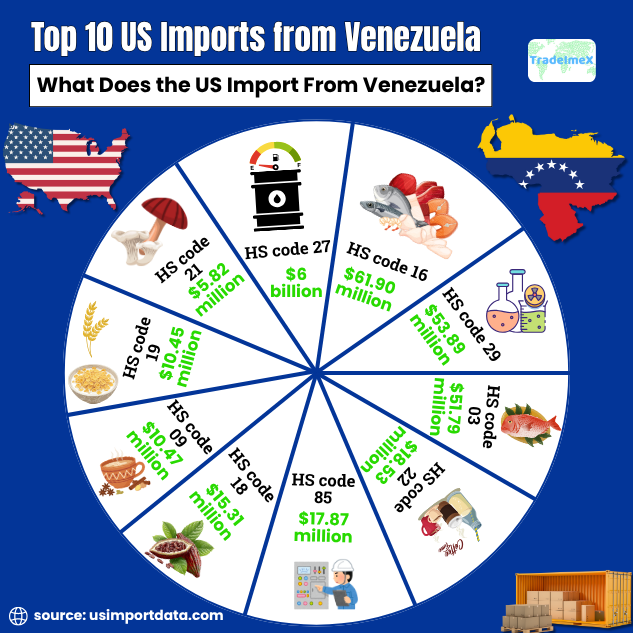
The top 10 US imports from Venezuela cover a diverse range of products, with crude oil being the most significant import. Besides petroleum, the United States also imports other goods like chemicals, aluminum, vegetables, fruits, and cocoa from Venezuela. These imports contribute significantly to the bilateral trade relationship between the two countries and further strengthen the US-Venezuela trade relations. The major US imports from Venezuela, as per the US-Venezuela trade data and the US import shipment data for 2024-25, include:
1. Mineral fuels and oils (HS code 27): $6 billion
One of the top imports from Venezuela to the US in 2024-25 was mineral fuels and oils, totaling a substantial $6 billion. With Venezuela being a significant producer of oil, it comes as no surprise that this category topped the list.
2. Preparations of meat, fish, & seafood (HS code 16): $61.90 million
Another notable import from Venezuela to the US was preparations of meat, fish, and seafood, amounting to $61.90 million. This category includes a range of products that cater to the US market's demand for diverse food options.
3. Organic chemicals (HS code 29): $53.89 million
Organic chemicals were also among the top imports from Venezuela, totaling $53.89 million. These chemicals are essential in various industries, including pharmaceuticals, agriculture, and manufacturing.
4. Fish and seafood (HS code 03): $51.79 million
In addition to preparations of meat, fish, and seafood, the US also imported fish and seafood directly from Venezuela, amounting to $51.79 million. This category includes fresh, frozen, and processed fish and seafood products.
5. Beverages, spirits, and Vinegar (HS code 22): $18.53 million
Beverages, spirits, and vinegar were also significant imports from Venezuela, totaling $18.53 million. These products cater to the US market's demands for various beverages and alcoholic beverages.
6. Electrical machinery and equipment (HS code 85): $17.87 million
Electrical machinery and equipment were another category of imports from Venezuela to the US, amounting to $17.87 million. These products play a crucial role in various industries and are essential for daily use.
7. Cocoa and cocoa preparations (HS code 18): $15.31 million
Venezuela is known for its high-quality cocoa, making cocoa and cocoa preparations a noteworthy import, totaling $15.31 million. These products are essential for the production of chocolates and various confectionery items.
8. Coffee, tea, and spices (HS code 09): $10.47 million
Coffee, tea, and spices were also among the top imports from Venezuela to the US, amounting to $10.47 million. These products cater to the US market's demand for beverages and culinary ingredients.
9. Preparations of cereals & pastrycook products (HS code 19): $10.45 million
Preparations of cereals and pastrycook products were significant imports from Venezuela, totaling $10.45 million. These products include a variety of cereal-based items and pastry products.
10. Miscellaneous edible preparations (HS code 21): $5.82 million
Rounding off the list of top imports from Venezuela to the US were miscellaneous edible preparations, amounting to $5.82 million. These products encompass a range of food items that cater to diverse consumer preferences.
Top 10 US Exports to Venezuela: What Does the US Export to Venezuela?
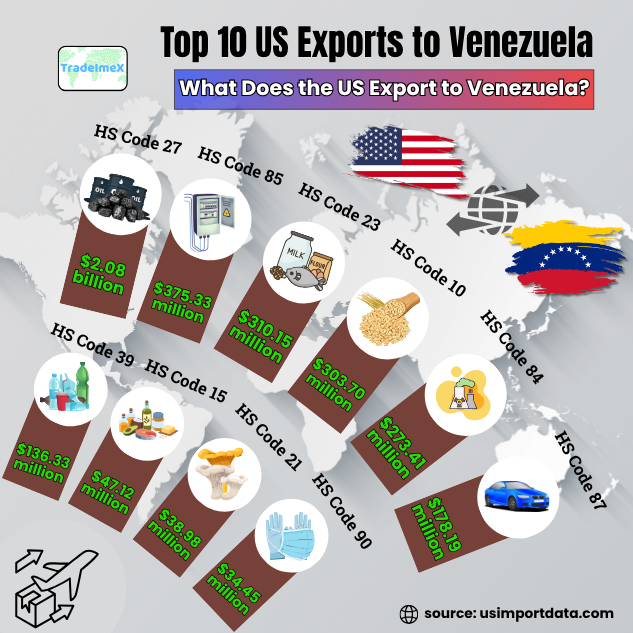
The top 10 US exports to Venezuela encompass a diverse range of goods and services. Some key items include refined petroleum products, machinery, electrical machinery, medical instruments, and plastic products. These exports play a crucial role in fostering economic relations between the two countries and highlight the dynamic trade partnership that exists despite geopolitical challenges. The main US exports to Venezuela, as per the data on US exports by country and US shipment data for 2024-25, include:
1. Mineral Fuels and Oils (HS Code 27): $2.08 billion
Mineral fuels and oils were the top US export to Venezuela in 2024-25, with a total value of $2.08 billion. Venezuela heavily relies on imported fuels and oils for its energy needs, making this the most lucrative export category for the US.
2. Electrical Machinery and Equipment (HS Code 85): $375.33 million
The second-largest export category was electrical machinery and equipment, with a total value of $375.33 million. This includes items like generators, transformers, and electrical appliances that are essential for Venezuela's infrastructure development.
3. Prepared Animal Food (HS Code 23): $310.15 million
Prepared animal food was another significant export from the US to Venezuela, with a total value of $310.15 million. This category includes pet food, livestock feed, and other animal-related products that cater to Venezuela's agricultural sector.
4. Cereals (HS Code 10): $303.70 million
Cereals also featured prominently among US exports to Venezuela, with a total value of $303.70 million. This category includes grains like wheat, corn, and rice, which are essential staples in Venezuela's diet.
5. Nuclear Reactors and Machinery (HS Code 84): $273.41 million
Nuclear reactors and machinery were a significant export category, with a total value of $273.41 million, as per the data on US machinery exports to Venezuela by HS code. This category includes equipment used in power generation, medical imaging, and other industrial applications.
6. Vehicles (HS Code 87): $178.19 million
Vehicles were also among the top US exports to Venezuela, with a total value of $178.19 million. This category includes cars, trucks, and other motor vehicles that cater to Venezuela's transportation needs.
7. Plastics and Articles Thereof (HS Code 39): $136.33 million
Plastics and articles thereof were a significant export category, with a total value of $136.33 million. This category includes plastic products, packaging materials, and other items that are widely used in various sectors of Venezuela's economy.
8. Animal or Vegetable Fats and Oils (HS Code 15): $47.12 million
Animal or vegetable fats and oils were also among the US exports to Venezuela, with a total value of $47.12 million. This category includes products like cooking oils, margarine, and animal fats that are essential for Venezuela's culinary industry.
9. Miscellaneous Edible Preparations (HS Code 21): $38.98 million
Miscellaneous edible preparations also featured among US exports to Venezuela, with a total value of $38.98 million. This category includes food preparations, sauces, and condiments that cater to Venezuela's diverse culinary preferences.
10. Optical, Medical, & Surgical Instruments (HS Code 90): $34.45 million
Optical, medical, and surgical instruments rounded up the top 10 US exports to Venezuela, with a total value of $34.45 million. This category includes items like eyeglasses, medical devices, and surgical equipment that are essential for Venezuela's healthcare sector.
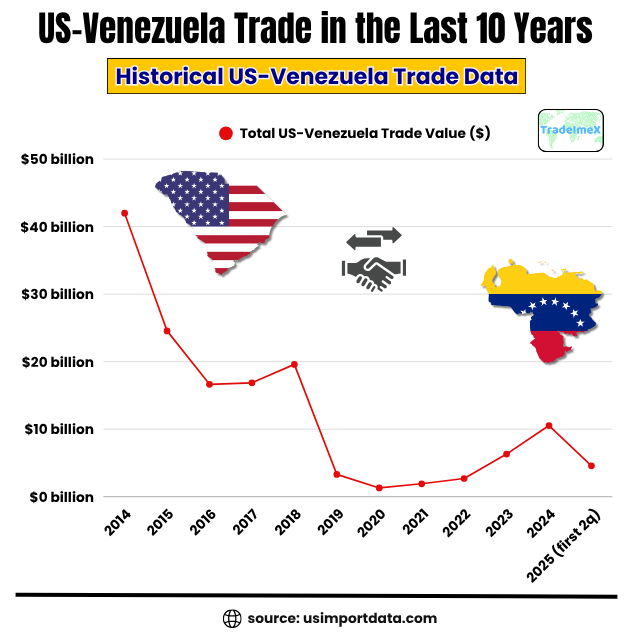
US-Venezuela Trade in the Last 10 Years: Historical US-Venezuela Trade Data
|
Year of Trade |
Total US-Venezuela Trade Value ($) |
|
2014 |
$41.99 billion |
|
2015 |
$24.56 billion |
|
2016 |
$16.65 billion |
|
2017 |
$16.87 billion |
|
2018 |
$19.6 billion |
|
2019 |
$3.31 billion |
|
2020 |
$1.30 billion |
|
2021 |
$1.92 billion |
|
2022 |
$2.70 billion |
|
2023 |
$6.32 billion |
|
2024 |
$10.54 billion |
|
2025 (first 2 quarters) |
$4.58 billion |
Composition of Trade: What Each Side Trades
U.S. Imports from Venezuela
Venezuelan exports to the United States remain overwhelmingly dominated by crude oil and refined petroleum products. In 2024:
-
Over 90% of total Venezuelan exports to the U.S. consisted of mineral fuels, oils, and related products, about $6 billion in value.
-
Smaller import categories included organic chemicals, fishery products, and nonferrous metals, but these collectively made up less than 10% of total U.S. imports from Venezuela.
-
Imports of Venezuelan crude averaged roughly 220,000 barrels per day in late 2024, placing Venezuela among the top ten foreign suppliers of oil to the United States.
The resumption of oil imports was enabled by temporary U.S. Treasury licenses that allowed select firms, such as Chevron, to resume limited crude trading and investment under strict conditions. However, production limitations and infrastructural decay in Venezuela’s oil fields capped the extent of this recovery.
U.S. Exports to Venezuela
Unlike Venezuela’s export basket, U.S. exports to Venezuela are more diversified, though still concentrated in a few sectors. The key categories in 2024 included:
-
Mineral fuels and refined products — around $2.1 billion, including diluents and light oil products essential for blending and refining Venezuela’s heavy crude.
-
Electrical machinery and equipment — approximately $375 million, covering generators, transformers, and industrial electronics.
-
Cereals (wheat, corn, rice) — roughly $300 million, as Venezuela relies on imported grain to meet domestic consumption.
-
Industrial machinery, boilers, and pumps — about $250 million.
-
Animal feed and agricultural by-products — estimated at $180 million, including soybean meal and other feed ingredients.
-
Plastics and chemical inputs — around $150 million, primarily used by Venezuela’s manufacturing and food packaging industries.
In total, agricultural exports from the United States to Venezuela in 2024 reached approximately $800 million, up nearly 19% compared with 2023. This growth reflected higher demand for food and feed imports as Venezuela’s domestic production struggled to recover from years of economic crisis.
Venezuela-US Trade Trends in 2025
While 2024 was a year of resurgence, 2025 began with a slowdown. Data from the first half of 2025 showed that:
-
Total U.S. trade with Venezuela declined by 3–5% compared to the same period in 2024.
-
U.S. exports fell by about 5%, while imports dropped by roughly 1.5%.
-
By mid-year, total bilateral trade was estimated at around $4.6 billion, representing a 16–17% year-over-year decline.
This moderation stemmed from new U.S. policy changes, fluctuations in oil prices, and Venezuela’s limited ability to sustain production growth. The new U.S. tariff policy, effective April 2025, also indirectly dampened oil trade by raising uncertainty for buyers and partners engaging with Venezuelan crude.
Key Factors Shaping U.S.–Venezuela Trade
1. Sanctions and Licensing Environment
The U.S. sanctions regime against Venezuela remains the single most decisive factor shaping trade. The restrictions primarily target Venezuela’s state-owned oil company (PDVSA), government officials, and financial transactions involving the Maduro regime.
Although some temporary licenses were granted in late 2023 and early 2024, these were conditional and revocable. The Treasury Department allowed certain U.S. and foreign energy firms to operate in Venezuela for limited periods, facilitating the oil trade rebound seen in 2024. However, renewed sanctions enforcement in early 2025 curtailed expansion.
The U.S. government’s approach remains pragmatic: allowing limited trade for energy security reasons, but maintaining political pressure through sanctions to encourage democratic reforms. This dual-track approach produces volatility; companies never know how long their licenses or exemptions will last.
2. Oil Market Dynamics
Oil is the backbone of U.S.–Venezuela goods trade. Global oil price movements directly determine trade value. In 2024, higher average crude prices and easing restrictions made Venezuelan exports more valuable. Venezuelan crude’s heavy, sulfurous composition makes it ideal for U.S. Gulf Coast refineries equipped for such blends.
However, Venezuela’s oil infrastructure continues to suffer from years of neglect, mismanagement, and underinvestment. Despite nominal output increases, the country’s production capacity remains below 1 million barrels per day, far below its potential of 2–3 million barrels seen two decades ago. Consequently, even with sanctions relief, Venezuela can’t export at the levels it once did.
By mid-2025, lower oil prices and the imposition of new tariffs had reduced the profitability of Venezuelan crude exports to the U.S., explaining part of the year’s trade contraction.
3. Agricultural Demand in Venezuela
Venezuela’s agricultural sector remains fragile. Despite some recovery, local production still covers only a portion of domestic food demand. Inflation and currency instability have undermined the sector’s competitiveness, making imports essential for feeding the population and sustaining the livestock industry.
The United States has become one of the top suppliers of grains, oilseeds, and processed food products to Venezuela. U.S. agricultural exports, especially corn, soybean meal, rice, and wheat, have risen steadily. Many private importers in Venezuela now prefer U.S. products because of consistent quality and predictable logistics, even under payment and financing restrictions.
This agricultural connection is one of the few stable pillars of bilateral trade, less vulnerable to sanctions than the oil sector.
4. Political and Diplomatic Tensions
The U.S.–Venezuela relationship is fundamentally political. Diplomatic relations remain limited, and the U.S. continues to recognize Venezuela’s opposition movements as legitimate political actors. As a result, trade policy often serves as a geopolitical tool.
In 2025, Washington’s “tariff deterrence policy” introduced a 25% tariff on goods from countries that import Venezuelan oil or gas. While not directly aimed at Venezuela, this measure isolates it further by discouraging third-party trade partners. This policy signaled that the U.S. aims not only to limit its own trade with Venezuela but to restrict Venezuela’s access to global markets.
5. Financial Barriers
Even where trade is legally permissible, practical barriers remain formidable. Payments for Venezuelan exports must often go through complex third-party structures due to banking restrictions. Shipping and insurance costs are higher because of the political risk premium attached to Venezuelan goods. U.S. companies also face due diligence challenges to ensure compliance with sanctions.
These frictions increase transaction costs and deter smaller firms from participating in trade. For U.S. exporters, securing payment from Venezuelan buyers can be risky due to foreign exchange shortages and inconsistent banking channels.
Economic Impacts and Implications
For the United States
The U.S. benefits from access to Venezuelan heavy crude, which supports specialized Gulf Coast refineries. However, the trade imbalance, with imports exceeding exports, has widened, creating a deficit of around $1.8 billion in 2024, as per the data on US oil exports to Venezuela.
American agricultural exporters have gained a steady market, but exposure to sanctions risk and delayed payments remain persistent issues. Overall, trade with Venezuela remains marginal in the context of total U.S. international trade but strategically significant due to its energy implications.
For Venezuela
Trade with the U.S. is crucial for Venezuela’s economic survival. Oil exports to the U.S. provide hard currency revenues, while U.S. imports supply critical food and industrial goods. However, this dependence comes at a cost; sanctions can halt trade almost overnight, cutting off key income streams, as per the data on US-Venezuela oil trade.
The 2024 trade rebound gave Venezuela temporary fiscal relief, helping stabilize its currency and boost food availability. But the 2025 slowdown, combined with renewed tariffs and sanctions, threatens to reverse these gains. Without long-term sanctions relief and infrastructure investment, Venezuela’s trade recovery will remain fragile and short-lived.
For Third Countries
The U.S. 2025 tariff policy affects not just Venezuela but also countries that trade with it. Nations importing Venezuelan oil, including some in Asia and Latin America, now face a 25% tariff on exports to the U.S. This could prompt a reshuffling of supply chains, as companies seek to minimize exposure to tariff risk.
In the long term, this policy may push Venezuela closer to non-Western partners such as China, India, and Russia, further reducing its integration with Western economies.
Key Data Snapshot for US Trade with Venezuela
|
Indicator |
2023 |
2024 |
Change (YoY) |
2025 (Jan–Jun) |
Trend |
|
Total trade (goods + services) |
$8.1B |
$11.9B |
+47% |
$4.6B (H1) |
Down 3–5% YoY |
|
U.S. exports to Venezuela |
$2.5B |
$4.2B |
+68% |
$2.0B (H1) |
Down 5% |
|
U.S. imports from Venezuela |
$3.6B |
$6.0B |
+67% |
$2.6B (H1) |
Down 2% |
|
U.S. trade deficit |
$1.1B |
$1.8B |
+65% |
— |
Slightly narrowing |
|
Venezuelan agricultural imports |
$2.7B |
$3.0B |
+9% |
— |
Rising |
|
U.S. agricultural exports to Venezuela |
$670M |
$800M |
+19% |
— |
Stable |
Challenges and Risks Ahead
-
Policy Volatility: Sanctions waivers and license renewals are temporary. Any U.S. administration shift or Venezuelan political event could upend trade overnight.
-
Infrastructure Decay: Venezuela’s oil industry remains constrained by poor infrastructure and a lack of capital investment.
-
Global Market Shifts: If oil prices fall or the U.S. accelerates its energy transition, demand for Venezuelan crude could diminish.
-
Financial Risk: Currency instability and payment delays continue to deter private exporters.
-
Diplomatic Uncertainty: Venezuela’s political trajectory and potential U.S. recognition of alternative leadership will keep trade relations in flux.
Future Outlook
Despite its volatility, the US-Venezuela trade relationship is unlikely to vanish. Both sides have practical incentives to keep certain economic channels open. The U.S. benefits from access to heavy crude and a potential stabilizing influence in the region, while Venezuela needs U.S. goods and markets to sustain basic operations.
However, the long-term trajectory will depend on:
-
Whether Venezuela undertakes genuine political and economic reforms.
-
How the U.S. balances energy needs with human rights and democracy promotion.
-
The enforcement and longevity of the 2025 tariff policy.
-
The ability of the private sectors in both nations to navigate compliance and risk efficiently.
If sanctions persist and infrastructure remains underdeveloped, trade volumes are likely to stagnate or decline modestly in 2025–2026. But if the U.S. relaxes restrictions, even partially, trade could rebound again, particularly in oil and agricultural goods.
Conclusion and Final Words
The U.S.–Venezuela trade relationship in 2024–2025 is best described as a fragile recovery under constant political pressure. After years of near-collapse, trade rebounded strongly in 2024, driven by temporary sanctions relief and high oil prices. Yet by mid-2025, new tariffs, policy tightening, and trade hurdles began eroding those gains. For the U.S., the partnership remains minor in scale but vital in strategic energy terms. For Venezuela, it is a lifeline, a channel for scarce hard currency and essential imports. However, without structural reforms, economic diversification, and sustained policy stability, the trade revival will remain short-lived.
Ultimately, U.S.–Venezuela trade in this period reflects a broader truth about modern geopolitics: economic flows no longer depend solely on markets but on politics, diplomacy, and compliance. As long as sanctions and political tension define the relationship, every trade statistic will carry a political price tag.
We hope that you liked our data-driven and insightful blog report on US-Venezuela trade relations. For more insights into the latest US trade data, or to search live US import-export data by country, visit USImportdata. Contact us at info@tradeimex.in for customized US trade reports, market insights, and the latest US trade database.
What's Your Reaction?