US Beef Imports Data & Beef Importers in USA | US Beef Imports by Country
Discover how much beef does the US import in 2025 and US beef imports by country. Get insights into the US beef import data.
Beef may be as American as burgers, but in 2025, an increasing amount of that beef is coming from overseas. With the U.S. cattle herd at historic lows and global trade patterns shifting fast, imports are playing a critical role in keeping grocery store shelves stocked and prices in check. This year’s beef trade story isn’t just about how much is coming in; it’s about where it’s coming from, why it’s increasing, and how policy and quotas are reshaping the market. According to the US import data and Beef import data of the USA, the total value of US beef imports reached $5.86 billion in 2024, a 10% increase from the previous year. In the first five months of 2025, the US imported beef worth $2.54 billion, according to the US beef import statistics. The demand for beef imports to US has been rising steadily as domestic production struggles to keep pace with consumption.
Much of the imported beef in USA comes from major exporting nations known for large-scale cattle production and consistent supply. In recent years, Australian beef imports to US have grown due to Australia’s reputation for high-quality grass-fed beef, while Brazilian beef imports to US have increased as Brazil expands its global export footprint and offers competitive pricing for processors, retailers, and foodservice businesses.
In 2025, the United States continues to be a major player in the global beef market, with a significant portion of its beef supply coming from imports. As the demand for beef in the US remains high, understanding the dynamics of beef imports by country is crucial for stakeholders in the industry. The US is ranked as the largest beef importer in the world, as per the global trade data. This data-driven report will delve into how much beef does the US import from various countries in 2025, providing valuable insights for those interested in the beef trade with a key focus on the US beef import data for 2024-25.
Overview of US Beef Imports: How Much Beef Does the USA Import?
The United States is one of the largest importers of beef in the world. Despite being a major producer of beef domestically, the US still relies on imports to meet the high demand for beef products. Does the US import beef? Yes, the United States does import beef even though it is one of the world’s largest beef producers. In fact, the country ranks among the major beef-importing countries because imported beef helps meet domestic demand and supports food processing industries.
If you’re wondering how much beef does the USA import, recent data shows that the U.S. imported about 4.6 billion pounds of beef in 2024, sourced mainly from countries such as Australia, Canada, Brazil, Mexico, and New Zealand. In 2025, the US imported a significant amount of beef from various countries to satisfy consumer preferences and ensure a steady supply of beef in the market. The United States imported 4.64 billion pounds of beef in 2024, a record amount compared to 3.73 billion pounds in 2023. A declining U.S. cow herd, increased production costs, and robust consumer demand all contributed to this spike. According to projections, beef imports are expected to establish a new high in 2025, reaching an estimated 4.77 billion pounds.
US Beef Imports by Country: Where Does the US Import Beef From?
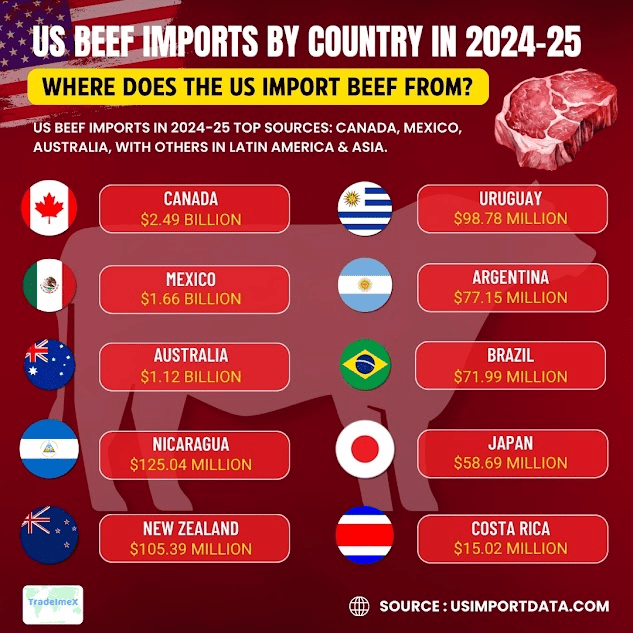
The United States is one of the largest consumers of beef in the world, with a high demand for imported beef to fulfill the needs of its population. In 2024-25, the US imported beef from various countries around the world. US Beef Imports by Country is a pivotal aspect of the US beef industry, shedding light on the origins of imported beef to meet domestic demands. The United States primarily imports beef from countries like Australia, Canada, New Zealand, Mexico, and Argentina, among others. These countries play a crucial role in supplementing the local supply and ensuring a diverse range of beef products in the US market. The top 10 countries from where the US imports beef, as per the US shipment data for 2024-25, include:
1. Canada: $2.49 billion (42.6%)
Canada is the largest supplier of beef to the US, accounting for a significant portion of the total import value. The proximity of Canada to the US makes it an ideal trading partner for beef imports, ensuring fresh and high-quality products reach American consumers.
2. Mexico: $1.66 billion (28.5%)
Mexico is another key player in providing beef to the US market. The geographical proximity of Mexico to the US allows for efficient and cost-effective transportation of beef products, making it a popular choice for importers.
3. Australia: $1.12 billion (19.3%)
Australia is known for its high-quality beef products, making it a top choice for US beef imports, as per the data on US beef imports from Australia by HS code. Despite the distance between the two countries, Australia's commitment to quality and safety standards ensures that its beef products reach American consumers in pristine condition.
4. Nicaragua: $125.04 million (2.1%)
Nicaragua may not be as prominent as other countries on this list, but it still plays a significant role in supplying beef to the US market. The growing demand for imported beef has led to an increase in imports from Nicaragua in recent years.
5. New Zealand: $105.39 million (1.8%)
New Zealand is renowned for its pasture-raised beef, which appeals to health-conscious consumers in the US. The unique taste and quality of New Zealand beef have made it a popular choice for importers looking to offer premium products to American consumers.
6. Uruguay: $98.78 million (1.7%)
Uruguay is a relatively small country, but it has made a mark in the US beef market with its high-quality products. The commitment to sustainable farming practices and animal welfare standards has made Uruguayan beef a sought-after option for US importers.
7. Argentina: $77.15 million (1.3%)
Argentina is famous for its flavorful beef, which has gained a loyal following among US consumers. The rich taste and quality of Argentine beef make it a popular choice for importers looking to diversify their product offerings.
8. Brazil: $71.99 million (1.2%)
Brazil is a major player in the global beef market, with a strong presence in the US market as well, as per the data on US beef imports from Brazil. The vast expanse of Brazilian cattle farms and the country's expertise in beef production make it a reliable source of beef for American consumers.
9. Japan: $58.69 million (1%)
Japan may be better known for its seafood, but it also plays a role in supplying beef to the US market. The unique Japanese beef breeds and production techniques result in premium products that appeal to discerning American consumers.
10. Costa Rica: $15.02 million (0.3%)
Costa Rica may be a small player in the US beef market, but it still contributes to the diverse range of beef products available to American consumers. The focus on sustainability and eco-friendly practices in Costa Rican beef production has helped it gain recognition in the US market.
List of Top Beef Importers in the US: USA Beef Importers Database
The USA Beef Importers Database is an invaluable resource for businesses looking to connect with prominent beef importers in the United States. This comprehensive database offers a curated list of top entities involved in importing beef products, providing valuable insight into the industry landscape. The top 10 leading beef importers & beef buyers in the USA, as per our meticulously curated US beef importers data and US buyers list for 2024-25, include:
|
Rank |
Company |
Approx. Import Value in 2024 ($) |
Top Import Sources |
Main Beef Types |
|
1 |
$1.15 billion |
Brazil, Uruguay, Australia |
Processed beef, primal cuts |
|
|
2 |
Cargill Meat Solutions |
$990 million |
Australia, Canada, New Zealand |
Lean beef, ground beef |
|
3 |
Tyson Fresh Meats |
$900 million |
Australia, New Zealand |
Primal cuts, ground beef |
|
4 |
National Beef Packing |
$760 million |
Mexico, Canada |
Boxed beef, chilled beef |
|
5 |
Greater Omaha Packing |
$315 million |
Australia, Canada |
Premium boxed beef |
|
6 |
J.R. Simplot |
$270 million |
Mexico, Canada |
Frozen beef, ground beef |
|
7 |
Cactus Feeders |
$240 million |
Mexico, Canada |
Live cattle, boxed beef |
|
8 |
Agri Beef Co. |
$220 million |
Australia, Canada |
Premium boxed beef |
|
9 |
Creekstone Farms |
$135 million |
Australia, New Zealand |
Premium beef cuts |
|
10 |
Caviness Beef Packers |
$110 million |
Mexico, Canada |
Boxed beef, trimmings |
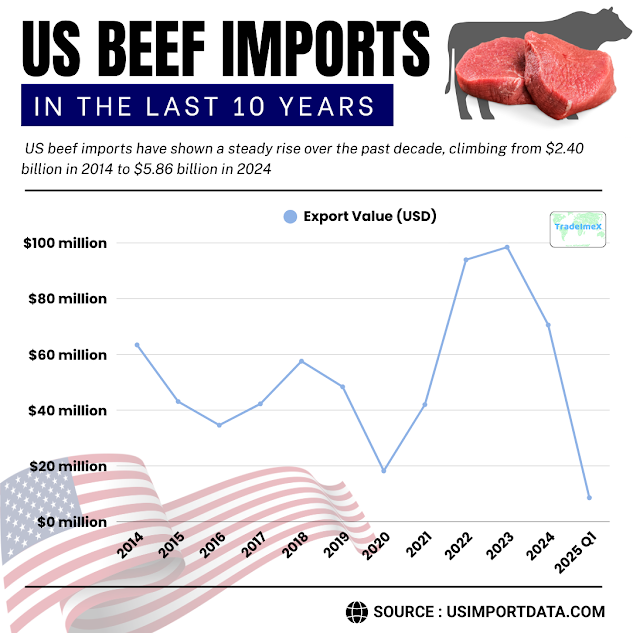
US Beef Imports in the Last 10 Years: Yearly US Beef Import Data
|
Year of Imports |
US Beef Import Value ($) |
|
2014 |
$2.40 billion |
|
2015 |
$2.90 billion |
|
2016 |
$2.73 billion |
|
2017 |
$2.80 billion |
|
2018 |
$3.05 billion |
|
2019 |
$3.44 billion |
|
2020 |
$3.74 billion |
|
2021 |
$4.97 billion |
|
2022 |
$4.87 billion |
|
2023 |
$5.34 billion |
|
2024 |
$5.86 billion |
|
2025 (first 5 months) |
$2.54 billion |
Growth Trends in US Beef Imports by Country
The data from 2025 also highlights some interesting growth trends in US beef imports by country. While traditional suppliers like Australia and Canada continue to dominate the market, emerging players such as Brazil and Mexico are increasing their market share. This diversification of beef sources reflects the evolving nature of the global beef trade and the US's efforts to ensure a reliable supply of beef for consumers. The U.S. beef market in 2025 is being reshaped by supply shortages at home, aggressive export moves abroad, and trade policy nuances. For consumers, this means the steak on your plate might be from halfway around the world, and for policymakers and producers, it’s a reminder that America’s beef supply is now truly global.
The Big Picture: How Much Beef is the US Importing in 2025?
According to the USDA, total beef imports in 2025 are projected to reach approximately 5.27 billion pounds, up 13.8% from 2024.
-
January 2025: Imports hit an all-time monthly high of 608 million pounds, a 21% jump from January 2024.
-
By April 2025: Monthly imports stood at 475 million pounds, 45% higher year-over-year. Year-to-date totals were already 28% higher than in the same period last year.
Why so much growth?
The U.S. cattle herd has shrunk to roughly 86 million head, the smallest since 1951, due to persistent drought, high feed costs, and slow herd rebuilding. That means domestic beef production can’t meet demand, and imports are filling the gap.
Where is America’s Beef Coming From?
Here’s a breakdown of key suppliers in 2025 and how their role has changed from last year.
|
Country |
Change vs. 2024 |
Notable Factors |
|
Brazil |
+72% |
Huge jump thanks to strong early-year shipments and expanded quota access |
|
Australia |
+20% by August |
Benefiting from lower tariffs (10%) and strong herd recovery |
|
Canada |
-14% |
Reduced exports as domestic needs take priority |
|
Mexico |
-3% |
Slight dip tied to regulatory and tariff-related slowdowns |
|
Paraguay |
New entrant |
First-time access to the U.S. market, quickly making gains |
|
Argentina |
+33% |
Increased shipments under tariff-rate quotas |
|
Uruguay |
+45% |
Steady growth from South America |
The January Surge: Brazil & Paraguay Steal the Show
In January alone:
-
Brazil shipped 42 million more pounds of beef to the US than a year earlier.
-
Paraguay, newly approved to export to the U.S., sent 28 million pounds right out of the gate.
How Does This Compare to Past Years?
In 2024, the U.S. sourced most of its beef from:
-
Canada: 23% of imports
-
Australia: 23%
-
Mexico: 14%
-
Brazil: 14%
-
New Zealand: 12%
-
Uruguay: 6%
For the last five years, Canada and Mexico together have made up around half of total U.S. beef imports, with Australia, New Zealand, and Brazil supplying much of the rest. But in 2025, South America, especially Brazil, Paraguay, Uruguay, and Argentina, is claiming a larger slice of the pie, as per the South America trade data.
The Forces Driving These Changes
A. Tight Domestic Supply
-
Cattle herd at 70+ year lows.
-
Slow rebuilding due to high costs and unpredictable weather.
-
Domestic production can’t keep up with strong beef demand.
B. Trade Policy & Tariffs
-
Brazil faces US tariffs up to 50%, but still posts record gains thanks to quota access and high demand.
-
Australia enjoys modest tariffs (10%), giving it a competitive edge.
-
Some suppliers benefit from political trade shifts. Australia, for example, has emerged as a “safe” supplier amid tariff disputes with others.
C. Quota Systems
-
Tariff-rate quotas (TRQs) dictate how much beef a country can export at lower tariffs. It can also impact the US beef export data.
-
Paraguay’s rapid rise shows how new quota access can open markets almost overnight.
-
Countries that fill quotas early may see slowed exports later in the year.
What This Means for Prices and Supply
-
Grocery Prices: Imports are preventing even sharper price spikes, but beef is still historically expensive.
-
Restaurant Supply: Foodservice relies heavily on imported lean beef for ground meat, critical for burger-heavy menus.
-
Future Outlook:
-
Herd rebuilding is slow, and import dependency will likely remain high for several years.
-
Tariff and quota policy shifts could rapidly change supplier rankings.
Key Takeaways for US Beef Imports in 2025
-
The U.S. will import more than 5.2 billion pounds of beef in 2025.
-
Brazil is the biggest growth story, with a 72% year-over-year surge.
-
Australia, Paraguay, Uruguay, and Argentina are rising players, diversifying the U.S. supply base.
-
Tight U.S. cattle supply means imports aren’t just a supplement, they’re essential.
Conclusion and Final Thoughts
In conclusion, the data-driven report on US beef imports by country in 2025 provides valuable insights into the dynamics of the beef trade. With a significant volume of beef imports expected from key suppliers like Australia, Canada, Mexico, and Brazil, the US is well-positioned to meet the high demand for beef in the market.
In 2025, the U.S. beef import landscape is transforming under pressure from tight domestic supply, trade shifts, and strategic quota plays. With imports expected to hit 5.27 billion pounds, sourcing is becoming more diversified, yet pricing and policy risk remain central concerns. By understanding the trends and growth patterns in US beef imports, stakeholders in the industry can make informed decisions to navigate the ever-changing landscape of the global beef trade.
We hope that you liked our insightful and data-driven blog on US beef imports data 2025. For more such insights into the latest US export-import data or to search live data on US beef imports by country, visit USImportdata. Contact us at info@tradeimex.in for customized trade data reports, verified importer-exporter lists, and market insights. Acquire a verified database along with a list of the top beef importers in the USA, as per your business needs.
Also read about:
Top California Almond Exporters in USA
Top Olive Oil Importers & Buyers in the USA 2024-25
US Truck Import Data 2024-25
What's Your Reaction?