How Much Copper Does The US Import? US Copper Imports By Country
Discover how much copper the US imports as USA copper import data shows $17.37B in 2024 and $13.22B till Q2 2025. Explore US copper imports by country & key import partners.
Copper is the quiet backbone of modern infrastructure. It powers electrical grids, keeps factories running, and is indispensable in electric vehicles, renewable energy systems, and consumer electronics. The U.S. is the world’s second-largest consumer of copper after China, yet despite having sizable domestic reserves, it imports a huge share of its refined copper needs. Copper is an essential metal that is used in various industries, from construction to electronics. The United States is one of the largest consumers of copper in the world, but how much copper does the US import? According to the US import data and copper import data of the USA, the total value of US copper imports reached $17.37 billion in 2024, a 20% increase from the previous year. The US imported copper worth $13.22 billion in the first two quarters of 2025, as per the US copper import data. When looking at where does the us import copper from, the answer lies primarily in a handful of countries that dominate copper imports USA.
A large share of copper imports to US comes from Chile, which alone provides around 70% of its refined copper, followed by Canada, Peru, and Mexico. These nations together account for nearly 98% of the U.S.'s imported refined copper, underlining how dependent copper imports USA are on a few key global suppliers
As per the global trade data, the US is the 2nd largest copper importer in the world. This paradox arises not from a shortage of ore in the ground but from structural constraints in processing. The U.S. produces plenty of raw copper in the form of concentrates and scrap but lacks sufficient smelting and refining capacity. As a result, it ships out large volumes of raw material, then pays to bring refined copper back in from other countries. So just how much copper does the U.S. import, and from where? Let’s dig into the numbers, the trade flows, and the countries that keep America’s copper supply chain running, and the imports of copper into the United States. In this article, we will take a closer look at US copper imports by country and analyze the data to understand the current state of copper imports in the US.
How Much Copper Does the US Import?
The numbers fluctuate year by year, but a clear picture emerges:
-
The U.S. consumes roughly 1.6 million metric tons of refined copper annually.
-
Domestic production covers about 1.1 million tons, leaving a gap of around 500,000 tons.
-
Imports bridge this shortfall, with refined copper imports ranging between 800,000 and 920,000 metric tons per year.
-
In certain years, imports account for 45–50% of U.S. refined copper demand.
These figures place the U.S. in a vulnerable position: even though it ranks among the top global producers of mined copper, it remains one of the world’s largest net importers of refined copper.
US Copper Imports by Country 2024-25: Where Does the US Import Copper From?
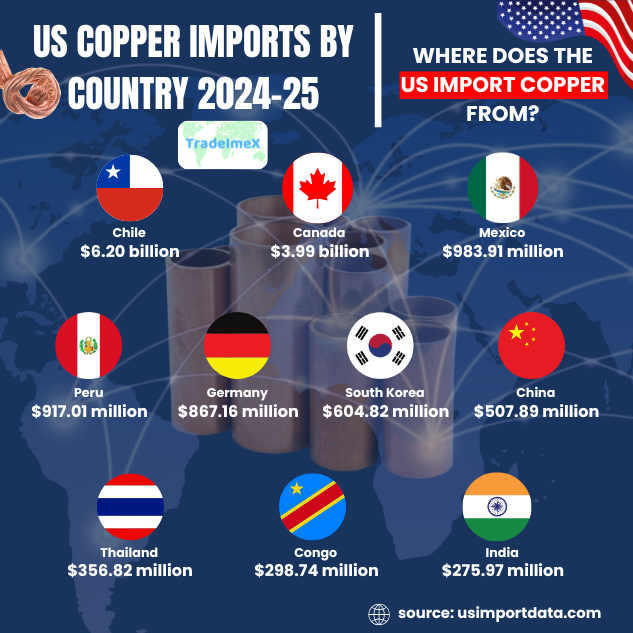
In the realm of US copper imports, the origins of this valuable metal span far and wide. The United States sources copper from various countries, with significant contributions coming from Chile, Mexico, and Canada. These nations are pivotal players in supplying copper to meet the demands of various industries within the US. The top 10 import partners for US copper imports by country, as per the US shipment data and US copper import statistics for 2024-25, include:
1. Chile: $6.20 billion (35.7%)
Chile is the largest supplier of copper to the United States, accounting for 35.7% of total copper imports in 2024-25. With its rich copper reserves and advanced mining industry, Chile has been a consistent source of copper for the US.
2. Canada: $3.99 billion (23%)
Canada is another significant supplier of copper to the US, making up 23% of total imports. With its proximity to the US and well-developed mining sector, Canada plays a crucial role in meeting the copper needs of the United States.
3. Mexico: $983.91 million (5.7%)
Mexico is also a key contributor to US copper imports, accounting for 5.7% of the total, as per the data on US copper imports from Mexico. With its own copper reserves and mining operations, Mexico provides a steady supply of copper to the US market.
4. Peru: $917.01 million (5.3%)
Peru is an important source of copper for the United States, contributing 5.3% to total imports. The country's copper production is supported by its abundant mineral resources and mining infrastructure.
5. Germany: $867.16 million (5%)
Germany may not be known for its copper production, but it is among the top suppliers of copper to the US, representing 5% of total imports, as per the data on US copper imports from Germany by HS code. Germany's advanced manufacturing capabilities make it a reliable source of copper products for the United States.
6. South Korea: $604.82 million (3.5%)
South Korea plays a significant role in supplying copper to the US, accounting for 3.5% of total imports. The country's thriving electronics industry drives the demand for copper, making it an important trading partner for the United States.
7. China: $507.89 million (2.9%)
China, known for its vast industrial output, also contributes to US copper imports, representing 2.9% of the total. Despite being a major copper producer itself, China's manufacturing sector relies on imports to meet its copper needs.
8. Thailand: $356.82 million (2.1%)
Thailand is a growing player in the global copper market, supplying 2.1% of US imports. The country's mining industry and export capabilities make it an emerging source of copper for the United States.
9. Congo: $298.74 million (1.7%)
The Democratic Republic of the Congo, rich in copper reserves, is a minor but significant supplier to the US, accounting for 1.7% of total imports. Despite challenges in the mining sector, Congo remains a valuable source of copper for the United States.
10. India: $275.97 million (1.6%)
India completes the list of top countries from which the US imports copper, contributing 1.6% to total imports. With its growing manufacturing sector and increasing demand for copper, India plays a modest yet important role in supplying copper to the United States.
US Copper Imports in the Last 10 Years: Yearly USA Copper Import Data
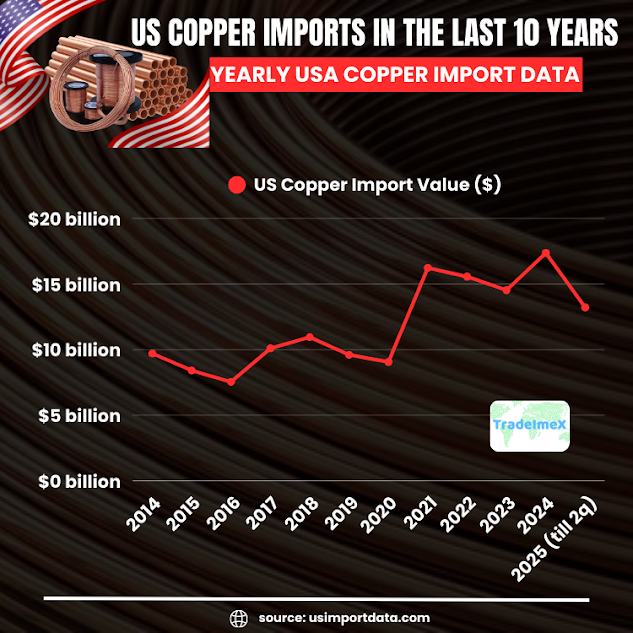
|
Year of Imports |
US Copper Import Value ($) |
|
2014 |
$9.70 billion |
|
2015 |
$8.41 billion |
|
2016 |
$7.54 billion |
|
2017 |
$10.09 billion |
|
2018 |
$10.95 billion |
|
2019 |
$9.60 billion |
|
2020 |
$9.06 billion |
|
2021 |
$16.23 billion |
|
2022 |
$15.56 billion |
|
2023 |
$14.53 billion |
|
2024 |
$17.37 billion |
|
2025 (till quarter 2) |
$13.22 billion |
USA Copper Imports by Country
The bulk of U.S. copper imports comes from just a handful of nations, with Chile at the center of the story.
Breakdown by Country (Recent Estimates)
-
Chile (60–70%): Chile is the undisputed heavyweight in U.S. copper imports. As the world’s largest copper producer, Chile ships vast volumes of refined copper northward. Its stable mining sector and strong trade ties make it a cornerstone of U.S. supply, as per the data on Chile copper exports.
-
Canada (15–20%): Canada provides a steady flow of copper thanks to its proximity, integrated logistics, and shared trade agreements. This makes Canadian copper more resilient to shipping disruptions compared to overseas suppliers.
-
Peru (6–8%): Peru, the world’s second-largest copper producer after Chile, plays a growing role in U.S. imports. Its copper is highly competitive globally, though political unrest occasionally disrupts supply chains.
-
Mexico (5–7%): As a USMCA partner, Mexico contributes a smaller but meaningful share of refined copper. Its proximity makes it an important buffer supplier when markets tighten.
-
Others (5%): A small fraction of U.S. imports comes from countries like Japan, Brazil, and a few European nations, though these volumes are relatively minor compared to Latin American suppliers.
At a Glance: U.S. Copper Import Partners
|
Country |
Share of Imports |
Key Advantage |
|
Chile |
60–70% |
World leader in copper output, stable supply |
|
Canada |
15–20% |
Proximity, trade agreements, and reliable |
|
Peru |
6–8% |
Strong mining industry, competitive costs |
|
Mexico |
5–7% |
Regional trade ties, short supply chain |
|
Others |
5% |
Niche or opportunistic suppliers |
Together, Chile, Canada, and Peru account for over 90% of U.S. refined copper imports, underscoring how geographically concentrated the supply chain is.
The Flow of Copper: Production, Exports, Imports
The U.S. copper trade balance can look puzzling. Here’s how it works in practice:
-
Domestic Mined Production: Roughly 1.1 million tons per year.
-
Secondary Production (Recycling): About 600–800 thousand tons annually.
-
Exports of Raw Material: The U.S. often exports 300–500 thousand tons of concentrates and up to 1 million tons of scrap copper annually. Much of this goes to countries like China for processing.
-
Imports of Refined Copper: Around 800–900 thousand tons come back into the U.S. as finished copper cathodes and refined forms ready for industrial use.
This means the U.S. is simultaneously a major copper exporter and importer, but it exports unprocessed raw material and re-imports the processed version at a higher cost.
US Imports of Copper Ores and Concentrates
While the U.S. mostly imports refined copper, it does bring in small amounts of ores and concentrates. These volumes are modest compared to refined imports but provide insight into supply flexibility.
-
In some years, imports of copper ores total just a few million kilograms, valued in the tens of millions of dollars.
-
Main sources include Canada, Mexico, and occasionally Asian or European suppliers.
-
These imports typically serve specialized smelters rather than the broader industrial market.
Overall, refined copper is far more important than ore imports, but the presence of concentrates in U.S. trade flows reflects how globalized and interconnected the industry has become.
Why the U.S. Relies So Heavily on Copper Imports
Limited Smelting Capacity
The central issue is refining. The U.S. has abundant copper mines in Arizona, Utah, New Mexico, and Nevada, but only a handful of active smelters and refineries. Major facilities include:
-
The Hayden Smelter in Arizona (Grupo México).
-
The Kennecott Smelter in Utah (Rio Tinto).
-
Freeport-McMoRan facilities in Arizona.
This small network can’t process the full volume of domestic ore. Much of it is shipped abroad, leaving the U.S. dependent on foreign refineries.
Recycling Limitations
While copper recycling is significant, nearly 900,000 tons per year, a large portion of scrap is exported, especially to China. That reduces the volume of recycled copper available to U.S. manufacturers.
Demand Growth
Rising demand from electric vehicles, solar and wind power, and grid modernization has widened the gap between domestic supply and consumption. Without major investments in new smelting and refining capacity, imports will remain essential.
Policy Moves and Market Shifts
Tariffs and Trade Investigations
In 2025, the U.S. government launched a Section 232 investigation into copper imports, citing national security concerns. Since refined copper is critical for defense and energy infrastructure, the heavy reliance on foreign suppliers was flagged as a strategic risk.
This led to a 50% tariff on certain copper imports (with exceptions for cathodes, the most widely used refined form). The policy aimed to encourage domestic processing and reduce dependence on foreign refiners, though it also raised concerns about higher costs for U.S. manufacturers.
Scrap Export Restrictions
Policymakers have also considered limiting scrap exports, with proposals to reduce them by 25% or more. The logic is that keeping more scrap in the U.S. will strengthen recycling supply chains and offset import reliance. However, exporters and recyclers warn that enforcement will be complex and could disrupt established global markets.
Strategic Implications
-
Positive: Moves may boost domestic recycling and encourage smelting investment.
-
Negative: Tariffs and restrictions risk raising costs for downstream industries that depend on affordable copper.
Looking Ahead: The Future of US Copper Imports
Several long-term factors will shape America’s copper import profile:
-
Energy Transition: Copper demand will keep rising as electric vehicles, renewable power, and grid modernization accelerate. Some forecasts predict U.S. copper demand could double by 2040.
-
Domestic Mining Expansion: New projects in Arizona and Nevada could increase mined supply, but without new smelters, much of this ore will still be exported.
-
Recycling Growth: Investments in circular economy infrastructure could significantly raise secondary copper supply and reduce import dependency.
-
Geopolitics: Heavy reliance on Chile and Peru, both South American countries with histories of political volatility, leaves the U.S. exposed to external risks. Diversification efforts may become more urgent.
Conclusion and Final Words
In conclusion, the U.S. imports between 800,000 and 920,000 metric tons of refined copper each year, accounting for nearly half of its total demand. Chile dominates as the primary supplier, followed by Canada, Peru, and Mexico. Despite its rich domestic mining base, the U.S. lacks the refining muscle to meet its own needs, exporting raw materials while paying to import finished copper. Policy shifts like tariffs and scrap restrictions aim to reduce this dependency, but the core challenge remains: without major investment in smelting and refining, the U.S. will continue to rely heavily on foreign copper.
As the clean energy transition accelerates, copper will only grow more critical. For the U.S., the choice is clear: build the infrastructure to process more copper at home or remain at the mercy of global supply chains dominated by Latin America.
We hope that you liked our insightful blog report on US copper imports by country in 2025. For more information on the latest US export-import data or to search live data on USA copper imports by country, visit USImportdata. Contact us at info@tradeimex.in for a customized trade report, market insights, and get a verified database of the top copper importers in the USA, as per your business needs.
What's Your Reaction?