US-Iran War Impact on Asian Economies: Top 10 Trade-Affected Countries Due to the US-Iran War
Explore the impacts of US-Iran war on Southeast Asia & Asia’s economies. Learn how the US-Iran conflict affects India trade, oil prices & regional markets.
The US–Iran war in 2026 has rapidly escalated into one of the most consequential geopolitical conflicts of the decade. While the immediate confrontation is centered in the Middle East, the economic shockwaves are being transmitted globally. Among all regions, Asia stands out as the most exposed and most vulnerable. According to the latest US export data and Asia trade data, the total value of US-Asia trade reached $2.11 trillion in 2025.
This is not accidental. Asia’s economic architecture is deeply intertwined with Middle Eastern energy flows, global maritime trade routes, and export-led growth strategies. When a conflict disrupts oil supply chains, shipping lanes, and financial stability, Asian economies tend to feel the impact first and most intensely.
This article takes a detailed, data-backed look at how the USA-Iran war is affecting Asia through trade channels and identifies the top 10 Asian economies most affected, based on energy dependence, trade exposure, and macroeconomic vulnerability.
Why Asia Is Uniquely Exposed
To understand the scale of the impact, it helps to look at the structural factors that make Asia particularly sensitive to a US–Iran conflict. Also, the Iran war holds trade implications for Southeast Asia.
1. Heavy Dependence on Middle Eastern Oil
Asia consumes the majority of oil exported from the Middle East. Estimates suggest that nearly 70–80% of crude oil shipments through the Strait of Hormuz are destined for Asian markets. Countries like India, Japan, South Korea, and China rely heavily on Gulf producers such as Saudi Arabia, Iraq, and the UAE. This dependence creates a direct vulnerability. Any disruption in supply leads to immediate increases in import costs, inflation, and fiscal pressure. Henceforth, the US-Iran war is reshaping Asia’s energy security plans.
2. The Strait of Hormuz as a Critical Chokepoint
The Strait of Hormuz handles roughly 20% of the global oil supply. Even partial Strait of Hormuz disruptions, whether due to military activity, sanctions enforcement, or insurance risks, can send oil prices surging. For Asia, this is not just a price issue. It is a supply security issue. Delays, rerouting, and risk premiums all translate into higher costs and uncertainty in industrial production.
3. Export-Driven Growth Models
Many Asian economies depend heavily on exports to sustain growth. Countries like Vietnam, South Korea, China, and Thailand rely on global demand and efficient trade.
When:
-
Shipping costs rise
-
fuel prices increase
-
global demand weakens
Exports suffer. This creates a second-order shock beyond energy prices.
4. Early Economic Indicators
Since the escalation of the war:
-
Oil prices have crossed $100 per barrel, with volatility increasing
-
Global trade growth is projected to slow significantly
-
Asian equity markets have shown consistent declines
-
Manufacturing PMIs in several countries have weakened
These are early warning signals of a broader economic slowdown.
Top 10 Trade-Affected Asian Economies Due to US-Iran War
1. India: High Exposure Across All Channels
India is among the most vulnerable economies in this scenario.
-
Imports over 85% of its crude oil
-
Large trade ties with the Gulf region
-
Significant remittance inflows from Middle East workers
Impact
The rise in oil prices directly widens India’s trade deficit. Higher fuel costs feed into inflation, affecting everything from transportation to food prices. Recent data suggests a slowdown in manufacturing activity, reflecting cost pressures and weakening demand.
Trade Consequences
-
Rising import bill
-
Pressure on the rupee
-
Reduced export competitiveness
India’s challenge is balancing inflation control with growth stability.
2. China: Large but Strategically Buffered
China’s scale makes it highly exposed, but its policy tools provide some insulation.
-
One of the largest oil importers globally
-
Significant imports from Iran and the broader Gulf
Impact
China faces higher input costs for manufacturing and energy-intensive industries. However, it benefits from:
-
diversified energy sources
-
strategic reserves
-
long-term supply contracts
Trade Consequences
Export demand may weaken due to global slowdown, even if domestic stability remains relatively strong.
3. Japan: Extreme Energy Dependence
Japan is one of the most energy-dependent economies in the world.
-
Over 90% of oil imports come from the Middle East
Impact
The increase in oil prices immediately affects:
-
electricity generation
-
industrial production
-
transportation costs
Trade Consequences
-
Higher production costs reduce export competitiveness
-
Currency volatility adds additional pressure
Japan’s reliance on imported energy makes it highly sensitive to prolonged conflict.
4. South Korea: Manufacturing Under Pressure
South Korea’s export-oriented economy is heavily reliant on stable energy supplies.
-
Around 70% of oil imports come from the Middle East
Impact
Key sectors such as semiconductors, automobiles, and shipbuilding face rising input costs.
Trade Consequences
-
Margin compression in exports
-
Increased trade costs
-
Vulnerability to global demand slowdown
5. Thailand: Dual Shock from Energy and Tourism
Thailand faces a unique combination of risks.
Impact Channels
-
Rising fuel costs increase inflation
-
Tourism declines due to higher travel costs and geopolitical uncertainty
Trade Consequences
-
Reduced service exports
-
Slower overall GDP growth
Thailand’s economic model, which relies on both exports and tourism, makes it particularly vulnerable.
6. Indonesia: Mixed Effects with Fiscal Stress
Indonesia is both an energy producer and importer, creating a mixed impact.
Positive
Higher commodity prices can boost export revenues.
Negative
Domestic fuel subsidies become more expensive, putting pressure on government finances.
Trade Consequences
-
Fiscal strain reduces economic flexibility
-
Trade balance improvements may be offset by internal costs
7. Philippines: High Import Dependence
The Philippines is highly vulnerable due to its reliance on imports.
Impact
-
Rising oil and food prices increase inflation
-
Currency depreciation worsens import costs
Trade Consequences
-
Expanding trade deficit
-
Reduced consumer purchasing power
8. Malaysia: Partial Buffer Through Energy Exports
Malaysia has a more balanced position.
Positive
-
LNG and oil exports benefit from higher prices
Negative
-
Global demand slowdown affects manufacturing exports
Trade Outcome
Net impact is moderate, but volatility remains high.
9. Pakistan: Severe Macroeconomic Stress
Pakistan’s fragile economic position makes it one of the most affected.
Impact
-
Rising oil prices worsen the balance of payments
-
Inflation accelerates sharply
Trade Consequences
-
Import compression
-
Increased reliance on external financing
10. Vietnam: Supply Chain Disruptions
Vietnam’s rise as a manufacturing hub makes it vulnerable to global trade shocks.
Impact
-
Higher shipping and trade costs
-
Supply chain delays
Trade Consequences
-
Reduced competitiveness
-
Slower export growth
US Bilateral Trade with Affected Asian Economies (2025)
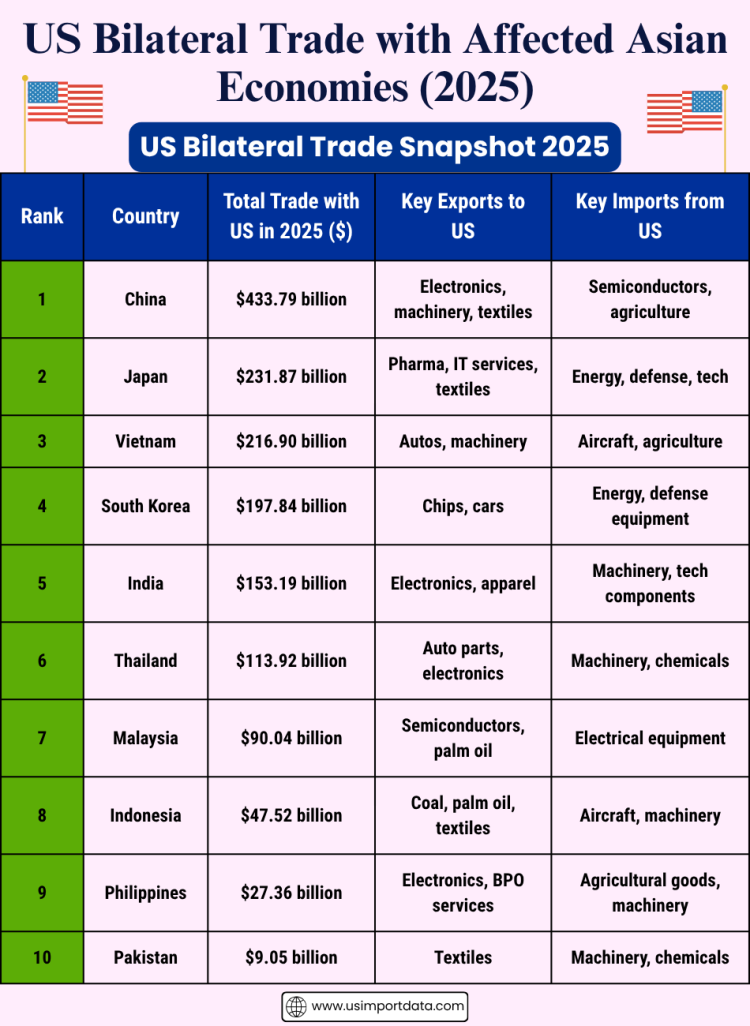
To fully understand the global trade implications of the US–Iran war, it’s important to examine how closely the United States is economically tied to the most affected Asian countries. The table below provides 2025 bilateral trade volumes (goods) between the US and each of the top 10 affected economies.

Key Insights from the Trade Data
1. China, Japan, and India dominate US–Asia trade
These three economies alone account for the majority of US trade exposure in Asia. Any slowdown in their economies due to war-related shocks has direct consequences for US exports and global supply chains. China is the largest Asian trade partner of the US, as per the data on US exports to China.
2. Vietnam and South Korea are critical supply chain partners
Vietnam and South Korea play key roles in:
-
Electronics manufacturing
-
Semiconductor supply chains
Disruptions in these economies can ripple into US industries, especially tech and consumer electronics.
3. Southeast Asia is increasingly important
Countries like Thailand, Malaysia, and Indonesia are not the largest partners individually, but collectively they represent a growing share of US trade diversification away from China. This makes them strategically important and vulnerable.
4. Energy and defense trade linkages matter
The US exports:
-
LNG and crude oil (to India, South Korea, Japan)
-
Defense equipment (India, South Korea, Japan)
If the war escalates, these trade flows may actually increase in value, even as overall trade volumes decline.
How the War Affects US–Asia Trade Relations
1. Reduced export demand
If Asian economies slow down:
-
US exports of machinery, aircraft, and technology decline
-
Services exports (especially IT and finance) weaken
2. Supply chain disruptions
The US relies heavily on Asia for:
-
Electronics
-
Intermediate goods
-
Manufacturing inputs
Any disruption raises costs for US companies and consumers.
3. Strategic realignment
The war could accelerate:
-
“Friend-shoring” strategies
-
Trade diversification away from high-risk regions
-
Greater US engagement with India and Southeast Asia
4. Inflation feedback loop
Higher import costs from Asia (due to energy-driven price increases) can contribute to inflation in the US, creating a feedback loop between regions.
How the War Impacts Asian Economies
The economic impact flows through three primary channels:
Energy Shock
Rising oil and gas prices increase costs across industries, from transportation to manufacturing.
Trade and Shipping Disruption
Shipping routes become riskier and more expensive. Insurance premiums rise, and delivery timelines stretch.
Financial and Currency Volatility
Capital flows shift toward safe-haven assets. Emerging Asian currencies face depreciation pressure, increasing import costs further.
Sector-Level Impact Across Asia
Energy Sector
Oil price spikes affect all economies, with the potential to reach extreme levels in prolonged conflict scenarios.
Manufacturing
Industries face rising costs and shrinking margins. Export-dependent sectors are hit hardest.
Agriculture
Fertilizer and fuel costs increase, pushing food prices higher and adding to inflationary pressure.
Tourism
Travel becomes more expensive, reducing international arrivals across Southeast Asia.
Financial Markets
Stock markets and currencies reflect increased uncertainty, with capital moving toward safer assets.
Broader Trade Implications
1. Slowing Global Trade
The conflict is expected to significantly reduce global trade growth. Protectionist tendencies may increase as countries prioritize domestic stability.
2. Shift Toward Regionalization
Asian countries may strengthen regional trade agreements to reduce reliance on unstable global routes.
3. Energy Diversification
Countries are likely to accelerate investments in:
-
renewable energy
-
alternative suppliers
-
strategic reserves
4. Supply Chain Realignment
Businesses are rethinking supply chains to reduce geopolitical risk. This may benefit some countries in the long run, but creates short-term disruption.
Winners and Losers
Relative Winners
-
Energy exporters like Malaysia and partially Indonesia
Major Losers
-
Energy importers with weak fiscal positions
-
Export-driven economies are facing demand shocks
Long-Term Outlook
If the conflict continues, Asia could face:
1. Persistent Inflation
Energy and food prices may remain elevated for an extended period.
2. Slower Economic Growth
Several economies may see growth reductions of 1–3 percentage points.
3. Policy Tightening
Central banks may raise interest rates, while governments struggle with fiscal deficits.
4. Strategic Shifts
Energy security and supply chain resilience will become top priorities.
Conclusion and Final Thoughts
In conclusion, the US–Iran war is not just a regional conflict. It is a global economic event with deep implications for trade, inflation, and growth. Asia, due to its structural dependencies, is at the center of this economic fallout. The top 10 countries discussed here highlight how varying levels of exposure can shape different outcomes, but the overall direction is clear: increased uncertainty, higher costs, and slower growth.
The key lesson is simple but critical. Economic resilience in the modern world depends on diversification of energy sources, trade partners, and supply chains. Countries that adapt quickly will be better positioned to navigate not just this crisis, but future disruptions as well.
Note For Our Readers
We hope you found this blog on the US–Iran War Impact on Asian Economies insightful and useful for understanding the evolving global trade landscape. As geopolitical tensions continue to reshape trade flows, access to accurate, timely data is more important than ever for informed decision-making.
If you’re looking for deeper insights or need customized US import-export data, or to search live US import-export data by country feel free to connect with USImportdata. We provide comprehensive and up-to-date US trade databases. For exclusive access or tailored US trade data solutions, contact us at info@tradeimex.in today.
What's Your Reaction?