US Petroleum Exports 2024-25: Top Destinations & Why is the US Net Exporter of Petroleum?
Explore US Petroleum Exports and key markets in 2024–25. The US petroleum export data shows exports worth $117.53B in 2024, up 4%, making the US a net exporter of petroleum.

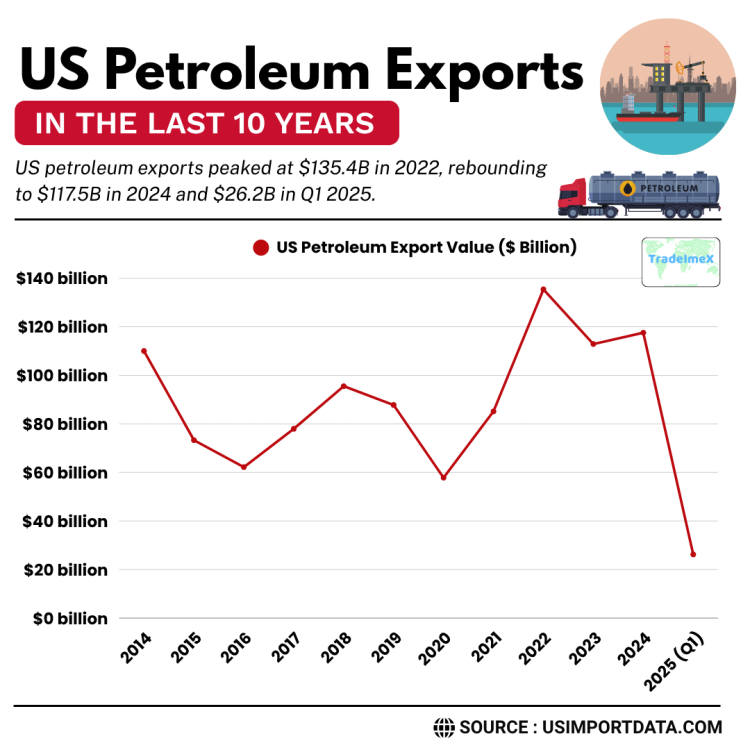
In recent years, the United States has emerged as a key player in the global petroleum market, with a significant increase in petroleum exports. As we look ahead to the years 2024-25, it is essential to explore the top destinations for US petroleum exports and delve into the reasons behind the US becoming a net exporter of petroleum. According to the US export data and the USA petroleum export data, the total value of US petroleum exports reached $117.53 billion in 2024, a 4% increase from the previous year. In the first quarter of 2025, the US exported petroleum worth $26.21 billion, as per the US shipment data. The United States plays a significant role in the global energy market, and many people ask does the US export petroleum given its large domestic production.
In recent years, exports have increased steadily, raising the question “how much petroleum does the US export” compared to other nations. While the U.S. ships substantial volumes of crude oil, refined fuels, and petroleum products worldwide, it still competes with other major petroleum exporting countries such as Saudi Arabia, Russia, Iraq, and the United Arab Emirates. The top petroleum exporters in the world play a crucial role in stabilizing global energy markets. In recent years, the United States has emerged as a major player, transforming from a large importer to a net oil exporter due to advances in shale production and energy infrastructure. The United States net oil exporter status has helped the US oil industry.
From the shale fields of Texas and Pennsylvania to massive export terminals along the Gulf Coast, the United States has ascended to a dominant position in global petroleum trade. By 2024–25, it wasn’t merely a producer, it was a major supplier, even a net exporter of petroleum for the first time in decades. The US will remain a net exporter of petroleum till 2050. Let’s dissect who’s buying U.S. petroleum now, how volumes are changing, and why this shift matters. This article will delve into the top destinations for US petroleum exports in the years 2024-25 and explore the reasons behind the country's status as a net exporter of petroleum.
The Rise of US Petroleum Exports
Over the past decade, the United States has experienced a remarkable transformation in its energy landscape, marked by a surge in domestic oil and gas production. This increase in production, fueled by advancements in technology such as hydraulic fracturing and horizontal drilling, has catapulted the US into a position of global energy leadership. As a result, the US has transitioned from being a net importer of petroleum to a net exporter, with significant implications for the country's economy and geopolitical standing. In 2020, the US became a net petroleum exporter for the first time in 67 years, symbolizing a shift in the global energy paradigm.
US Petroleum Exports by Country: Where Does the US Export Petroleum?
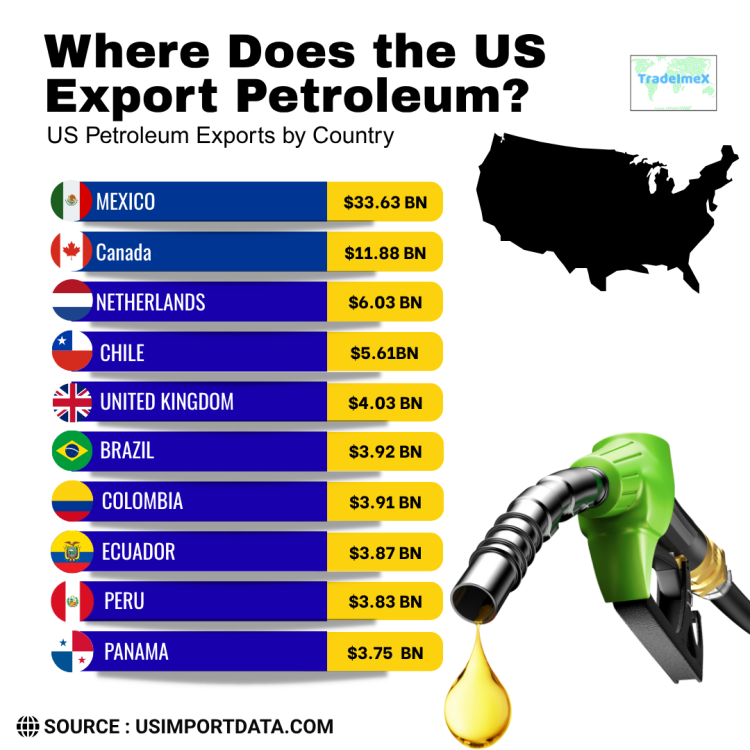
US petroleum exports by country are a vital component of the United States' global trade network. The U.S. primarily exports petroleum to various countries around the world, with its top export destinations including Mexico, Canada, and Japan. These petroleum exports play a significant role in the country's economy and international relations. The top 10 US petroleum export destinations in 2024-25, as per the US petroleum exports by year and data on the US petroleum exports by country, include:
1. Mexico: $33.63 billion (28.6%)
Mexico stands out as the top destination for US petroleum exports, with a total value of $33.63 billion, accounting for 28.6% of all exports in 2024-25. This strong trade relationship is driven by Mexico's high demand for petroleum products to support its economy and infrastructure.
2. Canada: $11.88 billion (10.1%)
Neighboring Canada is the second-largest importer of US petroleum, with imports totaling $11.88 billion, representing 10.1% of total exports. The proximity between the two countries allows for efficient trade and collaboration in the energy sector.
3. Netherlands: $6.03 billion (5.1%)
The Netherlands emerges as a key player in US petroleum exports, with imports reaching $6.03 billion, accounting for 5.1% of the total. The country's strategic location in Europe and strong refining capabilities make it an attractive market for US petroleum products.
4. Chile: $5.61 billion (4.8%)
Chile stands out as a significant importer of US petroleum, with a total value of $5.61 billion, representing 4.8% of all exports. The country's growing energy needs and stable economy create opportunities for enhanced trade partnerships with the US.
5. United Kingdom: $4.03 billion (3.4%)
The United Kingdom ranks fifth in terms of US petroleum imports, with a total value of $4.03 billion, making up 3.4% of total exports. The strong historical ties between the US and the UK further bolster this trade relationship.
6. Brazil: $3.92 billion (3.3%)
Brazil emerges as a key market for US petroleum exports, with a total value of $3.92 billion, representing 3.3% of the total, as per the data on US petroleum exports to Brazil by HS code. The country's expanding energy sector and ambitious infrastructure projects drive the demand for US petroleum products.
7. Colombia: $3.91 billion (3.3%)
Colombia plays a significant role in U.S. petroleum exports, with imports totaling $3.91 billion, accounting for 3.3% of all U.S. exports, as per the data on US petroleum exports to Colombia. Colombia’s growing economy and energy sector present opportunities for further collaboration with the US.
8. Ecuador: $3.87 billion (3.3%)
Ecuador ranks eighth in terms of US petroleum imports, with a total value of $3.87 billion, accounting for 3.3% of total exports. The country's rich oil reserves and expanding energy infrastructure make it a valuable market for US petroleum products.
9. Peru: $3.83 billion (3.3%)
Peru emerges as a key player in U.S. petroleum exports, with imports reaching $3.83 billion, accounting for 3.3% of the total. The country's growing demand for energy and ambitious development projects create opportunities for enhanced trade cooperation with the US.
10. Panama: $3.75 billion (3.2%)
Rounding out the top 10 US petroleum export destinations is Panama, with a total value of $3.75 billion, representing 3.2% of total exports. The country's strategic location and role as a major transportation hub in the region make it an essential market for US petroleum products.
List of Top Petroleum Exporters in the US: USA Petroleum Exporters Database
The US Petroleum Exporters Database provides a comprehensive resource for identifying key players in the American petroleum industry. This database serves as a valuable tool for stakeholders looking to engage with the leading petroleum exporters within the United States. The top 10 petroleum exporters and suppliers in the US in 2025 include:
1. ExxonMobil

– Approx. export value in 2024: $10.5 billion
– Top export markets: Netherlands, South Korea, India
As the largest exporter, ExxonMobil sends light and medium crude as US crude exports, along with refined products, to major refining hubs in Europe and Asia.
2. Chevron Corporation

– Approx. export value: $9.2 billion
– Top export markets: United Kingdom, Netherlands, Singapore
Chevron leverages its global midstream and refining footprint to supply crude and fuels across Europe and Southeast Asia.
3. ConocoPhillips

– Approx. export value: $8.7 billion
– Top export markets: Germany, South Korea, Canada
Focused on upstream output, ConocoPhillips dispatches large crude volumes to European and North American refineries, plus growing Asian demand.
4. Valero Energy

– Approx. export value: $7.9 billion
– Top export markets: Mexico, Netherlands, United Kingdom
A major product exporter, Valero sends gasoline, diesel, and jet fuel to Latin America and Europe from its vast refinery network.
5. Marathon Petroleum

– Approx. export value: $7.4 billion
– Top export markets: Canada, United Kingdom, Netherlands
Marathon uses its Gulf Coast and Midwest refineries to serve Canada and Europe with refined fuel exports.
6. Occidental Petroleum

– Approx. export value: $6.8 billion
– Top export markets: India, South Korea, Netherlands
Occidental sends shale-produced crude to Asian giants and European refining centers, leveraging its Permian output.
7. Phillips 66

– Approx. export value: $6.2 billion
– Top export markets: Germany, Netherlands, United Kingdom
Phillips 66 specializes in exporting refined fuels—especially diesel and jet—to core European markets.
8. Enterprise Products

– Approx. export value: $5.6 billion
– Top export markets: Netherlands, Singapore, South Korea
While primarily a midstream operator, Enterprise channels crude and NGLs to Asia and Europe via Gulf terminals.
9. Energy Transfer

– Approx. export value: $5.1 billion
– Top export markets: Netherlands, United Kingdom, India
This midstream giant supports U.S. crude flow toward major refining and petchem markets abroad.
10. Delek US Holdings

– Approx. export value: $4.5 billion
– Top export markets: Mexico, Netherlands, South Korea
Delek’s refinery-driven exports focus on regional markets in Latin America and strategic hubs in Europe and Asia.
Insights & Observations
-
These ten players collectively exported $72–78 billion worth of petroleum in 2024, roughly two-thirds of the total U.S. petroleum export value.
-
ExxonMobil and Chevron top the list, leveraged by massive upstream and downstream integration.
-
Refiner-heavy companies like Valero, Marathon, and Phillips 66 focus on distillates and gasoline exports.
-
Midstream specialists (Enterprise, Energy Transfer) play key roles in moving crude and NGLs to export terminals.
Setting the Scene: U.S. Net Exporter Status
Historic Turning Point
When the U.S. lifted its 40-year crude export ban in 2015, it paved the way for exponential growth in exports. Three years later, U.S. crude oil exports saturated global markets, and by 2020, the U.S. became a net exporter of petroleum (crude + products) for the first time since at least 1949.
In 2024, the momentum accelerated:
-
Record crude exports of 4.1 million barrels/day (b/d)
-
Petroleum product exports soaring to new highs
-
Total energy exports (all fuels) are hitting record combined volumes
Crucially, petroleum product exports (11.5 quads) and crude oil exports (8.6 quads) were among the top components of U.S. energy exports as per the reports of the U.S. Energy Information Administration.
Net export position: As of mid‑2025, the U.S. continues to export more petroleum than it imports, with the net surplus stemming from policy changes, infrastructure build-outs, and sustained production growth.
U.S. as a Net Petroleum Exporter: When and Why
Becoming a net exporter
-
In 2020, the U.S. became a net exporter of petroleum (crude oil + refined products) for the first time since at least 1949.
-
In 2023, U.S. exports averaged 10.15 M b/d, while imports were 8.51 M b/d, a net surplus of –1.64 M b/d.
-
Continued into 2024–25, with record export levels and sustained net export positioning.
Why the shift?
-
Shale revolution – Breakthroughs in fracking (Permian, Eagle Ford, Bakken) pushed U.S. crude output above 13 M b/d by April 2025.
-
Lifting the crude-export ban in 2015 encouraged free-flowing crude outflows.
-
Refining dominance – U.S. refineries optimized for domestic crude have become global product-export juggernauts since 2010.
-
Global market gaps – Disruptions like Russia bans, OPEC+ shifts, and rising demand in emerging economies created openings that U.S. producers filled.
-
Policy environment – Supportive energy strategy and infrastructure (pipelines, terminals) built post-2015 have vastly improved U.S. export capacity.
US Petroleum Exports in the Last 10 Years: Historical US Petroleum Export Data
|
Year of Exports |
US Petroleum Export Value ($) |
|
2014 |
$110.01 billion |
|
2015 |
$73.31 billion |
|
2016 |
$62.17 billion |
|
2017 |
$77.97 billion |
|
2018 |
$95.54 billion |
|
2019 |
$87.76 billion |
|
2020 |
$57.81 billion |
|
2021 |
$85.14 billion |
|
2022 |
$135.40 billion |
|
2023 |
$112.88 billion |
|
2024 |
$117.53 billion |
|
2025 quarter 1 |
$26.21 billion |
US Petroleum Production, Export Infrastructure, & Markets
The U.S. petroleum export machine is fueled and structured by:
-
Unmatched crude production: U.S. petroleum export output soared past 13 million b/d through 2024–25, largely thanks to shale plays like Permian Basin, Eagle Ford, and Bakken.
-
Refined product prowess: Gulf Coast refineries turned WTI into export-grade gasoline, distillates, propanes, and jet fuel.
-
Export hubs: Pipelines, terminals (e.g., LOOP), and tanker hubs (Houston, Corpus Christi, New Orleans) ensure efficient flows.
-
Geopolitical & market demand: Russian export bans, emerging economy demand, and trade diversification boosted U.S. market share.
This alignment allowed 2024 crude exports to hit record highs, especially to Europe and Asia.
US Crude Oil Exports: Who’s Buying from America's Fields?
2024 Snapshot
According to EIA:
-
Europe total: 1.93 M b/d (+6% YoY)
-
Asia & Oceania total: 1.58 M b/d (131 k b/d)
-
China: 217 k b/d (53%, from 460 k b/d in 2023)
-
India: +32% YoY to 230 k b/d in 2024
Top Destinations Insights
|
Rank |
Country/Region |
2024 Avg (b/d) |
YoY Change & Notes |
|
1 |
Netherlands |
825,000 b/d |
+32% YoY; Rotterdam hub; no. 1 global importer |
|
2 |
Europe (total) |
1.93 million b/d |
+6% YoY; gains offset Spain/France/Italy dips |
|
3 |
Asia & Oceania |
1.58 million b/d |
Mixed: up in India/Korea/Singapore, down in China |
|
4 |
India |
230,000 b/d |
+32% YoY filling gap from reduced Russian crude |
|
5 |
South Korea, etc. |
Included in the Asia total |
Benefitting from the Russian shift and diversification |
Financial scale: In April 2025, U.S. crude exports topped $1.95 billion to the Netherlands, $1.16 billion to South Korea, $847 million to India.
Shifting Trends
-
Europe remains the primary buyer due to diminished Russian flows.
-
India increasingly relied on U.S. oil as Russia’s discount waned.
-
China’s share dropped sharply amid domestic fuel demand falter and tariff retaliation.
US Refined Petroleum Products: Engines & Heating Across the Globe
Crude isn’t the only story; U.S. petroleum products exports surged across several categories in 2024:
A. Distillate Fuel (Diesel / Heating Oil / Marine)
-
1.30 million b/d exported (+182 k b/d YoY).
-
Mexico: 272 k b/d (21% share).
-
Netherlands: 103 k b/d.
-
U.K.: 81 k b/d.
-
Chile, Peru, and others are collectively significant.
B. Motor Gasoline
-
Total: 877 k b/d (24 k b/d YoY)
-
Largest buyer: Mexico (495 k b/d; 56%)
-
Followed by Guatemala, Colombia, Canada, and Panama, mostly in the Western Hemisphere.
C. Jet Fuel
-
Exports: 209 k b/d (record highs)
-
Mexico again the largest single importer (63 k b/d, 30%)
Aggregate Export Destinations: Volume & Value
Crude + Petroleum Products Combined
Looking at total petroleum exports (crude + products), EIA data for 2022 showed:
-
Mexico 12% share
-
Canada 9%
-
China 7%
-
South Korea 6%
-
Netherlands 6%
Although the distribution has shifted in 2024, these remain the top corridors.
Energy Value Flows (2025 Q2 Snapshot)
-
Mexico: $27.8 billion in exports
-
Canada: $27.2 billion
-
U.K.: $9.24 billion
-
China: $8 billion
This economic footprint underscores the commodity's global centrality.
Why the U.S. Became a Net Exporter of Petroleum
Several forces converged:
1. Shale Production Surge
Innovation in hydraulic fracturing and horizontal drilling unlocked massive supplies. U.S. crude output surged to 13.4 million b/d in early 2025, averaging 13.4 m in both 2025 and 2026.
2. Policy & Infrastructure
-
The 2015 crude export ban was lifted.
-
Robust worldwide pipeline network from Midland to the Gulf.
-
Export terminals like LOOP and Corpus Christi have been reconfigured for outgoing flows.
3. Refinery & Product Strength
-
Gulf Coast refineries are fine-tuned for light sweet shale crude.
-
Export-focused design supports gasoline, diesel, LPG, and jet fuel shipments.
4. Global Market Shocks
-
2022+ sanctions on Russia opened European lanes.
-
Demand from India, Southeast Asia continues strong.
-
China’s 2024 slowdown shifted volumes, but global demand stayed robust.
5. Price Advantages
-
WTI is often cheaper than Brent & Middle Eastern grades.
-
Cost savings yield profit on export.
-
U.S. “medium-sour” grades also absorb European/international refinery demand.
2024–25 Data Breakdown: US Petroleum Exports by Category
Crude Oil
-
4.1 M b/d in 2024 (record).
-
Europe: up 6% YoY to 1.93 M b/d; Netherlands alone 825 k b/d (+32%).
-
Asia: 1.58 M b/d (down 131 k b/d), with China dropping 53%, India jumping 32%.
-
China: 217 k b/d (1.7% of its crude supply); down from 460 k b/d in 2023.
-
India: 230 k b/d, up 32%, making India the 5th top supplier in early 2025.
Petroleum Products
-
Distillates/Diesel: 1.30 M b/d (+182 k b/d); Mexico is the top destination.
-
Gasoline: 877 k b/d; over half to Mexico.
-
Jet Fuel: 209 k b/d; Mexico again leads with 63 k b/d exported.
Total Energy
According to EIA, crude accounted for 28% of total energy exports, petroleum products 37%, solidifying the dominance of petroleum in U.S. energy trade.
Obstacles & Pivot Points Ahead
Trade Tensions & Tariffs
-
China imposed tariffs affecting crude & LPG in 2025.
-
U.S. tariffs on Canada/Mexico could prompt retaliatory action.
-
China reduced LPG purchases by 150 k b/d, redirecting to Middle East and Asian buyers.
Production & Price Risks
-
EIA forecasts output slip from 13.4 m b/d (2Q 2025) to 13.3 m b/d by end‑2026, driven by price & cost trends.
-
Price forecast: WTI $65.2/bbl (2025), Brent ~$68.9/bbl.
Global Supply Shocks
-
Oil market volatility from geopolitics (Iran, Middle East) may boost U.S. export demand.
-
OPEC+ output adjustments could shift the global supply balance.
Energy Transition Slowdown
-
Long-term decline in hydrocarbon reliance threatens underlying structural demand, but short- to mid-term persistence remains strong.
Broader Implications of U.S. Net Petroleum Export Status
Domestic Spillovers
-
Economic & Trade Benefits: Petroleum export surplus contributes positively to the trade balance.
-
Energy Security: Reduced import dependence, domestic control.
-
Workers & Infrastructure: Jobs in production, refining, shipping.
Global and Strategic Effects
-
Market Security: U.S. crude opens alternative supply routes for Europe, Asia.
-
Price Stabilizer: U.S. presence helps moderate price swings.
-
Diplomatic Leverage: U.S. exports integrate allies into its energy ecosystem.
US Petroleum Exports Forecast 2025–26
-
Crude Supply: Peak 13.4 m b/d in 2Q 2025, slight decline toward 13.3 m b/d by late 2026.
-
Export Volumes:
-
Crude: Plateau/slight decrease; China & tariffs may cut demand.
-
Products: Diesel and LPG demand expected to be steady, especially in Latin America.
-
Destinations:
-
Europe: Consistent buyer.
-
India: Growing demand, potential for further increases.
-
China: Recovery depends on tariff resolution.
-
Latin America: Continued product strength in Mexico, Colombia, and Peru.
-
Geopolitical shifts: Middle East tensions, OPEC strategy could spike demand temporarily.
-
Energy pivot: Transition to renewables may cap long‑term growth but leave room for near-term petroleum prominence.
US Petroleum Export Trends & Highlights
Exports by Category (2024 avg b/d)
|
Category |
Total Volume (b/d) |
Trend & Notes |
|
Crude Oil |
4.1 million b/d |
Record high, Europe/Asia split, Netherlands top destination |
|
Distillate |
1.30 million b/d |
+182 k b/d YoY; Europe & Latin America strong |
|
Gasoline |
0.88 million b/d |
Slight decline; Mexico dominant (56%) |
|
Jet Fuel |
0.21 million b/d |
Slight growth; Latin American buyers key |
Top US Petroleum Buyers by Category
-
Crude: Netherlands, India, South Korea, China
-
Distillate: Mexico, Netherlands, U.K., Chile, Peru
-
Gasoline: Mexico, Guatemala, Colombia, Canada
-
Jet: Mexico, area countries
Strategic Insights & Takeaways
-
Diversification & Reach: U.S. supply rapidly shifted to Europe, Asia, and Latin America.
-
Trade Volatility: Tariffs impose complexity; China's, in particular, have ripple effects.
-
Policy synergy: Export deregulation, terminal build-out, and refinery optimization drove results.
-
Economic anchor: Petroleum continues as a vital pillar of U.S. trade strength.
-
Future uncertainty: Production plateau, market pushback, global policy trends could limit growth, but fundamentals remain solid short term.
Why is the US a Leading Petroleum Exporter?
The shift towards becoming a net exporter of petroleum is the result of several factors that have reshaped the US energy landscape in recent years. Some of the key reasons why the US has become a net exporter of petroleum include:
-
Technological Advancements: The technological innovations in oil and gas extraction, such as hydraulic fracturing and horizontal drilling, have unlocked vast reserves of shale oil and natural gas in the US. This increase in domestic production has reduced the country's reliance on imported petroleum products.
-
Diversification of Energy Sources: The US has diversified its energy sources, moving towards renewables and natural gas while maintaining a strong presence in the petroleum market. This diversified energy portfolio has positioned the US as a robust player in the global energy trade.
-
Strategic Investments in Infrastructure: Investments in infrastructure, such as pipelines and export terminals, have enhanced the USA's ability to transport and export petroleum products efficiently. This infrastructure development has facilitated the increase in US petroleum exports.
-
Geopolitical Considerations: The USA's status as a net exporter of petroleum has significant geopolitical implications, allowing the country to wield greater influence in global energy markets. By reducing its dependence on foreign oil, the US has increased its energy security and diplomatic leverage.
Final Takeaway
U.S. petroleum exports in 2024–25 aren’t simply a milestone; they’re a transformation. Fueled by:
-
bold policy shifts
-
unmatched shale output
-
world-class refining
-
diversified foreign demand
America has switched from an uncertain energy importer to a global energy powerhouse. Despite rising challenges, tariffs, evolving demand, and market dynamics, the infrastructure and strategy that got us here point to sustained influence. The U.S. is now an essential node in global oil markets.
Conclusion and Final Take
In conclusion, the US petroleum exports for the years 2024-25 are poised to continue their upward trajectory, with key destinations such as Mexico, Canada, China, and Japan driving this growth. The shift towards becoming a net exporter of petroleum reflects a fundamental transformation in the US energy landscape, underpinned by technological advancements, diversification of energy sources, strategic investments in infrastructure, and geopolitical considerations. As the US solidifies its position as a global energy powerhouse, the future of US petroleum exports looks bright.
We hope that you liked our insightful blog report on US Petroleum Exports 2025 & why is the US net exporter of petroleum. For more such US trade trends or to access the latest US import-export data, visit USImportdata. Contact us at info@tradeimex.in to get the latest and exclusive customized database report on US petroleum exports, along with a verified list of the top petroleum exporters in the US.
What's Your Reaction?