US-Thailand Trade Relations 2025: Top Thailand Exports to US & US-Thailand Trade Deal Insights
Discover key insights into US–Thailand trade relations in 2025, top Thailand exports to the US, tariff changes, & the evolving bilateral trade deal.

Trade between the United States and Thailand is entering one of its most important periods in decades. Rising export volumes, shifting tariff structures, supply-chain recalibration, and new rules of origin have pushed this bilateral relationship to the center of Southeast Asia’s economic landscape. As the U.S. seeks to tighten compliance and reduce trade deficits, and Thailand aims to safeguard its export strength and maintain market access, the years 2024 & 2025 are shaping up to be transformative. According to the latest US import data and Thailand export data, the total value of US imports from Thailand reached $66.01 billion in 2024, a 12% increase from the previous year. Discussions around what does Thailand export to the US often focus on electronics, automotive parts, seafood, and machinery, as Thai export to US markets continue to grow through strong bilateral demand, reflecting the broader scope of Thailand trade with US that supports supply chains and investment flows.
While overall Thailand export to USA figures highlight the country’s role as a key manufacturing and trading partner. The evolving landscape of Thailand and US trade reflects growing cooperation in sectors like electronics and agriculture, and ongoing discussions about a potential US Thailand trade agreement aim to modernize rules and expand market access; however, policymakers continue to examine the US trade deficit with Thailand as they evaluate future economic strategies.
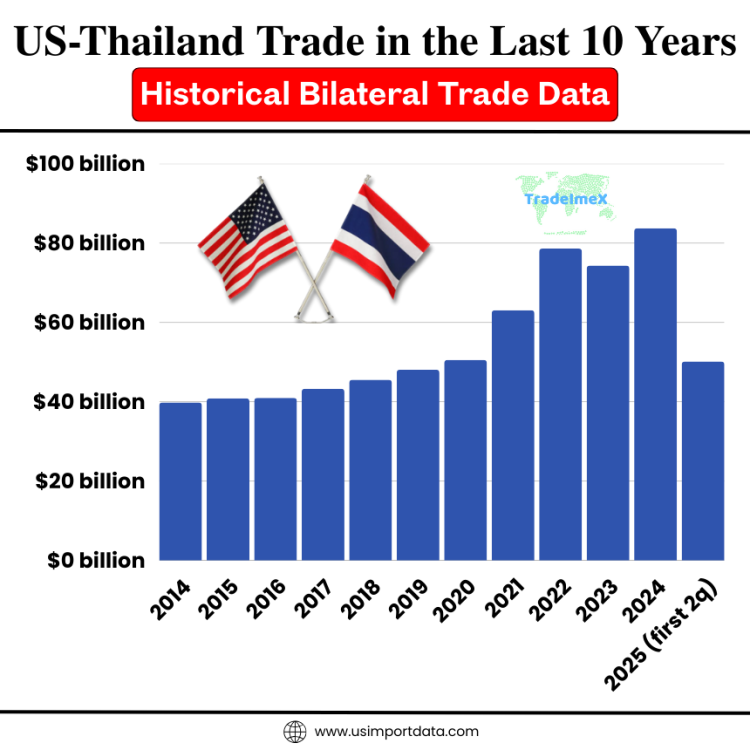
The total value of US imports from Thailand accounted for $40.26 billion in the first two quarters of 2025, as per the data on Thailand exports to US & US import statistics. The total US-Thailand trade value reached $83.72 billion in 2024, and $50.15 billion in the first two quarters of 2025, as per the data on US trade with Thailand & US trade data. Thailand is ranked as the 18th largest trading partner of the USA, as per the global trade data.
This report breaks down the top Thai exports to the U.S., the structure of American exports to Thailand, the reasons behind the large trade imbalance, and the details of the evolving trade agreement. It also examines the risks, pressures, and opportunities that will define this relationship going forward.
The Big Picture: Trade Volume and Imbalance in 2024
The United States and Thailand recorded a record-high 83 billion USD in total goods trade in 2024. This marked a rise of more than 13 percent over the previous year, a sign of strong bilateral activity for US-Thailand trade despite global uncertainty.
The trade relationship, however, is far from balanced:
-
The United States exported around 18 billion USD in goods to Thailand.
-
Thailand exported more than 63 billion USD in goods to the United States.
-
The resulting American goods trade deficit with Thailand stood at about 45 billion USD, one of the highest deficits the U.S. runs with any Southeast Asian partner.
Services trade was nearly balanced, with each side exchanging a little over 3.5 billion USD in tourism, transportation, professional services, and digital-related activity. From Thailand’s viewpoint, this surplus underscores the strength of its export industries, especially electronics, machinery, and rubber products. From the U.S. perspective, the widening deficit has increased the pressure to revisit tariff structures, origin rules, and market-access terms.
Top Goods Thailand Exports to US: What Does the US Import from Thailand?

Thailand, a key trading partner of the United States, exports a variety of goods to the US market. Some of the top goods that Thailand exports to the US include electronic equipment, motor vehicles, rubber, seafood, and machinery. Electronic equipment, such as computers and parts, stands out as one of the major exports from Thailand to the US. Additionally, motor vehicles and automotive parts represent a significant portion of Thailand's exports to the US. Moreover, Thailand is known for exporting high-quality seafood products, particularly shrimp and tuna, to meet the American market's demand. The top 10 goods that the US imports from Thailand, as per the Thailand customs data and the US shipment data for 2024-25, include:
1. Electrical machinery & equipment (HS code 85): $23.05 billion
One of the top goods that Thailand exports to the US is electrical machinery and equipment, with a total value of $23.05 billion, as per the data on US electronics imports from Thailand by HS code. This category includes items such as computers, televisions, and other electronic devices. Thailand has a strong manufacturing industry when it comes to electrical machinery, making it a key player in this sector.
2. Nuclear reactors & machinery (HS code 84): $15.72 billion
Another significant export from Thailand to the US is nuclear reactors and machinery, with a value of $15.72 billion. This category covers a range of equipment used in the nuclear energy sector, including reactors, turbines, and parts thereof. Thailand's expertise in this area has made it a valuable source of these goods for the US market.
3. Rubber & articles thereof (HS code 40): $5.49 billion
Thailand is also a major exporter of rubber and rubber products to the US, with a total value of $5.49 billion, as per the data on US rubber imports from Thailand by HS code. This category includes items such as tires, tubes, and other rubber goods. Thailand is known for its high-quality rubber production, making it a top choice for US importers looking for reliable sources of these products.
4. Vehicles (HS code 87): $2.59 billion
Thailand is a significant player in the automotive industry, exporting vehicles and automotive parts worth $2.59 billion to the US. This category includes cars, trucks, and other motor vehicles, as well as components such as engines and transmissions. Thailand's strong manufacturing base and skilled workforce have made it a key exporter of vehicles to the US market.
5. Precious stones & metals (HS code 71): $1.83 billion
Thailand is also known for its exports of precious stones and metals, with a total value of $1.83 billion. This category includes items such as gemstones, gold, and silver. Thailand's expertise in gemstone cutting and jewelry making has made it a top choice for US importers looking for high-quality precious stones and metals.
6. Optical, medical, & surgical instruments (HS code 90): $1.76 billion
Optical, medical, and surgical instruments are another top export from Thailand to the US, with a total value of $1.76 billion. This category includes items such as medical devices, surgical instruments, and optical equipment. Thailand's strong healthcare industry and skilled workforce have made it a valuable source of these goods for the US market.
7. Plastics & articles thereof (HS code 39): $1.45 billion
Thailand is a major exporter of plastics and plastic products to the US, with a total value of $1.45 billion. This category includes items such as plastic bags, containers, and packaging materials. Thailand's advanced plastic manufacturing sector and innovative products have made it a top choice for US importers seeking high-quality plastic goods.
8. Furniture, bedding, & mattresses (HS code 94): $1.23 billion
Thailand is also known for its exports of furniture, bedding, and mattresses, with a total value of $1.23 billion. This category includes items such as sofas, beds, and other household furniture. Thailand's skilled craftsmanship and high-quality materials have made it a top exporter of furniture to the US market.
9. Articles of iron or steel (HS code 73): $1.17 billion
Thailand exports a wide range of articles made of iron or steel to the US, with a total value of $1.17 billion. This category includes items such as steel pipes, structures, and other metal products. Thailand's strong steel industry and expertise in metalworking have made it a valuable source of these goods for the US market.
10. Preparations of meat, fish, & seafood (HS code 03): $926.98 million
Finally, Thailand is a significant exporter of preparations of meat, fish, and seafood to the US, with a total value of $926.98 million. This category includes items such as processed meats, fish fillets, and other seafood products. Thailand's thriving food processing industry and high food safety standards have made it a popular choice for US importers looking for quality meat, fish, and seafood products.
US-Thailand Trade in the Last 10 Years: Historical Bilateral Trade Data
|
Year of Trade |
Total Value of US-Thailand Trade ($) |
|
2014 |
$39.82 billion |
|
2015 |
$40.83 billion |
|
2016 |
$40.96 billion |
|
2017 |
$43.24 billion |
|
2018 |
$45.53 billion |
|
2019 |
$48.05 billion |
|
2020 |
$50.50 billion |
|
2021 |
$63.06 billion |
|
2022 |
$78.60 billion |
|
2023 |
$74.33 billion |
|
2024 |
$83.72 billion |
|
2025 (first 2 quarters) |
$50.15 billion |
Thailand’s Top Exports to the United States in 2024-25
Thailand exported more than 55 billion USD worth of goods to the U.S. in 2024. While the country is known for its consumer goods, the bulk of its exports to America are actually industrial inputs and technology products. Below are the major categories, along with approximate export values:
1. Electrical and Electronic Equipment — about 17.6 billion USD
This is the largest export category. It includes semiconductors, integrated circuits, data-processing components, and a wide range of parts used by American manufacturers. Thailand’s electronics sector plays a major role in U.S. supply chains for computing, automotive electronics, telecommunications devices, and industrial machinery.
2. Machinery and Mechanical Appliances — about 13.6 billion USD
This category includes combustion engines, pumps, turbines, machine parts, HVAC equipment, and industrial components. Many of these goods are intermediate inputs for American factories, defense contractors, automotive plants, and infrastructure projects.
3. Rubber and Rubber-Based Products — about 5 billion USD
Thailand is one of the world’s largest producers of natural rubber. Exports to the U.S. include tires, medical gloves, industrial tubing, and specialized rubber compounds used in manufacturing.
4. Vehicles and Auto Parts — around 2.3 billion USD
Thailand, known as “the Detroit of Asia,” is a major exporter of automotive parts and assembled pickups. American demand for certain vehicle components has remained strong, helping sustain this category.
5. Precious Stones, Metals, and Jewelry — about 2 billion USD
Thailand’s gemstone processing and gold jewelry manufacturing industries maintain a significant presence in the American retail market.
6. Plastics — roughly 1.4 billion USD
This includes plastic polymers, molded components, packaging materials, and resin-based products.
7. Iron and Steel Articles — about 1.15 billion USD
Not raw steel, but fabricated components such as fasteners, structural parts, and specialized fittings.
8. Optical, Medical, and Technical Instruments — roughly 1 billion USD
Exports include microscopes, diagnostic equipment, lenses, measurement devices, and precision instruments.
9. Furniture and Prefabricated Structures — about 1 billion USD
Thailand is a reliable source for wood and composite furniture, modular office structures, and commercial furnishings.
10. Prepared Seafood and Meat Products — around 900 million USD
Thailand is a major player in canned tuna, frozen seafood, and processed poultry.
These categories reveal that Thai exports to the U.S. are highly diversified, technologically sophisticated, and heavily integrated with American supply chains.
Why Thailand Exports to US Surged in 2024
Several factors explain why Thailand’s shipments to the U.S. climbed sharply:
Strong domestic production
Thailand’s manufacturing sector rebounded strongly in 2024. Factories operated at higher capacity thanks to stronger global demand, improved trade, and new investments in machinery and automation.
Rising American demand
U.S. companies increased orders for electronics, machinery parts, consumer goods, and vehicles. Much of this demand was tied to reshoring and diversification strategies, where importers attempted to reduce reliance on single-country suppliers.
Currency dynamics
The Thai baht stayed relatively competitive compared to the U.S. dollar, keeping Thai goods attractive for American importers.
Reduced tariff uncertainty
Until mid-2024, there was concern that U.S. reciprocal tariffs would rise to as high as 36 percent. Clarity and negotiations later reduced this risk, encouraging exporters to push shipments before any new rules took effect.
U.S. Exports to Thailand: What America Sells
While Thailand runs a large surplus, it is still an important buyer of American goods. In 2024, the United States exported nearly 18 billion USD in goods to Thailand.
Key categories include:
1. Mineral fuels and refined petroleum — nearly 4 billion USD
Thailand imports American liquefied petroleum gases, refined fuels, and energy-related feedstocks used by petrochemical plants.
2. Electrical machinery — around 2.5 billion USD
This includes equipment for telecommunications, renewable-energy systems, and industrial automation.
3. Industrial machinery — nearly 2 billion USD
American-made high-precision machinery and pumps are widely used across Thailand’s manufacturing and infrastructure sectors, as per the data on US exports to Thailand by HS code.
4. Precious stones and metals — around 870 million USD
The Thai jewelry and gem industries heavily depend on imported raw materials from the U.S.
5. Vehicles, medical devices, aircraft parts, chemicals, and agricultural products
These categories are smaller but important in terms of strategic relationships and supply chain stability.
Although the United States exports high-value goods, the overall volume remains far smaller than the flow of Thai goods entering the American market.
The Trade Imbalance: Why It Matters
The U.S. deficit with Thailand, approximately 45 billion USD, has drawn increasing attention in Washington. Several factors contribute to this gap:
-
Thailand’s industrial structure is geared toward export manufacturing.
-
The U.S. relies heavily on foreign electronics and machinery.
-
American companies have offshored production to Thailand over the past two decades.
-
Consumer demand in the U.S. remains strong for products Thailand specializes in.
-
U.S. exports to Thailand are constrained by regulatory barriers, competition, shipping costs, and the limited size of the Thai market.
For Thailand, this surplus supports jobs, growth, foreign-exchange reserves, and investor confidence. For the U.S., the imbalance is now seen as a vulnerability that needs gradual correction.
The US-Thailand Trade Deal: What Changed
1. The new reciprocal tariff rate
One of the biggest developments was the US-Thailand agreement on Reciprocal Trade to set a 19% reciprocal tariff on many Thai-origin goods. This rate is far lower than the previously signaled 36 percent that sparked concern in Thailand’s export industries.
The 19 percent figure provides:
-
More stability for exporters
-
A predictable environment for supply-chain planning
-
A clear benchmark aligned with regional peers
2. Stricter rules of origin
The U.S. has become more vigilant about transshipment, goods from third countries being passed off as Thai to gain tariff advantages. As a result:
-
Product origin verification has tightened.
-
Certification requirements have multiplied.
-
Thai exporters face new documentation and compliance steps.
This shift aims to ensure genuine Thai value-added production, especially in electronics, steel, rubber goods, and machinery.
3. Thailand’s support measures
To soften the impact of the new tariff and origin rules, Thailand introduced:
-
Low-interest loans for exporters
-
Sector-specific subsidies
-
Customs modernization initiatives
-
Tax incentives for manufacturers upgrading their supply chains
4. Thailand's commitment to reduce its surplus
Thai officials announced plans to cut the trade surplus with the U.S. to around 20 billion USD over the medium term. The strategy includes:
-
Increasing imports of U.S. agricultural goods such as corn and soybeans
-
Buying more American energy-related products
-
Encouraging U.S. companies to expand domestic manufacturing in Thailand
This is partly a diplomatic gesture, partly an economic necessity.
Impact of the Trade Deal on Thailand’s Economy
Benefits
-
Protects key export sectors from higher duties
-
Strengthens investor confidence
-
Encourages industrial upgrading
-
Enhances Thailand’s global competitiveness
Challenges
-
Compliance costs will rise, especially for small exporters
-
Documentation delays may disrupt shipments
-
Some industries could face tighter margins under the 19 percent tariff
-
Increased imports may challenge local producers in agriculture and materials
Thailand will need to balance export protection with domestic support and regulatory adaptation.
Impact of the Trade Deal on the United States
Benefits
-
A more balanced trade relationship
-
Better enforcement against mis-declared imports
-
Stronger access to Thailand’s growing consumer and industrial markets
-
Greater leverage in Southeast Asia’s strategic landscape
Risks
-
Supply chains could face delays as Thai exporters adapt to new rules
-
Tariff policy could add cost pressures for U.S. manufacturers
-
Enforcement challenges may persist if documentation systems struggle
-
A sudden drop in Thai imports would disrupt the U.S. electronics and machinery sectors
The U.S. has much to gain but also much to manage.
What to Watch in 2025 and Beyond
The coming year will determine whether the new trade rules strengthen or strain the relationship. Key things to monitor include:
-
How strictly the origin rules are enforced
-
Whether Thailand can realistically reduce its surplus
-
The speed at which Thai exporters adapt to documentation changes
-
Growth of U.S. exports in agriculture, energy, and machinery
-
Shifts in American corporate sourcing strategies
-
Broader geopolitical tensions that could influence trade
Conclusion and Final Thoughts
In conclusion, the US–Thailand trade relations in 2025 reflect a powerful combination of economic pressure, strategic necessity, and long-term partnership. Thailand remains a crucial manufacturing hub for American industries, while the U.S. remains one of Thailand’s most important export destinations. The new 19 percent tariff agreement, along with stricter origin rules, marks a reset in how both countries approach market access and supply-chain integrity. If both sides manage the transition well, the result could be a more balanced, more transparent, and more resilient trade relationship. If not, the risks include supply-chain disruption, political tension, and lost competitiveness for businesses in both nations.
For now, momentum remains strong, driven by record trade volumes, expanding industrial cooperation, and a shared interest in economic stability and strategic alignment.
We hope that you liked our data-driven and interactive blog report on the US-Thailand trade relations 2025. For more insights into the latest US export-import data, or to search live US import-export data by country, visit USImportdata. Contact us at info@tradeimex.in for customized trade reports & US market insights.
What's Your Reaction?