US-South Korea Trade Relations: KORUS FTA & Bilateral Trade Data Insights 2025
Explore insights on US–South Korea trade 2025, KORUS FTA impacts, bilateral trade data, & trends shaping this key Indo-Pacific partnership.
The economic relationship between the United States and South Korea is one of the most important in the Indo-Pacific region. What began as a strategic alliance has evolved into a deep economic partnership driven by advanced manufacturing, technology, and cross-border investment. At the center of this relationship stands the Korea–United States Free Trade Agreement, or KORUS FTA. According to the US import data and South Korea export data, the total value of US imports from South Korea reached $135.46 billion in 2024, a 13.1% increase from the previous year. According to the US export data, the total value of US exports to South Korea reached $65.54 billion in 2024, a 1% increase from the previous year.
The total value of the US-South Korea trade accounted for a record high $201 billion in 2024 & $99.87 billion in the first two quarters of 2025. South Korea is the 7th largest trading partner of the USA, as per the global trade data. More than a decade after its implementation, the KORUS agreement continues to shape the trade landscape in ways that matter for both countries.
As the world moves through a period of rising tariffs, supply-chain rewiring, and geopolitical unease, understanding how the U.S. and South Korea trade with each other is essential. The 2024 and early-2025 data tell a story of growth, imbalance, and tension. This blog breaks down the numbers, the trends, and the risks shaping the next chapter of U.S.–Korea trade.
A Brief Background on the KORUS FTA
KORUS, or the Korea–United States Free Trade Agreement, entered into force in March 2012 after years of negotiation. When the agreement took effect, it became one of the most comprehensive trade deals the United States had signed with an Asian partner. Its goals were straightforward: expand market access, remove tariff and non-tariff barriers, protect intellectual property, and strengthen investment frameworks.
What KORUS Actually Did
The agreement worked in stages. Tariffs on most industrial goods were removed immediately or phased out over a decade. For agriculture, the U.S. gained preferred access to one of Asia’s most high-value food markets. For South Korea, KORUS meant improved access for manufactured goods, particularly in autos, electronics, machinery, and steel.
Some highlights of the agreement’s structural benefits include:
-
Nearly all tariffs on industrial products have been reduced to zero.
-
Key agricultural imports from the U.S. are given tariff-free treatment.
-
A binding framework for intellectual property, digital trade, and services.
-
Investor protections and clearer dispute-settlement mechanisms.
-
Strengthened services trade in finance, telecom, and transportation.
The agreement was revised in 2018, mainly to address U.S. concerns about autos and to adjust steel quotas. Despite periodic political friction, KORUS has remained the foundation of bilateral economic activity.
The Shape of US-South Korea Bilateral Trade in 2024
The most recent full-year data offer the clearest picture of how deeply integrated the two economies have become in terms of the US-South Korea trade relationship.
Total Trade Volume
In 2024, combined goods and services trade between the U.S. and South Korea reached roughly 239 to 240 billion dollars, an increase of about 8 percent from the previous year. This is one of the highest annual trade volumes in the history of the two economies.
Goods Trade
Goods trade makes up the bulk of the relationship.
-
U.S. goods exports to South Korea in 2024: about 65.5 to 66 billion dollars.
-
U.S. goods imports from South Korea: roughly 135 billion dollars.
-
U.S. goods trade deficit: about 66 billion dollars, a jump of nearly 30 percent from 2023.
The deficit is now the largest the U.S. has ever recorded with South Korea. Several sectors, autos, machinery, electronics, and parts, play major roles in widening the gap.
Services Trade
The services relationship is much more balanced and actually favors the United States.
-
U.S. services exports to Korea in 2024 reached 27 billion dollars.
-
U.S. services imports from Korea were approximately 15.5 billion dollars.
-
Resulting U.S. services surplus: around 11.5 billion dollars, which also grew year-over-year.
The U.S. is dominant in technology services, finance, intellectual property, entertainment, and trade.
Investment Flows
South Korea has become a top investor in the American economy, especially in advanced manufacturing. In 2024:
-
Korean investment in the U.S. totaled approximately 92 billion dollars.
-
U.S. investment in Korea stood near 36 billion dollars.
Much of the Korean capital is tied to electric vehicles, batteries, semiconductors, steel, and renewable energy projects. These investments are also one reason such a large share of U.S. imports from Korea are intermediate goods used in U.S. factories, an important nuance that changes how the trade deficit should be interpreted.
Top Goods the US Imports from South Korea: What Does the US Import from South Korea?
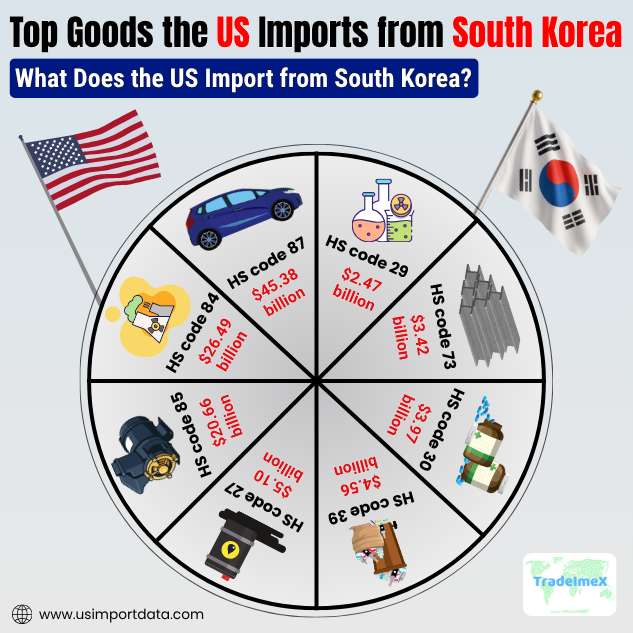
The United States imports a wide range of goods from South Korea, making it one of the country's significant trading partners. Some of the top products imported from South Korea include electronic equipment such as semiconductors, computers, and telecommunication equipment. With a reputation for high-quality products and technological advancements, South Korea continues to be a key player in the global market, meeting the demands of American consumers and businesses alike. The top 10 products that the US imports from South Korea, as per the US-South Korea trade data & US import statistics for 2024-25, include:
1. Vehicles (HS code 87): $45.38 billion
Vehicles are one of the top goods that the US imports from South Korea, as per the data on US vehicle imports from South Korea by HS code. South Korean automakers such as Hyundai and Kia have gained popularity in the US market, leading to a significant amount of vehicle imports from South Korea.
2. Nuclear reactors & machinery (HS code 84): $26.49 billion
Another major import category from South Korea is nuclear reactors and machinery. South Korea is known for its advanced technology and machinery, which contributes to the significant import value in this category.
3. Electrical machinery & equipment (HS code 85): $20.66 billion
Electrical machinery and equipment are also among the top imports from South Korea. With South Korea being a major manufacturer of electronic goods, it's no surprise that the US imports a substantial amount in this category.
4. Mineral fuels & oils (HS code 27): $5.10 billion
Mineral fuels and oils are essential commodities that the US imports from South Korea. While the import value in this category may not be as high as others, it still plays a significant role in the overall trade between the two countries.
5. Plastics & articles thereof (HS code 39): $4.56 billion
Plastics and articles thereof are also the top imports from South Korea. With the plastics industry being a major sector in both countries, the trade of plastic products is substantial.
6. Pharmaceutical products (HS code 30): $3.97 billion
Pharmaceutical products are important imports from South Korea, contributing to the healthcare sector in the US. South Korea is known for its high-quality pharmaceuticals, which is reflected in the import value in this category.
7. Articles of iron or steel (HS code 73): $3.42 billion
Articles of iron or steel are also significant imports from South Korea. With South Korea being a major producer of steel products, the US imports a substantial amount in this category.
8. Organic chemicals (HS code 29): $2.47 billion
Organic chemicals are essential imports from South Korea, used in various industries, including pharmaceuticals, agriculture, and manufacturing. The import value in this category highlights the importance of organic chemicals in the US market.
9. Miscellaneous chemical products (HS code 38): $2.23 billion
Miscellaneous chemical products are also among the top imports from South Korea. With a wide range of chemical products being manufactured in South Korea, the US imports a significant amount of this category.
10. Optical, medical, & surgical instruments (HS code 90): $2.13 billion
Lastly, optical, medical, and surgical instruments are important imports from South Korea. With South Korea being known for its advanced technology in the medical field, the US imports a considerable amount of these instruments.
Top Goods the US Exports to South Korea: What Does the US Export to South Korea
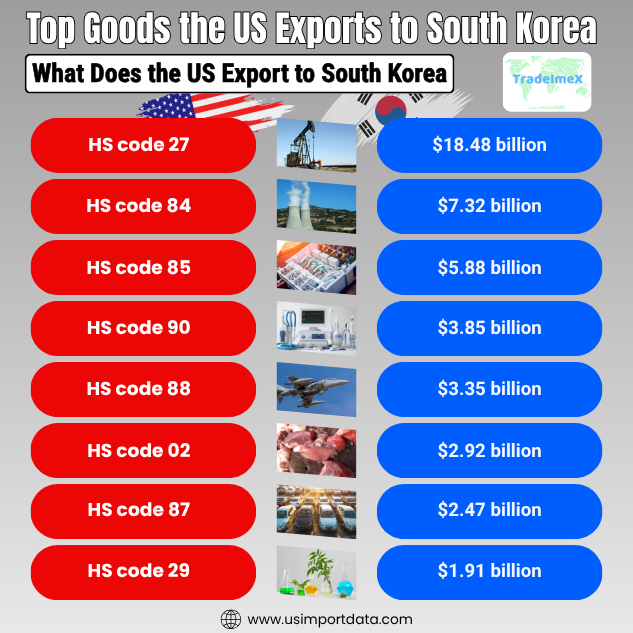
The United States has a robust trading relationship with South Korea, with several top goods regularly exported. Among the key exports are machinery, aircraft, mineral fuel, precision instruments, and medical equipment. These high-quality products are in demand in the South Korean market, contributing significantly to the bilateral trade between the two countries. The top 10 goods that the US exports to South Korea, as per the data on US exports by country & US shipment data for 2024-25, include:
1. Mineral Fuels & Oils (HS code 27): $18.48 billion
At the very top of the list is mineral fuels and oils, with a hefty $18.68 billion in exports to South Korea. This category includes petroleum oils, coal, and other fossil fuels that are crucial for powering South Korea's economy.
2. Nuclear Reactors & Machinery (HS code 84): $7.32 billion
Coming in second is nuclear reactors and machinery, totaling $7.32 billion in exports, as per the data on US machinery exports to South Korea by HS code. As South Korea continues to invest in nuclear power generation, the US plays a key role in providing the necessary equipment and technology.
3. Electrical Machinery & Equipment (HS code 85): $5.88 billion
Electrical machinery and equipment are another major export category, with South Korea importing $5.88 billion worth of goods in this sector. This includes everything from generators to semiconductors.
4. Optical, Medical, & Surgical Instruments (HS code 90): $3.85 billion
In the realm of healthcare and technology, the US exports $3.85 billion in optical, medical, and surgical instruments to South Korea. This category encompasses everything from MRI machines to contact lenses.
5. Aircraft, Spacecraft, & Parts Thereof (HS code 88): $3.35 billion
The aerospace industry is a significant player in US exports to South Korea, with $3.35 billion in aircraft, spacecraft, and related parts being shipped across the ocean. This includes airplanes, helicopters, and components.
6. Meat & Edible Meat Offal (HS code 02): $2.92 billion
American meat products are also in demand in South Korea, with $2.92 billion in exports falling under this category. From beef to pork, US meat is a popular choice for Korean consumers.
7. Vehicles (HS code 87): $2.47 billion
Automobiles and other vehicles make up a substantial portion of US exports to South Korea, totaling $2.47 billion. American cars, trucks, and SUVs are well-received in the Korean market.
8. Organic Chemicals (HS code 29): $1.91 billion
Chemicals play a vital role in various industries, and South Korea imports $1.91 billion worth of organic chemicals from the US. This category includes substances used in pharmaceuticals, plastics, and agriculture.
9. Pharmaceutical Products (HS code 30): $1.78 billion
With a growing demand for healthcare products, South Korea imports $1.78 billion in pharmaceuticals from the United States. This includes prescription medications, vaccines, and medical supplies.
10. Miscellaneous Chemical Products (HS code 38): $1.48 billion
Rounding out the top 10 are miscellaneous chemical products, amounting to $1.48 billion in exports. This category encompasses a variety of chemical compounds and substances used in different industries.
US-South Korea Trade in the Last 10 Years: Historical Bilateral Trade Data
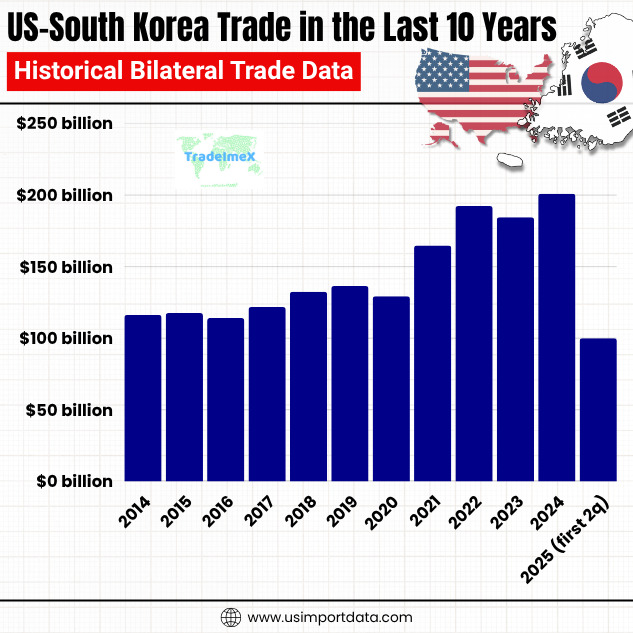
|
Year of Trade |
Total Value of US-South Korea Trade ($) |
|
2014 |
$116.21 billion |
|
2015 |
$117.54 billion |
|
2016 |
$114.14 billion |
|
2017 |
$121.77 billion |
|
2018 |
$132.49 billion |
|
2019 |
$136.43 billion |
|
2020 |
$129.31 billion |
|
2021 |
$164.71 billion |
|
2022 |
$192.34 billion |
|
2023 |
$184.55 billion |
|
2024 |
$201 billion |
|
2025 (first 2 quarters) |
$99.87 billion |
Sectors Driving the US-Korea Trade Relationship
To understand where the relationship is headed, it helps to break down the trade flows by sector.
1. Automotive
Autos remain the biggest contributor to the U.S. goods trade deficit with Korea. Korean automakers continue to expand their share of the American market with a mix of fuel-efficient models, SUVs, EVs, and luxury brands.
A large number of Korean vehicles entering the U.S. are now assembled domestically by plants in Georgia and Alabama. But many models are still imported from Korea, and auto parts continue to cross the Pacific in large volumes.
In 2024 and early 2025, auto trade came under pressure because of U.S. tariff actions, which created uncertainty about future pricing and supply chains. Korean firms, however, have mitigated some risk by expanding domestic production in the U.S., which improves their standing with policymakers.
2. Semiconductors and Electronics
South Korea is one of the world’s largest producers of semiconductors, memory chips, displays, and electronic components. These products remain essential inputs for U.S. technology companies.
Despite tariff pressure, Korea’s chip exports to the U.S. showed surprising resilience in 2024. Demand for memory chips, data-center hardware, and consumer electronics kept trade flowing even as global tech spending fluctuated.
Semiconductors are also at the heart of American industrial policy. Korea’s close technical cooperation with the US, particularly through major investments from leading Korean chipmakers, helps both countries compete in the global tech arena.
3. Steel and Aluminum
Steel is one of the sectors most exposed to rapid policy swings. Korean steelmakers face recurring tariff risks in the U.S., particularly under trade laws that allow protective duties for national security reasons.
In 2024 and 2025, Korean steel exports faced the threat of high reciprocal tariffs, raising concerns about competitiveness and supply stability. Steelmakers warned that heavy tariff hikes could force them to redirect exports to other markets or cut production.
4. Agriculture and Food
Agriculture is a bright spot for U.S. exporters. Since KORUS took effect, agricultural shipments to Korea have expanded significantly.
Key exports include:
-
Beef
-
Pork
-
Corn
-
Wheat
-
Soybeans
-
Dairy products
-
Processed foods
U.S. beef exports, in particular, have grown rapidly because the 40 percent Korean tariff on American beef was phased out under KORUS. Korea is one of the top foreign buyers of U.S. beef, and American producers rely heavily on this market, as per the data on US beef exports to South Korea.
5. Energy and Minerals
The U.S. exports liquefied natural gas, refined petroleum, and mineral fuels to South Korea. These flows expand or contract with global pricing, but they remain a key part of the relationship. As Korea expands its electric vehicle and battery production, demand for U.S. critical minerals and energy inputs will likely rise.
6. Services and Digital Trade
The U.S. runs a strong and consistent surplus in services. Korea is a major consumer of U.S. cloud services, entertainment, intellectual property, consulting, and aviation. These sectors are less sensitive to tariffs and tend to be more stable over time.
Rising Tensions: The 2024–25 Trade Environment
While KORUS continues to underpin trade, the current environment is far less stable than in previous years. Several challenges now weigh on the relationship.
Rising Tariffs
By 2024 and 2025, the U.S. began implementing or considering broad tariff measures that directly affect Korean exports. These include:
-
A general tariff increase on many imported goods.
-
A country-specific additional tariff rate for South Korea.
-
Sector-specific tariffs on steel, autos, and other industrial products.
These moves triggered concerns in Seoul. Korean exporters warned that a 20 to 25 percent tariff environment could cut exports to the U.S. by more than 10 percent. Economists at major Korean institutions projected that the higher tariff levels could knock half a percentage point off Korea’s GDP growth.
A Record Korean Trade Surplus with the United States
South Korea posted a record trade surplus with the U.S. in 2024, over 55 billion dollars by some estimates. A large share of U.S. imports consisted of intermediate products used by Korean companies in the U.S., but the size of the imbalance still raised political tensions in Washington.
Supply-Chain Realignment
The U.S. is aggressively reshaping its supply chains to reduce dependence on China. Korea is often seen as a “friend-shoring” partner, but not all Korean exports align neatly with U.S. industrial policy goals. This creates contradictions: the U.S. wants Korean investment in domestic manufacturing, yet it is also scrutinizing trade practices and deficit levels.
Economic Pressure at Home
South Korea is an export-driven economy. More than three-quarters of its GDP is tied to trade. Any major disruption in trade with the U.S. carries economic and political implications for Seoul. Korean policymakers have warned that tariff shocks could lead to slower growth, lower export competitiveness, and job losses in key sectors like steel and electronics.
Why KORUS Still Matters Despite the Turbulence
Even with rising tensions, neither country has moved away from KORUS. There are four major reasons why the agreement remains valuable.
1. Integrated Production Networks
The trade relationship is not simply a matter of buying and selling. Korean companies manufacture cars, batteries, and electronics inside the United States. Nearly half of U.S. imports from Korea are intermediate goods that feed American production lines. Disrupting these flows would hurt American factories as much as Korean exporters.
2. Strategic Alignment
Economic ties support the broader US–Korea alliance. The two countries coordinate on defense, technology, North Korea, and Indo-Pacific security. Strong trade reduces friction and reinforces strategic cooperation.
3. Investment as a Stabilizer
Record levels of Korean investment in the U.S. have created jobs and boosted local economies. These projects, especially in EVs, clean energy, and chips, make South Korea a long-term stakeholder in America’s economic stability. They also give Korean firms leverage in trade negotiations.
4. Predictability and Rule of Law
KORUS offers a structured system for resolving disputes. Even during tense moments, the agreement ensures there is a predictable process, rather than ad hoc decisions. In an era of global trade uncertainty, that stability matters.
What Both Countries Should Consider Going Forward
For the United States
-
Recognize the role of Korean intermediate goods in supporting U.S. manufacturing. Not all imports widen vulnerability. Many strengthen domestic production.
-
Use structured negotiations, not sudden tariffs, to adjust sectoral imbalances.
-
Deepen supply-chain partnerships with Korea in semiconductors, critical minerals, clean energy, and defense technologies.
-
Preserve services expansion, where the U.S. retains a competitive edge.
For South Korea
-
Diversify exports to lessen dependence on the U.S. market.
-
Localize more production inside the U.S., reducing tariff exposure.
-
Invest in high-value-added sectors, where Korea’s technology leadership is strong.
-
Engage in proactive diplomacy to reduce friction and maintain the spirit of KORUS.
Conclusion and Final Thoughts
The U.S.–South Korea economic relationship is large, complex, and deeply interconnected. The KORUS FTA helped shape a decade of growth, integration, and mutual benefit. But the 2024–25 trade environment shows that the relationship is also vulnerable to political shifts, tariff escalation, and global supply-chain upheaval.
Still, the fundamentals remain strong. Korea is one of America’s most important trade and investment partners. The United States is vital to Korea’s economic security and technological future. Both countries depend on each other more than their headlines sometimes suggest.
If they manage the next few years with discipline and strategic clarity, the U.S. and South Korea can keep building a partnership that balances economic gain, security interests, and long-term stability.
We hope that you liked our data-driven & interactive blog report on the US-South Korea trade relations & KORUS FTA 2025. For more insights into the latest US trade data, ot to search live US import-export data by country, product, or HS code, visit USImportdata. Contact us at info@tradeimex.in for customized trade reports & verified USA import-export databases.
What's Your Reaction?