Honey Import Data of the US: Top Honey Importers & Buyers in USA in 2025
Explore US honey import data 2025, key import trends, top honey buyers & importers, major supplier countries, & forecasts for the US honey industry.

Honey has grown into one of the most strategically traded food commodities in the United States. It is used in household consumption, food manufacturing, nutraceuticals, confectionery, beverages, and the rapidly expanding clean-label ingredient market. Because U.S. honey production cannot fully cover domestic consumption, the country has become one of the world’s largest honey importers. According to the US import data and honey import data of the USA, the total value of US honey imports reached $650.24 million in 2024, an 11% increase from the previous year. According to the US honey import data, the USA exported honey worth a total value of $543.60 million in the first three quarters of 2025. The US honey import data 2025 reveals strong momentum across the sector, supported by detailed honey import statistics USA and a growing need for deeper US honey import market analysis. Rising USA honey import trends are tied to limited domestic output, which also influences US honey import volume 2024 and the expanding US honey import value 2025, reflecting sustained honey import growth in the USA.
Market reports highlight an ongoing gap in US honey demand vs supply, leading buyers to track honey import prices USA and consult US honey trade data for strategic sourcing decisions. This environment encourages buyers to evaluate top honey importers in USA, understand the role of major honey buyers in the US, and use the US honey importers list to identify reliable partners among American honey importing companies, including bulk honey importers USA, raw honey importers USA, industrial honey buyers in the USA, premium honey importers USA, and established commercial honey packers USA serving the food and ingredient sectors.
The US is the largest honey importer in the world, according to global trade data. U.S. honey imports reached a record high of 562 million pounds in 2024–25, making up 74% of the country's entire honey supply. During 2024–25, import volumes reached record highs, supplier patterns shifted, and U.S. buyers faced new challenges related to duties, pricing, and quality management. This article provides a granular, data-rich overview of the U.S. honey import landscape, including production shortfalls, global supplier standings, importer trends, market drivers, and forward-looking projections for 2025.
Honey has evolved far beyond a household sweetener in the United States. Today, it is a strategic agricultural commodity used extensively across food manufacturing, nutraceuticals, pharmaceuticals, beverages, bakery products, sports nutrition, and clean-label formulations. As consumer preference continues to shift toward natural sweeteners, demand for honey in the U.S. has grown steadily.
However, domestic honey production in the United States remains structurally insufficient to meet this rising demand. As a result, the country has become the largest honey importer in the world, relying heavily on overseas suppliers. According to U.S. honey import data, total honey imports reached USD 650.24 million in 2024, marking an 11 percent year-on-year increase. During the first two quarters of 2025 alone, U.S. honey exports were valued at USD 336.58 million, reflecting strong trade activity and ongoing market momentum.
This data-driven article provides a comprehensive overview of U.S. honey import trends in 2024–25, including production gaps, import volumes, supplier countries, leading honey importers in the USA, market drivers, challenges, and future outlook.
Why the United States Depends on Honey Imports
Domestic Production Falls Short of Demand
The U.S. has a well-established beekeeping industry, yet production levels have consistently failed to match consumption. In 2024, U.S. honey production was estimated at approximately 134 million pounds, showing a modest decline from the previous year.
Although the number of honey-producing colonies increased, yield per hive dropped to around 52 pounds, affected by adverse weather, limited forage availability, disease pressure, and colony stress. Even in peak production years, U.S. honey output rarely exceeds 150 million pounds.
By contrast, total U.S. honey demand exceeds 560 million pounds annually, creating a persistent supply deficit that must be filled through imports.
Imports Supply Nearly Three-Quarters of U.S. Honey Consumption
In 2024–25, imported honey accounted for around 74 percent of the total honey supply in the United States. Over the past decade, reliance on imported honey has steadily increased due to expanding use in processed foods and natural health products.
Honey imports are no longer supplemental. They form the core foundation of the U.S. honey supply chain, supporting both retail consumption and industrial demand.
U.S. Honey Import Volume and Value Trends (2024–25)
Record Import Volumes
Total U.S. honey imports reached approximately 255 million kilograms (562 million pounds) in 2024, representing one of the highest import volumes on record. This growth occurred despite ongoing anti-dumping duties and increased regulatory scrutiny on honey quality.
Key factors behind the import surge include:
-
Rising demand from food and beverage manufacturers
-
Recovery in global honey production
-
Competitive pricing from high-volume exporters
-
Importer efforts to diversify sourcing origins
Import Value Growth
The total value of U.S. honey imports climbed to USD 650.24 million in 2024, up from about USD 584 million in 2023. This increase was driven by:
-
Higher import volumes
-
Increased sourcing of premium and specialty honey
-
Higher imports, insurance, and testing costs
-
Inflationary pressures in agriculture
Import prices varied widely, reflecting the coexistence of bulk multifloral honey and high-value specialty honey, such as monofloral and medicinal varieties.
US Honey Imports by Country: Where Does the US Import Honey From?
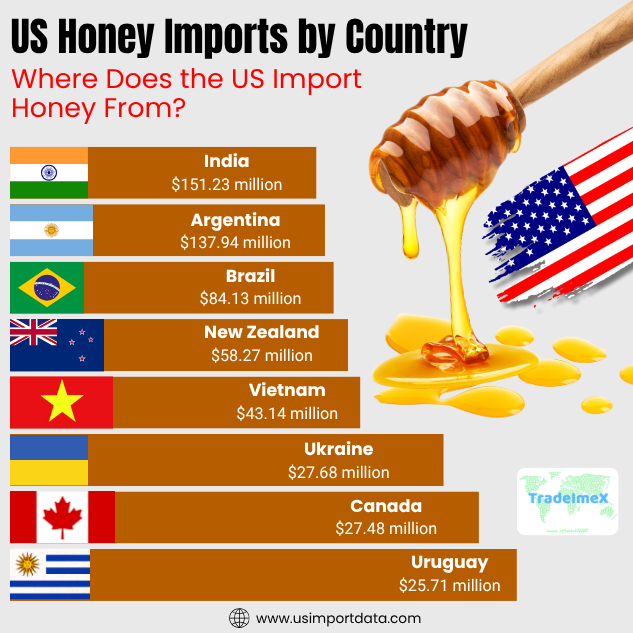
The United States imports honey from various countries around the world. According to data on US Honey Imports by Country, the top countries from which the US imports honey include China, Argentina, Vietnam, India, and Brazil. These countries are known for their production of high-quality honey, meeting the demand in the US market. The United States imports honey from more than 50 countries, but a small group dominates total volume and value.
Country-level sourcing data shows that US honey imports from India, US honey imports from Argentina, and US honey imports from Brazil continue to dominate, while diversification extends to US honey imports from Vietnam, US honey imports from Mexico, and US honey imports from Turkey. These flows are consistently reflected in US honey imports by country 2025 reports and rankings of the top honey supplying countries to USA. Importers also reference the correct honey import HS code USA and honey tariff code USA, especially when navigating US honey import duties, mitigating risks linked to anti-dumping duties on honey, and ensuring compliance with honey import regulations USA, USDA honey import rules, and broader honey import compliance USA requirements.
The industry is further shaped by US beekeeping production 2024, evolving US honey consumption trends, and rising participation in the natural sweetener market USA, where expanding clean label ingredient demand boosts the role of honey in food manufacturing USA and strengthens the overall honey supply chain USA, supported by broader global honey market trends 2025. The import of honey from these countries contributes significantly to the availability and diversity of honey choices for consumers in the United States. The top 10 countries that supply honey to the US, as per the US honey imports by country and the US shipment data for 2024-25, include:
1. India: $151.23 million (23.3%)
India is the largest producer of honey in the world, so it's no surprise that it is also a major exporter to the US, as per the data on US honey imports from India by HS code. India is the leading supplier of honey to the United States, accounting for a substantial 23.3% of total honey imports. Indian honey is known for its high quality and diverse range of flavors, making it a popular choice among American consumers.
2. Argentina: $137.94 million (21.2%)
Argentina has a long history of beekeeping and honey production, and its honey is prized for its rich taste and aromatic qualities. Argentine honey is prized for its unique floral notes and dark amber color, making it a sought-after ingredient in many culinary dishes. The US imports a significant amount of honey from Argentina to satisfy the growing demand for this delicious natural sweetener.
3. Brazil: $84.13 million (12.9%)
Brazil is another major player in the global honey market, and its honey is particularly sought after for its unique tropical flavors, as per the data on US honey imports from Brazil. The US imports a substantial amount of honey from Brazil, adding variety to the selection available to American consumers.
4. New Zealand: $58.27 million (9%)
New Zealand is renowned for its pristine natural environment, which provides the perfect conditions for bees to produce high-quality honey. The US imports a considerable amount of honey from New Zealand, appreciating the distinct taste and purity of this honey.
5. Vietnam: $43.14 million (6.6%)
Vietnam may not be as well-known for its honey production as some other countries, but it has been steadily increasing its honey exports to the US in recent years. Vietnamese honey is valued for its unique floral notes and is a favorite among health-conscious consumers.
6. Ukraine: $27.68 million (4.3%)
Ukraine is a rising star in the global honey market, with its honey gaining recognition for its exceptional quality and flavor. The US imports a growing amount of honey from Ukraine, reflecting the increasing popularity of Ukrainian honey among American consumers.
7. Canada: $27.48 million (4.2%)
Our neighbors to the north are also a significant source of honey for the US market. Canadian honey is esteemed for its purity and craftsmanship, and the US imports a considerable amount of honey from Canada to meet domestic demand.
8. Uruguay: $25.71 million (4%)
Uruguay may be a small country, but it punches above its weight when it comes to honey production. Uruguayan honey is prized for its rich flavor and exceptional quality, attracting a loyal following among American consumers.
9. Mexico: $22.53 million (3.5%)
Mexico is renowned for its diverse range of honey varieties, from the delicate floral notes of orange blossom honey to the robust flavors of avocado honey. The US imports a significant amount of honey from Mexico, adding a touch of Mexican sweetness to American pantries.
10. Türkiye: $12.81 million (2%)
Turkey, or Türkiye as it is known locally, is a rising star in the global honey market. Turkish honey is distinguished by its rich taste and aromatic qualities, making it a popular choice among American consumers looking for something special.
List of Top Honey Importers & Buyers in USA: US Honey Importers Database
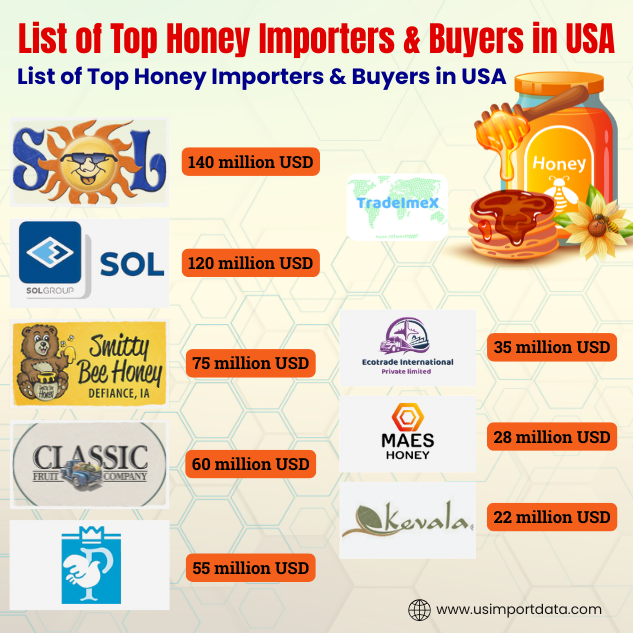
The US Honey Importers Database is a valuable resource for businesses seeking to connect with prominent players in the honey import industry in the United States. This database provides crucial information on key American honey importers and buyers, helping companies establish beneficial relationships and enhance their market presence. The leading honey importers & buyers in the USA, as per the US honey importers data & honey buyers list for 2024-25, include:
|
Rank |
Company Name |
Approx. Import Value (2024) |
Top Imported Honey Types |
Main Source Countries |
|
1 |
Sol Group Marketing Co |
140 million USD |
Bulk honey, multifloral |
India, Argentina, Brazil |
|
2 |
Sol Group Marketing Fresh Ex Ltd |
120 million USD |
Raw and bulk honey |
India, Argentina, Brazil |
|
3 |
75 million USD |
Raw honey |
India, Vietnam, Argentina |
|
|
4 |
Classic Fruit Co. |
60 million USD |
Bulk honey |
India, Brazil, Ukraine |
|
5 |
Prince of Peace Enterprises Inc. |
55 million USD |
Bulk and industrial honey |
India, Argentina |
|
6 |
Ecotrade International |
35 million USD |
Bulk honey |
Brazil, India |
|
7 |
Mae’s Honey International S.L.U. |
28 million USD |
Bulk honey |
Argentina, Brazil |
|
8 |
Kevala International LLC |
22 million USD |
Raw and specialty honey |
Mexico, Brazil, India |
|
9 |
DP World Logistics USA Inc. |
18 million USD |
Raw honey |
India, Vietnam |
|
10 |
Natural Honey Importers (USA) |
15 million USD |
Bees' honey and raw honey |
Argentina, India, Brazil |
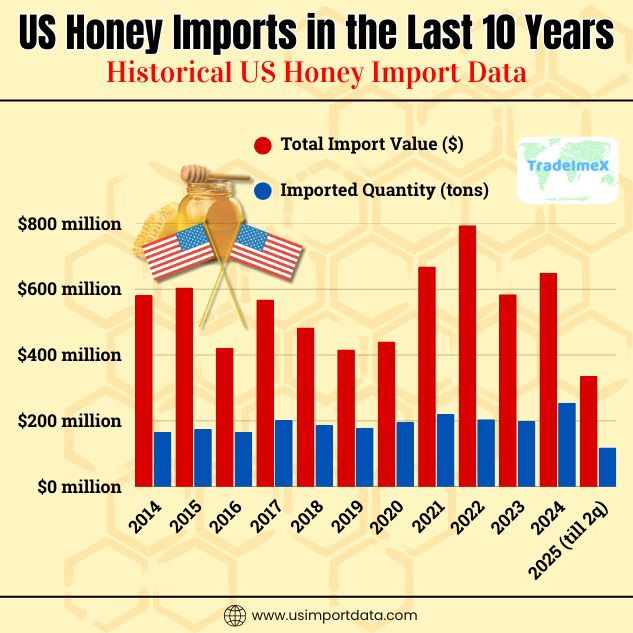
US Honey Imports in the Last 10 Years: Historical US Honey Import Data
|
Year of Imports |
Total Import Value ($) |
Imported Quantity (tons) |
|
2014 |
$582.23 million |
165.94 million tons |
|
2015 |
$605.03 million |
175.20 million tons |
|
2016 |
$422.38 million |
166.44 million tons |
|
2017 |
$568.73 million |
202.56 million tons |
|
2018 |
$483.75 million |
187.62 million tons |
|
2019 |
$416.89 million |
178.94 million tons |
|
2020 |
$441.47 million |
196.53 million tons |
|
2021 |
$668.84 million |
220.53 million tons |
|
2022 |
$794.27 million |
205.15 million tons |
|
2023 |
$584.68 million |
199.29 million tons |
|
2024 |
$650.24 million |
254.92 million tons |
|
2025 (till quarter 3) |
$543.60 million |
195.52 million tons |
Who Imports Honey in the US? Importer & Buyer Landscape
The U.S. honey import market is far more fragmented than many other food commodity markets. While some major companies handle large volumes, thousands of importers participate every year. The growing demand for natural sweeteners has significantly increased the number of honey importers in USA, creating strong opportunities for global honey buyers in USA and international suppliers. The U.S. honey import market is highly fragmented, with over 2,000 active importers and more than 15,000 shipments annually.
Many established honey importers work directly with bulk honey buyers in USA who rely on a consistent, high-quality supply for food manufacturing and retail markets. For producers seeking how to export honey to USA guidelines, understanding FDA compliance, quality standards, and documentation is essential for successfully exporting honey to USA. As global competition intensifies, experienced honey exporters aim to partner with reliable U.S. importers, and countries like India, Argentina, and Brazil often compete for the title of the biggest exporter of honey to the American market.
The Scale of Import Activity
Trade records show that the United States receives well over 15,000 honey shipments annually, from nearly 3,000 foreign exporters and more than 2,000 U.S.-based buyers. This large footprint signals an extremely diverse market.
Types of U.S. Honey Importers
U.S. importers generally fall into several categories:
1. Large Commercial Honey Packers
These companies import tens of millions of pounds of honey annually. They buy in bulk, blend different honey varieties, and pack honey under national or regional retail brands. They also supply food manufacturers across the country.
2. Industrial Ingredient Suppliers
Many companies import honey not for consumer retail but as a functional ingredient. Honey is used in baked goods, sauces, candies, cereal bars, herbal remedies, and beverage formulations. Ingredient suppliers source honey in drums, totes, and intermediate bulk containers.
3. Specialty and Premium Honey Importers
These niche importers bring in monofloral or high-grade honey from specific regions. Their customers include natural food stores, health product brands, luxury food retailers, and boutique honey shops.
4. Distributors and Brokers
Honey brokerage is a major business. Brokers coordinate shipments, match buyers with foreign suppliers, handle customs processes, and negotiate long-term sourcing deals.
How Importers Operate
U.S. honey buyers typically evaluate imported honey based on:
-
Moisture content
-
Flavor profile
-
Pollen analysis
-
Color grading (white, amber, dark amber)
-
Purity testing
-
Certification needs (organic, non-GMO, fair-trade)
-
Compliance with U.S. food safety rules
Many importers run their own testing systems or contract independent laboratories. Blending plays a major role in the market, as bulk imports from multiple countries are often combined to create products of consistent flavor, color, and cost.
Why U.S. Honey Imports Increased in 2024–25
Several forces contributed to the record import levels seen in the U.S. honey market.
1. Production Limitations at Home
Lower hive productivity and environmental stresses reduced domestic output. Even small declines in colony yield have outsized effects on supply.
2. Strong Consumer Demand
Honey use in the U.S. has expanded in:
-
Sports nutrition
-
Healthy snacks
-
Breakfast products
-
Premium beverages
-
Natural medicines
-
Wellness formulations
The public perception of honey as a natural alternative to refined sugar fuels this growth.
3. Lower Production Costs in Supplier Countries
Countries like India and Argentina can supply honey more cheaply due to:
-
Economies of scale
-
Favorable climate
-
Large beekeeping networks
-
Lower labor and production costs
These cost advantages push U.S. honey importers to favor foreign honey for large-scale blending and industrial uses.
4. Trade Diversification and Risk Hedging
Importers increasingly source honey from multiple countries to avoid:
-
Seasonal shortages
-
Geo-political disruptions
-
Contamination risks in individual supply regions
-
Tariff-driven price jumps
5. Growth in the Clean Label and Natural Ingredient Sector
Consumer interest in ingredient transparency accelerated honey’s role as a sweetening agent, increasing demand from food manufacturers.
Challenges and Risks Facing U.S. Honey Importers
Growing dependence on imported honey brings new complications.
1. Quality and Adulteration Issues
The global honey trade has long faced allegations of adulteration through added sugars, syrups, or filtration. As a result:
-
Importers invest heavily in purity testing
-
The U.S. enforces strict inspection and standards
-
Buyers rely on multilayered quality assurance systems
Maintaining authenticity is one of the most expensive aspects of honey importing.
2. Anti-Dumping Duties and Policy Volatility
If the U.S. government determines that honey from a country is being dumped at artificially low prices, it can impose heavy duties. These duties sharply increase the cost of imported honey from affected countries.
Policy shifts directly influence:
-
Importer sourcing decisions
-
Retail honey prices
-
Blending strategies
-
Supplier diversification
3. Supply Chain Disruptions
Global honey flows can be disrupted by:
-
Unusual weather patterns
-
Droughts that reduce nectar flow
-
Political instability in the exporting regions
Importers increasingly build multi-country supply networks to reduce these risks.
4. Price Fluctuations
Honey prices can swing due to:
-
Crop yields in the top exporting countries
-
World demand for natural sweeteners
-
Competition from domestic beekeepers
-
Shipping and insurance costs
-
Currency exchange movements
Importers must navigate these price movements while also maintaining stable retail consumer prices.
Market Outlook for 2025 and Beyond
1. Imports Expected to Reach New Highs
Projections for the 2025 market year estimate U.S. honey imports could rise to 260,000 to 270,000 metric tons, representing a continued upward trajectory. The total import value could approach or exceed 900 million dollars.
2. Supplier Composition May Shift
While India, Argentina, and Brazil will remain dominant, other suppliers may gain ground if they offer competitive pricing or meet higher quality standards. Countries emerging as potential growth suppliers include:
-
Mexico
-
Vietnam
-
Turkey
-
Ethiopia
-
Spain (for specialty honey)
3. Higher Investment in Traceability Systems
To protect brand integrity, more U.S. importers will invest in:
-
Laboratory testing
-
QR-code traceability
-
Supply chain audits
-
Certification programs
-
Batch-level tracking
This is especially important for premium honey segments.
4. Increased Competition Among U.S. Importers
With thousands of buyers participating in honey imports, competition will intensify in:
-
Pricing
-
Supplier relationships
-
Certifications
-
Retail partnerships
-
Private label contracts
Large packers will continue to dominate volume-based imports, while smaller niche importers will grow their presence in specialty markets.
Key Projections for US Honey Imports in 2026
-
Imports are projected to reach 260,000–270,000 metric tons
-
Import value could approach USD 900 million
-
Greater emphasis on traceability and certification
-
Increased competition among importers
-
Continued dominance of India, Argentina, and Brazil, with emerging suppliers gaining share
Conclusion and Final Summary
In conclusion, the U.S. honey market in 2024–25 shows a clear and accelerating trend: honey imports are essential, not optional. With domestic production covering only about one-quarter of total demand, the United States relies heavily on global trade to meet consumer and industrial needs. Looking ahead, the US honey market forecast 2025 indicates stronger imports and shifting supplier portfolios, shaping the future of honey imports in USA and informing detailed US honey import projections used by major buyers. Analysts also track the honey price outlook USA, asking why the US imports most of its honey, how much honey does the US import annually, and identifying the best countries to import honey from while evaluating the cost of importing honey to the USA.
Businesses prepare for evolving US honey import shipping requirements, while buyers monitor bulk honey prices for US importers and evaluate the challenges faced by US honey importers as competition increases. Across all segments, the industry continues to rely heavily on the top honey exporters to the US market, ensuring that supply remains stable despite global volatility.
Key takeaways:
-
The U.S. imported more than 562 million pounds of honey in 2024.
-
Honey imports were worth about 650 million dollars.
-
India, Argentina, and Brazil were the top suppliers by volume.
-
A few large U.S. packers dominate the bulk honey market, but more than 2,000 buyers participate in imports annually.
-
Strong consumer demand, low domestic production, and competitive global pricing fuel rising imports.
-
Importers face challenges related to duties, quality testing, and supply chain risk.
-
Forecasts for 2025 indicate further increases in both volume & value of imports.
As demand continues to grow and consumer preferences shift toward natural sweeteners, imported honey will remain central to the U.S. food economy.
We hope that you liked our data-driven and interactive blog report on the US honey import data 2025. For more insights into the latest US export-import data, or to search live data on US honey imports by country, visit USImportdata. Contact us at info@tradeimex.in for customized trade reports, a verified database of the top honey importers & buyers in USA, and market insights.
What's Your Reaction?