China Cancels US Pork Imports in 2025: What does it mean for US Pork Imports by Country?
In 2025, China canceled 12,000 tons of US pork imports, with major shifts in pork trade. Explore the reasons behind China’s ban, & how it reshapes US pork imports by country.
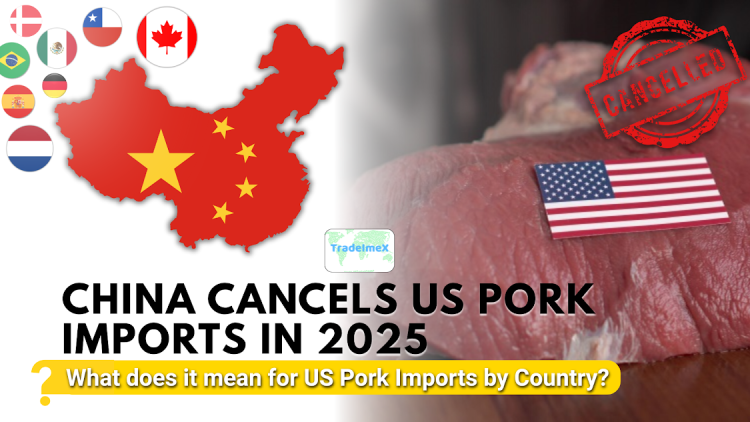
In a surprising move, China announced in 2025 that it would be canceling all pork imports from the United States. This decision has sent shockwaves throughout the global pork industry, as the US is one of the largest exporters of pork in the world. But what does this mean for US pork imports by country? Let's take a closer look at the implications of China's decision. In April 2025, China unexpectedly canceled a record 12,000 metric tons of US pork imports, the largest such cancellation since the early COVID-19 supply-chain chaos in 2020. As far as the US pork imports are concerned, the total value of pork imports into the US reached a record $1.48 billion in 2024, a 7% increase from the previous year, as per the US import data and the USA pork import data. Many businesses researching the global meat trade often ask, does the US import pork from China, especially as international supply chains continue to evolve.
While sourcing decisions vary by year and regulatory conditions, companies and analysts frequently evaluate how much pork does the US import from China when studying market dynamics, trade policy, and food safety considerations. Understanding these factors helps importers, exporters, and industry stakeholders stay informed about shifts in demand, compliance requirements, and the broader landscape of U.S. protein imports.
This sudden turn in trade highlights how geopolitical tensions and tariff policies can disrupt global markets and poses important questions about how US pork will find new import destinations. The US is the 8th largest pork importer in the world, as per the global trade data. Let’s break down what happened, how it's reshaping trade flows, and why it matters to consumers and producers worldwide. In this article, we will explore the implications of China's decision to cancel US pork imports and what it means for US pork imports by country, with a key focus on the US pork import data for 2024-25.
US Pork Imports by Country 2024-25: Where does the US Import Pork From?
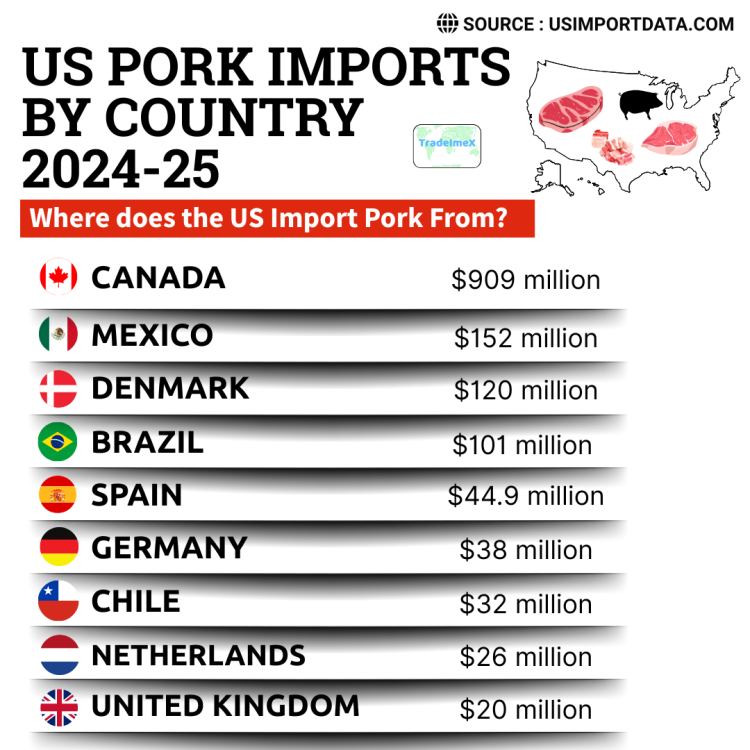
US Pork imports by country are sourced from various nations worldwide to meet the demands of the US market. The top countries the US imports pork from include Canada, the largest supplier, followed by Mexico and Denmark. These imports play a significant role in maintaining pork supply and diversity in the US market, ensuring consumers have access to a wide range of pork products and pig meat imports. The top 10 pork import partners of the US, as per the US shipment data and US pork imports by country in 2024-25, include:
1. Canada: $909 million (61.5%)
Canada takes the top spot as the leading supplier of pork to the United States, accounting for a substantial 61.5% of total US pork imports, as per the data on US pork imports from Canada. Known for its high-quality pork products, Canada has established itself as a reliable source for pork, meeting the needs of American consumers and businesses alike.
2. Mexico: $152 million (10.3%)
Coming in second is Mexico, with a 10.3% share of US pork imports. With its proximity to the US and strong agricultural industry, Mexico plays a crucial role in supplying pork to its neighbor to the north. The trade relationship between the two countries continues to strengthen, benefiting both economies.
3. Denmark: $120 million (8.1%)
Denmark holds the third position on the list of top US pork importers, contributing 8.1% of total imports. Danish pork is well-known for its high standards of quality and safety, making it a popular choice among American consumers. The strong trade ties between the US and Denmark ensure a steady flow of pork into the American market.
4. Brazil: $101 million (6.8%)
Brazil is another key player in the US pork import market, with US pork imports from Brazil accounting for 6.8% of total imports. With its vast agricultural resources and competitive pricing, Brazil has carved out a significant share of the US pork market. American consumers benefit from the variety of pork products that Brazil has to offer.
5. Spain: $44.9 million (3.0%)
Spain may be a smaller player compared to other countries on the list, but it still holds a notable 3.0% share of US pork imports. Spanish pork products are renowned for their unique flavors and culinary traditions, adding diversity to the American pork market. The US continues to import pork from Spain to satisfy the demand for specialty products.
6. Germany: $38 million (2.6%)
Germany's presence in the US pork import market is significant, contributing 2.6% of total imports, as per the data on US pork imports from Germany by HS code. German pork is coveted for its quality and innovative production methods, attracting American consumers seeking premium pork products. The strong trade relationship between the two countries ensures a steady flow of German pork into the US.
7. Chile: $32 million (2.2%)
Chile may be geographically distant from the US, but it still manages to capture a 2.2% share of US pork imports. Chilean pork is appreciated for its freshness and sustainability, appealing to health-conscious American consumers. The US imports pork from Chile to diversify its pork products and meet the changing preferences of consumers.
8. Netherlands: $26 million (1.8%)
The Netherlands plays a modest yet important role in the US pork import market, contributing 1.8% of total imports. Dutch pork is valued for its high standards of animal welfare and sustainable farming practices, aligning with the values of American consumers. The US continues to import pork from the Netherlands to offer a range of premium pork products to its consumers.
9. United Kingdom: $20 million (1.4%)
The United Kingdom holds a 1.4% share of US pork imports, showcasing its presence in the competitive US market. British pork is known for its traditional flavors and heritage breeds, appealing to American consumers looking for unique pork products. The US imports pork from the UK to cater to the demand for specialty pork items.
10. Italy: $17 million (1.1%)
Italy rounds out the top 10 list of US pork importers, contributing 1.1% of total imports. Italian pork is renowned for its artisanal production methods and rich flavors, adding a touch of luxury to the American pork market. The US imports pork from Italy to offer consumers a taste of traditional Italian pork products.
What triggered the cancellation of US pork imports from China?
The decision of why China cancels US pork imports comes amid escalating trade tensions between the two countries. The US and China have been engaged in a trade war for several years, with both sides imposing tariffs on each other's goods. The pork industry has been particularly hard hit, with Chinese tariffs making US pork more expensive and less competitive in the Chinese market. This US-China trade war played a huge part in halting the US pork imports from China.
China slapped a 172% tariff on US pork in response to earlier US tariffs on Chinese goods dating back to the 2018 trade war. That tariff spree made US pork nearly four times as expensive as competitors. China reacted by canceling a massive shipment of 12,000 tons in April 2025, marking the largest single pullback since 2020. Around the same time, China let permits for almost 1,000 US meat-processing plants expire, jeopardizing about $5 billion in annual meat exports, important groundwork for broader restrictions.
How big was China's pork market, and what's shrinking?
-
In 2024, China imported around 475,000 metric tons of US pork, worth over $1 billion, the third-largest market after Mexico and Japan.
-
The April cancellation slashed export sales to a 5-year low, with weekly US pork exports to China tumbling to 5,800 tons, a 72% drop from the previous 18,000-ton week.
-
USDA data show pork exports to China fell 35% in April, while US beef exports plunged 70%.
Why China is shifting away from US pork
-
Tariffs are making US pork prohibitively expensive: With 172% duties, US pork is far costlier than Brazilian or European alternatives.
-
Sourcing flexibility: China can easily shift to Brazil, Spain, and other suppliers who are not under these hefty tariffs.
-
Tailored product mismatch: US pork for China is often specially labeled and ractopamine-free. Once canceled, it’s challenging to re-route because other markets don’t seek the same cuts.
-
Policy signaling: Analysts view this pullback as a calculated step in China’s economic diplomacy, using agricultural trade pressure to influence US domestic politics.
Who wins as US pork loses out?
China rapidly replaced US pork with alternatives:
-
Brazil and Spain saw surging imports.
-
Other nations like Australia, Korea, Japan, and Mexico picked up smaller volumes.
For example, North Carolina producers exported pork mainly to Korea, Japan, Australia, and then China; as China recedes, Asia-Pacific buyers are becoming key targets.
Domestic repercussions along the US supply chain
-
Rising inventories and lower cut prices: Pork meant for China, especially offal-like heads, feet, tails, and now faces limited in demand. Alternatives like rendering or pet food pay much less, putting pressure on producers.
-
Packer margins collapse: US Meat Export Federation estimates a hit of $8–10 per hog due to value loss in supplemental cuts.
-
Farm-level effects: With weaker back-end pricing, farmers find hog sales less lucrative. Analysts warn that ongoing disruptions could threaten foodgrain prices and agricultural profitability.
-
Plant registration standoff: Loss of export registrations threatens to disrupt other markets as it signals a wider breakdown in regulatory trust.
Are things turning around?
There are signs of thaw, but they’re modest:
-
In mid-May, China agreed to temporarily reduce tariffs from 172% to 57% for 90 days, though the January-February pre-tariff baseline remains in place.
-
Negotiators are discussing a “Phase Two” that would lower tariffs further. US exporters hope it will renew export plant registrations and loosen trade barriers.
However, analysts caution that without a formal deal unwind, the market remains restricted.
US Pork Imports in the Last 10 Years: Historical US Pork Import Data
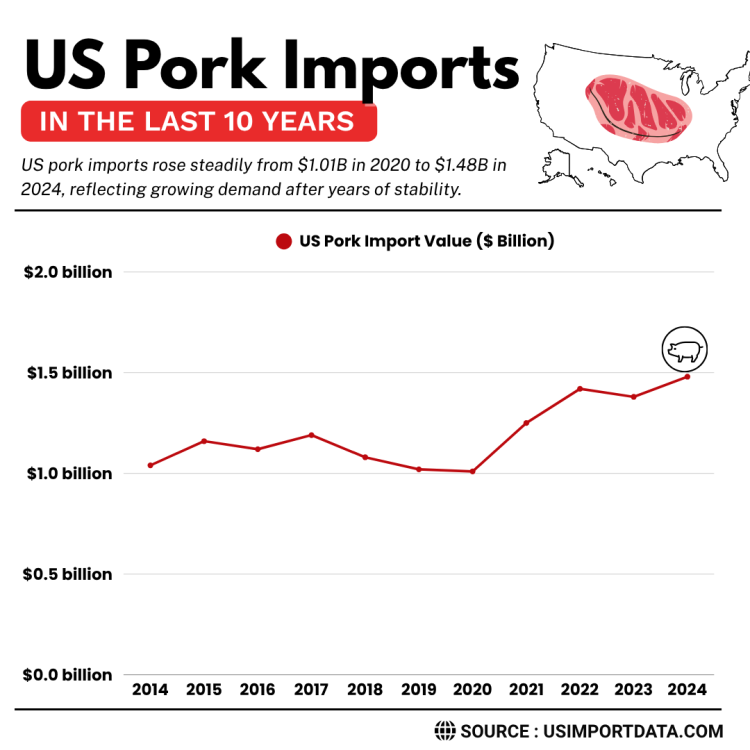
|
Year of Imports |
US Pork Import Value ($) |
|
2014 |
$1.04 billion |
|
2015 |
$1.16 billion |
|
2016 |
$1.12 billion |
|
2017 |
$1.19 billion |
|
2018 |
$1.08 billion |
|
2019 |
$1.02 billion |
|
2020 |
$1.01 billion |
|
2021 |
$1.25 billion |
|
2022 |
$1.42 billion |
|
2023 |
$1.38 billion |
|
2024 |
$1.48 billion |
A global reshuffle of US Pork Import: Winners, losers, & shifting lanes
|
Role |
Impact of China pulling out of the US pork |
Rebound Chances |
|
Brazil, Spain, Australia |
Major gains in export volume |
Continued access is likely if stable trade |
|
US exporters |
Declining export returns, loss of volume |
Small gains if the tariffs pause becomes permanent |
|
US packers/farmers |
Margin squeeze, lower hog prices |
Partial relief with tariff rollback |
|
Alternative buyers |
Asia-Pacific markets expanding share |
Opportunity for long-term alignment |
In essence, if China "weans off" US pork, US producers face long-term displacement, while other exporters cement trade ties.
What does it mean for US Pork Imports by Country?
-
China: Loss of price-competitive US pork; pivoting to cheaper suppliers like Brazil and Spain. Tariff pause may open windows, if re-negotiations go well.
-
Brazil & Spain: Positioned to permanently capture more of China’s offal demand.
-
Japan, Korea, Mexico, Australia: Incremental growth in US pork imports as other markets remain limited.
-
U.S. domestic markets: Could see modest consumer price relief, but producers face lower revenues and sensitive margins.
What comes next?
Three variables to follow:
-
Tariff negotiations: Will the 57% rate get extended or lowered?
-
Plant registration renewals: Crucial for export feasibility and confidence.
-
Market adaptation: US businesses must pivot to alternative buyers or internal products.
Industry strategy:
-
Build new market relationships in Southeast Asia, Mexico, EU.
-
Repurpose specialized inventory (e.g., offal) into pet food or domestic use.
-
Lobby for deal clarity, focusing on tariff rollback and regulatory reopening.
The Impact on US Pork Producers
The cancellation of US pork imports by China will undoubtedly have a significant impact on American pork producers. China has been a major market for US pork, and the sudden loss of this important export market will likely lead to an oversupply of pork in the US. This could result in lower prices for US pork producers, which would be detrimental to their bottom line.
Seeking Alternative Markets
With China no longer importing US pork, American producers will need to look to other countries to make up for the lost revenue. This could present an opportunity for other countries to increase their pork exports to the US. Countries such as Canada, the European Union, and Brazil may benefit from China's decision to cancel US pork imports.
Diversifying Markets
In light of China's cancellation of US pork imports, American producers may also need to consider diversifying their export markets. Relying too heavily on a single market can leave producers vulnerable to sudden changes in demand. By expanding into new markets, US pork producers can reduce their risk and ensure a more stable income stream.
The Long-Term Outlook for US Pork Imports
While the cancellation of US pork imports by China is certainly a blow to American producers, it is important to remember that the global pork industry is constantly evolving. New markets may emerge, trade agreements may be renegotiated, and consumer preferences may shift. US pork producers will need to adapt to these changes to remain competitive in the global marketplace.
Conclusion and Final Thoughts
In conclusion, the cancellation of US pork imports by China in 2025 is a significant development that will have far-reaching implications for American pork producers. While the immediate impact may be challenging, there are opportunities for US producers to seek out new markets, diversify their exports, and adapt to a changing global landscape. For US pork by country: US supply to China is down, Brazil & Spain are up, and alternative buyers are gaining share. Whether this trend flips depends heavily on political will, global negotiations, and strategic positioning in the months ahead.
China's cancellation of US pork imports in April 2025 reflects more than price volatility; it signals a structural shift reinforced by tariffs and trade policy. Even as a temporary "pause" reduces some pressure, US exporters are working to reorient their supply chains for resilience. Margins are tighter, farmers face uncertain futures, and only strategic diversification, plus diplomatic breakthroughs, will safeguard a rebuilt export footprint. Other exporters like Brazil and Spain are stepping in, while domestic buyers are adapting to surplus.
We hope that you liked our insightful blog report on why China Cancels US Pork Imports and its impact on US pork imports by country. For more such trade trends on US pork imports or to access the latest US export-import data, visit USImportdata. Contact us at info@tradeimex.in to get exclusive and customized database reports, along with a verified list of the top pork importers in the US.
Read more of our latest & insightful US import-export blogs at:
Top Olive Oil Importers & Buyers in the USA 2024
What's Your Reaction?