Where Does the US Import Cheese From? USA Cheese Importers Database 2025
Explore US Import Cheese trends — the USA imported cheese worth $1.99B in 2024, up 10%. Discover top USA Cheese Importers and key supplier insights.
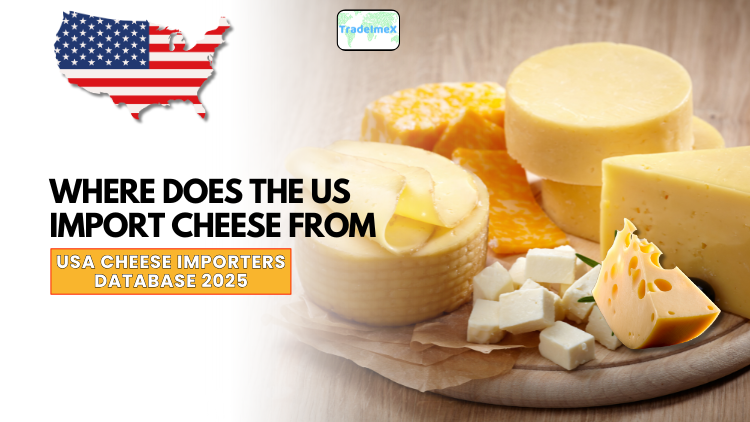
Cheese has long been a staple of the American diet. From the classic slices layered into burgers to artisanal wedges proudly displayed in specialty shops, cheese reflects both convenience and culture. While the United States is itself one of the world’s largest cheese producers, it is also a significant importer. The reasons are twofold: first, domestic consumers and food manufacturers crave specialty varieties that are unique to other countries; second, large-scale manufacturers often find it efficient to source commodity cheese from global suppliers when pricing and availability are favorable. According to the US import data and cheese import data of the USA, the total value of US cheese imports reached $1.99 billion in 2024, a 10% increase from the previous year. Many countries import cheese to USA to meet the growing demand for diverse dairy products. Importing cheese to USA involves following strict regulations set by the FDA and USDA to ensure quality, safety, and proper labeling of all imported varieties.
The USA is the 8th largest cheese importer in the world, as per the global trade data and cheese importers data. In the first two quarters of 2025 (H1 2025), the US imported cheese worth $880.1 million, as per the US import statistics. In 2024–25, U.S. cheese imports reveal an intricate balance of demand: gourmet imports from Europe coexist alongside bulk industrial shipments from Oceania and parts of Europe. To understand the picture, we’ll explore the trade numbers, the main supplier countries, the role of tariffs and quotas, the split between commodity and specialty cheeses, and finally, how to structure a USA Cheese Importers Database to manage and analyze these flows.
U.S. Cheese Import Landscape in 2024–25
In fiscal year 2024, U.S. cheese imports were valued at almost 2 billion US dollars. This placed cheese as one of the leading dairy import categories, with significant year-over-year growth compared to earlier years. Globally, cheese imports were worth more than 45 billion dollars, so while the U.S. is not the largest importer worldwide, it represents a considerable share of global demand, as per the reports of the Cheese Importers Association of America (CIAA).
The growth trajectory into 2025 has been upward. Monthly data from government and industry reporting shows double-digit increases in U.S. cheese import values in early 2025 compared to the same months in 2024. This increase reflects strong foodservice recovery (particularly fast-food chains and pizza outlets), robust demand in packaged foods, and consumer willingness to pay for specialty imports. Imports are no longer just supplementary; they are central to how the U.S. food system sources diversity and bulk volumes alike.
US Cheese Imports by Country: Where Does the US Import Cheese From?
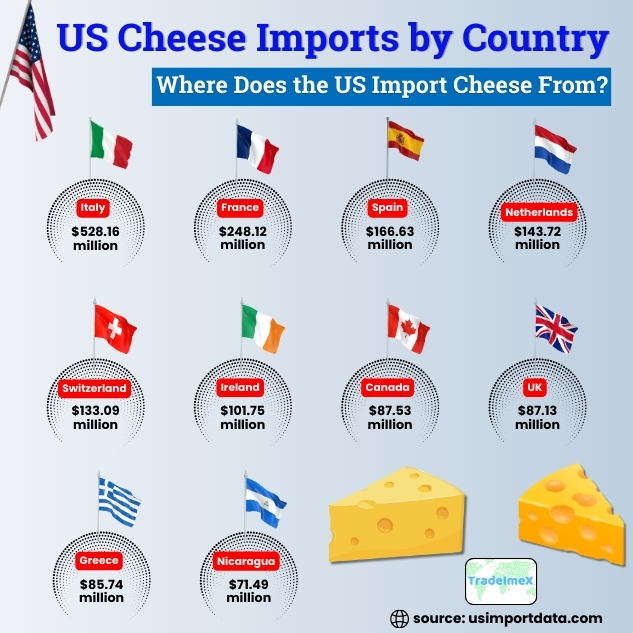
When it comes to US cheese imports by country, the United States sources its supply from various countries around the world. Some of the top contributors to US cheese imports include Italy, France, and the Netherlands. These countries are known for their high-quality cheeses, which cater to the diverse tastes and preferences of American consumers. The top 10 import partners for US cheese imports, as per the US shipment data and US cheese import data for 2024-25, include:
1. Italy: $528.16 million (26.4%)
Italy is renowned for its delicious cheeses, such as Parmigiano-Reggiano, mozzarella, and pecorino romano. In 2024-25, the US imported $528.16 million worth of cheese from Italy, making it the top cheese import source for the US, as per the data on US cheese imports from Italy. Italian cheese is loved for its high quality and exceptional taste.
2. France: $248.12 million (12.4%)
French cheeses are famous worldwide for their rich flavors and distinct textures. In 2024-25, the US imported $248.12 million worth of cheese from France, as per the data on US cheese imports from France by HS code. Brie, Camembert, and Roquefort are just a few of the popular French cheeses that find their way to US shores.
3. Spain: $166.63 million (8.3%)
Spain is known for its diverse and flavorful cheeses, such as Manchego and Cabrales. In 2024-25, the US imported $166.63 million worth of cheese from Spain. Spanish cheeses are cherished for their unique taste profiles and traditional production methods.
4. Netherlands: $143.72 million (7.2%)
Dutch cheeses, including Gouda and Edam, are beloved around the world for their creamy textures and mild flavors. In 2024-25, the US imported $143.72 million worth of cheese from the Netherlands. Dutch cheese is a popular choice among US consumers for its versatility and consistent quality.
5. Switzerland: $133.09 million (6.7%)
Swiss cheese, particularly Emmental and Gruyère, is well-known for its nutty taste and holey texture. In 2024-25, the US imported $133.09 million worth of cheese from Switzerland. Swiss cheese is often used in fondue and sandwiches, adding a delicious touch to various dishes.
6. Ireland: $101.75 million (5.1%)
Irish cheeses, like Dubliner and Cashel Blue, have gained popularity for their rich flavors and artisanal production methods. In 2024-25, the US imported $101.75 million worth of cheese from Ireland. Irish cheese is appreciated for its distinctive taste and high-quality ingredients.
7. Canada: $87.53 million (4.4%)
Canada may be known for its maple syrup, but its cheeses are also making a name for themselves. In 2024-25, the US imported $87.53 million worth of cheese from Canada. Canadian cheese, such as cheddar and mozzarella, offers a delicious alternative to other cheese varieties.
8. United Kingdom: $87.13 million (4.4%)
British cheeses, like Stilton and Cheddar, are beloved for their sharp flavors and crumbly textures. In 2024-25, the US imported $87.13 million worth of cheese from the United Kingdom. British cheese has a long history and is a staple in many US households.
9. Greece: $85.74 million (4.3%)
Greek cheeses, such as feta and halloumi, are celebrated for their tangy flavors and versatile uses. In 2024-25, the US imported $85.74 million worth of cheese from Greece. Greek cheese adds a Mediterranean flair to salads, pastas, and grilled dishes.
10. Nicaragua: $71.49 million (3.6%)
Nicaraguan cheeses may be less well-known compared to those of other countries, but they offer a unique and flavorful option for US consumers. In 2024-25, the US imported $71.49 million worth of cheese from Nicaragua. Nicaraguan cheese provides a taste of Central America and a new culinary experience.
Top 10 Cheese Importing Companies in the US: USA Cheese Importers Database
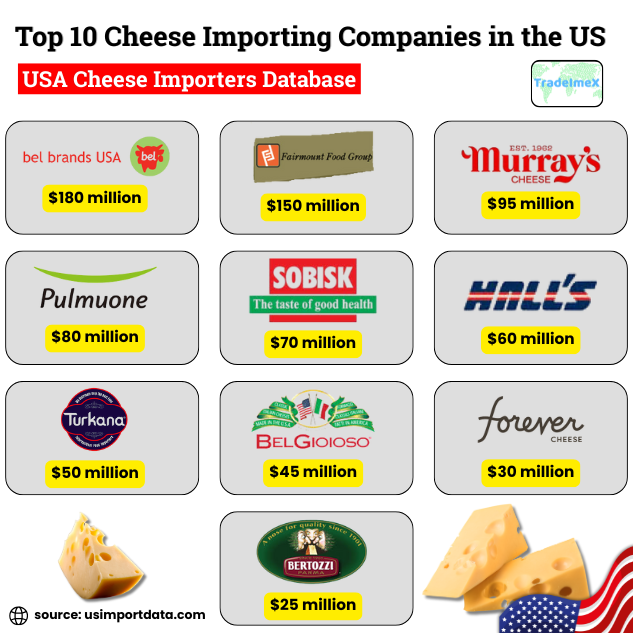
The USA Cheese Importers Database provides valuable insights into the leading players in the cheese importing industry. With a professional tone, this database offers detailed information on the top companies that significantly contribute to the importation and distribution of cheese in the United States. The leading & best cheese importers in the US, as per the US cheese importers data and the US cheese buyers list for 2024-25, include:
|
Rank |
Company Name |
Approx. Import Value (2024, $) |
Types of Cheese Imported |
Top Import Sources |
|
1 |
$180 million |
Brie, Camembert, processed cheeses |
France, Germany |
|
|
2 |
Fairmount Food Group |
$150 million |
Specialty, deli-style, hard cheeses |
Italy, Switzerland |
|
3 |
Murray’s Cheese |
$95 million |
Premium specialty, aged, blue cheeses |
Italy, France, Spain |
|
4 |
Pulmuone Foods USA |
$80 million |
Mozzarella, semi-hard cheeses |
Italy, New Zealand |
|
5 |
Sobisk Foods LLC |
$70 million |
Cheddar, processed blocks |
New Zealand, Ireland |
|
6 |
Hall Warehouse Corp. |
$60 million |
Industrial cheddar, processed cheeses |
New Zealand, Netherlands |
|
7 |
Turkana Food Inc. |
$50 million |
Gouda, Edam, semi-hard cheeses |
Netherlands, Germany |
|
8 |
BelGioioso Cheese |
$45 million |
Parmesan, Asiago, fresh mozzarella |
Italy, EU |
|
9 |
Forever Cheese |
$30 million |
Mediterranean specialty cheeses |
Spain, Italy, Greece |
|
10 |
Bertozzi Corporation |
$25 million |
Artisan, heritage cheeses |
UK, France, Spain |
US Cheese Imports in the Last 10 Years: Yearly USA Cheese Import Data
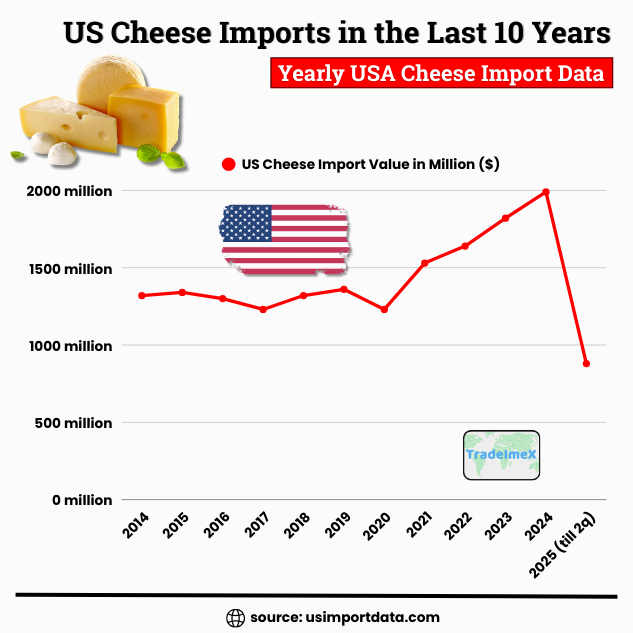
|
Year of Imports |
US Cheese Import Value ($) |
|
2014 |
$1.32 billion |
|
2015 |
$1.34 billion |
|
2016 |
$1.30 billion |
|
2017 |
$1.23 billion |
|
2018 |
$1.32 billion |
|
2019 |
$1.36 billion |
|
2020 |
$1.23 billion |
|
2021 |
$1.53 billion |
|
2022 |
$1.64 billion |
|
2023 |
$1.82 billion |
|
2024 |
$1.99 billion |
|
2025 (till quarter 2) |
$880.1 million |
Who Supplies Cheese to the U.S.? Top Origin Countries
Cheese import origins fall broadly into two groups: Europe, which dominates in high-value specialty varieties, and Oceania, which plays a central role in bulk commodity cheese supply, as per the latest cheese importer-exporter statistics.
Europe: The Premium Supplier
-
Italy is one of the most important suppliers of specialty cheeses to the U.S. Iconic varieties like Parmigiano-Reggiano, Grana Padano, and Pecorino Romano are irreplaceable in the American culinary scene. Italian mozzarella, too, finds its way into upscale restaurants. Italian cheese exports are highly dependent on tariff agreements, PDO (Protected Designation of Origin) certification, and consistent branding.
-
France contributes strongly with soft and specialty cheeses: Brie, Camembert, Roquefort, and other artisanal products. France caters mostly to high-income retail and gourmet markets in the U.S.
-
The Netherlands is a hybrid supplier; while Dutch cheese like Gouda is sold as specialty cheese, the country also exports large blocks of semi-hard cheese for industrial uses.
-
Germany and Ireland both supply mid-tier cheeses. Ireland is known for cheddar exports, while Germany produces a mix of industrial cheese and consumer-packaged varieties.
-
Switzerland, Greece, and the United Kingdom fill in specialty niches: Switzerland for Gruyère and Emmentaler, Greece for feta, and the UK for cheddar and Stilton. These flows are smaller in overall dollar terms but highly visible in specialty foodservice and retail markets.
Oceania: The Bulk Supplier
-
New Zealand is the largest Oceania contributor, supplying vast volumes of cheddar and processed cheese. New Zealand’s dairy industry is export-oriented, and competitive pricing often makes its cheeses attractive for U.S. food manufacturers.
-
Australia plays a smaller but important role, supplying both industrial and artisanal cheeses. Australia has strengthened trade ties with the U.S. in recent years, giving its exporters favorable access.
Value vs. Tonnage: Two Different Stories
When looking at U.S. cheese imports, it’s important to distinguish value from volume.
-
By value, European countries dominate. A wheel of Parmigiano-Reggiano or Roquefort can cost significantly more per kilogram than a block of cheddar from New Zealand. Thus, Italy and France consistently rank near the top in dollar terms.
-
By tonnage, Oceania is often dominant. Large blocks of cheddar or mozzarella, sold in high-volume industrial contracts, can outweigh specialty cheeses by sheer volume, even if they are lower in value per kilogram.
This split is critical for importers and policymakers. Value data tells us where consumer taste and premium demand are concentrated, while volume data reveals the backbone of industrial food supply chains.
Key Drivers of US Cheese Imports in 2024–25
Demand Growth
-
Foodservice chains, particularly pizza outlets, require vast amounts of mozzarella and processed cheese. The rebound in restaurant demand after the pandemic years boosted industrial cheese imports in 2024–25.
-
Retail specialty demand remains strong. Supermarkets and specialty stores continue to expand their imported cheese sections, appealing to consumers who value authenticity and heritage products.
Relative Prices
-
When U.S. domestic cheese prices rise relative to EU or New Zealand export prices, import volumes increase. Favorable exchange rates further amplify this effect.
-
Conversely, when domestic production is abundant and competitively priced, imports slow down.
Tariffs and Trade Policy
-
Tariff disputes in 2025 affected Italian and Swiss cheeses. Italy raised concerns about the misapplication of tariff agreements, while Swiss cheese faced unexpectedly high duties. These policy issues create volatility in landed costs, shipment timing, and supplier strategies.
-
Tariff Rate Quotas (TRQs) remain a central part of U.S. dairy trade policy. Importers of specific categories must monitor quota fill levels closely, as exceeding quotas can impose steep tariffs.
Supply in Exporting Countries
-
New Zealand’s strong dairy output in 2024–25 provided ample supply for U.S. importers seeking bulk cheddar.
-
In Europe, production constraints (energy prices, feed costs, labor issues) created short-term price fluctuations that occasionally affected competitiveness.
The Role of TRQs and Licensing
Cheese is among the most heavily quota-regulated import categories in the U.S. The Dairy Import Licensing Program allocates TRQs across cheese categories, ensuring orderly imports and protecting domestic producers from sudden surges. Importers must apply for licenses and monitor quota fill rates carefully. Once quotas fill, additional imports face high out-of-quota tariffs, which can quickly make products uncompetitive.
In practice, this means that specialty cheeses often enter under tightly managed TRQs, while some bulk commodities are imported through negotiated quotas. Importers with established licenses hold a competitive advantage in this space.
Risks and Watchpoints for 2025
Looking forward, several risks and uncertainties must be tracked:
-
Tariff Uncertainty: Continued disputes could result in sudden duties on Italian, Swiss, or other EU cheeses, disrupting trade flows.
-
Quota Constraints: If TRQs are filled early, importers may face steep tariff bills or scramble to source alternatives.
-
Global Dairy Prices: Fluctuations in global milk and cheese prices affect arbitrage opportunities. New Zealand’s pricing especially influences U.S. industrial sourcing decisions.
-
Shipment Costs: Ocean freight capacity and container shortages can raise costs for bulky shipments of industrial cheese.
-
Consumer Demand Shifts: Premiumization continues, but economic downturns could reduce demand for high-end specialty imports.
Key Takeaways
-
The U.S. imported nearly two billion dollars’ worth of cheese in 2024, with volumes rising into 2025.
-
Europe supplies value through artisanal and specialty cheeses; Oceania supplies volume through bulk cheddar and mozzarella.
-
Tariffs, quotas, and licensing play outsized roles in shaping flows.
-
Building an importer-level database allows stakeholders to track trends, analyze risks, and identify sourcing opportunities.
-
2025 will test the resilience of U.S. cheese importers as tariff disputes, TRQ management, and global dairy supply dynamics play out.
Conclusion and Final Thoughts
Cheese imports are more than just a trade statistic; they represent the intersection of global supply chains, culinary culture, and economic strategy. The U.S. market relies on imports both to satisfy consumer demand for authentic foreign cheeses and to provide manufacturers with bulk inputs for processed foods. A data-driven approach, anchored in a robust USA Cheese Importers Database, allows stakeholders to see beyond aggregate numbers and drill down into the who, where, and why of cheese trade.
In 2025, the story is clear: imports are growing, supplier countries are diverse, and the challenges ahead will be shaped by trade policy, quota regimes, and evolving consumer preferences. By investing in granular importer-level visibility, the U.S. can better balance its role as both a cheese-producing giant and a cheese-importing powerhouse.
For more insights into the latest US export-import data, or to search live data on US cheese imports by country, visit USImportdata. Contact us at info@tradeimex.in and get customized trade reports, market insights, and an exclusive & verified database of the top cheese importers in the USA, as per your needs.
Also Read:
Top Olive Oil Importers & Buyers in USA
What's Your Reaction?