U.S. Agricultural Exports: What Are the Top US Food Imports & Exports?
Discover the top U.S. agricultural exports & food imports in 2024-25. Explore key products, top export partners, & trade trends in the US agri-food sector.

In today's global economy, the United States plays a significant role in the agricultural export market. With a wide range of products and a robust agricultural sector, the U.S. can supply food products to countries worldwide. According to the US agricultural export data and the US export data, the US agricultural exports accounted for $170.5 billion in 2024, while the US food imports reached $204 billion, as per the US import data.
When exploring what foods are imported to the US, it's clear that the country relies heavily on products like coffee, seafood, fresh fruits, and vegetables to meet consumer demand. The rise in American food import trends reflects both seasonal needs and global trade partnerships. At the same time, what food does the US import varies by region and time of year, with countries like Mexico, Canada, and Chile being major suppliers. On the other hand, what food does the US export includes a wide range of agricultural products such as soybeans, corn, meat, and dairy, which support strong American food exports across the globe. These export relationships play a crucial role in maintaining the United States’ position as one of the world's top agricultural powers.
After the European Union, the United States is the second-largest agricultural trader in the world. The economic rise of many emerging economies and the adoption of both domestic and foreign policies that boosted U.S. access to international markets have contributed to a large growth in U.S. agricultural imports and exports over the past 25 years.
As worldwide supply and demand for agricultural and food goods changed over the same time due to rising incomes and emerging nations' expanding supply capacities, the geography and product mix of U.S. agricultural trade also changed. In this article, we will take a closer look at the top US food imports and exports and their impact on the economy.
List of Top US Food Exports: Biggest US Agricultural Exports
The list of top US food exports shows the country's prowess in agricultural exports, highlighting its leading role in the global food market. From soybeans and corn to meat and dairy products, the United States consistently ranks among the top exporters worldwide. With a diverse range of high-quality products and advanced farming practices, American agricultural exports continue to have a significant impact on international trade and play a crucial role in meeting global food demands. The top 10 Food Exports from the US or American food exports, as per the US food export data and USA agricultural export data for 2024, are:
1. Soybeans: $28 billion
Soybeans are one of the main foods that the US exports, as per US soybean export data. The majority of soybeans are farmed in the Midwest. 48.71 million tons of soybeans were produced in the United States, as per the soybean export data of USA. The crop is also used to make other kinds of culinary products. In 2024, the United States exported the most soybeans to China, totaling $15.16 billion. Soybeans' 4-digit HS code is 1201.
2. Corn: $13.68 billion
Corn is a plentiful crop in the United States. It ranks second on the list of important US exports because of this. In 2024, the United States produced 45.94 million tons of grain. Corn products, including high-fructose corn syrup, are exported both raw and processed. In 2024, the United States exported $5.47 billion worth of corn to Mexico, as per the US corn export data. Corn's 4-digit HS code is 1005.
3. Nuts: $8.07 billion
Among the most well-known food exports from the United States are almonds, walnuts, pistachios, and other nuts. The principal exporting countries are Europe and Asia (China and India). In 2024, the United States produced 1.66 million tons of nuts. The United States is the biggest supplier to the global nut business. In 2024, the United States exported the most nuts to India, totaling $1.09 billion. 0802 is the four-digit HS code for nuts.
4. Dairy products: $6.66 billion
Dairy products in the US mostly refer to products manufactured from cow's milk. On some occasions, however, eggs are also a part of this category. Dairy production in the US has increased over time. During the pandemic, this helped the country's economy. In 2024, the United States exported the most dairy products to Mexico, totaling $2.37 million. Dairy products have the two-digit HS code 04.
5. Wheat: $6.13 billion
In the United States, wheat is farmed in many different places and regions. Another important export good is this one. In 2024, the United States produced 17.94 million tons of wheat. In 2024, the United States exported the most wheat to Mexico, totaling $1.07 billion. Wheat's 4-digit HS code is 1001.
6. Pork: $6.04 billion
Pork is the most widely produced meat in the United States. In 2024, about one-third of the nation's total pork production was exported. In 2024, the United States produced 2.17 million tons of pork. According to experts, the pork industry contributes roughly $23.4 billion to the US GDP. Pork exports from the US to Mexico were $1.98 billion in 2024. Pork has a 4-digit HS code, 0203.
7. Poultry: $4.88 billion
The US poultry industry has already faced criticism for using hormones and antibiotics to raise large chickens for export. In 2024, the United States produced 3.75 million tons of poultry. In recent years, stricter regulations have been put in place to ensure the welfare of poultry and agricultural practices. In 2024, the United States exported the most poultry to Mexico, totaling $993.60 million. This commodity's 4-digit HS code is 0207.
8. Beef: $4.39 billion
After pork, beef is the second-largest meat export from the United States. In 2024, the United States produced 406,000 tons of beef. Farmers in Texas, Oklahoma, and Missouri raise most of the country's beef cattle. In 2024, the United States exported the most beef to South Korea ($965.07 million). Beef's 4-digit HS code is 0201.
9. Vegetable Oils: $2.74 billion
Vegetable oils are another important US food export. The most widely used edible oil produced and exported by the country is soybean oil. For people who are unfamiliar with the term "soybean oil," it is also referred to as "vegetable oil." In 2024, the United States exported the most vegetable oils to Canada, totaling $918.56 million. Vegetable oils have a 2-digit HS code of 15.
10. Cereal Grains: $131.96 million
Cereal Grains are the primary cash crop in the country. The important grains from the top are sorghum, barley, and oats. In 2024, the United States produced 197.56 thousand tons of cereal grains. They are exported in both their raw and milled forms to make a wide range of other products. In 2024, the United States exported the most cereal grains to Mexico, totaling $72.46 million. Cereal grains have the 4-digit HS code 1104.
List of Top US Food Imports: Biggest US Agricultural Imports
The list of top US food imports reveals the most significant agricultural imports that contribute to the country's diverse food supply. From fresh fruits and vegetables to coffee, chocolate, and seafood, the US food market is enriched by imports from around the world. Horticultural goods, such as fruits, vegetables, tree nuts, and more, account for around 50% of all agricultural imports into the United States. Meat, grains, oilseeds, sugar, and tropical goods are some of the other major import categories. Now you must be wondering, how much food does the US import? In light of that, we dissect each American food import category and highlight the top food products in terms of import value from a single origin. The top 10 US food imports, as per the US shipment data and US food import data for 2024, include:
1. Fresh Fruits: $15 billion
Fresh fruits are a popular import in the US, with a total estimated import value of $15.0 billion in 2024, as per the US fresh fruits import data by HS code. The US imports a wide range of fresh fruits from countries all over the world, including apples, bananas, grapes, and oranges.
2. Fresh Vegetables: $12.5 billion
Fresh vegetables are another important agricultural import for the US, with an estimated import value of $12.5 billion in 2024. The US imports a variety of fresh vegetables, such as tomatoes, lettuce, carrots, and onions, from countries like Mexico, Canada, and China.
3. Coffee: $9 billion
Coffee is a staple in many American households, and the US imports a significant amount of coffee each year. In 2024, the estimated import value of coffee is $9.0 billion. The US imports coffee from countries like Brazil, Colombia, and Vietnam, as per the US coffee import data.
4. Wine and Beer: $8.5 billion
Wine and beer are popular beverages in the US, and the country imports a large amount of these products from around the world. In 2024, the estimated import value of wine and beer is $8.5 billion. The US imports wine from countries like Italy, France, and Spain, and beer from countries like Mexico, Canada, and Germany.
5. Processed Fruits and Vegetables: $8 billion
In addition to fresh fruits and vegetables, the US also imports a significant amount of processed fruits and vegetables. In 2024, the estimated import value of processed fruits and vegetables is $8.0 billion. The US imports products like canned fruits, frozen vegetables, and fruit juices from countries all over the world.
6. Cocoa and Cocoa Products: $7.5 billion
Cocoa and cocoa products are essential ingredients in many delicious treats, and the US imports a large amount of cocoa each year. In 2024, the estimated import value of cocoa and cocoa products is $7.5 billion. The US imports cocoa from countries like the Ivory Coast, Ghana, and Ecuador.
7. Fish and Seafood: $7.2 billion
Fish and seafood are important sources of protein for many Americans, and the US imports a significant amount of these products each year. In 2024, the estimated import value of fish and seafood is $7.0 billion. The US imports a variety of fish and seafood, such as shrimp, salmon, tuna, and crab, from countries like Canada, China, and Thailand.
8. Sugar and Related Products: $6.8 billion
Sugar and related products are commonly used in a wide range of food and beverage products, and the US imports a substantial amount of sugar each year. In 2024, the estimated import value of sugar and related products is $6.5 billion. The US imports sugar from countries like Brazil, Mexico, and India.
9. Bakery and Confectionery Products: $6.4 billion
Bakery and confectionery products are beloved treats in the US, and the country imports a significant amount of these products each year. In 2024, the estimated import value of bakery and confectionery products is $6.0 billion. The US imports products like chocolate, cookies, and pastries from countries all over the world.
10. Spices: $5.5 billion
Spices are essential for adding flavor to a wide range of dishes, and the US imports a large number of spices each year. In 2024, the estimated import value of spices is $5.5 billion. The US imports spices like pepper, cinnamon, and turmeric from countries like India, Indonesia, and Vietnam.
US Agricultural Exports by Country: Where does the US Export Food?
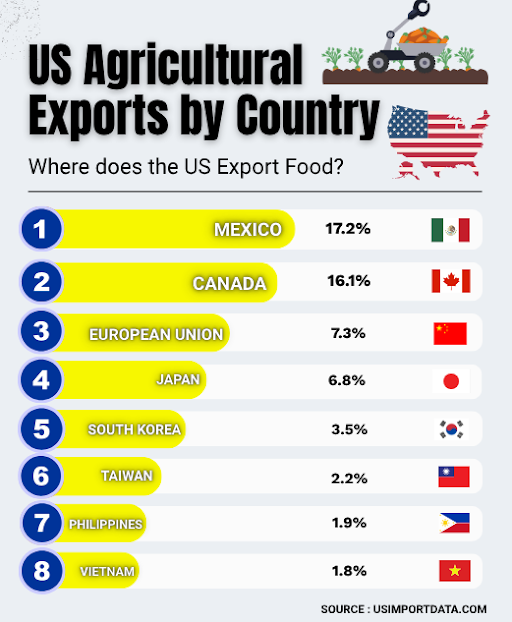
U.S. agricultural Exports are crucial to the global food market, with the US being a major player in supplying agricultural products around the world. Countries such as Canada, Mexico, China, Japan, and South Korea are among the top destinations for US agricultural exports. These exports cover a wide range of products, including soybeans, corn, wheat, pork, beef, and dairy products. The top 10 US food export markets as per the data on US agricultural exports by country and US agricultural export statistics, for 2024-25, include:
1. Mexico: $30.32 billion (17.2%)
Mexico stands out as the top destination for US agricultural exports, with a total value of $30.32 billion, accounting for 17.2% of the total exports. Key products exported to Mexico include corn, soybeans, dairy products, and beef, as per the data on US exports to Mexico.
2. Canada: $28.38 billion (16.1%)
Canada comes in second place, importing $28.38 billion worth of agricultural products from the US, making up 16.1% of total exports. Some of the top products exported to Canada include pork, poultry, and fresh fruits, as per the data on US food exports to Canada.
3. China: $24.65 billion (14%)
China remains a major importer of US agricultural products, with a total value of $24.65 billion, accounting for 14% of the total exports of U.S. agricultural exports to China. Soybeans, sorghum, and pork are among the key products exported to China, as per the data on U.S. agricultural exports to China
4. European Union: $12.80 billion (7.3%)
The European Union is a significant market for US agricultural exports, with a total value of $12.80 billion, making up 7.3% of the total exports. Products such as tree nuts, wine, and processed foods are popular imports in the EU.
5. Japan: $11.98 billion (6.8%)
Japan is another key destination for US agricultural products, importing $11.98 billion worth of goods, comprising 6.8% of total exports. Beef, corn, and wheat are some of the top products exported to Japan.
6. South Korea: $6.10 billion (3.5%)
South Korea is a growing market for US agricultural exports, with a total value of $6.10 billion, accounting for 3.5% of the total exports. Products like beef, pork, and corn are popular imports in South Korea.
7. Taiwan: $3.80 billion (2.2%)
Taiwan is a smaller but significant market for US agricultural products, importing $3.80 billion worth of goods, making up 2.2% of total exports. Dairy products, pork, and soybeans are among the key products exported to Taiwan.
8. Philippines: $3.40 billion (1.9%)
The Philippines imports $3.40 billion worth of agricultural products from the US, comprising 1.9% of the total exports. Key products exported to the Philippines include soybeans, wheat, and dairy products.
9. Vietnam: $3.10 billion (1.8%)
Vietnam is an emerging market for US agricultural exports, with a total value of $3.10 billion, accounting for 1.8% of the total exports. Products like corn, soybeans, and cotton are popular imports in Vietnam.
10. Colombia: $2.95 billion (1.7%)
Colombia rounds out the top 10 countries that import US agricultural products, with a total value of $2.95 billion, making up 1.7% of the total exports. Products such as corn, soybeans, and poultry are key items exported to Colombia.
US Agricultural Exports in the Last 10 Years: Yearly Food Export Data
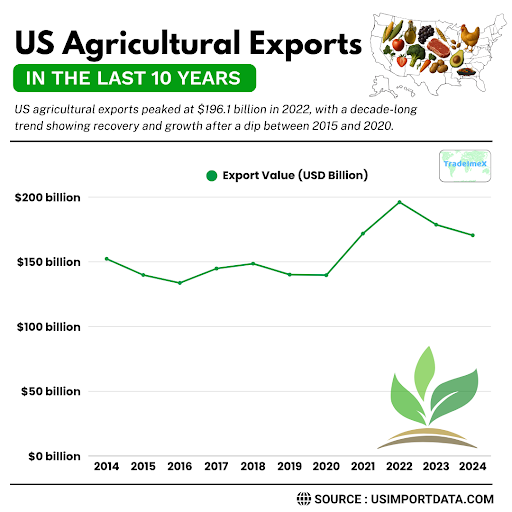
|
Year of Exports (2014-2024) |
US Agricultural export value ($) |
|
2014 |
$152.3 billion |
|
2015 |
$139.8 billion |
|
2016 |
$133.7 billion |
|
2017 |
$144.8 billion |
|
2018 |
$148.6 billion |
|
2019 |
$140.1 billion |
|
2020 |
$139.7 billion |
|
2021 |
$171.8 billion |
|
2022 |
$196.1 billion |
|
2024 |
$178.7 billion |
|
2024 |
$170.5 billion |
U.S. agricultural exports have changed in composition & destinations
-
U.S. farmers and agricultural companies have been depending on export markets to maintain prices and earnings because U.S. agricultural output has been increasing more quickly than domestic demand for many items.
-
Consequently, over the last 25 years, U.S. agricultural exports have increased substantially, rising from $57.3 billion in 1998 to $170 billion in 2024.
-
Over those 25 years, the product mix of agricultural exports changed to reflect shifts in global supply and demand.
-
Notably, exports of consumer-oriented goods, particularly high-value products (HVP) such as meats, dairy products, fruits, and vegetables, demonstrated a robust increase due to rising global incomes and populations as well as dietary variety.
-
Over the past 25 years, US agricultural export destinations have also changed.
-
Since the North American Free Trade Agreement (NAFTA) was replaced in July 2020 by the United States- Mexico- Canada Agreement (USMCA), agricultural trade barriers have been removed, resulting in a more than fourfold increase in exports (by value) to Canada and Mexico.
-
Export growth has been fueled by shifting trade regulations and rising household incomes in emerging East and Southeast Asia, which coincide with policy developments.
-
This is particularly true for China, whose proportion of U.S. agricultural exports more than doubled from 4% in 1998–2004 to 15% in 2012–23. In the meantime, exports to Europe and high-income East Asia, especially Japan, have decreased.
Consumer-oriented goods: The Main driver of the expansion of US agricultural imports
Over the previous 25 years, U.S. agricultural imports have also increased steadily, primarily due to rising domestic demand for a variety of consumer-oriented goods. Now, let's find out how much food does the US import. The value of all agricultural imports more than quadrupled between 1998 and 2024, reaching $204 billion in 2024.
Since 1998, U.S. agricultural imports have been dominated by consumer-oriented goods, which have expanded at a higher rate than all agricultural product imports, averaging around 7% each year. Imports of horticultural items during the off-season in the United States have been fueled by the growing need for year-round variety in cuisine. In 2024, horticultural goods (fruits, nuts, vegetables, and drinks) made up half of all agricultural imports into the United States. About 15% of imports were made up of sugar and tropical goods, including coffee, cocoa, and spices.
Rise in the Consumption Share of US Food Imports
The amount and variety of food consumed domestically have expanded along with the growth and diversification of the U.S. population, leading to an increase in the importation of various agricultural products. From 13.5 percent in 2014 to 17.3 percent in 2024, the proportion of imports in total food and beverage consumption has increased during the last ten years.
The Economic Impact of U.S. Agricultural Exports
The export of agricultural products is a crucial component of the U.S. economy. It helps to support farmers and agricultural producers, as well as create jobs in related industries such as transportation and food processing. Additionally, agricultural exports help to improve the trade balance and strengthen the U.S. economy overall.
Conclusion
In conclusion, U.S. agricultural exports play a vital role in the global food market. With a diverse range of products being exported to countries around the world, the United States can maintain a strong presence in the agricultural sector. By continuing to focus on key export products and markets, the US can remain a major player in the global food trade.
We hope that you liked our insightful blog report on US Agricultural Exports. Visit USImportdata to learn more about the latest US import-export data and US food export data. Contact us at info@tradeimex.in and get a list of top food-exporting companies in the USA with our US exporters database.
What's Your Reaction?