US-Argentina Trade Agreement & Bilateral Trade Statistics 2025
Learn about US imports from Argentina, US exports to Argentina, and the latest updates on the US Argentina trade agreement and market trends.

Introduction: Why US–Argentina Trade Matters in 2025
Trade relations between the United States and Argentina have entered a period of renewed relevance in 2025. While Argentina is not among the top ten U.S. trading partners globally, it plays a strategic role in South America due to its resource base, industrial demand, and geopolitical positioning. For the United States, Argentina represents both a growing export destination and a gateway market in the Southern Cone. According to the latest US export data and Argentina import data, the total value of US exports to Argentina reached $9.17 billion in 2024, a 3% decline from the previous year. The total value of US exports to Argentina reached $7.48 billion in the first three quarters of 2025.
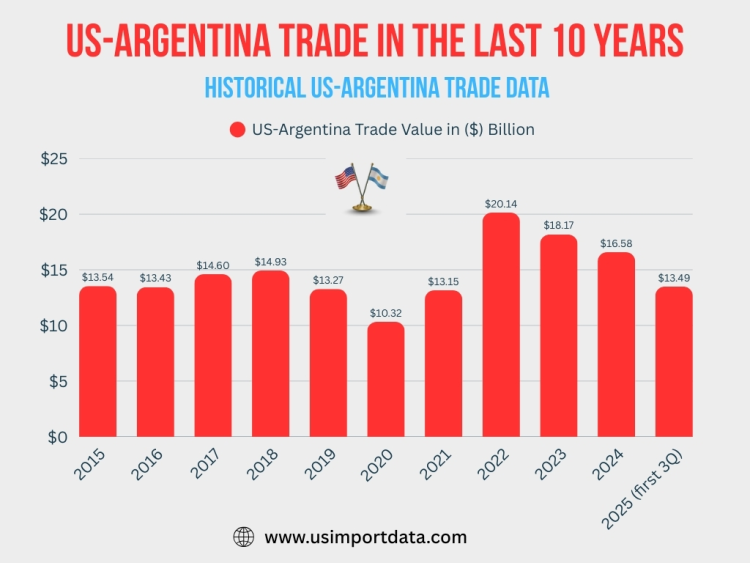
The total value of US trade with Argentina, or the US-Argentina trade, accounted for $16.58 billion in 2024 and $13.49 billion in the first three quarters of 2025. Argentina is the 35th largest trading partner of the US, as per the global trade data. Argentina recorded its largest trade surplus in history in 2024, while the United States reinforced its trade presence in Latin America amid global supply chain realignments. Together, these developments reshaped bilateral trade flows, investment patterns, and policy priorities.
This blog provides a detailed analysis of:
-
The structure of US–Argentina trade in 2024–25
-
The top U.S. export categories to Argentina
-
Sector-specific drivers of export growth
-
The evolving trade and investment framework between the two countries
-
Risks, constraints, and future opportunities shaping trade relations in 2025
US–Argentina Trade Overview: The 2024–25 Landscape
Total Trade Value and Balance
In 2024, total trade in goods and services between the United States and Argentina exceeded $26 billion. U.S. exports accounted for a larger share of this exchange, giving the United States a consistent trade surplus with Argentina.
-
U.S. goods exports to Argentina (2024): $9.1 billion
-
U.S. goods imports from Argentina (2024): $7.4 billion
-
U.S. services exports to Argentina (2024): approximately $7.4 billion
-
Overall U.S. trade surplus: between $5–6 billion
This surplus reflects Argentina’s reliance on imported capital goods, energy products, pharmaceuticals, and advanced industrial inputs, many of which the United States supplies competitively.
Trade Momentum Entering 2025
Early and mid-2025 US-Argentina trade data show continued engagement, though with month-to-month volatility driven by:
-
Argentine currency adjustments
-
Import licensing reforms
-
Energy price fluctuations
-
Seasonal demand for machinery and chemicals
Despite short-term fluctuations, the underlying structure of the trade relationship remains stable, with U.S. exporters maintaining a strong market share in high-value categories.
Top Goods US Exports to Argentina: What Does the US Export to Argentina?
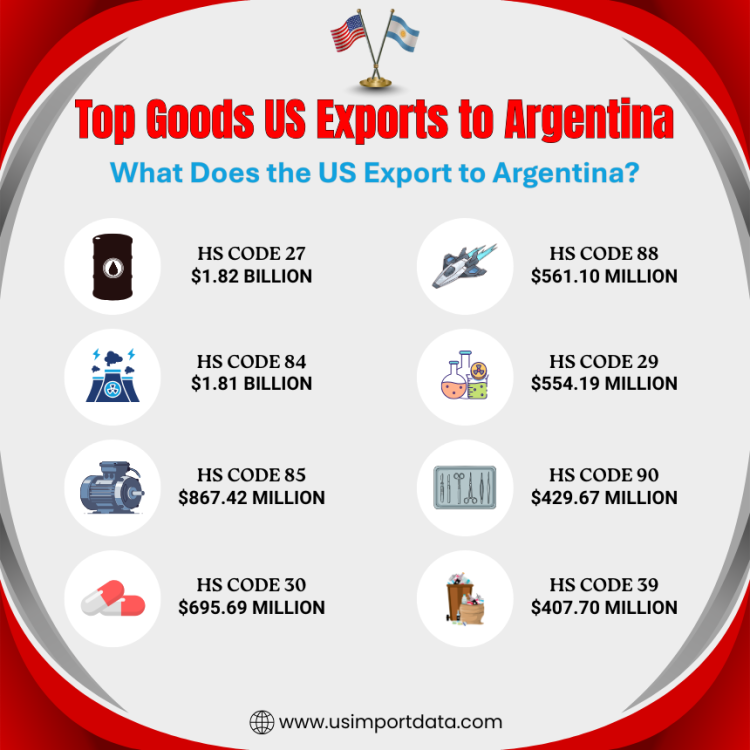
The United States exports a wide range of goods to Argentina, showcasing a robust trade relationship between the two countries. Some of the top goods that the US exports to Argentina include machinery, mineral fuels, aircraft, electrical machinery, and medical instruments. The leading exports of Argentina are primarily agricultural and industrial products, with major exports of Argentina including soybeans, corn, and meat, while Argentina major imports focus on machinery, vehicles, and energy products to support domestic production and consumption.
These products are not only essential for Argentina's economy but also reflect the diverse industries in the US. The top 10 products that the US exports to Argentina, as per the US-Argentina trade data & US shipment data for 2024-25, include:
1. Mineral fuels & oils (HS code 27): $1.82 billion
Mineral fuels and oils are one of the largest categories of exports from the US to Argentina. This category includes products such as petroleum oils, coal, and natural gas. With a value of $1.82 billion, it is a significant part of the trade relationship between the two countries. Energy products remain the largest U.S. export category to Argentina. This includes refined petroleum products, specialized fuels, lubricants, and energy-related derivatives.
Although Argentina possesses significant energy resources, including shale reserves, it continues to rely on imported refined products due to infrastructure constraints and fluctuating domestic production. U.S. suppliers benefit from scale, reliability, and technical standards that align well with Argentina’s industrial and transportation needs.
Energy exports are also linked to:
-
Electricity generation inputs
-
Industrial fuel use
-
Transportation sectors
As Argentina expands its energy infrastructure, demand for U.S. energy technology and products is expected to remain strong through 2025.
2. Nuclear reactors & machinery (HS code 84): $1.81 billion
Nuclear reactors and machinery are another major export category to Argentina from the US. This category includes equipment and machinery used in the nuclear industry, such as reactors and parts, as per the data on US machinery exports to Argentina by HS code. With a value of $1.81 billion, it demonstrates the importance of this sector in the trade between the two nations. Machinery is one of the most strategically important U.S. export categories to Argentina.
This segment includes:
-
Industrial machinery
-
Agricultural equipment
-
Construction and mining machinery
-
Manufacturing production lines
Argentina’s domestic manufacturing sector depends heavily on imported machinery due to limited local production capacity. U.S. machinery is particularly valued for durability, precision, and after-sales support.
Growth drivers in 2024–25 include:
-
Agricultural modernization
-
Infrastructure rehabilitation
-
Energy sector expansion
-
Food processing investments
Machinery imports also signal longer-term capital investment, making this category a key indicator of economic confidence.
3. Electrical machinery & equipment (HS code 85): $867.42 million
Electrical machinery and equipment are essential components of modern industries, and the US exports a significant amount of these products to Argentina. With a value of $867.42 million, this category covers a wide range of products, including electrical appliances, generators, and transmission equipment.
Electrical machinery includes a broad range of products:
-
Power generation equipment
-
Electrical components
-
IT hardware
-
Control systems
Argentina’s demand for electrical machinery is tied to digitalization, grid upgrades, telecommunications, and industrial automation. U.S. firms hold a competitive edge due to advanced technology, regulatory compliance, and integration with global supply chains. This category has shown steady year-on-year growth, particularly in sectors linked to energy efficiency and smart infrastructure.
4. Pharmaceutical products (HS code 30): $695.69 million
The pharmaceutical industry is another key sector in the trade relationship between the US and Argentina. With a value of $695.69 million, pharmaceutical products play a crucial role in meeting the healthcare needs of the Argentine population. This category includes medicines, vaccines, and other healthcare products. Pharmaceutical exports represent one of the fastest-growing U.S. export categories to Argentina.
Products include:
-
Branded medicines
-
Specialized treatments
-
Vaccines and biologics
Argentina imports a large share of high-value pharmaceutical products due to limited domestic R&D capacity. U.S. pharmaceutical companies benefit from strong brand recognition, regulatory credibility, and demand for advanced therapies. Healthcare spending and an aging population support continued growth in this sector through 2025.
5. Aircraft, spacecraft, & parts thereof (HS code 88): $561.10 million
The aerospace industry is a significant contributor to US exports to Argentina, with aircraft, spacecraft, and parts being exported to the country. With a value of $561.10 million, this category includes airplanes, helicopters, and components used in the aviation sector.
Aircraft and aerospace exports include:
-
Commercial aircraft components
-
Maintenance and repair parts
-
Aviation technology systems
Argentina’s civil aviation sector relies heavily on imported aircraft technology. U.S. aerospace firms dominate this market due to technical standards, safety records, and global servicing networks. Aerospace exports are high-value but irregular, often influenced by fleet renewal cycles and financing conditions.
6. Organic chemicals (HS code 29): $554.19 million
Organic chemicals are essential raw materials used in various industries, including pharmaceuticals, agriculture, and manufacturing. With a value of $554.19 million, this category covers a wide range of chemical compounds that are exported from the US to Argentina.
Organic chemicals are essential inputs for:
-
Pharmaceuticals
-
Plastics
-
Agrochemicals
-
Industrial manufacturing
Argentina’s agricultural and industrial sectors create steady demand for chemical inputs. U.S. chemical exports benefit from scale, consistency, and compliance with international safety standards. This category is sensitive to global price shifts but remains structurally important.
7. Optical, medical, surgical instruments (HS code 90): $429.67 million
Optical, medical, and surgical instruments are crucial for the healthcare sector, and the US exports a significant amount of these products to Argentina. With a value of $429.67 million, this category includes products such as medical devices, diagnostic equipment, and surgical instruments. These exports include diagnostic equipment, laboratory instruments, and precision devices used in healthcare and industry.
Demand is driven by:
-
Healthcare modernization
-
Scientific research
-
Industrial quality control
U.S. products dominate the high-end segment due to precision and technological sophistication.
8. Plastics & articles thereof (HS code 39): $407.70 million
Plastics and articles thereof are essential materials used in various industries, including packaging, construction, and automotive. With a value of $407.70 million, this category covers a wide range of plastic products exported from the US to Argentina, as per the data on US plastic exports to Argentina.
9. Miscellaneous chemical products (HS code 38): $354.01 million
Miscellaneous chemical products encompass a broad range of chemicals used in different industries, from cosmetics to cleaning products. With a value of $354.01 million, this category includes chemicals, waxes, and other related products exported to Argentina from the US.
10. Vehicles (HS code 87): $274.83 million
Vehicles are an essential part of the transportation sector, and the US exports a significant amount of vehicles to Argentina. With a value of $274.83 million, this category includes passenger cars, trucks, and other vehicles exported to the country.
US-Argentina Trade in the Last 10 Years: Historical US-Argentina Trade Data
|
Year of Trade |
Total US-Argentina Trade Value ($) |
|
2015 |
$13.54 billion |
|
2016 |
$13.43 billion |
|
2017 |
$14.60 billion |
|
2018 |
$14.93 billion |
|
2019 |
$13.27 billion |
|
2020 |
$10.32 billion |
|
2021 |
$13.15 billion |
|
2022 |
$20.14 billion |
|
2023 |
$18.17 billion |
|
2024 |
$16.58 billion |
|
2025 (first 3 quarters) |
$13.49 billion |
Argentina’s Exports to the US: Trade Context
Argentina’s exports to the U.S. are concentrated in:
-
Energy products
-
Precious metals
-
Aluminum
-
Agricultural and food products
These exports are commodity-heavy and sensitive to global prices. As a result, bilateral trade balances can fluctuate year to year, even if underlying demand remains stable.
Trade Policy Developments and New Frameworks in 2025
Reciprocal Trade and Investment Framework
On March 23, 2016, Argentina and the United States signed the Trade and Investment Framework Agreement (TIFA). The main forum for talks about trade and investment matters between Argentina and the United States is this agreement. In 2025, the U.S. and Argentina advanced a new framework aimed at modernizing trade relations.
While not a full free trade agreement, it focuses on:
-
Reducing non-tariff barriers
-
Improving customs efficiency
-
Expanding market access for key sectors
-
Encouraging bilateral investment
The framework reflects a pragmatic approach, prioritizing achievable reforms over sweeping agreements.
Sector-Specific Cooperation
Key areas of cooperation include:
-
Agriculture and food security
-
Energy and critical minerals
-
Technology and innovation
-
Infrastructure development
These initiatives are designed to deepen integration without requiring large-scale treaty changes.
Economic and Political Context Shaping Trade
Argentina’s Economic Reset
Argentina’s record trade surplus in 2024 was driven by strong exports and reduced imports. Structural reforms, fiscal tightening, and currency adjustments reshaped trade incentives.
For U.S. exporters, this creates both opportunity and risk:
-
Opportunities through liberalized imports and investment rules
-
Risks from reduced purchasing power and policy volatility
US Strategic Interests
For the United States, Argentina represents:
-
A counterbalance to other global trade influences
-
A destination for high-value exports
-
A partner in regional stability and supply chain diversification
Challenges and Risks Ahead
Despite positive momentum, challenges remain:
-
Currency volatility affects import affordability
-
Regulatory uncertainty can delay transactions
-
Infrastructure bottlenecks limit trade expansion
-
Global economic shocks can disrupt demand
Managing these risks will be essential for sustained growth in bilateral trade.
Conclusion: The Road Ahead for US–Argentina Trade
In conclusion, by 2025 and beyond, US–Argentina trade relations will be more complex, more diversified, and more strategic than in previous decades. The data from 2024–25 shows strong U.S. export performance across energy, machinery, pharmaceuticals, and technology, supported by new policy frameworks and economic reforms.
While challenges persist, the long-term outlook suggests continued engagement, particularly in high-value sectors where the United States holds a competitive advantage. For exporters, investors, and policymakers, Argentina remains a market worth watching and engaging in as bilateral ties continue to evolve.
We hope that you liked our data-driven & insightful blog report on the US-Argentina trade relations & trade deal insights 2025. For more information on the latest US import-export data, or to search live US import-export data by country, visit USImportdata. Contact us at info@tradeimex.in for customized trade reports & market insights.
What's Your Reaction?