Top Diamond Importers in the USA & US Diamond Import Trends: Duties and Regulations Explained
Discover the top diamond importers in the USA and explore US diamond import trends, key source countries, tariff regulations, & duties.
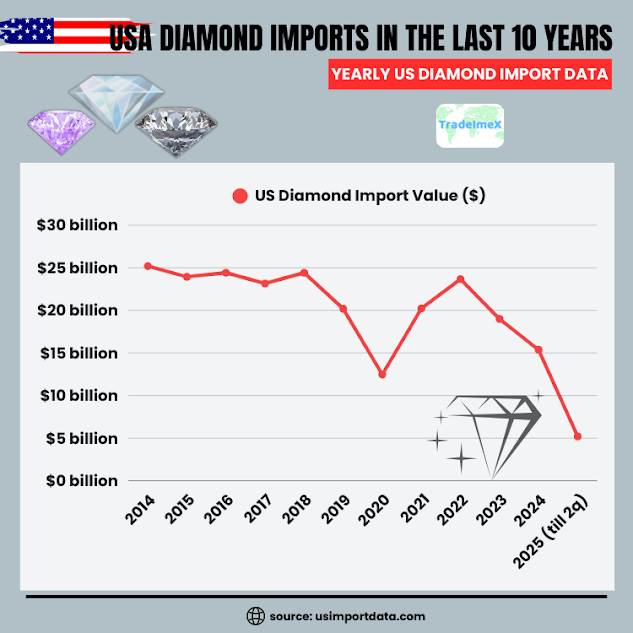
Diamonds are not only a symbol of beauty and luxury but also a cornerstone of international trade. The United States, home to the world’s largest consumer market for diamond jewelry, is at the center of this trade. While the U.S. mines very few diamonds domestically, its role as the ultimate buyer makes it one of the most influential players in the global diamond supply chain. According to the US import data and diamond import data of the USA, the total value of US diamond imports reached $15.36 billion in 2024, a 19% decline from the previous year. The US imported diamonds worth a total value of $5.2 billion in the first two quarters of 2025, as per the US diamond import data. The market for importing diamonds has grown steadily as American diamond importers expand their global sourcing networks, carefully evaluating quality, pricing, and regulations, especially when navigating the import duty on diamond jewellery in usa.
As per the global trade data, the USA is the 2nd largest diamond importer in the world, only behind India. In recent years, however, U.S. diamond import patterns have been shifting, driven by tariffs, changing consumer behavior, and new regulatory frameworks. In this data-driven blog, we’ll break down who the top U.S. diamond importers are, how the US diamond import trends have evolved, and what duties and regulations businesses must understand to stay compliant and competitive.
U.S. Diamond Import Market at a Glance
The U.S. is the largest consumer of diamonds in the world, accounting for about half of global demand for polished stones, according to reports on US diamond and jewellery consumers. Engagement rings, wedding bands, and luxury jewelry fuel this consumption. Unlike India or Belgium, which import diamonds to process and re-export, the U.S. imports mostly for final consumption.
-
2023 imports: Around $19 billion worth of diamonds.
-
2024 imports: Dropped to about $15.4 billion, a nearly 20% decline.
-
Share of global imports: Roughly 19%, second only to India.
The decline highlights how sensitive diamond demand is to economic trends, tariffs, and competition from lab-grown alternatives.
US Diamond Imports by Country: Where Does the US Import Diamonds From?
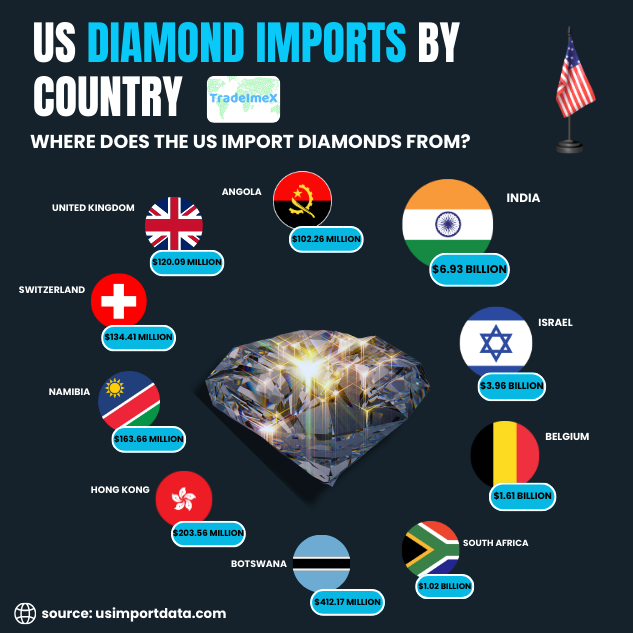
US Diamond Imports by Country show that the United States sources diamonds from various countries worldwide. The year 2024-25 saw a substantial amount of diamond imports into the US from various countries around the globe. Some of the top countries from which the US imports diamonds include India, Belgium, Israel, Canada, and the United Arab Emirates. These countries have established themselves as key players in the diamond industry, providing a wide range of high-quality diamonds to meet the demands of the US market. The top 10 import partners for US diamond imports by country, as per the US shipment data and US diamond import statistics for 2024-25, include:
1. India: $6.93 billion (45.1%)
India stands out as the top country for diamond imports into the US, accounting for a significant 45.1% of the total imports, as per the data on US diamond imports from India. The Indian diamond industry is renowned for its cutting and polishing expertise, making it a crucial player in the global diamond trade.
2. Israel: $3.96 billion (25.8%)
Israel is another major contributor to US diamond imports, with a share of 25.8% in the market. The country's cutting-edge technologies and skilled workforce have established it as a key player in the diamond industry.
3. Belgium: $1.61 billion (10.5%)
Belgium holds a prominent position in the US diamond import market, claiming 10.5% of the total imports. The country's long-standing tradition of diamond trading and craftsmanship has made it a favored destination for high-quality diamonds.
4. South Africa: $1.02 billion (6.7%)
South Africa's rich diamond mines contribute significantly to the US diamond market, holding a share of 6.7% in total imports. The country's diamond industry is known for producing some of the world's most exquisite gems.
5. Botswana: $412.17 million (2.7%)
Botswana's diamond industry plays a vital role in supplying diamonds to the US, capturing a market share of 2.7%. The country's partnership with De Beers has helped it become a major player in the global diamond trade.
6. Hong Kong: $203.56 million (1.3%)
Hong Kong serves as an important source of diamonds for the US market, holding a share of 1.3% in total imports. The city's strategic location and well-established diamond trading infrastructure make it a key player in the industry.
7. Namibia: $163.66 million (1.1%)
Namibia's diamond exports make a significant contribution to the US market, with a share of 1.1% in total imports. The country's commitment to sustainable diamond mining practices has earned it a reputation for ethical sourcing.
8. Switzerland: $134.41 million (0.9%)
Switzerland's role in the US diamond market is noteworthy, accounting for 0.9% of total imports. The country's reputation for precision craftsmanship and high-quality diamonds has made it a favored supplier.
9. United Kingdom: $120.09 million (0.8%)
The United Kingdom also plays a part in supplying diamonds to the US market, with a share of 0.8% in total imports. The country's long history of diamond trading and expertise in the industry make it a reliable source of quality stones.
10. Angola: $102.26 million (0.7%)
Angola rounds out the list of top countries for US diamond imports, capturing a market share of 0.7%. The country's diamond reserves and commitment to sustainable mining practices make it a valuable contributor to the global diamond trade.
List of Diamond Importers in the US: Top 10 U.S. Diamond Importing Companies
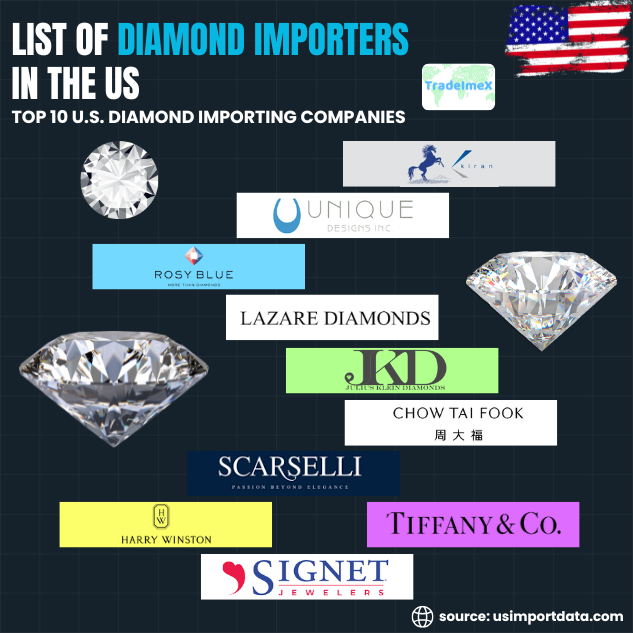
When looking for reliable and top-tier diamond importers in the U.S., the US Diamond Importers Database is a valuable resource showcasing the leading U.S. Diamond Importing Companies. This list of the top 10 importers provides insight into the key players in the industry, offering a wealth of information for those seeking to engage in the diamond trade. The leading diamond importers in the US, as per the US diamond buyers & American diamond importers data for 2024-25, include:
|
Rank |
Company Name |
Approx. Import Value (2024) |
Main Diamond Types Imported |
Top Import Source Countries |
|
1 |
$4 billion |
Polished diamonds, loose-cut stones |
India, Belgium |
|
|
2 |
Unique Designs Inc |
$3 billion |
Polished diamonds, designer cuts |
India, Israel |
|
3 |
Rosy Blue Inc (USA) |
$2 billion |
Polished diamonds, melee stones |
India, Belgium |
|
4 |
Lazare Kaplan International |
$1.7 billion |
“Ideal-cut” polished diamonds |
Botswana, South Africa, Canada |
|
5 |
Julius Klein Group |
$1.4 billion |
Polished diamonds, rough for in-house cutting |
South Africa, Namibia, India |
|
6 |
Chow Tai Fook (U.S. arm) |
$1.2 billion |
Polished diamonds for retail chains |
Hong Kong, China, India |
|
7 |
Scarselli Diamonds |
$1 billion |
Natural fancy colored diamonds |
South Africa, Botswana |
|
8 |
Harry Winston (U.S. ops) |
$0.9 billion |
High-value polished diamonds |
Canada, South Africa |
|
9 |
Tiffany & Co. (now LVMH) |
$0.8 billion |
Polished diamonds for branded jewelry |
Botswana, Namibia, Belgium |
|
10 |
Signet Jewelers (U.S. ops) |
$0.7 billion |
Polished diamonds for mass retail |
India, Israel, Botswana |
USA Diamond Imports in the Last 10 Years: Yearly US Diamond Import Data
|
Year of Imports |
US Diamond Import Value ($) |
|
2014 |
$25.20 billion |
|
2015 |
$23.94 billion |
|
2016 |
$24.42 billion |
|
2017 |
$23.16 billion |
|
2018 |
$24.42 billion |
|
2019 |
$20.19 billion |
|
2020 |
$12.47 billion |
|
2021 |
$20.22 billion |
|
2022 |
$23.67 billion |
|
2023 |
$18.99 billion |
|
2024 |
$15.36 billion |
|
2025 (till quarter 2) |
$5.20 billion |
Top U.S. Diamond Import Partners by Country
The U.S. sources its diamonds from a mix of cutting centers, trading hubs, and mining nations. Here’s a breakdown of the major partners:
1. India – The Dominant Supplier
India is the largest source of diamonds for the U.S., shipping nearly $7 billion worth of stones in 2024. While these diamonds may have originated in Africa, Russia, or Canada, India’s role as the world’s premier polishing hub means that most pass through Indian hands before reaching U.S. jewelers.
-
Strengths: Low-cost skilled labor, massive polishing infrastructure in Surat.
-
Recent trend: Imports fell by about 10% in 2024, as U.S. demand weakened and tariffs raised costs.
2. Israel – The Polished Diamond Specialist
Israel supplies about $4 billion in diamonds to the U.S. annually, though exports fell nearly 30% in 2024. Israel has built a reputation for cutting larger, higher-value stones, especially those above 1 carat, making it an important partner for luxury retailers in the U.S.
-
Strengths: Expertise in precision cutting of high-value diamonds.
-
Challenge: Tariffs have eroded competitiveness against India.
3. Belgium – Antwerp’s Declining Share
Once the world’s diamond capital, Antwerp remains a key player, with U.S. imports worth $1.6 billion in 2024. But that number represents a steep drop of more than 20% year over year. Tariffs and competition from India have severely dented Belgium’s position.
-
Strengths: Historic trading hub, strong compliance infrastructure.
-
Weakness: High costs compared to Indian and African suppliers.
4. South Africa – The African Producer
South Africa supplied nearly $1 billion worth of diamonds to the U.S. in 2024, roughly flat from the year before. As a major mining nation, South Africa increasingly seeks to export polished stones directly rather than sending rough stones abroad for processing.
5. Botswana – Growing Beneficiation Model
Botswana exported around $400 million in diamonds to the U.S. in 2024. Its government has been pushing for local polishing, known as beneficiation, to capture more of the value chain domestically.
6. Other Growing Sources
-
Namibia: Exports to the U.S. surged nearly 50% in 2024.
-
Lesotho: Also saw export growth of more than 40%.
-
Canada: Supplies smaller volumes but benefits from preferential trade treatment under USMCA.
-
UK & Armenia: Emerging suppliers, though on a smaller scale.
Trends in U.S. Diamond Imports
1. Declining Import Volumes
The sharp decline from $19 billion in 2023 to $15.4 billion in 2024 reflects weaker consumer spending. Inflation, high interest rates, and slowing luxury demand all played a role.
2. Shift in Supply Sources
While India remains dominant, African nations like Namibia, Botswana, and Lesotho are increasing direct exports of polished stones. This trend reflects efforts by producer countries to keep more of the value chain at home rather than outsourcing cutting to India.
3. Tariff-Driven Distortions
The introduction of broad tariffs, typically 10% on diamond imports, has reshaped sourcing decisions. Some shipments surged ahead of tariff deadlines, while others slowed as costs rose. For example, Indian exporters rushed shipments to the U.S. in early 2025 to beat tariff hikes, creating a temporary spike.
4. Rising Lab-Grown Competition
Lab-grown diamonds are eroding demand for natural stones, particularly in the U.S. engagement ring market. With prices up to 70% lower than mined diamonds, lab-grown alternatives appeal to younger, budget-conscious buyers. This shift is directly impacting U.S. imports of natural diamonds.
Duties & Tariffs on US Diamond Imports
Understanding tariff and duty structures is critical for U.S. importers.
The 10% Baseline Duty
Since 2018, a 10% duty has applied to most diamond imports. This measure was part of broader trade actions designed to reduce trade deficits, though it had little domestic economic benefit given the lack of U.S. diamond production.
Special Country Treatments
-
Canada: Duty-free under USMCA, provided diamonds are mined and polished in Canada.
-
India & Belgium: Standard 10% duty applies.
-
China: Subject to extremely high tariffs, in some cases exceeding 100%, effectively shutting China out of the U.S. diamond market.
Substantial Transformation Rule
For polished diamonds, the country of origin is determined by where the stone is cut and polished, not where it was mined.
-
Example: A rough stone mined in Canada but polished in India is considered Indian-origin, subject to a 10% duty.
-
If polished in Canada, it qualifies for duty-free entry.
Impact on Industry
Jewelry companies and importers argue these tariffs act as a consumption tax with no U.S. industry to protect. Instead, they add costs for American consumers and put pressure on jewelry retailers. Industry groups continue to lobby for exemptions.
Regulations Governing U.S. Diamond Imports
Kimberley Process Certification Scheme (KPCS)
The Kimberley Process is the cornerstone of diamond import regulations. Its purpose is to prevent the trade in “conflict diamonds” used to fund wars.
Key Requirements for Importers:
-
All rough diamond shipments must be accompanied by a valid Kimberley Process Certificate from the exporting country.
-
Certificates must be retained for at least five years.
-
Importers must declare the certificate number on all U.S. Customs filings.
U.S. Enforcement
The U.S. Kimberley Process Authority oversees compliance. Non-compliance can lead to fines, seizure of goods, or criminal charges. Customs and Border Protection (CBP) also requires that diamond importers use the Automated Broker Interface for proper filing.
Other Compliance Considerations
-
Anti-Money Laundering (AML) rules: Jewelers and diamond dealers in the U.S. must comply with AML obligations, including reporting suspicious transactions.
-
Consumer protection and disclosure: The Federal Trade Commission (FTC) requires that lab-grown diamonds be clearly disclosed to avoid consumer deception.
Challenges Facing the US Diamond Importers
1. Tariff Uncertainty
Frequent changes in tariff policy make long-term planning difficult. Importers must constantly adapt to shifting cost structures.
2. Weak Consumer Demand
Economic uncertainty and growing acceptance of lab-grown diamonds are dampening natural diamond demand.
3. Rising Compliance Burden
Kimberley Process requirements, customs filings, and AML obligations add to the administrative load of importers.
4. Shifting Global Trade Routes
Traditional hubs like Antwerp are losing share to Dubai, Surat, and African beneficiation centers, forcing U.S. importers to diversify sources.
Looking Ahead: The Future of US Diamond Imports
The U.S. diamond import landscape is being reshaped by tariffs, shifting supply chains, and consumer preferences. Going forward, several factors will define the trajectory:
-
Tariff policy adjustments – Exemptions or reductions could revive imports from traditional centers like Belgium and Israel.
-
African beneficiation – Direct exports of polished stones from Botswana, Namibia, and South Africa will likely continue to rise.
-
Consumer behavior – If lab-grown diamonds capture more market share, imports of natural stones could face further decline.
-
Transparency and traceability – New technologies for tracking diamonds from mine to market may strengthen regulatory compliance and consumer trust.
Conclusion and Final Thoughts
In conclusion, the United States remains the heart of global diamond consumption, but its import market is under pressure. India, Israel, and Belgium remain key suppliers, while African nations are emerging as direct exporters. Imports have declined sharply due to tariffs, weaker consumer demand, and competition from lab-grown diamonds. For US importers, the challenge lies in navigating this complex environment, balancing cost, compliance, and consumer expectations. Duties, the Kimberley Process, and shifting trade dynamics are all critical considerations. Those who adapt quickly, diversify suppliers, and embrace transparency will be best positioned to succeed in a market that is as glittering as it is volatile.
We hope that you liked our insightful blog report on the US diamond import trends in 2025. To access the latest US export-import data or to search live data on US diamond imports by country, visit USImportdata. Contact us at info@tradeimex.in to get customized trade reports, market insights, and a verified list of the top diamond importers in the USA, as per your requirements.
What's Your Reaction?