US-Ukraine Trade Relations 2025: Trade Deal Insights & Top US Imports from Ukraine
Discover the US-Ukraine trade relations in 2025, top US imports from Ukraine, & the new strategic minerals deal shaping future economic cooperation.

For the US-Ukraine bilateral trade, 2025 is a turning point. Bilateral goods trade remains modest in absolute value, dominated by raw materials and metals. Still, a new resource-investment agreement between the United States and Ukraine shifts the relationship toward a long-term strategic partnership. In 2024, the two countries recorded roughly $2.9 billion in goods trade: about $1.7 billion in U.S. exports to Ukraine and $1.23 billion in U.S. imports from Ukraine, giving the United States a goods surplus of approximately $517 million. According to the latest US import data and Ukraine export data, the total value of US imports from Ukraine reached $1.23 billion in 2024, a 1% decline from the previous year. The US imported goods worth $800 million from Ukraine in the first two quarters of 2025. The total US-Ukraine trade accounted for $2.91 billion in 2024 and $1.96 billion in the first two quarters of 2025, as per the US-Ukraine trade statistics.
Ukraine is the 47th largest trading partner of the US, as per the global trade data. The largest U.S. import categories from Ukraine are iron and steel in both primary and semi-finished forms, followed by processed steel products, electronics components, agricultural fats and oils, prepared foods, and various chemicals. A 2025 minerals and resources agreement creates a reconstruction investment vehicle and provides U.S. firms privileged access to certain Ukrainian resources; if implemented well, it could finance reconstruction and deepen industrial ties, but it also carries governance, security, and commodity-dependence risks.
In this article, we will explore the US-Ukraine trade relations in 2025, along with the top US imports from Ukraine & the latest US-Ukraine minerals deal.
The Baseline: US-Ukraine Trade Flows & What They Mean
Trade in context
Measured against the scale of U.S. global trade, trade with Ukraine is small. That said, the composition of US-Ukraine trade is revealing. In 2024, U.S. exports to Ukraine rose sharply, driven largely by capital goods, machinery, and defense-adjacent items needed for reconstruction and military trade. U.S. imports from Ukraine, meanwhile, declined modestly from the prior year but remain concentrated in a few commodity categories. Services trade flows show a larger U.S. surplus, driven by professional services, IT, and financial services, but the goods picture remains the best single lens for understanding industrial linkages. Ukraine maintains a focused trade relationship with the United States, where Ukraine biggest export to US is largely driven by raw materials and agricultural commodities. Among the Ukraine main exports to US, products such as iron and steel, agricultural goods, and food items play a significant role in bilateral trade.
In particular, Ukraine grain exports to US have gained attention in recent years, with commodities like corn and wheat contributing to supply chains, although most Ukrainian grain is traditionally directed toward Europe, Asia, and the Middle East rather than the U.S. market. Understanding what does Ukraine export to USA involves looking at the broader flow of us imports from Ukraine, which includes metals, agricultural goods, and specialized industrial products. Recent discussions about a US-Ukraine minerals deal have also brought attention to critical raw materials in Ukraine trade with US, especially as the U.S. evaluates supply-chain security. Key food-related questions, such as does Ukraine export sunflower oil, connect to the role of major Ukraine sunflower oil exporters and how they fit into overall US trade with Ukraine. These evolving exchanges form an important part of United States relations with Ukraine, especially in sectors tied to energy, food, and strategic resources.
On the other side of the economic relationship, us exports to Ukraine include machinery, vehicles, and high-tech equipment, shaping the balance of US-Ukraine trade. Both countries continue to explore frameworks for a deeper US-Ukraine trade deal, reflecting mutual interest in expanding market access. Agricultural trade remains a frequent topic, with many asking about US grain imports from Ukraine and US wheat imports from Ukraine, as well as whether does US import oil from Ukraine given Ukraine’s limited crude production. Altogether, these factors highlight the complexity and strategic importance of US trade with Ukraine in today’s geopolitical environment.
What the numbers mean for each country
For the United States: Modest imports, strategic interest. The U.S. is not replacing major supplier relationships through trade with Ukraine, but it is positioning itself to secure specific raw materials and diversify supply chains for critical inputs.
For Ukraine: Imports exceed exports globally by a wide margin. Ukraine’s overall goods exports in 2024 were far larger than its exports to the U.S. alone, but reconstruction needs and wartime disruption mean imports of capital goods and fuels remain crucial. The bilateral trade surplus the U.S. enjoys here masks Ukraine’s broader external deficits and dependence on outside capital.
Top Goods US Imports from Ukraine: What Does the US Import from Ukraine?
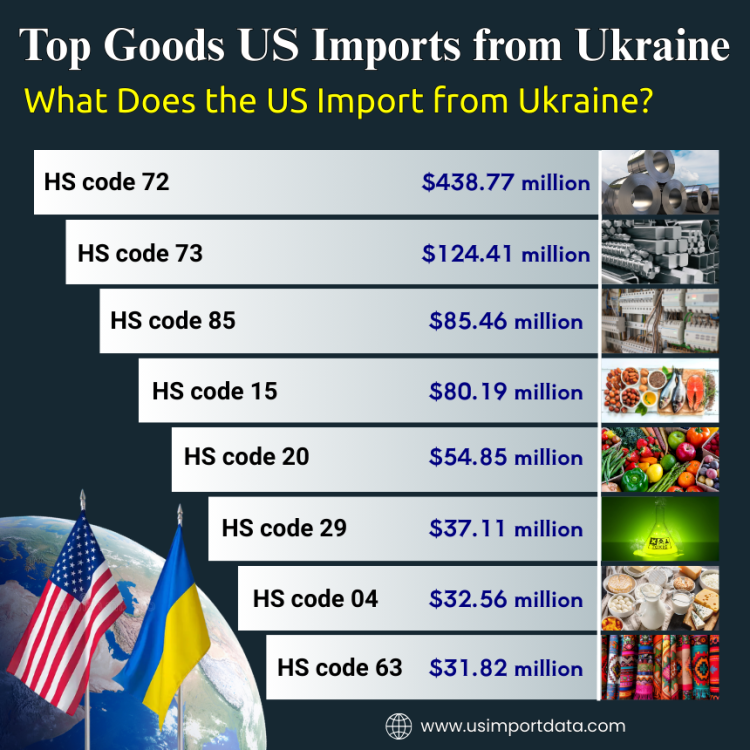
The United States imports a variety of goods from Ukraine, with key products including steel, cereals, iron, and miscellaneous edible preparations. The trade relationship between the US and Ukraine has strengthened over the years, with both countries benefiting from the exchange of goods and services. The top 10 products that the US imports from Ukraine, as per the US shipment data for 2024-25, include:
1. Iron & Steel (HS code 72): $438.77 million
Iron and steel products are among the top goods that the US imports from Ukraine. These goods are essential for various industries, including construction, automotive, and manufacturing. The US relies on Ukraine for a significant amount of iron and steel imports, with a value of $438.77 million.
2. Articles of Iron or Steel (HS code 73): $124.41 million
In addition to raw iron and steel, the US also imports articles made of iron or steel from Ukraine. These could include products like iron and steel pipes, screws, and other metal items. The total value of these imports amounts to $124.41 million, reflecting the importance of these goods in the US market.
3. Electrical Machinery & Equipment (HS code 85): $85.46 million
Electrical machinery and equipment are crucial for various industries and daily life in the US. Ukraine is a significant supplier of these goods to the US, with an import value of $85.46 million. These products include items like electrical transformers, generators, and other electrical equipment.
4. Animal or Vegetable Fats & Oils (HS code 15): $80.19 million
Fats and oils derived from animals or vegetables are another category of goods that the US imports from Ukraine. These products have a wide range of uses, from food production to industrial applications. The US imports animal or vegetable fats and oils from Ukraine with a total value of $80.19 million.
5. Preparations of Fruits & Vegetables (HS code 20): $54.85 million
Preparations of fruits and vegetables are also among the top goods that the US imports from Ukraine. These could include products like fruit jams, vegetable preserves, and other processed food items. The US imports preparations of fruits and vegetables from Ukraine with a total value of $54.85 million.
6. Organic Chemicals (HS code 29): $37.11 million
Organic chemicals are essential for various industries, including pharmaceuticals, agriculture, and manufacturing. The US imports organic chemicals from Ukraine with a total import value of $37.11 million. These chemicals play a crucial role in the production of a wide range of products.
7. Dairy Products (HS code 04): $32.56 million
Dairy products are a staple in the US market, with a high demand for items like milk, cheese, and yoghurt. Ukraine is a significant supplier of dairy products to the US, with an import value of $32.56 million. These products play a crucial role in meeting the needs of US consumers.
8. Other Made-Up Textiles (HS code 63): $31.82 million
Textile products are another category of goods that the US imports from Ukraine. These could include items like clothing, fabrics, and textile accessories. The US imports other made-up textiles from Ukraine with a total value of $31.82 million, reflecting the importance of these products in the US market.
9. Ores, Slag, & Ash (HS code 26): $31.37 million
Ores, slag, and ash are essential raw materials for various industries, including mining, metallurgy, and construction. The US imports ores, slag, and ash from Ukraine, totaling $31.37 million, highlighting the significance of these goods in the US economy.
10. Miscellaneous Chemical Products (HS code 38): $28.78 million
Miscellaneous chemical products are crucial for numerous industries, including pharmaceuticals, cosmetics, and manufacturing. The US imports miscellaneous chemical products from Ukraine with a total import value of $28.78 million. These products serve a wide range of applications in the US market.
The US-Ukraine Minerals/Natural-Resources Deal: What It Is, & Why It Matters
One of 2025’s landmark developments has been a deal between the U.S. and Ukraine that goes well beyond ordinary trade in goods. In effect, the US-Ukraine minerals deal transforms their relationship into a strategic, resource-driven partnership.
What the deal does:
-
In April 2025, the two countries signed a minerals and natural resources agreement that establishes a joint framework for exploiting Ukraine’s natural resource wealth.
-
Under that agreement, a joint investment vehicle, the U.S.-Ukraine Reconstruction Investment Fund, was created, which is designed to channel funds and resources into mining, extraction, and related infrastructure.
-
Ukraine’s parliament ratified the agreement in May 2025, with unanimous approval.
-
The deal reportedly gives U.S. companies preferential access to critical raw materials, including minerals that are increasingly strategic globally (rare earths, titanium, graphite, potentially lithium, etc.), as well as oil and gas resources.
Why it matters:
-
Strategic-resource access for U.S.: For Washington and U.S. firms, the deal represents a major opportunity to secure a supply of materials increasingly in demand globally, especially for green technologies, electronics, aerospace, & defense industries.
-
Long-term capital influx for Ukraine: For Kyiv, the deal offers a source of capital for reconstruction and a mechanism to monetize under-exploited natural resources, potentially funding infrastructure, industry rebuilding, resettlement, and long-overdue economic development.
-
Shift from wartime aid to economic partnership: Up until now, much of U.S.–Ukraine engagement has centred on security aid, humanitarian assistance, and short-term support. This deal reframes the relationship around long-term mutual economic interest and resource-based cooperation.
-
Potential structural transformation: If implemented properly, the revenues and investment from resource extraction could become a foundation for Ukraine to reindustrialize, modernize its economy, and gradually rebuild its export capacity, beyond raw commodities.
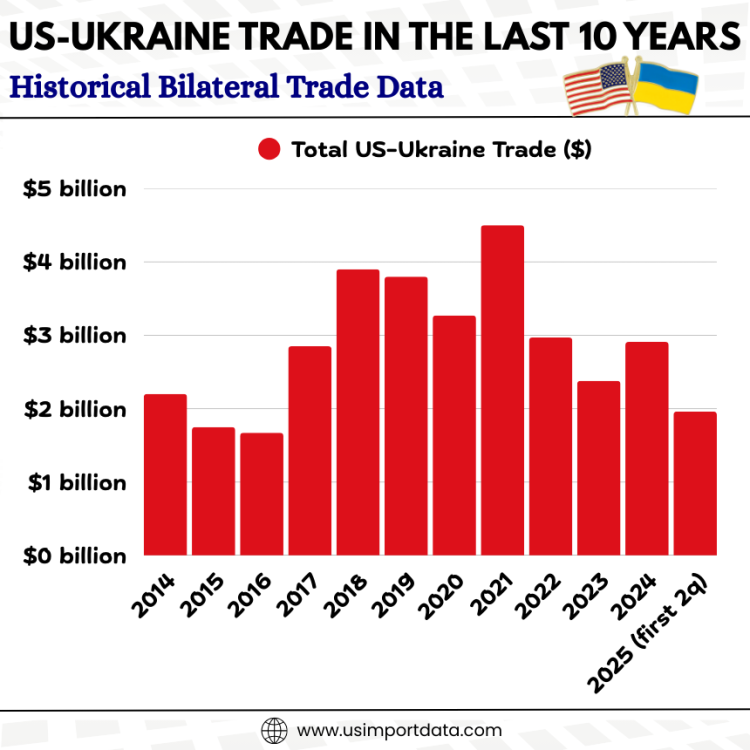
US-Ukraine Trade in the Last 10 Years: Historical Bilateral Trade Data
|
Year of Trade |
Total US-Ukraine Trade ($) |
|
2014 |
$2.20 billion |
|
2015 |
$1.75 billion |
|
2016 |
$1.67 billion |
|
2017 |
$2.85 billion |
|
2018 |
$3.90 billion |
|
2019 |
$3.80 billion |
|
2020 |
$3.27 billion |
|
2021 |
$4.50 billion |
|
2022 |
$2.97 billion |
|
2023 |
$2.38 billion |
|
2024 |
$2.91 billion |
|
2025 (first 2 quarters) |
$1.96 billion |
The 2025 US-Ukraine Trade Agreement
What the agreement does in practical terms
In 2025, the United States and Ukraine formalized a strategic minerals and resources agreement. The deal establishes a reconstruction investment fund and a legal framework for joint ventures between U.S. companies and Ukrainian entities to develop select mineral deposits. It prioritizes minerals deemed critical for modern industry, including certain rare earths, titanium, graphite, and battery-relevant inputs, while explicitly excluding fields already under active production until existing contracts are resolved.
Economic consequences for Ukraine
If executed transparently, the agreement can deliver three economic gains for Ukraine: capital inflows for investment, technology transfer to upgrade extraction and processing, and a revenue stream that can be allocated to reconstruction and industrial modernization. Because much of Ukraine’s heavy industry and infrastructure was damaged, access to foreign capital and expertise could catalyze faster rebuilding than aid alone.
Strategic consequences for the United States
For the U.S., the deal diversifies sources of critical minerals away from concentrated global suppliers. It is a strategic hedge: reduce geopolitical exposure associated with single-country dependencies and bolster supply chain resilience for defense, energy transition, and high-tech manufacturing. Preferential access to Ukrainian resources can secure long-term inputs for U.S. industrial policy goals.
Political and governance risks
Large resource deals often create moral hazards and governance challenges. Risks include rent capture by politically connected actors, weak oversight leading to corruption, and the potential for extraction revenues to be misapplied. Managing those risks requires robust transparency mechanisms, clear governance of the reconstruction fund, and domestic Ukrainian political reforms to ensure broad benefit.
Security and implementation risks
Practical challenges are significant. Mining projects require stable infrastructure, secure transport corridors, and safe operating environments. With ongoing hostilities and potential for attacks on energy and transport infrastructure, getting mines up and running at scale will be complex and time-consuming. The timeline from discovery to commercial output can be measured in years, not months.
Interpreting the trade and the deal together
A shift from short-term aid to a strategic economic partnership
Until now, the US–Ukraine trade relationship had been dominated by security aid and humanitarian assistance. The 2025 agreement signals a pivot toward embedding economic and industrial interests in the bilateral relationship. That can deepen ties and create mutual incentives for stability, but it also reframes the relationship: economic returns and resource security now shape policy alongside security concerns.
Will resource access translate into broader industrial revival?
The central question for Ukraine’s long-term growth is whether resource revenues will be reinvested into productive capacity and infrastructure or simply exported as raw gains. Ideally, revenue should finance roads, ports, power grids, and training that enable domestic processing and value addition. If instead extraction proceeds without local processing capacity or reinvestment, Ukraine risks a resource-export path that leaves it vulnerable to commodity cycles and limited technology transfer.
Short-term trade does not equal long-term transformation
Modest bilateral trade volumes today do not preclude major economic effects tomorrow. The deal’s promise is future-oriented: if investors bring capital and technology, the composition of exports could shift from raw ore and pig iron to processed metals, refined chemicals, and higher-value manufactured goods over a multi-year horizon. That shift would require concerted policy choices and large public and private investment.
Policy lessons and recommendations
For Ukraine
-
Transparent revenue management: Implement strict rules for how resource revenue is collected, audited, and spent. Use ring-fenced mechanisms to ensure a portion of funds for infrastructure and human capital development.
-
Local value addition: Link extraction projects with obligations or incentives for domestic processing facilities and joint ventures that build local capacity in metallurgy and refining.
-
Security investment: Prioritize protecting transport routes and energy infrastructure that resource projects depend on; integrate security planning with economic project timelines.
-
Labor and environmental standards: Maintain high standards to avoid social backlash and long-term environmental costs that could undermine reconstruction.
For the United States
-
Conditional engagement: Tie preferential access to enforceable standards on governance, labor, and environmental protections to mitigate reputational and strategic risk.
-
Support for diversification: Complement resource deals with programs that help Ukraine develop non-commodity sectors, agriculture processing, light manufacturing, and IT services, to reduce single-sector dependence.
-
Long-horizon financing: Recognize that mining and processing take time; provide multi-year technical assistance and financing instruments that align with project maturation.
For private investors and industry
-
Risk-aware investment: Factor in security, trade, and governance risk premiums; work with multilateral partners to reduce political risk.
-
Local partnerships: Prioritize joint ventures with Ukrainian firms and long-term capacity building to create more stable supply chains.
-
Supply-chain integration: Plan for downstream integration so that mined materials feed regional processing hubs instead of being shipped raw overseas.
Scenario outlook: Three Plausible Paths to 2030
Optimistic scenario: managed transformation
Transparent governance, sustained U.S. and allied investment, and security stabilizations allow mines and processing plants to scale. Resource revenues fund infrastructure projects; local processing capacity expands; Ukrainian exports diversify. By 2030, Ukraine will show rising manufactured exports and reduced chronic trade deficits as economic output broadens.
Baseline scenario: partial progress, partial dependence
Projects proceed unevenly. Some resource projects succeed, but revenues are only partly reinvested. Ukraine sees modest GDP recovery and incremental industrial revival but remains exposed to commodity prices and external financing cycles. Trade with the U.S. grows slowly and remains focused on raw minerals and intermediate goods.
Pessimistic scenario: extractive trap
Security setbacks, weak governance, and price volatility lead to limited commercial output or capture of profits by foreign firms. Ukraine fails to build domestic processing, remains dependent on raw commodity exports, and the reconstruction fund yields limited social benefit. Political strain increases as expectations about a fast recovery go unmet.
What to watch in 2025–2026
-
Project announcements and financing rounds: Concrete investments, joint ventures, and timelines will indicate if the deal moves from framework to implementation.
-
Parliamentary and regulatory actions in Ukraine: Laws governing mineral rights, revenue management, and environmental safeguards will show the political appetite for transparent governance.
-
Export composition over time: A sustained increase in processed products versus raw materials would demonstrate industrial upgrading.
-
Security developments affecting infrastructure: Attacks or blockades that hit transport or power infrastructure will directly impede mining and processing efforts.
-
Commodity price trends: Markets for titanium, graphite, rare earths, and battery minerals will affect project economics and investor appetite.
Conclusion and Final Thoughts
In conclusion, 2025 is the year the U.S.–Ukraine relationship pivoted from primarily wartime support toward a long-term economic partnership anchored in resource cooperation. Current trade in goods remains modest and concentrated in metals and a few other categories, but the new resources agreement sets the stage for a possible transformation. The upside is substantial: capital, technology transfer, & reconstruction funding that could underwrite industrial revival. The downside is equally real: governance failures, security risks, and an economic trap of commodity dependence.
For both countries, success will require long horizons, careful governance, integrated planning across security and economic domains, and a commitment to reinvesting resource gains into broader structural modernization. If those pieces come together, 2025 will be remembered as a turning point that helped Ukraine rebuild and helped the U.S. secure critical supply chains. If they don’t, it will be a cautionary episode about the limits of resource-driven economic diplomacy.
We hope that you liked our data-driven & insightful blog report on the US-Ukraine trade relations & trade deal 2025. For more insights into the latest US export-import data, or to search live data on US imports by country, visit USImportdata. Contact us at info@tradeimex.in for customized trade reports & market insights.
What's Your Reaction?