US-South Africa Trade Relations: Top US Imports from South Africa & Bilateral Trade Data Insights
Explore US–South Africa trade relations, including South Africa exports to USA & US imports from South Africa. Discover key insights on US–African trade, AGOA trade benefits, & bilateral trade trends.

Trade between the United States and South Africa has evolved into a complex, resource-driven relationship shaped by global demand cycles, policy shifts, and geopolitical pressures. While the partnership is not among the largest in U.S. global trade, it holds outsized importance due to its concentration in strategic commodities such as precious metals, automobiles, and agricultural goods. According to the latest US export data and South Africa import data, the total US-South Africa trade value reached $23.04 billion in 2025, a 6% increase from the previous year. This blog takes a deep, data-driven look at U.S.–South Africa trade in 2025, focusing on:
-
Bilateral trade volumes and balance
-
Top U.S. imports from South Africa
-
Sector-level breakdowns
-
Policy developments and tariffs
-
Strategic insights shaping the future of trade
Overview of US–South Africa Trade Relations
The United States remains one of South Africa’s most important trading partners, though it ranks behind the EU and China in overall trade volume. In 2025, total goods trade between the two countries exceeded $23 billion, highlighting a strong & growing commercial relationship, as per the data on US-South Africa trade. South Africa exports to USA play a vital role in shaping the overall trade between South Africa and USA, reflecting strong economic ties despite evolving global dynamics. As one of South Africa's biggest trade partners, the United States continues to influence South Africa-US trade relations through strategic policies and market demand.
At the same time, US exports to South Africa contribute significantly to bilateral trade, strengthening US and South Africa trade relations across multiple sectors. The broader US-South Africa relations framework supports ongoing negotiations & policy alignment, especially regarding South Africa US trade tariffs and regulatory conditions. Discussions around a potential South Africa US Trade Agreement or updates to an existing US-South Africa trade deal remain central to enhancing long-term trade growth and stability between the two nations.
Key 2025 Trade Figures
-
South Africa exports to the U.S. (2025): $8.75 billion
-
South Africa imports from the U.S. (2025): $7.64 billion
-
U.S. imports from South Africa (2024 baseline): $14.82 billion
This indicates a persistent U.S. trade deficit with South Africa, driven largely by high-value commodity imports. In fact, the U.S. imported $7.5 billion more than it exported in 2024, a trend that continued into 2025.
Monthly Trade Trends in 2025
Monthly trade data reveals volatility driven by commodity prices and shipment cycles.
2025 Monthly Data
|
Month |
U.S. Exports |
U.S. Imports |
Balance |
|
Jan |
$379.8M |
$2.25B |
-1.87B |
|
Feb |
$498.7M |
$3.33B |
-2.83B |
|
Mar |
$624.8M |
$1.41B |
-786.6M |
|
Jul |
$564.5M |
$1.98B |
-1.42B |
|
Oct |
$524M |
$1.09B |
-567M |
Key Observations
-
Imports consistently exceed exports every month
-
Large spikes (e.g., February) are linked to precious metals shipments
-
Trade deficit fluctuates but remains structurally negative
This pattern reinforces that U.S. demand is heavily tied to resource imports rather than diversified goods.
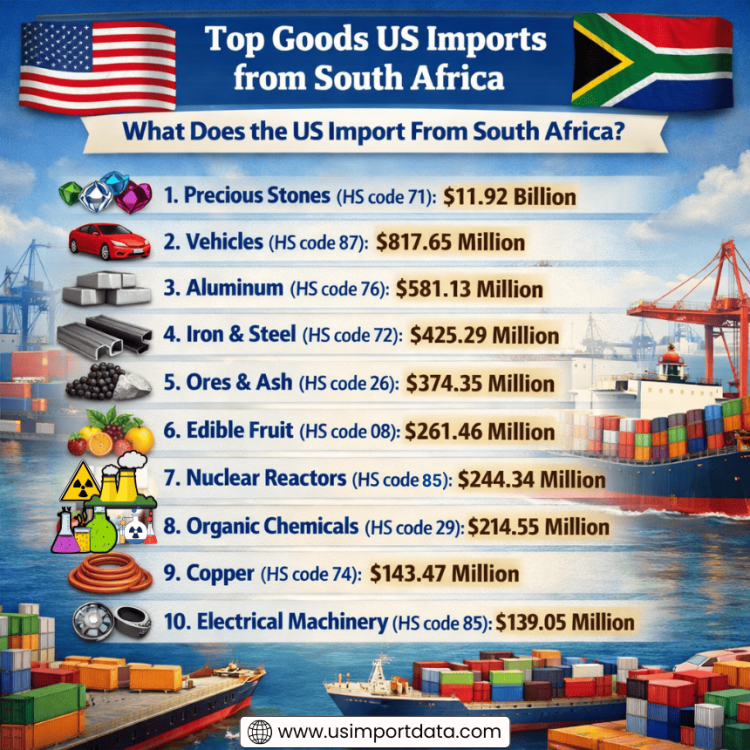
Top Goods US Imports from South Africa: What Does the US Import From South Africa?
When it comes to US imports from South Africa, there are various top goods that play a significant role in bilateral trade. Some notable items that the US imports from South Africa include precious metals such as platinum, machinery, vehicles, and agricultural products like citrus fruits and wine. These imports not only cater to American consumer demands but also strengthen the economic relations between the two countries.
The US imports a variety of goods from South Africa, ranging from precious stones and metals to vehicles and aluminum. The total value of US imports from South Africa reached $16.68 billion in 2025, according to the latest US import data. The top 10 products that the US imports from South Africa, as per the US shipment data for 2025, include:
1. Precious stones & metals (HS code 71): $11.92 billion
One of the most valuable commodities that the US imports from South Africa is precious stones and metals. South Africa is famous for its diamonds, and the US is a major importer of these precious gems. In addition to diamonds, South Africa also exports gold, platinum, and other valuable metals to the US.
2. Vehicles (HS code 87): $817.65 million
Another significant import from South Africa to the US is vehicles. South Africa has a growing automotive industry, and the US imports a variety of vehicles, including cars, trucks, and buses, as per the data on US vehicle imports from South Africa by HS code. The US market is an important destination for South African-made vehicles, and this trade helps to support the economy in both countries.
3. Aluminum & articles thereof (HS code 76): $581.13 million
Aluminum is another important import from South Africa to the US. South Africa is a leading producer of aluminum, and the US relies on this metal for a variety of industries, including construction, transportation, and aerospace. The import of aluminum and aluminum products helps to support both the South African and US economies.
4. Iron & steel (HS code 72): $425.29 million
Iron and steel are essential materials for a wide range of industries, including construction, manufacturing, and infrastructure. South Africa is a major producer of iron and steel, and the US imports these materials to meet its domestic demand. The import of iron and steel from South Africa helps to ensure a stable supply of these vital materials for US businesses.
5. Ores, slag, & ash (HS code 26): $374.35 million
South Africa is rich in mineral resources, including ores, slag, and ash. These materials are used in a variety of industries, including mining, manufacturing, and agriculture. The US imports a significant amount of ores, slag, and ash from South Africa to support its own industries and infrastructure.
6. Edible fruit & nuts (HS code 08): $261.46 million
In addition to minerals and metals, South Africa also exports agricultural products to the US. Edible fruits and nuts are one of the top agricultural exports from South Africa to the US, as per the data on US fruit imports from South Africa. These products are in high demand in the US market, and South Africa's warm climate and fertile soil make it an ideal location for growing a variety of fruits and nuts.
7. Nuclear reactors & machinery (HS code 85): $244.34 million
South Africa has a developing nuclear energy industry, and the US imports nuclear reactors and machinery from South Africa to support its own energy needs. Nuclear energy is an important source of power for both countries, and the import of nuclear reactors and machinery helps to strengthen the partnership between South Africa and the US.
8. Organic chemicals (HS code 29): $214.55 million
Organic chemicals are another top import from South Africa to the US. These chemicals are used in a variety of industries, including pharmaceuticals, agriculture, and manufacturing. South Africa produces high-quality organic chemicals, and the US imports these products to support its own industrial and commercial activities.
9. Copper & articles thereof (HS code 74): $143.47 million
Copper is a versatile metal that is used in a wide range of applications, including electronics, plumbing, and construction. South Africa is a major producer of copper, and the US imports copper and copper products from South Africa to meet its own needs. The import of copper helps to ensure a stable supply of this essential metal for US businesses.
10. Electrical machinery & equipment (HS code 85): $139.05 million
Finally, electrical machinery and equipment are important imports from South Africa to the US. South Africa produces a variety of electrical goods, including appliances, electronics, and telecommunications equipment. The US imports these products to support its own technology and communications industries.
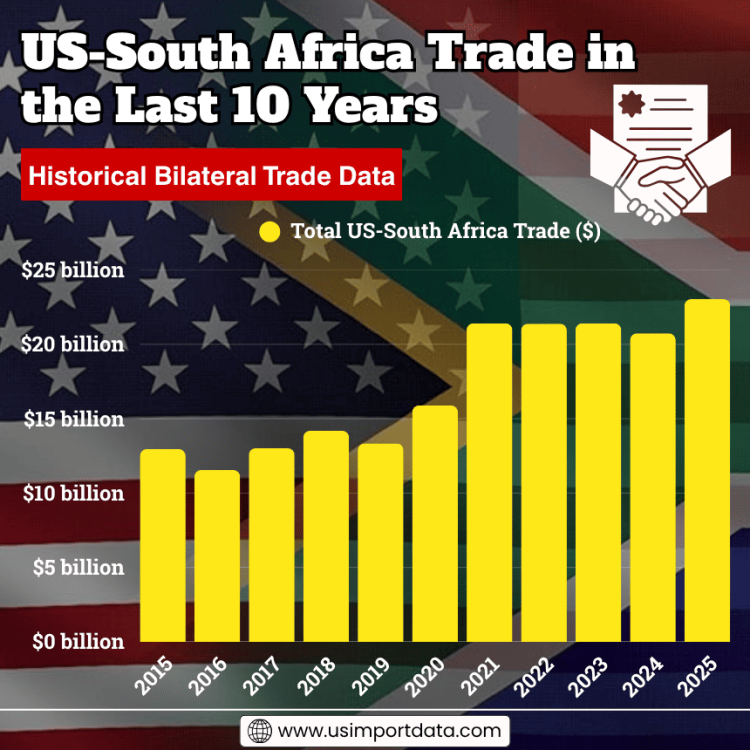
US-South Africa Trade in the Last 10 Years: Historical Bilateral Trade Data
|
Year of Trade |
Total US-South Africa Trade ($) |
|
2015 |
$12.95 billion |
|
2016 |
$11.55 billion |
|
2017 |
$13.01 billion |
|
2018 |
$14.19 billion |
|
2019 |
$13.34 billion |
|
2020 |
$15.89 billion |
|
2021 |
$21.41 billion |
|
2022 |
$21.38 billion |
|
2023 |
$21.41 billion |
|
2024 |
$20.73 billion |
|
2025 |
$23.04 billion |

Major Product Categories Imported into the US From South Africa
1. Precious Metals: The Dominant Category
The single most important driver of U.S. imports from South Africa is precious metals.
-
Over 70% of the total import value comes from this category
-
Includes:
-
Platinum
-
Gold
-
Palladium
-
Rhodium
These metals are critical for:
-
Automotive catalytic converters
-
Electronics
-
Renewable energy technologies
-
Investment demand (bullion)
Why This Matters
South Africa is one of the world’s largest producers of platinum group metals (PGMs), making it strategically important for U.S. industrial supply chains.
In 2025:
-
U.S. imports of South African palladium surged significantly
-
Demand was driven by the automotive and clean energy sectors
2. Automotive Vehicles and Components
Another major category is automobiles and auto parts.
South Africa exports:
-
Passenger vehicles
-
Engine components
-
Automotive assemblies
However, this sector faced pressure in 2025 due to:
-
25% U.S. tariffs on vehicles and parts
-
Increased competitiveness challenges
Impact
-
Reduced export margins
-
Potential decline in long-term volumes
-
Threat to South African manufacturing jobs
3. Agricultural Products
Agricultural exports saw strong growth in 2025.
Key exports include:
-
Citrus fruits
-
Grapes
-
Apples and pears
-
Wine
-
Nuts
In Q2 2025:
-
Agricultural exports to the U.S. rose 26% year-on-year
Constraints
Despite growth:
-
New tariffs (30%) threaten future expansion
-
Market diversification is becoming essential
4. Minerals and Industrial Inputs
Beyond precious metals, South Africa exports:
-
Iron and steel products
-
Coal and mineral fuels
-
Chemicals and industrial inputs
These goods support:
-
U.S. manufacturing
-
Energy systems
-
Infrastructure sectors
5. Niche and Emerging Categories
Other notable exports include:
-
Machinery and equipment
-
Textiles (historically under AGOA)
-
Jewelry and processed metals
While smaller in value, these categories indicate gradual diversification.
Structural Drivers of US-South Africa Bilateral Trade
1. Commodity Dependence
Trade is heavily skewed toward resource extraction sectors.
-
The top 300 products account for nearly all trade value
-
A handful of commodities dominate overall flows
Implication
This creates:
-
Price volatility
-
Exposure to global commodity cycles
-
Limited diversification
2. The Role of AGOA
The African Growth and Opportunity Act (AGOA) historically enabled duty-free access for South African exports.
However, in 2025:
-
Policy uncertainty increased
-
Tariffs were reintroduced on many goods
This marks a shift toward:
-
More protectionist U.S. trade policy
-
Reduced preferential access
3. Tariff Escalation in 2025
The U.S. imposed:
-
10% baseline tariffs on imports
-
Up to 30% on South African goods
Sector-Specific Effects
|
Sector |
Impact |
|
Automotive |
Severe |
|
Agriculture |
Moderate |
|
Precious metals |
Mostly exempt |
This selective exemption reinforces the importance of strategic minerals.
Trade Balance and Deficit Dynamics
The U.S. consistently runs a trade deficit with South Africa.
2025 Snapshot
-
The deficit widened significantly in early 2025
-
Reached $6.3 billion in H1 2025
Why the Deficit Exists
-
High-value commodity imports
-
Limited U.S. export penetration
-
Strong U.S. demand for industrial metals
Growth Trends and Historical Context
Long-Term Growth (2017–2024)
-
U.S. imports from South Africa more than doubled
-
CAGR: 13.36%
2025 Growth Signals
-
Exports to the U.S. increased 37% in early 2025
-
Strong growth despite tariffs
Interpretation
Demand for:
-
Critical minerals
-
Agricultural goods
continues to outweigh trade barriers in many sectors.
Strategic Importance of South Africa to the US
Although Africa accounts for only 1.2% of total U.S. imports, South Africa plays a unique role.
Strategic Value
South Africa provides:
-
Critical minerals (PGMs)
-
Stable supply chains outside geopolitical hotspots
-
Gateway to African markets
Key Challenges in 2026
1. Policy Uncertainty
-
Expiration or weakening of AGOA
-
Tariff unpredictability
2. Trade Concentration Risk
-
Over-reliance on precious metals
-
Limited product diversification
3. Geopolitical Tensions
-
U.S. protectionism
-
Competition from China and EU
4. Domestic Constraints in South Africa
-
Infrastructure issues
-
Energy shortages
-
High unemployment
Opportunities for Future Growth
Despite challenges, several opportunities stand out:
1. Green Energy Transition
Demand for:
-
Platinum
-
Palladium
-
Rare minerals
will grow due to:
-
EV adoption
-
Hydrogen fuel technologies
2. Supply Chain Diversification
The U.S. is actively seeking:
-
Alternatives to China
-
Stable mineral suppliers
South Africa fits this role.
3. Agricultural Expansion
South Africa has strong potential in:
-
High-value fruit exports
-
Wine and specialty foods
4. Industrial Collaboration
Opportunities exist in:
-
Manufacturing partnerships
-
Technology transfer
-
Infrastructure investment
Key Takeaways
1. Trade Is Resource-Driven
Precious metals dominate, accounting for over 70% of U.S. imports.
2. The U.S. Runs a Persistent Deficit
Driven by high-value imports and limited exports.
3. 2025 Marked a Policy Shift
Tariffs and AGOA uncertainty reshaped trade flows.
4. Growth Remains Strong Despite Barriers
Commodity demand continues to drive trade expansion.
5. Strategic Importance Is Increasing
South Africa is critical for U.S. supply chains in key industries.
Conclusion and Final Thoughts
In conclusion, the U.S.–South Africa trade relations reflect a mix of opportunity and tension. On one hand, strong demand for precious metals and agricultural goods continues to fuel growth. On the other, rising tariffs and policy uncertainty are reshaping the landscape.
The relationship is likely to remain:
-
Commodity-centric in the short term
-
More diversified in the long term
As global supply chains evolve and clean energy demand rises, South Africa’s role as a strategic supplier to the United States is set to become even more important.
Note For Our Readers
We hope you found this blog on US–South Africa trade relations and top U.S. imports from South Africa insightful and helpful in understanding the key forces shaping bilateral trade in 2025. As global demand for critical minerals, agricultural goods, and industrial inputs continues to evolve, staying informed with accurate and timely trade data is more important than ever.
If you’re looking for deeper insights, customized trade reports, or want to explore live U.S. import-export data by country, feel free to connect with USImportdata. We provide comprehensive and up-to-date U.S. trade databases to support your research and business decisions. For exclusive access or tailored trade data solutions, contact us at info@tradeimex.in today.
Read also about:
What's Your Reaction?